

Most DTC ads fail for a simple reason: they look like every other ad in the feed. A clean product shot, a discount badge, a vague benefit, and a call to buy might technically be an ad, but it rarely gives people a reason to stop scrolling.
The best advertisement ideas for DTC brands are built around a sharper angle. They make the customer feel seen, prove the product belongs in real life, and give the brand a point of view competitors cannot easily copy.
That matters even more in 2026, when creative fatigue hits fast and paid social platforms need a steady flow of fresh concepts. Winning brands are not just producing more ads. They are producing more distinct reasons to care.
Below are 12 advertisement ideas you can adapt for paid social, email, landing pages, video, and creator briefs. Use them as creative starting points, then tailor the hook, proof, and offer to your category.
What makes a DTC advertisement idea stand out?
A standout DTC ad does not need to be loud, weird, or expensive. It needs to be specific. The ad should show a moment your customer recognizes, explain the product in plain language, and make the next step feel obvious.
Strong DTC advertisements usually include four ingredients:
- A clear customer tension, such as wasted time, frustration, uncertainty, discomfort, or aspiration.
- A visual idea that can be understood without sound.
- Proof that feels believable, including reviews, demonstrations, comparisons, or founder context.
- A simple action, such as shop the bundle, take the quiz, claim the offer, or see the routine.
If your idea is strong but the wording feels flat, pair it with a better hook and value proposition. Needle’s guide on how to write ad copy that converts is a useful companion when you want to turn an angle into a scroll-stopping script.
1. Lead with the moment before the product
Instead of opening with the product, open with the situation that makes the product necessary. This works because shoppers usually do not wake up thinking about your SKU. They think about the messy kitchen, the dry skin, the forgotten gift, the low energy, the outfit that does not fit right, or the pet problem they keep putting off.
For example, a cookware brand could start with someone realizing their pan is ruining breakfast again. A skincare brand could show the bathroom mirror moment before a big event. A baby brand could show the midnight scramble for something clean, safe, and easy.
The product enters as the natural fix, not the star forcing its way into the scene. This makes the ad feel less like a pitch and more like recognition.
2. Turn customer reviews into mini scripts
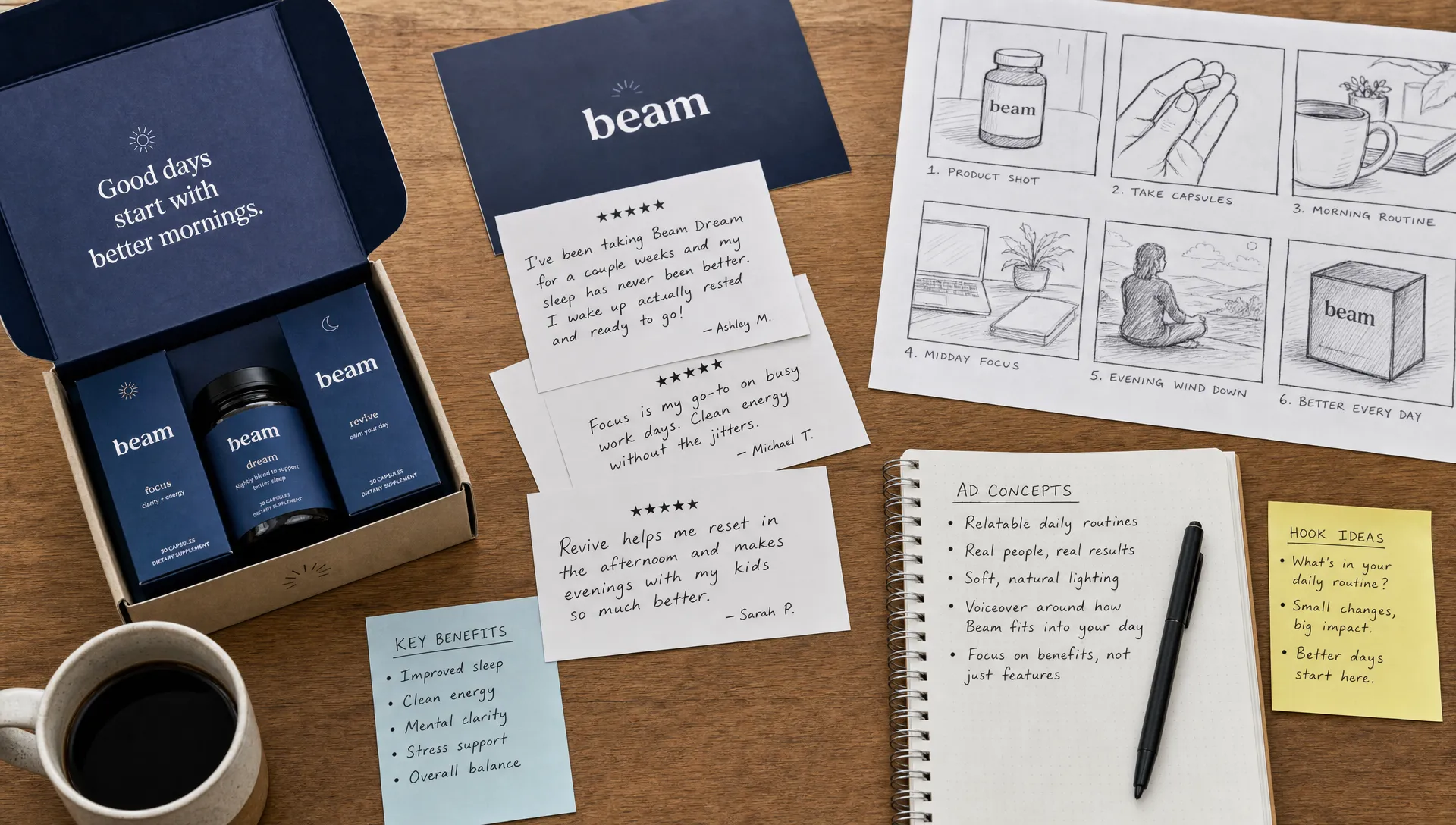
Reviews are often treated as static proof, but they can become full ad concepts. Take one detailed customer review and use it as the backbone of a video, carousel, or email.
The key is to preserve the customer’s language. If the review says the product finally solved something after three failed alternatives, build the ad around that journey. If the customer mentions a specific use case, such as travel, gifting, postpartum recovery, apartment living, or sensitive skin, make that the creative angle.
This idea works especially well for DTC brands because social proof feels more credible when it sounds like a real person, not a brand committee. You can create multiple versions by grouping reviews around themes: first-time buyers, skeptics, repeat customers, gift buyers, and people switching from a competitor.
3. Show a first-week diary
Many DTC products need trust before purchase. A first-week diary ad gives shoppers a low-pressure look at what it is actually like to receive, use, and evaluate the product.
The format is simple: day one is unboxing or setup, day two shows the first real use, day four highlights a small win, and day seven summarizes the result. This can be filmed by a creator, customer, founder, or internal team member.
A first-week diary is stronger than a generic testimonial because it gives the viewer a timeline. It answers silent questions like: Is it easy to use? When will I notice value? Does it fit my routine? What happens after it arrives?
Use this idea for products where adoption matters, such as supplements, beauty routines, home goods, fitness products, specialty foods, pet products, or apparel basics.
4. Make a founder diagnosis ad
A founder diagnosis ad starts with the problem your brand saw in the market. It is not just a founder story. It is a clear point of view about what is broken, outdated, overpriced, overcomplicated, or misunderstood.
For example, a founder might say that most products in the category were designed for shelf appeal, not daily use. Or that customers were paying for ingredients they did not need. Or that the old way forced people to choose between quality and convenience.
Then the ad explains how the product was designed differently. The strongest version is direct, specific, and humble. Avoid making exaggerated claims. Focus on the design choices, sourcing choices, customer insight, or category frustration that led to the product.
This works because DTC shoppers often want to know why your brand deserves attention in a crowded market.
5. Create a myth-busting mini lesson
Educational ads can stand out when they challenge something shoppers believe. The format is simple: name the myth, explain why it is incomplete, then show how your product or approach solves the issue.
A coffee brand might bust the myth that stronger flavor always means bitter coffee. A bedding brand might explain why thread count is not the only quality signal. A wellness brand might clarify a common misconception, while staying careful with compliance and claims.
The best myth-busting ads feel useful even if someone does not buy immediately. That usefulness builds trust. It also gives you a reason to advertise beyond discounts, which is important for brands that want stronger margins and better long-term positioning.
6. Build a better way comparison
Comparison ads are effective when they compare approaches, not just competitors. Instead of saying your product is better, show the old way versus the new way.
A cleaning brand could compare a cabinet full of harsh, single-use products with one simpler system. A meal brand could compare last-minute takeout decisions with a planned, healthier option. A luggage brand could compare overpacking chaos with organized compartments.
Keep the comparison fair and visual. The goal is not to attack another brand. The goal is to make the buyer think, That is exactly the problem I am trying to avoid.
7. Segment shoppers with a choose your match ad
One reason DTC ads blend together is that they try to speak to everyone at once. A choose your match ad turns segmentation into the creative concept.
For a skincare brand, the ad might show three skin goals and recommend a different product or bundle for each. For an apparel brand, it might show workday, travel day, and weekend fits. For a food brand, it could separate busy parents, fitness-focused shoppers, and snackers.
This format works well in carousels, short videos, quizzes, and email campaigns. It helps shoppers self-identify, which reduces friction and makes the ad feel more personalized without needing complicated messaging.
8. Film the product inside a real routine
A product demo is useful, but a routine demo is more persuasive. Instead of showing the product in isolation, show where it fits in the customer’s day.
A beauty product can appear between showering and leaving the house. A kitchen product can appear during a weekday dinner rush. A pet product can appear during the morning walk. A home product can appear during cleaning, hosting, or winding down at night.
Routine ads stand out because they answer the practical question behind every purchase: Will I actually use this? The more naturally the product fits into an existing habit, the easier it is for a shopper to imagine owning it.
For social platforms, keep the first three seconds concrete. Show the routine moment before adding captions or claims. If Instagram is a major channel for your brand, these Instagram advertising best practices can help you adapt the concept to Reels, Stories, and feed placements.
9. Advertise the product as a giftable solution
Gift ads do not need to be limited to holidays. DTC brands can build giftable campaigns around birthdays, new homes, new parents, graduations, host gifts, self-care moments, client thank-yous, and relationship milestones.
The creative angle should focus on the giver’s problem: they want something thoughtful, useful, and easy to send. Show why the product feels more personal than a generic gift card and more practical than something that gets forgotten.
This works especially well if your product has strong packaging, bundles, personalization, subscriptions, or a clear recipient type. The ad can show the gift being received, opened, used, and appreciated. That emotional loop is often more powerful than a product-only discount.
10. Build a challenge around one outcome
Challenge ads invite people to imagine progress. The key is to keep the outcome specific and realistic.
A fitness accessory brand might promote a seven-day mobility challenge. A food brand might run a five-breakfast upgrade challenge. A home organization brand might show a weekend closet reset. A skincare brand might focus on consistency rather than promising unrealistic transformation.
This concept works because it creates a reason to start now. It also gives you a natural content series, which can become paid ads, creator prompts, email sequences, and organic posts.
The strongest challenge ads make participation feel simple. Show the first step, the routine, and the product’s role. Avoid overcomplicating the ask.
11. Use objection-first creative
Most brands hide objections at the bottom of a product page. Strong ads bring them into the open.
Start with a common hesitation: Is it worth the price? Will it fit? Is it hard to use? Will it taste good? Is it safe for sensitive skin? Does it work for small spaces? Then answer with proof, demonstration, policy, or education.
This approach works especially well for retargeting, but it can also perform in prospecting if the objection is common across the category. A furniture brand might address assembly anxiety. A supplement brand might address taste and routine consistency. An apparel brand might address sizing uncertainty.
Objection-first ads stand out because they feel honest. They also reduce the burden on the shopper, who no longer has to dig for reassurance.
12. Show what happens after checkout
Many ads focus on getting the click, but shoppers also care about what happens next. A post-checkout ad highlights the experience after purchase: order confirmation, shipping updates, unboxing, first use, support, replenishment, or membership benefits.
This is especially useful for newer DTC brands that do not yet have universal name recognition. The ad reassures buyers that the brand is professional, the product will arrive as expected, and the experience has been thought through.
You can turn this into a simple video: someone orders, receives updates, opens the package, uses the product, and feels relieved they made the right choice. It is not flashy, but it can reduce perceived risk.
How to choose which advertisement ideas to test first
The right idea depends on where the customer is in the buying journey. A cold prospect might need a problem-led or myth-busting ad. A warm visitor might need a comparison, review script, or objection-first ad. A repeat customer might respond to routines, challenges, bundles, or gifting campaigns.
Before launching, map each idea to one clear role:
- Awareness: founder diagnosis, myth-busting lesson, real routine, or moment-before-product ad.
- Consideration: better way comparison, review script, first-week diary, or choose your match ad.
- Conversion: objection-first creative, giftable solution, challenge offer, or post-checkout reassurance.
- Retention: routine content, replenishment reminders, customer challenges, or new-use-case ads.
Creative testing also works better when operations are not chaotic. If your team is paying creators, managing multiple vendors, or running campaigns across entities, clean reporting and finance workflows matter. Tools for streamlined invoicing and reporting can help keep the business side organized while your marketing team tests more creative angles.
Once you choose the first few concepts, avoid testing too many variables at once. Keep the offer and audience stable when testing hooks. Keep the hook stable when testing proof formats. This makes the results easier to interpret.
How to turn one strong idea into a repeatable campaign
A common mistake is treating an advertisement idea as a single asset. A better approach is to turn each idea into a mini campaign with several variations.
For example, a first-week diary can become a 30-second video for prospecting, a 10-second cutdown for retargeting, a carousel with daily highlights, an email featuring the customer journey, and a landing page section that explains what to expect.
The same logic applies to almost every idea in this list. One customer review can become a UGC script, a static quote ad, a founder response, a comparison ad, and a post-purchase email. One myth can become a short video, a quiz, a creator brief, and an educational carousel.
This is how DTC brands get more mileage from creative strategy. You are not constantly starting from zero. You are building a system of angles, assets, channels, and learnings.
If you want to connect these ad ideas to a broader growth plan, Needle’s guide to DTC marketing strategies that actually work shows how paid creative fits alongside email, retention, CRO, content, and lifecycle campaigns.
Frequently Asked Questions
What are the best advertisement ideas for DTC brands? The best ideas are specific to the customer’s problem, routine, or buying hesitation. Strong options include customer review scripts, first-week diaries, founder diagnosis ads, myth-busting lessons, objection-first creatives, and routine-based product demos.
How often should DTC brands refresh ad creative? It depends on spend, audience size, and performance volatility, but most growing DTC brands need a steady weekly pipeline of new hooks, formats, and variations. Refresh the angle when frequency rises, click-through rate drops, or comments suggest the audience has seen the ad too often.
Should DTC brands use UGC in advertisements? Yes, when it is authentic and strategically briefed. UGC works best when creators show real use cases, address common objections, or explain why they switched. Avoid generic creator videos that could apply to any product in the category.
How do you know if an ad idea is worth scaling? Look beyond one metric. A strong scaling candidate usually has a healthy thumb-stop rate, efficient cost per click, strong conversion rate, useful comments, and performance that holds across more than one audience or placement.
Can AI help generate better advertisement ideas? Yes, especially when AI is connected to customer data, brand guidelines, performance history, and campaign goals. It can help turn insights into new angles, variations, creative briefs, and on-brand assets faster than a manual process alone.
Turn standout ad ideas into campaigns faster
Great ad ideas only matter if your team can turn them into assets, launch them, and learn from the results. That is where a repeatable system beats a scattered creative process.
Needle helps ecommerce and DTC brands generate tailored marketing ideas, create on-brand creative assets, publish content directly to platforms, automate campaign workflows, track results, and turn performance into actionable learnings.
If your team needs more high-quality creative without agency bloat or endless freelancer coordination, Needle can help you move from idea to execution faster, then keep optimizing week after week.