

Triple Whale is the analytics and attribution layer that powers most serious DTC brands on Shopify. It tracks billions in ad spend, unifies your channel data, and answers marketing questions in plain language. But it's priced for brands with significant revenue — and it doesn't execute campaigns for you.
The analytics are excellent. The attribution model is among the best in DTC. But if you need creative production, email campaigns, or a human team in your corner, you'll need a second tool.
This list covers five Triple Whale alternatives for Shopify brands in 2026. Each one offers something Triple Whale doesn't — lower entry costs, creative execution, email automation, or a human team. Pick based on your biggest gap.
What Are the Best Triple Whale Alternatives?
The five best alternatives each approach the problem from a different angle. Needle executes campaigns with a human team. Madgicx optimizes Meta ads with an AI recommendation engine.
Motion turns live creative data into actionable briefs. Klaviyo AI handles email and SMS lifecycle at every scale. Omneky generates and tests ad creative with a performance feedback loop.
| Platform | Starting price | Best for | Key differentiator | Free trial |
|---|---|---|---|---|
| Needle | $2,999/mo | DTC brands wanting full-stack execution | AI + human team; Meta, Klaviyo, and Shopify in one tab | No |
| Madgicx | $69/mo (annual) | Meta ad optimization | AI Marketer recommendation engine for Shopify brands | 7-day |
| Motion | Custom | Creative strategy teams | Frame-by-frame video analysis; data-backed creative briefs | No |
| Klaviyo AI | ~$20/mo | Email and SMS lifecycle | Marketing Agent free on all plans; deepest Shopify integration | Yes |
| Omneky | $24/mo | AI creative production | Brand LLM + granular attribution to specific design elements | 7-day |
1. Needle: Best Full-Stack Alternative to Triple Whale
Disclosure: Needle is our own product. We've included it because we believe it genuinely belongs on this list, but you should know we're not a neutral party.
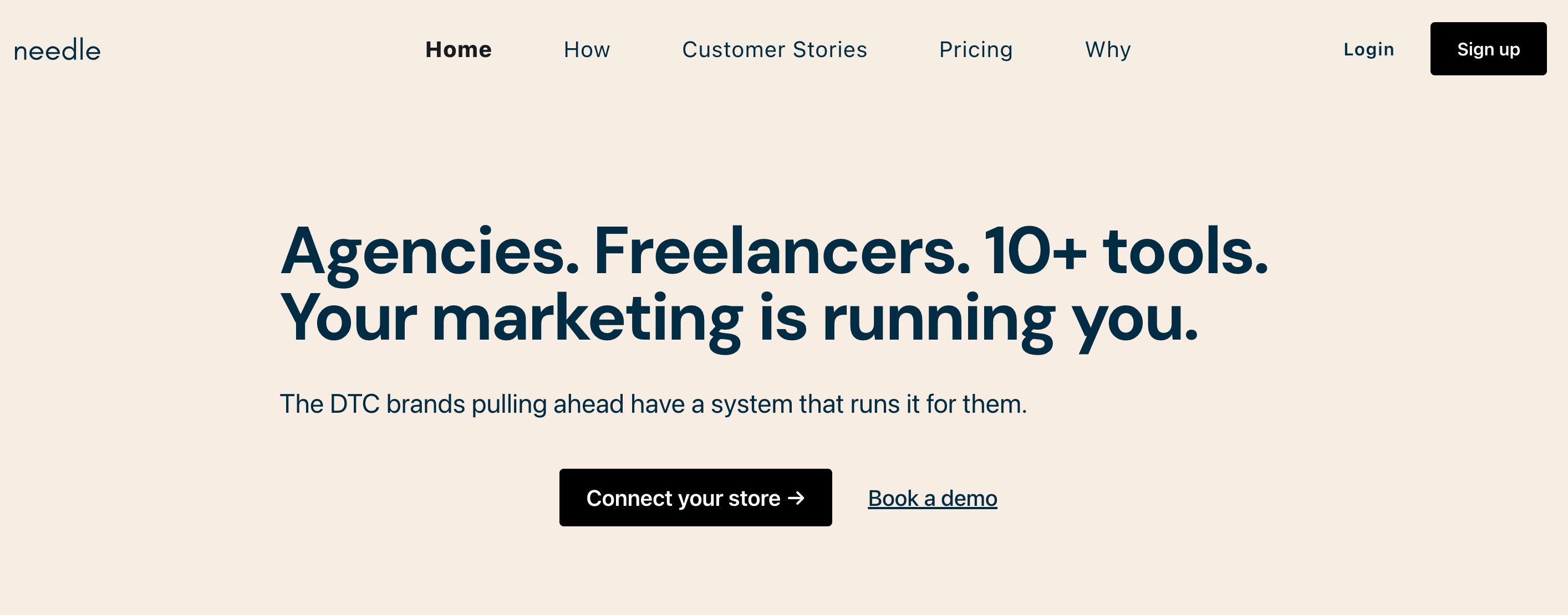
Triple Whale tells you what's working. Needle makes it happen. It's an AI-powered marketing team in one tab for DTC brands doing $1M–$10M in annual revenue — AI plus human strategists and designers — connected to Shopify, Klaviyo, Meta, Google, and TikTok.
Where Triple Whale surfaces insights and recommendations, Needle executes them. You get a weekly calendar, AI-drafted creatives polished by real designers, and live campaigns launched to Meta, Google, TikTok, and Klaviyo.
Needle starts at $2,999/month for brands running roughly $5–8K in monthly ad spend, scaling to $3,999/month at $8–11K, with tailored Custom pricing for brands running $11K+ in monthly ad spend. That covers strategy, creative, launch, and weekly reporting. Triple Whale tells you what happened; Needle makes it happen next week.
Key Features
- Strategic Edge — brand intelligence layer built during onboarding; maps your competitive landscape and informs every campaign recommendation
- Weekly Content Calendar — pre-loaded every Monday with campaign ideas from your data, performance history, and active channels
- Creative Production (AI + Human) — AI drafts assets; Needle's designers polish them for brand voice and quality; creative volume is uncapped and revisions are unlimited
- Campaign Launch — sets up and deploys to Meta, Google, TikTok, and Klaviyo without manual uploads
- Momentum Report — weekly performance summary that shapes the following week's recommendations
Pricing
- Growth: $2,999/month (~$5–8K monthly ad spend, ~5K active email subscribers)
- Scale: $3,999/month (~$8–11K monthly ad spend, 5K–10K active email subscribers)
- Custom: tailored pricing ($11K+ monthly ad spend, 10K+ subscribers, or more complex needs, including seasonal spikes like BFCM)
Pricing scales with ad spend and email list size, not deliverable count, with no percentage cut of ad spend. Creative volume is uncapped, and every tier includes hands-free campaign management, weekly ad optimization, a weekly Momentum Report, unlimited creative revisions, and a dedicated Needle strategist.
Pros & Cons
Pros:
- Execution-first: produces creative and launches campaigns, not just surfaces insights
- Human team embedded in every account — strategists, designers, campaign managers
- Covers Meta, Klaviyo, and Shopify from one tab
- System compounds weekly — gets smarter from your brand's data over time
Cons:
- No deep cross-channel attribution (Triple Whale's core strength)
- Priced by ad spend and email list size — the first published tier assumes roughly $5–8K in monthly ad spend and ~5K active subscribers, so smaller brands may fall below it
- 200+ active customers — smaller scale than Triple Whale's 60,000+
Customers
RTPTennis went from $3K to $4.8K in revenue per email send in month one. TWOOAK cut its cost per order from $41 to $19 and hit a peak marketing efficiency ratio of 41×. As Intended doubled its MER within 60 days and held a 6× ROAS for 8 months straight.
Heliotrope SF founder JP put it this way:
"It's like having a full marketing team in one tab… each email now brings in 3–4× ROI, and if something doesn't work Needle pivots fast."
2. Madgicx: Best for Meta Ad Intelligence
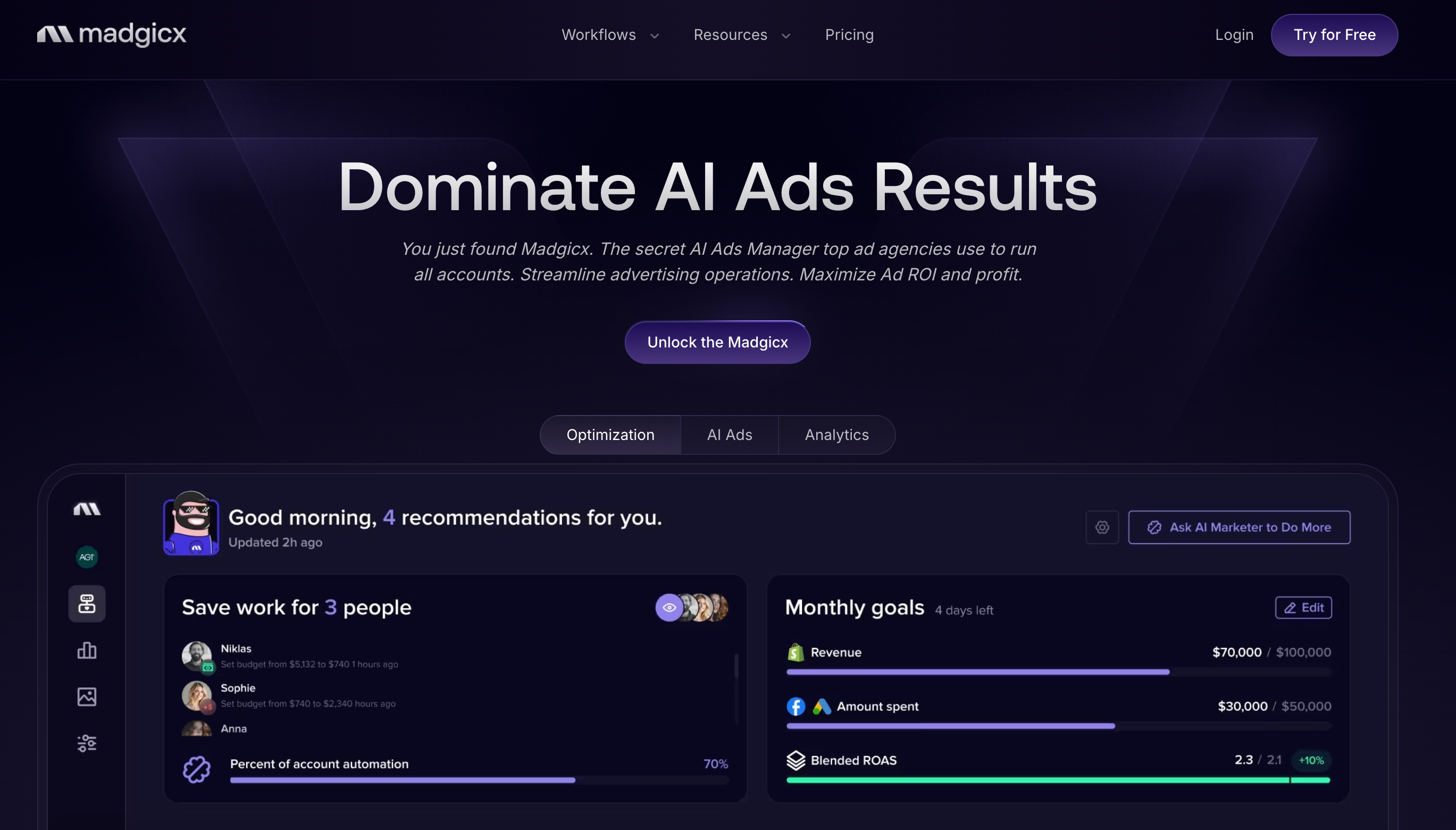
Madgicx is the most focused Meta ads intelligence tool on this list. It audits your ad account continuously, surfaces ranked recommendations with clear rationale, and lets you approve or dismiss each one. It describes its vision as "Advertising General Intelligence — an AI that runs your ads better than humanly possible."
Where Triple Whale handles multi-channel attribution, Madgicx goes deeper on Meta specifically. The intelligence loop — connect, audit, recommend, approve, execute, track — is tighter for Meta-heavy brands. It also pulls in Google Ads, Klaviyo, TikTok, and GA4 for reporting, even though it only executes on Meta.
Pricing is tied to your monthly ad spend. Brands spending up to $2,500/month pay $99/month (or $69/month annually). A 7-day free trial requires no credit card.
Key Features
- AI Marketer — continuously audits Meta ad account; surfaces prioritised recommendations with clear rationale; brand approves or dismisses each one
- Automated Ad Launch Tool — AI generates creative and deploys to Meta at scale; claimed 10× faster
- Creative Fatigue Detection — identifies underperforming ad sets before they waste budget
- Cross-Channel Reporting Dashboard — Meta, Google Ads, GA4, Shopify, Klaviyo, TikTok data in one view
- Automation Rules — configurable triggers that execute without per-action approval for experienced users
- Tracking Pro ($49/mo add-on) — server-to-server first-party data tracking
Pricing
| Monthly ad spend | Monthly | Annual |
|---|---|---|
| Up to $2,500 | $99 | $69 |
| $2,500–$5,000 | $119 | $83 |
| $5,000–$10,000 | $129 | $90 |
| $10,000–$20,000 | $229 | $160 |
| $20,000–$30,000 | $329 | $230 |
| $30,000+ | Custom | Custom |
Pros & Cons
Pros:
- Most focused Meta intelligence: deeper than Triple Whale on Meta-specific optimization
- Ad-spend-based pricing aligns cost with value — accessible for smaller brands
- Official Meta Business Partner with deep API access
- 15,000+ advertisers managing $500M+ in annual ad spend
- 7-day free trial, no credit card required
Cons:
- Meta-only for campaign execution — no Google Ads, TikTok, or email campaigns
- No human strategists or creative team
- No deep multi-channel attribution like Triple Whale's Compass model
- Customer support quality complaints appear regularly in reviews
Customers
Negative Apparel achieved 2× ROAS, 5× monthly ad spend, and grew its customer base 1.5×. Repcillin hit 20× sales and saved 42 hours of work each month. GLAMCOR reached a 12.72 retargeting ROAS and saw a 64% increase in attributed conversions.
Madgicx holds 4.6/5 on G2 from 188 reviews and 4.4/5 on Capterra from 57 reviews. Praised for automation time savings, AI audience targeting, and creative insights. Common criticism: customer support quality and occasional reliability issues with automated rules.
3. Motion: Best for Creative Analytics and Strategy
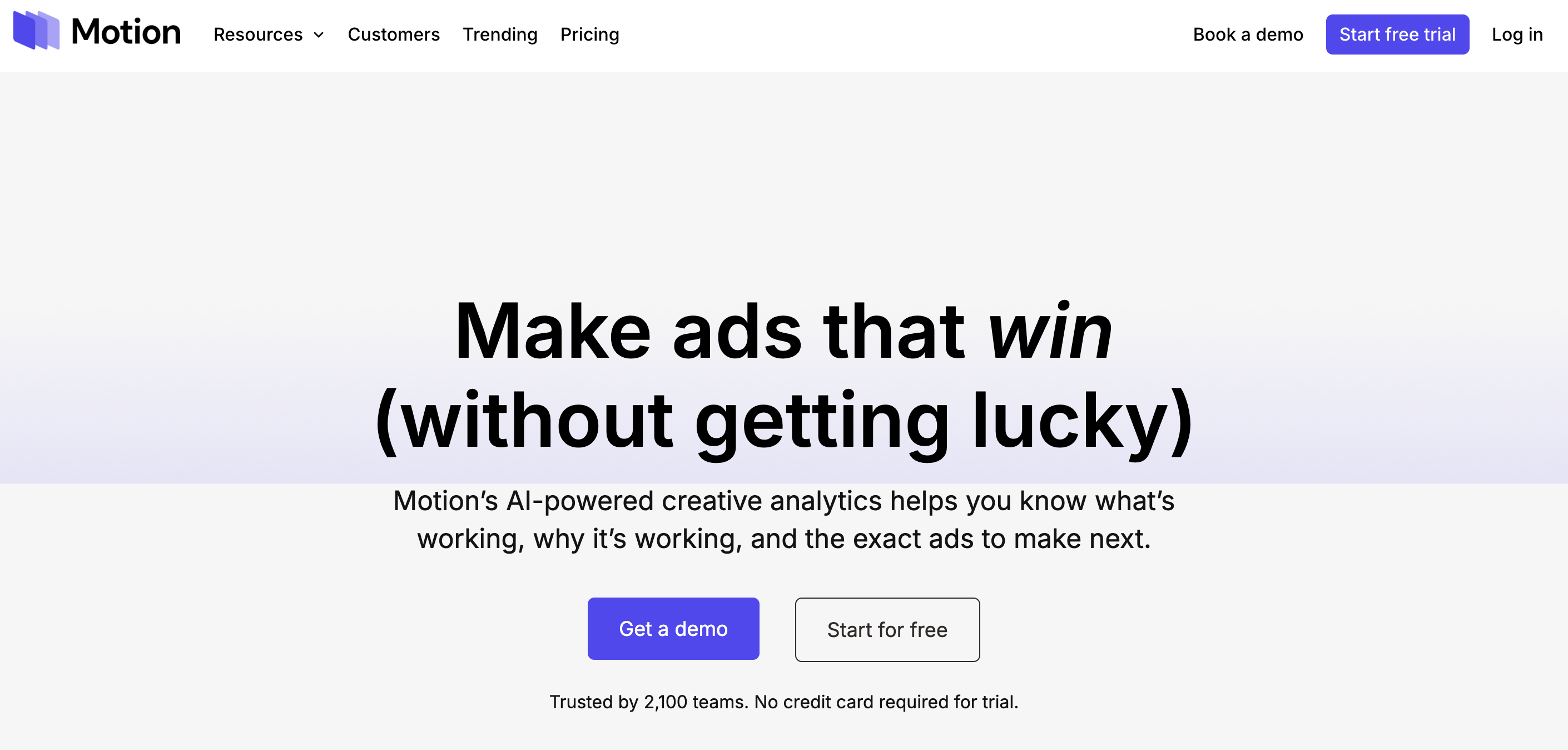
Motion is the tool DTC creative teams use to stop guessing about what's working. It ingests live ad performance, tags assets by hook type and messaging angle, and surfaces what's winning. No other tool on this list does frame-by-frame video analysis.
Triple Whale answers "what's driving revenue?" Motion answers "what creative should I make next?" The two tools are complementary — but if creative strategy is your gap, Motion is the direct answer.
Pricing isn't public — Motion requires a demo for paid plans. It raised a $30M Series B from Inovia Capital in September 2024. Creative Research (competitor ad tracking) is a free product.
Key Features
- Creative Performance Analysis — automatically groups and tags live creative assets by messaging angle, visual style, hook type, and CTA; identifies winning and losing patterns
- Frame-by-Frame Video Analysis — identifies exactly which seconds in a video are driving or losing attention; unique to Motion
- Data-Backed Creative Briefs — generates specific briefs for what to produce next, based on what is winning in your ad account
- Pre-Launch Creative Scoring — evaluates assets before publishing to predict performance
- Competitive Intelligence — AI agents monitor competitor ad libraries and surface counter-strategies
- Creative Research (free) — competitor ad tracking, Brand Intel, Collections, and Swipe File
Pricing
Pricing is not publicly listed — demo required. A free Creative Research product is available for competitor ad tracking and swipe file building.
Pros & Cons
Pros:
- Frame-by-frame video analysis — genuinely unique; no other tool on this list does it
- Bridges creative teams and media buyers with shared visual reporting
- $30M Series B from Inovia Capital; $14B+ in annual ad spend analysed
- Thumbstop newsletter (50,000 professionals) creates strong community distribution
- Pre-launch scoring reduces wasted spend before campaigns go live
Cons:
- No creative production, no campaign launch, no budget management
- Brand still needs a separate creative team to act on Motion's briefs
- No email, no Shopify integration, no paid media management
- Complementary to Triple Whale rather than a direct replacement
- Pricing is opaque — no self-serve option
Customers
HexClad's Head of Growth put it directly: "Every fast-growing DTC brand I know uses Motion for creative testing strategy." Jones Road Beauty CEO Cody Plofker called Motion "the missing link" for aligning media buyers and creative teams. ClickUp reported that Motion made "weekly reporting on creative tests so much easier."
Motion holds approximately 4.4/5 on G2 from 145 reviews and 4.1/5 for value for money on Capterra. Praised for visual reporting and ease of centralising multi-platform ad data. 2,100+ teams use it across DTC, agencies, and enterprise.
4. Klaviyo AI: Best for Shopify Brands Focused on Email and SMS
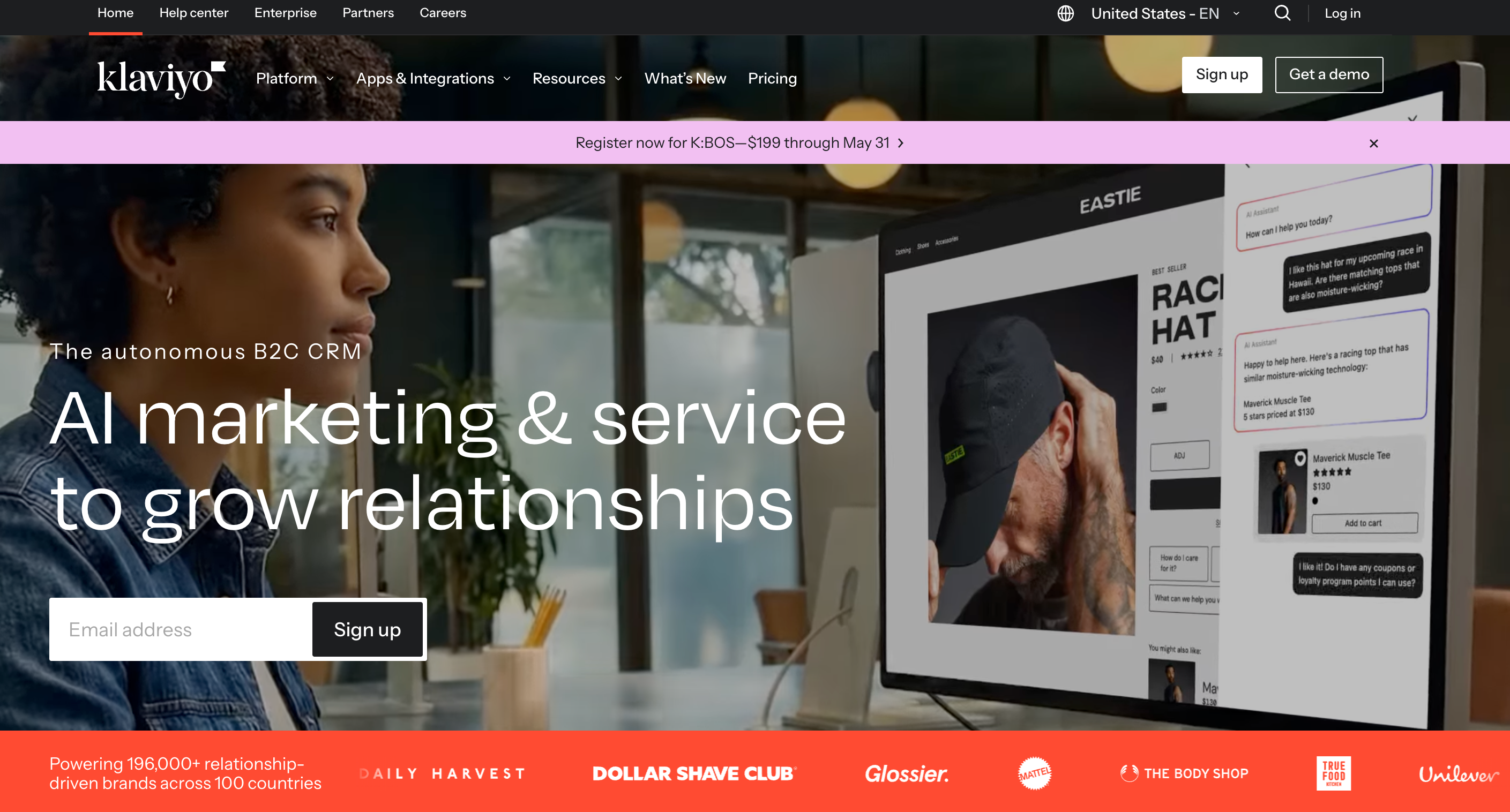
Klaviyo is the most widely used email and SMS tool for Shopify brands. Its AI layer has grown significantly since its 2023 IPO. The Marketing Agent (launched September 2025) generates weekly campaign content from your data — free on all plans.
Where Triple Whale shows you the full revenue picture across all channels, Klaviyo focuses exclusively on email and SMS lifecycle. The trade-off: unmatched depth on lifecycle marketing, but no paid media attribution or creative production. If email and SMS drive a significant share of your DTC revenue, Klaviyo AI is hard to replace.
Klaviyo's entry price is low — plans start around $20/month based on contact list size. At 205,000+ customers in 100+ countries, it has the largest installed base of any tool here. Note that Needle integrates with Klaviyo — the two are designed to work together.
Key Features
- Marketing Agent — autonomously generates weekly campaign content and strategy from performance history and seasonal signals; available at no additional cost on all plans
- Customer Agent — 24/7 AI handling pre/post-purchase inquiries across chat, SMS, email, and WhatsApp
- Segments AI — natural language segment builder
- Flows AI — creates complete flow logic from a text description
- Predictive CLV — forecasts customer lifetime value per contact
- Personalised Send Times — per-subscriber delivery optimisation
- 40+ AI features embedded across the platform
Pricing
Usage-based by contact list size. Plans start around $20/month. The Marketing Agent is included at no additional cost on all paid plans. A free tier is available for up to 250 contacts.
Pros & Cons
Pros:
- $370.6M in Q2 2026 revenue alone (26% YoY growth), with a 109% Dollar-Based Net Revenue Retention rate
- 40+ AI features embedded across the platform — not a bolt-on module
- Marketing Agent included free on all plans — lowest barrier to AI adoption
- Deepest Shopify integration in the industry
- 205,000+ customers creates a data flywheel that improves AI performance over time
Cons:
- Email and SMS only — no paid media attribution, no creative production
- Brands still need a separate tool for paid acquisition strategy
- Pricing escalates quickly with contact list size at scale
- Steep learning curve for advanced automation features
- Not a replacement for multi-channel attribution (Triple Whale's core strength)
Customers
At BFCM 2025, Klaviyo sent 22.7B+ messages (up 25% year over year) and drove $3.8B+ in attributed value across brands. Willow Tree Boutique saw a 44.6% increase in Klaviyo-attributed revenue and its highest-revenue BFCM ever. Saranoni achieved 35× platform ROI in its first six months.
Klaviyo holds 4.6/5 on G2 from 1,178 reviews. Named a Leader in the IDC MarketScape 2025 for AI-Enabled Marketing Platforms for small businesses. Praised for segmentation depth, Shopify integration, and email and SMS campaign creation.
5. Omneky: Best for AI Creative Production and Attribution
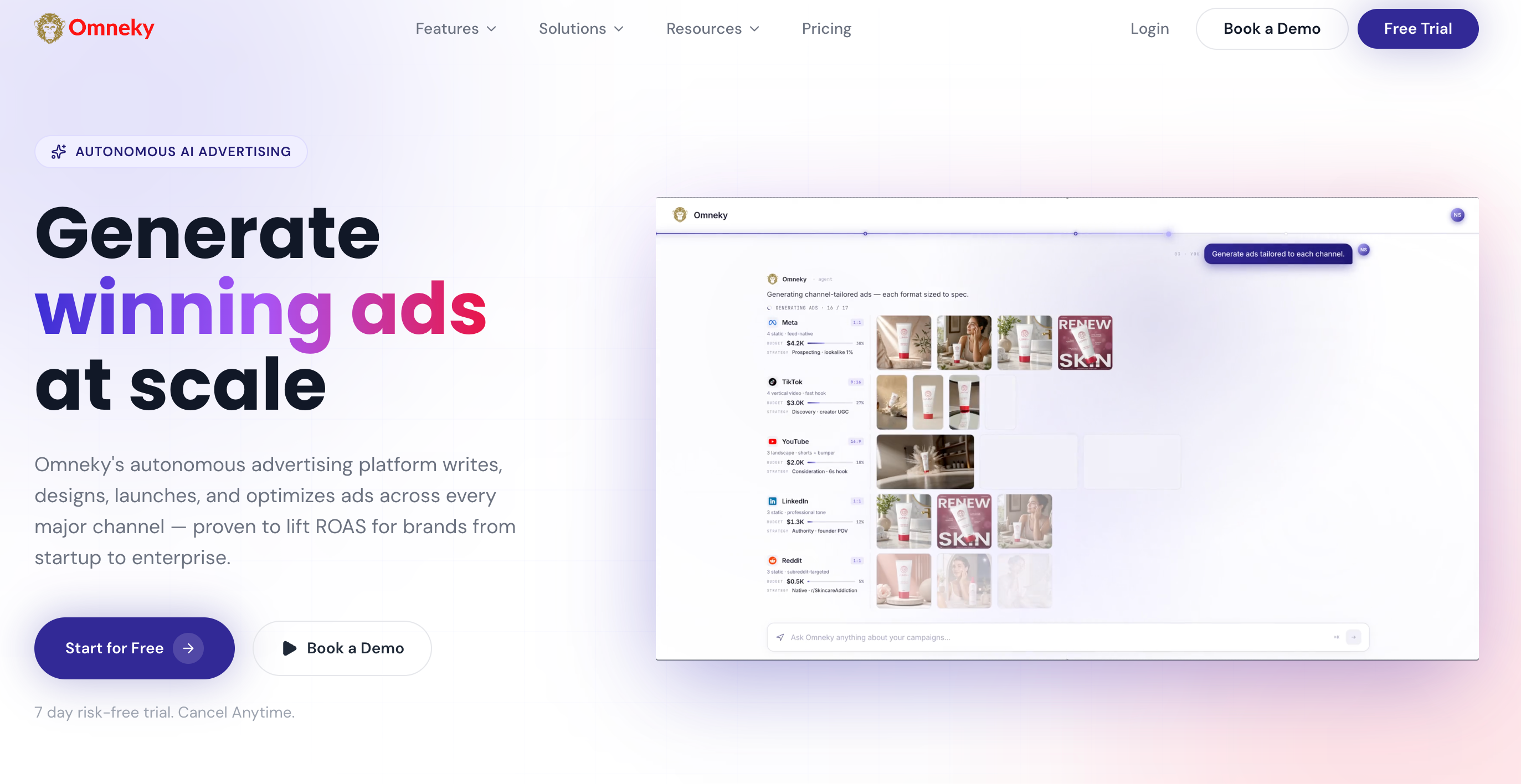
Omneky is the AI creative production tool with the deepest performance feedback loop on this list. It generates image ads, video ads, and product photography. Then it tracks which design elements — colors, headlines, CTAs — are actually driving results.
Where Triple Whale tells you which campaigns are winning, Omneky tells you exactly which creative elements made them win. The Brand LLM enforces visual and voice consistency across every generated variant. Smart Ads (launched April 2025) adapt creative automatically as real-time results come in.
Omneky starts at $24/month for the Lite tier and reaches $199/month for Pro. Enterprise plans are custom. A 7-day free trial is available.
Key Features
- Brand LLM — fine-tuned language model enforcing brand voice and visual standards across all generated assets
- Multi-Format Generation — image ads, video ads (scripts, storyboards, avatars, music, transitions), product photography, carousel ads
- AI Avatars — AI-generated spokespeople for product demos without video shoots
- Creative Attribution — links specific design choices (colors, headlines, imagery type, CTA wording) to business outcomes; the most granular attribution of any creative tool here
- Smart Ads (April 2025) — on-brand ads generated from live performance data; adapts creative automatically as results come in
- Agentic Optimisation — autonomous agent identifies which variants to scale and which to pause
Pricing
| Plan | Price | Credits |
|---|---|---|
| Lite | $24/mo | 200 credits |
| Standard | $79/mo | 1,000 credits |
| Pro | $199/mo | 4,000 credits |
| Enterprise | Custom | Custom |
Note: Credit-based pricing — high-volume usage can increase costs quickly.
Pros & Cons
Pros:
- Most granular creative attribution — links performance to specific design choices, not just campaign-level results
- AI Avatars remove the need for video production resources entirely
- Low entry price ($24/month) with a genuine performance feedback loop
- Runs across 10+ ad platforms; SOC 2 Type II certified; Google Premier Partner
- Gartner (November 2024): "leading innovator in AI-driven creative solutions"
Cons:
- Creative production and optimisation only — no email, no strategy, no budget management
- No human strategists, account managers, or creative team
- ~$2.1M ARR and StartEngine crowdfunding at $80M cap suggest slower growth
- Credit-based model can get expensive at high creative volume
- Trustpilot reviews flag subscription cancellation difficulties
Customers
Omiana scaled ad spend 135% profitably and increased sales 200%. Flex Agent achieved 227% more sign-ups with improved efficiency. Notable logos include Stance, Brex, Checkr, Wayfair, and Sony.
Omneky reports an average 2.7× ROAS across clients. Gartner named it a "leading innovator in AI-driven creative solutions" in November 2024. Reviews on G2 praise analytics dashboards, creative generation speed, and cross-platform management.
Frequently Asked Questions
Why would I look for a Triple Whale alternative?
Triple Whale is excellent at attribution and analytics — but it doesn't produce creative or launch campaigns. It's also priced for brands with meaningful revenue, putting it out of reach for earlier-stage DTC brands. If you need execution rather than just insight, you're looking for something different.
Which alternative is best for a Shopify brand new to AI marketing tools?
Klaviyo AI is the lowest-friction starting point — it's probably already connected to your Shopify store. Madgicx is the easiest on-ramp for Meta ad optimization, with a 7-day free trial. Needle is the right pick if you want someone to handle it all from day one.
Can I use one of these alongside Triple Whale instead of replacing it?
Yes — and many brands do. Motion and Madgicx are commonly stacked with Triple Whale because they solve different problems. Triple Whale handles attribution; Motion handles creative intelligence; Madgicx handles Meta execution.
What's the most affordable Triple Whale alternative?
Omneky starts at $24/month, Klaviyo at approximately $20/month, and Madgicx at $69/month annually. All three include a free trial. If cost is the primary driver, start with Klaviyo AI — it's likely already in your stack.
Does Needle include the attribution that Triple Whale provides?
Not in the same depth. Triple Whale's Compass attribution model (MMM + MTA + incrementality) is the most sophisticated in DTC. Needle provides a weekly Momentum Report — what worked, what didn't, what's next — but it doesn't replace dedicated attribution tooling.
Is Triple Whale still worth it for smaller Shopify brands?
Triple Whale has a freemium tier — so smaller brands can try the analytics layer at no cost. But the real value of Moby and Moby Agents sits behind paid plans, which require a demo. For brands under $1M, Klaviyo AI or Madgicx are more cost-effective starting points.
Conclusion: Which Triple Whale Alternative Is Right for You?
The right pick depends on which gap you're trying to close. If Meta ad performance is the priority, Madgicx fills that slice directly. If creative production and attribution are the issue, Omneky and Motion each solve a piece of it.
For DTC brands that want creative, strategy, and execution in one place — Needle is the pick. It's the only option here that bundles a human team, AI creative output, and live campaign execution in one tab. If you're doing $1M–$10M and tired of managing a stack, see how Needle works.