
Let's get one thing straight. For any serious DTC brand, connecting Klaviyo and Shopify isn't just a good idea. It's the engine room of your marketing operation. This integration is what separates brands that make real money from those just sending hopeful emails. It’s how you turn raw Shopify data into automated revenue that works for you 24/7.
Why This Integration Is a Must-Have
If you're running on Shopify, you're sitting on a goldmine of customer data. The problem? Shopify alone doesn't give you the tools to use it. That's where Klaviyo comes in. It creates a live, two-way sync that pulls every important customer action from your store directly into your marketing brain.
This isn't just about grabbing email addresses. We're talking about a complete picture of the entire customer journey.
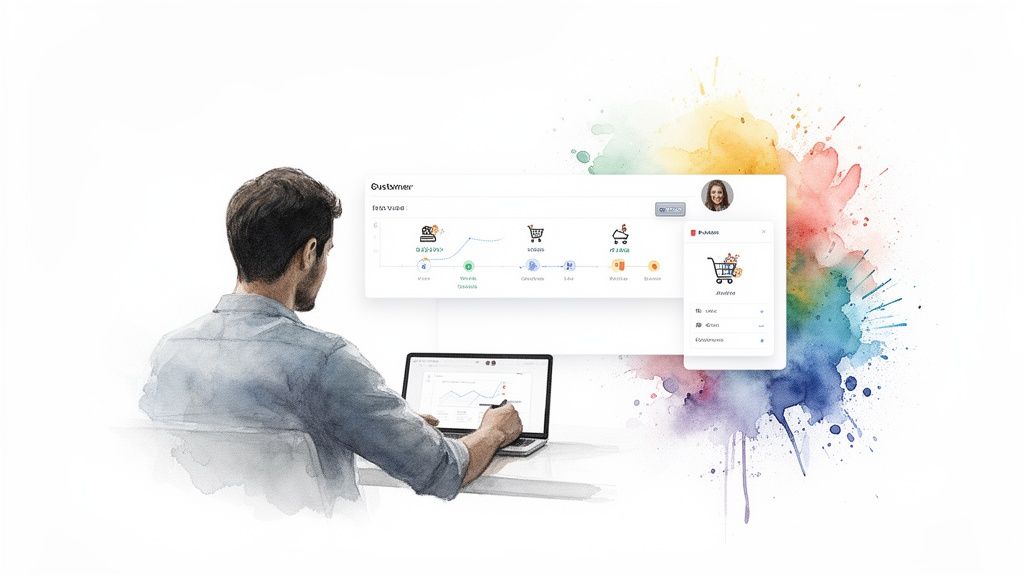
This level of detail separates the high-growth brands from everyone else. It lets you move from guesswork to precision marketing. Instead of annoying your whole list with a generic sale, you can build razor-sharp segments and automated flows based on what people actually do.
How Shopify Data Powers Your Klaviyo Marketing
The real magic happens when all that rich Shopify data gets put to work inside Klaviyo. It’s a direct pipeline that lets you trigger marketing based on real-time customer behavior.
| Shopify Data Point | What It Means for Your Marketing |
|---|---|
| Viewed Product | Trigger a reminder email or SMS to someone who looked but didn't buy. |
| Added to Cart | The classic abandoned cart flow, but now with dynamic product info. |
| Started Checkout | A more aggressive abandoned checkout series for high-intent shoppers. |
| Placed Order | Your post-purchase flow: thank yous, review requests, and cross-sells. |
| Fulfilled Order | "Your order is on its way!" notifications that build excitement. |
| Cancelled Order | A chance to win them back. Find out why they canceled and offer a fix. |
This isn't just theory. It has a massive impact on the bottom line. According to data from Shopify, merchants who add Klaviyo see an average revenue increase of 90% over those using other email providers.
Sure, there are other tools out there, and a good marketing automation software comparison will show you plenty of options. But while other tools might "connect" to Shopify, none offer the same depth of real-time, granular data sync.
That sync is everything. It’s how you turn one-time buyers into loyal fans who feel like you actually get them. And in a crowded market, that's the only way to build a brand that lasts.
The No-Nonsense Guide to a Perfect Setup
Connecting your Klaviyo Shopify accounts is more than just clicking "install." Anyone can do that. A proper setup means every piece of customer data syncs perfectly, giving you the power to act on real behavior from day one.
We've seen hundreds of brands rush this part. They install the app, then wonder why their flows aren't firing or their segments are empty. It’s the difference between having an expensive tool and having an engine that drives revenue. Let's do it right.
This isn’t a theoretical guide. This is a direct walkthrough of the exact settings we use for every single brand we onboard.
Get Your Data Syncing Correctly
First, grab the Klaviyo app from the Shopify App Store and connect your account. Once you’re in, you’ll land on the integration settings page inside Klaviyo. This is where the real work starts.
The very first checkbox is "Sync your Shopify data to Klaviyo." Make sure it's checked. Obvious, right? But you'd be surprised.
Next, you'll see an option to "Sync your price rules." Keep this enabled. This pulls in your Shopify discount codes. It lets you track coupon usage and segment out those "discount-only" shoppers.
Then comes the most important choice: "Sync historical data." Always check this box. Klaviyo will pull in all your past Shopify order and customer data. This is a goldmine. You can immediately build powerful segments—like a VIP list of past high-spenders or a win-back campaign for customers who haven't bought in 90 days. All before you've sent a single email.
Don't Fly Blind: Turn On On-Site Tracking
Without tracking what people do on your site, you’re just guessing. You need to know which products they look at and when they're browsing. This is handled by two crucial settings that are not enabled by default.
Inside your Klaviyo-Shopify integration settings, you have to manually enable these:
Viewed Product Tracking: This snippet tracks when an identified user looks at a product page. This is the foundation for your Browse Abandonment flow—one of the highest ROI automations you can build.
Added to Cart Snippet: This one tracks when someone adds an item to their cart without starting checkout. It lets you build a more targeted "Added to Cart" flow that can fire much sooner than the standard "Abandoned Checkout" trigger.
"We have seen the Abandoned Cart flow, in particular, be an absolute game-changer for our portfolio companies. It’s like having a sales associate follow up personally with every warm lead." — Andrew Faris, CEO of 4x400.
You have to manually turn these on and add the snippets to your Shopify theme code. Don't worry, Klaviyo gives you copy-paste instructions. You'll find the "Added to Cart" snippet under the Data Feeds tab in your account. To see what else is possible, check out our guide on e-commerce marketing automation software.
Track Every Move with Web Tracking
Finally, let's get your general web tracking sorted out. This goes beyond just viewed products and adds another layer of intelligence.
In your Klaviyo account settings, go to Domains and Hosting. Add your Shopify store’s domain here. This allows Klaviyo to track "Active on Site" events, which tell you when any known contact is browsing your website.
Why does this matter?
Live Segmentation: You can see who is on your site right now and act on it.
Sunset Policies: It's critical for list hygiene. You can easily find subscribers who haven't engaged with emails or visited your site in a long time.
Targeted Campaigns: You can send a flash sale to people active on your site in the last 7 days who didn't buy.
Getting these basic settings right from the jump ensures your Klaviyo Shopify integration isn't just a connection. It's a complete data pipeline fueling every marketing decision you make. This 30-minute setup will save you hundreds of hours of frustration and unlock revenue from day one.
The Klaviyo Flows That Actually Drive Revenue
Once your Klaviyo Shopify integration is live, the temptation is to build a dozen different automated flows. Don't. We’ve managed this for over 200 DTC brands. The truth is, a handful of core automations drive almost all the email revenue.
Get these three right, and you'll have an automated engine running 24/7. We’re talking about the Welcome Series, the Abandoned Cart Flow, and the Post-Purchase Flow. Everything else is a nice-to-have until these are dialed in.
The Welcome Series: Your First Impression
A new subscriber is the warmest lead you’ll ever get. They just handed you their email. Don't waste it. Your welcome series is your best shot at turning initial interest into a first purchase.
Forget complex, 10-email sequences. A simple three-part series is all you need. The goal isn't just to make a sale; it's to introduce your brand and build trust.
Email 1 (Immediately): Deliver the goods. If you promised a 10% discount, give it to them right away. Keep this email clean, simple, and focused on one thing: getting them back to the store to use their code.
Email 2 (1 Day Later): Tell your story. Why does your brand exist? What problem are you solving? This is where you connect on a human level, moving beyond a simple transaction.
Email 3 (2-3 Days Later): Build confidence. Sprinkle in social proof—customer reviews, user-generated content, testimonials. Feature your best-selling products. A gentle reminder that their welcome offer is expiring can be the final nudge they need.
This sequence works because it balances an immediate incentive with brand storytelling. It guides a curious subscriber toward their first purchase.
The Abandoned Cart Flow: Your Money-Maker
This flow pays for itself almost instantly. One of the most powerful things you can do is implement smart strategies to reduce shopping cart abandonment. This isn't about a single, desperate "Hey, you forgot this!" email. A good flow feels like a helpful customer service rep, gently nudging them back.
Thanks to the Shopify sync, you can pull the exact product images, names, and prices directly into the email. This makes it incredibly personal.
According to Klaviyo, businesses using their abandoned cart emails have earned over $60 million in sales. It’s an automation that pays for itself.
Here’s a proven three-email sequence we use for our brands:
Email 1 (1-2 Hours Later): The simple reminder. Keep it light. "Did you forget something?" or "Your cart is waiting." Show them what they left behind. No discounts, no pressure.
Email 2 (24 Hours Later): Overcome objections. Use a subject line like, "Still thinking it over?" This is your chance to address common concerns. Feature product reviews, link to your FAQ page, or highlight your return policy.
Email 3 (48-72 Hours Later): Create urgency. If it fits your brand, this is where you can introduce a small, time-sensitive incentive. "Complete your order in 24 hours for free shipping" is often more effective than a discount.
If you want to dig deeper, our guide on the perfect Shopify abandoned cart email breaks down more advanced tactics.
The Post-Purchase Flow: For Lifetime Value
So many brands stop marketing the second a credit card is charged. Huge mistake. The post-purchase experience is where you transform a one-time buyer into a repeat customer. According to Klaviyo's own data, these emails see open rates nearly 17% higher than average automations. People actually want to hear from you.
"The post-purchase journey is one of the most powerful marketing touch points because it’s the crossroads where brands either fall flat or earn long-term loyalty," explains Zac Fromson, co-founder of Lilo Social.
You have two jobs here: kill buyer's remorse and pave the way for the next purchase.
The 'Thank You' & Nurture Sequence
Immediately After Purchase: Send an order confirmation that does more than list items. Reassure them. "You made a great choice. Here's what to expect next." This reinforces their decision.
When The Order Ships: Build excitement with a shipping confirmation. Include the tracking link, but also use that real estate to point them to your blog or a "how-to" guide for their new product.
A Few Weeks After Delivery: Ask for a review. Timing is everything. If you sell supplements, wait 30 days. If it's apparel, a week is probably enough. Make it easy for them to leave feedback.
The 'Win-Back' Campaign
This is for customers who haven't bought in a while, maybe 90 or 120 days. Don't just blast them with a 20% off coupon. Remind them why they bought from you. Re-introduce your brand mission or show off new products they might like based on their last purchase.
Getting these three core flows running for your Klaviyo Shopify store isn't about being a technical wizard. It's about using the data you have to build real customer relationships, automatically. These flows work around the clock to convert leads, recover sales, and build a base of loyal fans.
Building Customer Segments That Actually Work
Sending the same email to your entire list is the fastest way to burn out your audience and leave money on the table. If you're just batch-and-blasting campaigns, you’re not really using the Klaviyo Shopify integration. You’re just using a bigger megaphone. Real growth happens when you stop shouting at everyone and start talking to specific groups.
Segmentation is how you pull this off. It’s about slicing your main list into smaller, smarter groups based on what they’ve actually done. All that rich Shopify data is already flowing into Klaviyo. It's time to use it.
Go Beyond Basic Subscriber Lists
Forget thinking in terms of one giant "newsletter subscribers" list. That's old-school thinking. The real power is in creating dynamic segments that automatically update as customer behavior changes.
This isn't about needing a data science degree. It's about building practical, high-value audiences you can start marketing to today.
VIP Customers: Your top-tier buyers who spend the most and buy the most often.
Potential Churn Risks: Once-loyal customers who've gone quiet and might be about to leave.
Discount Shoppers: The bargain hunters who almost exclusively buy when there's a coupon.
Single Category Buyers: Customers who love one part of your catalog but haven't explored anything else.
Each of these groups needs a different message. A VIP doesn't want a generic 10% off coupon. A potential churn risk won't be won back by another standard newsletter.
How to Build High-Value Segments in Klaviyo
Let's get practical. Here’s exactly how to build some of the most profitable segments in your Klaviyo account and what kind of campaigns resonate with them. This is how you make customers feel like you get them.
The VIP Customer Segment
These are the top 5-10% of your customer base. They already love your brand. Your job isn't to convince them with discounts—it's to make them feel like insiders.
How to build it in Klaviyo: Create a segment where
Placed Orderisat least 3 times over all timeANDRevenueisgreater than $500 over all time. Tweak these numbers based on your store’s AOV and purchase cycle.Campaign Idea: Grant them exclusive early access to a new product launch. The value here is exclusivity, not a discount. A subject line like "Your Early Access Is Here" or "A First Look, Just for You" works wonders.
The Potential Churn Risk Segment
These are customers who used to buy from you but have gone dark. The goal is to reactivate them before they’re gone forever.
How to build it in Klaviyo: Create a segment where
Placed Orderisat least once over all timeANDPlaced Orderiszero times in the last 90 days.Campaign Idea: A "We Miss You" campaign needs to be more than just a desperate coupon. Remind them why they bought from you. Highlight new arrivals in the specific category they shopped from previously. Show you remember what they like.
According to data from Klaviyo, post-purchase emails see open rates nearly 17% higher than the average email automation. This is proof that past customers are still listening. Your churn risk segment isn't a lost cause; they just need a compelling reason to come back.
The Discount Shopper Segment
Every store has them. These shoppers are driven by price. Blasting them with full-price product announcements is a waste of an email.
How to build it in Klaviyo: Create a segment where
Placed Orderisat least twice over all timeANDUsed Couponistrue for at least 50% of orders.Campaign Idea: Instead of just throwing another discount code at them, offer a bundle deal that increases AOV or a "free shipping over $X" offer. You’re still appealing to their deal-seeking nature, but you’re doing it in a way that protects your margins.
For more ideas on slicing your audience, our guide on advanced Shopify customer segmentation can help you uncover more opportunities. Getting your segmentation right is the bedrock of a personalized marketing strategy that drives revenue.
How to Scale Globally with Klaviyo and Shopify
Not long ago, going global meant duct-taping together separate stores, managing multiple currency setups, and wrestling with email lists for each region. It was an operational nightmare. The latest Klaviyo Shopify integration, especially if you’re using Shopify Markets, fixes this.
This isn’t just a minor update. It’s a fundamental change that makes global expansion genuinely simple. The integration rolls out Locale Aware Catalogs, a feature designed to solve the biggest headaches of cross-border ecommerce.
Speak Your Customer's Language (and Currency)
So what does this new feature actually do? In simple terms, it automatically syncs all your translated product content, regional pricing, and local currencies from Shopify Markets directly into your Klaviyo account.
No more juggling separate product catalogs. No more accidentally sending an email with USD pricing to your German customers. You can build one email campaign, and Klaviyo’s AI automatically shows the right language, currency, and pricing to each person based on their location. It makes your brand feel native to every market. You scale your presence without scaling your workload.
A Real-World Scenario
Let's make this concrete. Say you're a US-based brand dropping a new collection. You want to announce it to everyone, including your growing audience in the EU.
Before: You’d have to build two separate campaigns. One for the US in dollars, and a second for the EU in euros. Then you'd double-check that all links pointed to the correct regional product pages. It was tedious and ripe for error.
Now: You build a single campaign. A customer in New York sees the new jacket for $199 USD. A customer in Berlin opens the exact same email, but the price is automatically displayed as €185 EUR. The "Shop Now" button sends them directly to your EU-specific product page.
This isn't just a convenience. It's a massive conversion driver. A personalized experience that respects the customer's local context builds trust instantly. Sending the wrong currency is a dead giveaway that you don't understand their market. It kills the sale on the spot.
This deeper integration between Klaviyo and Shopify also fuels Klaviyo's AI tools like Smart Translations and Personalized Send Time. It all works together to make sure every message lands perfectly in the shopper's native market. With global ecommerce sales projected to hit $8.1 trillion by 2026, this is no longer a "nice-to-have." It’s essential for growth. You can learn more about how the Klaviyo Shopify integration powers cross-border ecommerce on digitalcommerce360.com.
By eliminating the tedious, manual work of international marketing, the Klaviyo Shopify connection lets you focus on your brand and products—not on managing spreadsheets and duplicate campaigns. This is how modern DTC brands scale globally.
Automate the Work, Get the Results
You’ve seen what it takes to get the Klaviyo Shopify integration running properly. The setup, the flows, the segments—it’s a powerful combo. But let's be honest. It's also a ton of work.
You still have to write the copy, design the creative, and constantly check the results. Most founders don't have time to become full-time email marketers. This is where a different approach, like Needle, changes the game.
Agency-Level Output, Minus the Agency
We're not just another tool you have to manage. Think of us as your AI-powered marketing team, living in a browser tab. Needle plugs directly into your Shopify and Klaviyo accounts, analyzes your data, and then suggests the exact campaigns and flows we’ve covered in this guide.
But it doesn't just suggest. It creates.
Needle generates the email copy and images for you. An AI drafts the first version. Then our human creatives step in to polish it, making sure it perfectly matches your brand’s voice. You get a content calendar on Monday with campaign ideas ready to go.
You approve the concepts. In just 48 hours, you have agency-level emails ready to launch. This is how you get the full power of the Klaviyo and Shopify integration without the full-time workload that usually comes with it.
From Marketing Chaos to Simple Control
The workflow is simple and predictable. You get a steady stream of high-quality marketing assets without getting bogged down in day-to-day execution. No more juggling freelancers or trying to brief a slow, expensive agency.
Data-Driven Ideas: Our system analyzes your store's performance to suggest campaigns that will move the needle on revenue.
AI Speed, Human Touch: We use AI for speed and our expert creatives for quality and brand alignment. You get the best of both worlds.
Seamless Launch: Once you approve an email, Needle can push it directly to your Klaviyo account, ready to send.
This approach gives you back your time while delivering consistent results. For founders who want to focus on their product and brand—not on managing marketing tasks—it’s a complete shift. You can find more details on this new way of working in our guide to marketing automation for ecommerce.
Frequently Asked Questions
When it comes to the Klaviyo Shopify integration, we see the same questions pop up from founders. Let's cut through the noise and get you straight answers.
Is Klaviyo really better than Shopify Email?
Yes. For any brand that's serious about making money with email, it’s not a fair fight. Shopify Email is fine if you just want to send a basic weekly newsletter. It gets the job done for simple announcements.
But that's where it stops. Klaviyo is a completely different beast. It’s an automation engine that taps directly into your Shopify data in real-time. With the Klaviyo Shopify integration, you can build revenue-generating machines based on subtle customer behaviors, like segmenting users who viewed a product three times but never added it to their cart. Shopify Email can't come close to that.
The question isn't if you should switch from Shopify Email to Klaviyo—it's when. If you have a real business with consistent sales, you're leaving money on the table every day you put it off.
How long does it take to see results?
Almost immediately. As soon as you set up the core money-making flows—the welcome series and the abandoned cart sequence—they start working for you around the clock. We consistently see brands get a measurable revenue lift from these two automations alone within the first 30 days.
The real, sustained growth, though, comes from what happens next. That initial setup gives you a quick win. But the compounding returns from ongoing testing, smarter segmentation, and more personalized campaigns are where you’ll see a massive impact on your bottom line over time.
Can I use Klaviyo for my international stores?
Absolutely. In fact, you’d be crazy not to. The 'Locale Aware Catalogs' feature, built specifically for Shopify Markets, is a total game-changer for anyone selling globally. It automatically syncs regional pricing, currency, and even product language straight into your Klaviyo account.
This means you can design a single email campaign, and it will automatically show a customer in France prices in Euros and a customer in Canada prices in Canadian Dollars. No more building dozens of separate emails or manually segmenting by country. It just works, solving one of the biggest operational headaches of international email marketing.
Do I need to be a tech expert to use Klaviyo?
Nope. The initial Klaviyo Shopify integration is surprisingly simple. Klaviyo’s pre-built templates for all the essential flows and segments are genuinely good. The core, high-impact features are built for marketers and founders, not developers.
Sure, you can get incredibly advanced with custom properties and complex logic if you want to. But you don't need to. The key is just nailing the basics we’ve covered in this guide. Get those few things right, and you'll already be way ahead of most brands.
Stop juggling marketing tasks and start getting results. Needle is your AI marketing team in a tab, turning your Shopify and Klaviyo data into agency-level campaigns without the agency price tag or timeline. Get a content calendar on Monday, approve concepts, and have polished emails ready in 48 hours. See how it works.