

Repeat sales are where ecommerce profit usually compounds. The first purchase proves someone was willing to try you. The second purchase proves your brand earned a place in their routine.
That is why one-to-one marketing matters. It is not about writing a completely unique email for every customer by hand. It is about using the signals customers already give you, what they bought, how they browse, when they reorder, which offers they ignore, to make each next message feel timely and relevant.
For lean ecommerce teams, the goal is simple: stop sending the same campaign to everyone and start building repeat purchase moments around actual customer behavior.
What one-to-one marketing means for repeat sales
One-to-one marketing is a customer-level approach to messaging, offers, creative, and timing. Instead of asking, “What campaign should we send this week?” the better question is, “What does this specific customer need next?”
In ecommerce, that usually comes down to three categories of data. Purchase data tells you what a customer has bought, how much they spent, and when they may need to buy again. Engagement data tells you which messages, products, and channels they respond to. Lifecycle data tells you whether they are a first-time buyer, active repeat customer, VIP, or at-risk customer.
The repeat sales opportunity is not just personalization for the sake of personalization. It is relevance. A customer who bought a starter kit should receive product education and a path to replenishment. A customer who bought three times in one category may need a complementary bundle. A customer who has not opened an email in 90 days probably needs a different angle, not another generic promotion.
Build the foundation before you personalize
One-to-one marketing breaks down when the data is messy or the segments are too complicated to act on. Before creating dozens of flows, start with a few practical customer groups that map directly to repeat purchase opportunities.
Useful ecommerce segments include:
- First-time buyers who need onboarding, usage tips, and a reason to come back.
- Replenishment-ready customers whose previous purchase has a predictable usage window.
- Category loyalists who repeatedly buy from one product family and may be open to adjacent products.
- High-value customers who deserve early access, bundles, or VIP treatment.
- At-risk customers who have not purchased within their normal buying cycle.
You do not need perfect data to begin. A Shopify purchase history, email engagement, product browsing behavior, and basic customer tags can already support strong one-to-one marketing tactics. The key is to connect each segment to a specific business outcome, such as second purchase rate, repeat order frequency, average order value, or retention.
A common mistake is building segments that sound impressive but do not change what you send. If two segments receive the same creative, same offer, and same timing, they are not operationally different. Better to manage five segments well than fifty segments no one uses.
Tactic 1: Personalize the post-purchase journey
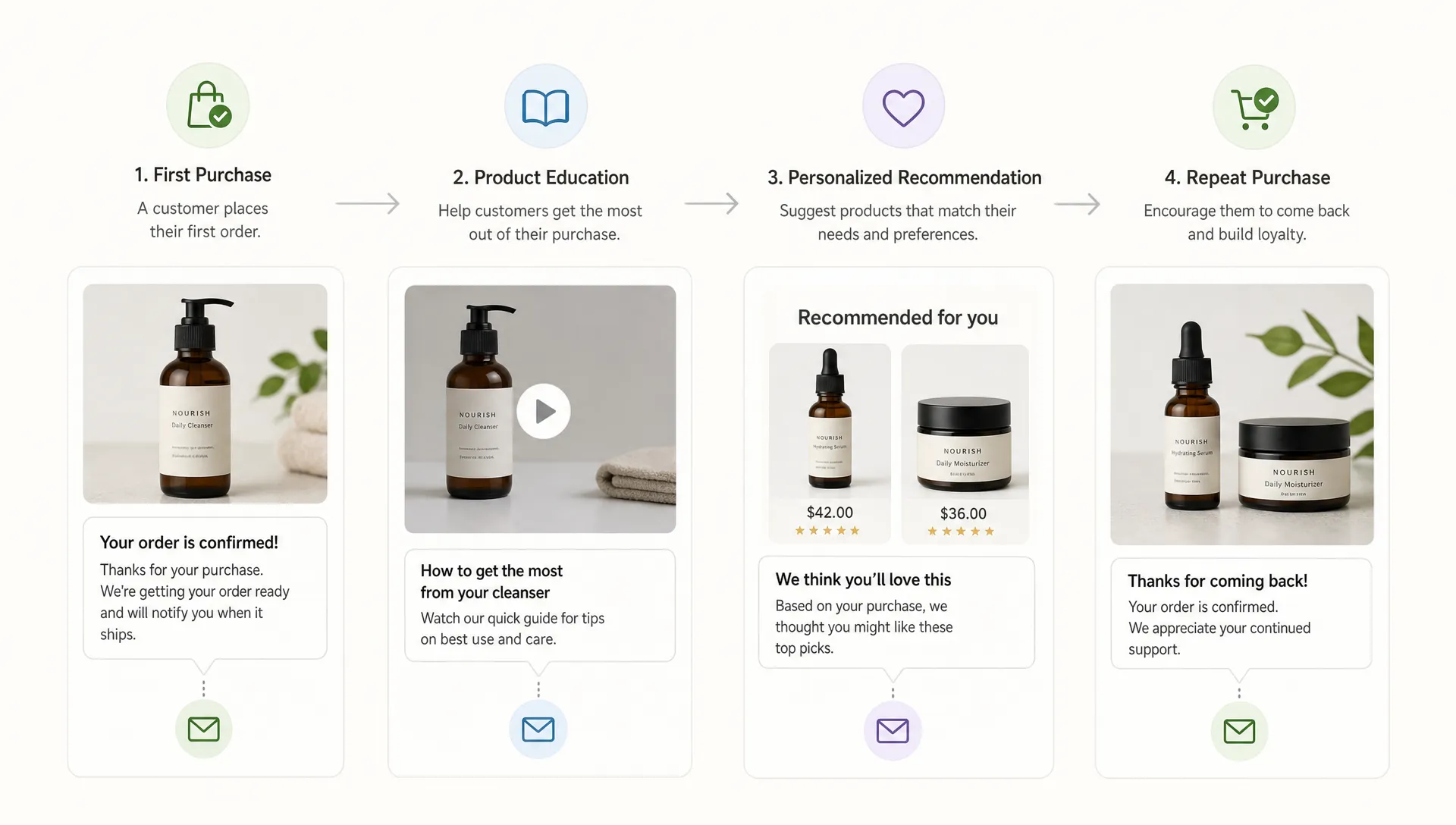
The post-purchase window is the easiest place to increase repeat sales because attention is still fresh. A customer just trusted your brand, paid you, and is waiting for the product experience to confirm they made the right choice.
Your post-purchase flow should not be a receipt followed by a discount. It should teach, reassure, and guide the next purchase. For example, a skincare brand can send usage instructions, then a “what to expect” email, then a routine-building recommendation based on the product purchased. An apparel brand can send styling ideas, care instructions, and later a complementary item recommendation.
The best post-purchase journeys answer the questions customers do not always ask out loud: Did I choose the right product? How do I get the most value from it? What should I buy next if I liked this? When should I reorder?
If you need campaign structure ideas, Needle’s guide to email marketing campaign examples DTC founders actually use includes several retention-oriented flows that can be adapted into more personalized post-purchase paths.
Tactic 2: Trigger messages from behavior, not just a campaign calendar
A weekly newsletter still has a place, but repeat sales often come from behavioral timing. The moment someone browses a product three times, returns to a replenishable item, clicks a size guide, or abandons a bundle page is more valuable than an arbitrary Tuesday send.
Behavioral triggers let you match intent with the next useful message. A customer who views a product they previously bought may need a refill reminder. A customer who browses accessories after buying a core product may need a bundle recommendation. A customer who clicks a sale email but does not buy may need urgency, while a customer who ignores discounts may respond better to education or social proof.
This is where one-to-one marketing becomes more profitable than blanket discounting. You are not pushing every customer toward the same offer. You are responding to the context they create.
Tactic 3: Use personalized offers without training customers to wait for discounts
Repeat sales do not require constant markdowns. In fact, too much discounting can make one-to-one marketing less effective because customers learn that patience is rewarded.
Instead, match the incentive to the customer’s likely reason for hesitating. A first-time buyer may need a low-friction second purchase offer. A VIP may value early access more than 15% off. A replenishment customer may respond to a subscription reminder or a bundle that saves them effort. A category loyalist may need a product discovery incentive, such as “complete your routine” or “try the next shade.”
Personalized incentives can include free shipping thresholds, samples, bonus products, early access, limited-edition bundles, loyalty points, or replenishment reminders. The best choice depends on margin, product category, and purchase frequency.
The rule is simple: offer value that moves the customer forward without weakening the brand.
Tactic 4: Turn retention content into one-to-one sales support
Content is often treated as top-of-funnel traffic fuel, but it can also drive repeat purchases. The right how-to guide, comparison, routine builder, or customer story can answer objections that block a second order.
For example, a supplement brand can send content based on a customer’s first product and goal. A home goods brand can send care tips and room-specific styling inspiration. A beauty brand can send routine sequencing content based on what the customer already owns.
This works because the content is not generic education. It is sales support tailored to the customer’s product experience. Instead of saying “buy again,” you are helping them get a better outcome from the first purchase and showing the next logical step.
Tactic 5: Add social proof at the moment of doubt
Customers often need reassurance before buying again, especially if the next purchase is higher-priced, new to them, or outside the category they first tried. One-to-one marketing should use social proof based on the customer’s specific hesitation.
If someone is considering a higher-ticket bundle, show reviews from customers who upgraded. If a customer is trying a new product line, share content from buyers with similar needs. If a loyal customer has not tried a new launch, show the founder story, product testing process, or early customer results.
External credibility can also help when you are launching something important. If a new collection, retail expansion, or founder milestone is part of your retention campaign, working with a partner for press release distribution across premium media outlets can create third-party proof that you can reference in emails, landing pages, and paid retargeting.
The point is not to add logos everywhere. The point is to place the right proof near the right decision.
Tactic 6: Personalize product recommendations around customer intent
Many ecommerce recommendations are based on simple logic: customers who bought X also bought Y. That can work, but stronger one-to-one marketing considers the job the customer is trying to complete.
A customer buying running socks may be training for a race, replacing basics, or buying a gift. A customer buying a moisturizer may want barrier repair, anti-aging support, or a simple daily routine. The next best product changes depending on the intent.
You can infer intent from product choice, quiz answers, landing page source, search terms, review language, and follow-up engagement. Then, recommendations can be framed around outcomes rather than inventory. “Complete your travel kit” is more compelling than “you may also like.” “Build your 3-step evening routine” is more useful than a random product carousel.
This approach also improves creative. Your ads, emails, and product blocks can speak to the customer’s goal, not just the SKU.
Tactic 7: Scale creative variation with an AI-human workflow
The hard part of one-to-one marketing is not the strategy. It is producing enough relevant creative to support different customers without overwhelming the team.
A single retention idea often needs many variations. First-time buyers need a different hook than VIPs. Replenishment customers need different timing than gift buyers. Lapsed customers need different proof than active subscribers. If every variation requires a fresh brief, freelance handoff, design round, copy review, and upload process, personalization stalls.
This is where an AI-powered marketing workflow can help. Needle is built for ecommerce teams that need to generate tailored marketing ideas, create on-brand assets, publish content directly, track results, and turn learnings into continuous optimization. The human still approves the work, but the system reduces the manual drag that usually keeps teams stuck sending one-size-fits-all campaigns.
The practical goal is not to create endless content. It is to create the right versions of the same campaign for the customer groups most likely to buy again.
Measure repeat sales like a retention system, not a one-off campaign
One-to-one marketing should be judged by customer behavior over time, not just click rate or same-day revenue. A campaign can look weak in last-click reporting but still improve second purchase rate, reorder timing, or customer lifetime value.
Track metrics that connect directly to repeat sales: second purchase rate, time between first and second order, repeat purchase rate by cohort, revenue per customer, product attach rate, unsubscribe rate, and margin after incentives. For replenishable products, also track reorder timing against the expected usage cycle. For higher-consideration products, track assisted behavior such as product page return visits, quiz completions, and bundle engagement.
If you are trying to separate real growth from noisy platform metrics, Needle’s founder-focused guide to marketing effectiveness measurement explains how to think beyond last-click reporting.
The most useful question is not “Did this email win?” It is “Did this customer group become more likely to buy again?”
A 30-day plan to launch one-to-one marketing for repeat sales
You do not need a six-month lifecycle overhaul to start. Use the next 30 days to build one repeat-sales system around your highest-opportunity customer group.
- Week 1: Choose one customer segment such as first-time buyers, replenishment-ready customers, or lapsed VIPs. Define the repeat purchase behavior you want to increase.
- Week 2: Map the next best action based on what the customer bought, when they bought, and what would make a second purchase feel natural.
- Week 3: Create three message variations with different angles, such as education, social proof, and offer-based urgency.
- Week 4: Launch, measure, and keep the winner by comparing repeat purchase behavior, not just opens and clicks.
Once one segment works, expand to the next. One-to-one marketing compounds when every new learning improves the next campaign.
Frequently Asked Questions
What is one-to-one marketing in ecommerce? One-to-one marketing is the practice of tailoring messages, offers, recommendations, and timing to individual customer behavior. In ecommerce, it usually uses purchase history, browsing behavior, engagement, and lifecycle stage to make campaigns more relevant.
How is one-to-one marketing different from segmentation? Segmentation groups customers by shared traits. One-to-one marketing goes further by using those traits to change the customer experience, including what they see, when they see it, and which next step you recommend.
Do I need a discount strategy for one-to-one marketing to work? No. Discounts can help in some cases, but repeat sales can also come from education, replenishment reminders, bundles, early access, loyalty perks, product recommendations, and timely social proof.
What is the best metric for repeat sales? Second purchase rate is often the most useful starting metric because it shows whether first-time buyers are becoming repeat customers. Over time, also track repeat purchase rate, customer lifetime value, reorder timing, and margin after incentives.
Can small ecommerce teams run one-to-one marketing? Yes, if they start with a few high-impact segments and automate the repetitive work. The key is to create reusable campaign systems rather than custom campaigns from scratch every week.
Turn personalization into repeatable growth
One-to-one marketing works when it is specific enough to feel personal and operational enough to run every week. For ecommerce brands, that means connecting customer signals to better timing, sharper creative, smarter offers, and clearer measurement.
If your team wants to create more relevant campaigns without adding agency bloat, Needle helps generate ideas, create on-brand assets, publish content, track results, and optimize continuously so repeat-sales marketing becomes a system, not a scramble.