
Let's get one thing straight. "Shopify marketing services" shouldn't be a random list of tasks. For a founder, it needs to be a predictable engine for sales. A complete system where your creative, ads, email, and analytics all work together. It’s about getting out of the chaos of random campaigns. It’s about building a smooth, results-driven process.
What Shopify Marketing Services Really Mean for Your Brand
For a DTC brand doing $1M–$10M, marketing is usually a massive source of stress. You're trying to juggle ads, emails, and social media. You're just hoping something sticks. Real Shopify marketing services fix that.
They aren’t about running a few one-off campaigns. They’re about building a machine where every part feeds the others. Think of it as a high-performance engine, not a messy toolbox of spare parts.
It All Starts with Your Shopify Store
Your Shopify store is the heart of your operation. No question. But a beautiful store doesn't automatically print money. You need a constant, reliable flow of the right kind of traffic. And a smart way to keep those customers coming back. This is where a focused marketing system comes in.
The competition is fierce. With over 4.8 million live websites on Shopify, just getting noticed is a battle. But the platform powers a global e-commerce market worth over $9 trillion.
"Your marketing shouldn’t feel like you’re throwing spaghetti at the wall. It should be a predictable system that connects the ad someone sees on Instagram to the welcome email they get after their first purchase." - David Heacock, Co-founder at Needle
The Core Parts of a Real Growth System
To get that predictable growth, you need a few core parts that all work together. When they’re in sync, they create a flywheel. You acquire new customers. You keep them engaged. And you get them to spend more over time.
Here are the essential services your Shopify brand needs to grow.
Shopify Marketing Services at a Glance
Without all these pieces working together, you're just running disconnected tactics. A true Shopify marketing service connects them into a single, powerful growth engine.
Here’s a closer look at what each of those moving parts actually does.
Creative Production
This is the fuel for everything else. It’s the user-generated content, slick product shots, and punchy headlines that grab attention. Without great creative, even the most perfectly targeted ad campaign will fall flat.
Paid Advertising (Media Buying)
This is where you put your creative to work. You run targeted ads on platforms like Meta and Google. The goal here is simple: drive high-quality traffic to your Shopify store for a profitable customer acquisition cost (CAC).
Email & SMS Marketing
This is how you turn a one-time buyer into a lifelong fan. It's about more than just blasting discounts. It’s the automated welcome series. The abandoned cart reminders that convert. And the campaigns that build a genuine connection. For a deep dive, check out our guide on the best Shopify email marketing apps.
Analytics & Reporting
This is the command center. Analytics tracks what’s working and what’s a waste of money. It lets you make smarter decisions. It’s what answers critical questions. "Which ad creative is actually driving sales?" or "What's our real customer lifetime value?"
The Four Pillars of a Winning Marketing System
Your marketing is only as strong as its weakest link. We’ve seen hundreds of brands try to bolt on different tactics. A freelancer for ads here, a cheap email tool there. And they wonder why nothing clicks. A winning system isn’t about just doing more. It's about making sure every piece works together.
For a Shopify brand, that means building on four solid pillars.
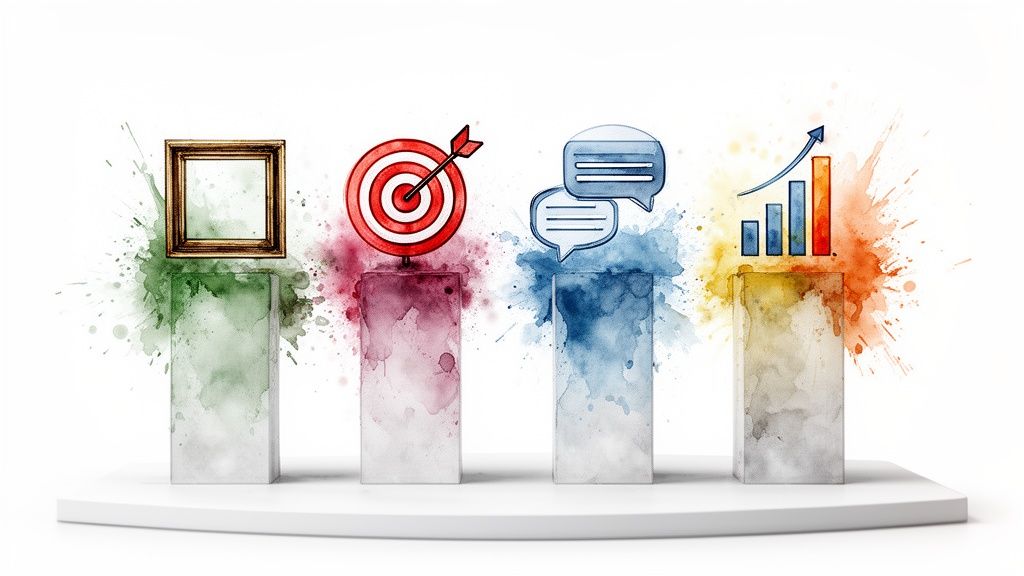
This isn't theory. It’s the blueprint we’ve used with over 200 brands. We build a genuine marketing machine, not just a messy collection of campaigns. When these parts connect, you create a predictable flow. An ad grabs attention. It sends a user to a landing page. It triggers an email sequence that turns a click into a loyal customer. This is what effective Shopify marketing services deliver.
Pillar 1: Creative That Stops the Scroll
Creative is the tip of the spear. It’s the videos, images, and ad copy. They have to cut through the chaos of social feeds. They have to make someone stop scrolling. In fact, creative quality drives 47% of a brand's sales growth from digital advertising.
If your creative is weak, nothing else matters. Your ad spend is wasted. Your ideal customer scrolls right past. Good creative isn't just about looking slick. It has to communicate your value in three seconds. It has to demand a click. It’s non-negotiable.
Pillar 2: Ads That Target the Right Buyers
Once you have killer creative, you need to get it in front of the right people. This is where paid media buying on platforms like Meta and Google comes in. This isn’t about blasting your ads to everyone. It’s about surgical precision.
A solid ad strategy involves:
Targeting the right audiences. Use data from your Shopify store and the ad platforms.
Managing your budget. Make sure you're acquiring customers at a profitable cost (CAC).
Continuously testing. Test different creatives, headlines, and audiences to find what moves the needle.
This pillar turns your creative into a reliable stream of qualified traffic. Without it, your beautiful ads never find an audience.
Pillar 3: Email and SMS That Build Loyalty
Getting the first sale is only half the battle. The real money is in turning that new customer into a repeat buyer. This is where email and SMS marketing take over. A 5% increase in customer retention can increase company revenue by 25-95%.
A well-built retention strategy does more than just send discount codes. It builds a direct line of communication. It has automated flows that work for you 24/7. A new customer gets a welcome series that tells your brand's story. An abandoned cart triggers a helpful reminder, not a desperate plea. These systems build relationships and drive revenue long after the first click.
For more, check our guide on DTC marketing strategies that focus on keeping customers.
Pillar 4: Analytics That Tell You What to Do Next
Analytics is the brain of the entire operation. This final pillar connects all your data. From Shopify sales to Meta ad performance to Klaviyo email engagement. It gives one clear picture of what's working.
It answers the questions that keep you up at night:
Which ad creative is driving the most profit?
What's the true lifetime value of a customer we acquired from TikTok?
Where are people dropping off in the checkout process?
Without clear analytics, you're flying blind. You're making decisions based on gut feelings instead of hard data. A proper marketing service integrates tools like HubSpot or uses a central platform to give you one source of truth. So you can stop guessing and start making smart moves.
The Agency Dilemma: Cost, Speed, and Quality
You know you need marketing help. Trying to run campaigns yourself is a fast track to burnout. But when you look at the options, you’re stuck. Making the wrong choice can cost you six months and tens of thousands of dollars.
It’s the classic agency dilemma. Do you hire a big, expensive agency? Take a risk on a freelancer? Or try to glue together a dozen software tools and pray it works? Each path forces a painful trade-off.
Let's cut through the noise. Let's talk about what these choices really mean for your brand.
The Traditional Agency Model
Traditional Shopify marketing services usually come from agencies. They promise a full team and deep expertise. They can produce good work, but it comes at a steep price. And not just in dollars.
These agencies typically charge retainers of $5,000–$10,000 per month. They often have extra fees for creative, strategy, and media buying. The real killer is the lack of speed. Their entire process is manual. A single campaign can take weeks to go from a brief to a live ad. For a fast-moving DTC brand, that’s just too slow.
This model is common. But it's breaking under the pressure of modern e-commerce.
"The old rule was: 'Fast, good, or cheap. Pick two.' For years, founders were forced to choose between slow, expensive quality (agencies) or fast, cheap chaos (DIY). That compromise is no longer necessary." - David Heacock, Co-founder at Needle
The DIY and Freelancer Route
On the other end is the DIY approach. You can get tools like Canva for creative and Mailchimp for email. But you’re still the one pulling all the levers. You have to come up with the strategy. You have to connect the data. You have to do all the execution yourself. It’s cheap on paper, but it drains your most valuable asset: your time.
Hiring freelancers can seem like a happy medium. But it often creates a different kind of chaos. Suddenly, you're not a founder. You’re a project manager. You're trying to coordinate a designer, a copywriter, and a media buyer. They don’t talk to each other. Consistency tanks. You spend your days managing people instead of growing the business.
Weighing whether to build a team or outsource is a major decision. Our guide on in-house marketing vs. agency can help.
The New AI-Hybrid Approach
There's a new model emerging. It finally breaks the "pick two" rule. It blends the oversight of a human expert with the raw speed of AI-powered execution. This isn't about replacing people. It's about making them radically more effective.
The growth of Shopify Plus—now over 47,000 live sites with an average year-over-year growth of 126%, according to one report on Shopify statistics—shows why faster, smarter marketing is no longer optional.
Think about it. A traditional agency charges $5K–$10K+ per month for manual work that takes weeks. A hybrid AI approach can deliver everything you need for around 20% of your ad spend. You get top-tier strategy, creative, and optimization. All with a 2-day turnaround.
This hybrid model gives you the best of both worlds. You get the strategic mind of an agency partner without the punishing overhead and slow pace. AI handles the repetitive, time-sucking tasks. This frees up human experts to focus on what matters. Brand alignment and driving real results. It’s an efficient growth engine built for today's market.
How Modern DTC Brands Get Marketing Done
Marketing theory is great, but it doesn't pay the bills. All that matters is whether your marketing is driving results. More sales, better margins, and less time wasted. The real test of any Shopify marketing service isn't a glossy report. It's the impact on your bank account.
Let's look at how real brands are breaking free from the chaos. Free from slow, expensive agency retainers. They are building predictable growth engines. These aren't vanity metrics. This is what happens when your marketing system is faster, cheaper, and just plain better.
Case Study: RTPTennis Cuts Hours and Boosts ROI
RTPTennis was in a classic founder's trap. The founder was personally building every single email campaign. A manual process that ate up his time. It was impossible to scale.
Before: He was spending 2–4 hours on each email. That slow pace meant they couldn't engage their audience consistently. They left money on the table.
After: By switching to an AI-hybrid workflow, the process was reduced to a quick 5-minute approval. That new speed let them run campaigns more often. It led to a 12x ROI on email in the first month.
This isn't just about saving a few hours. It’s about freeing up the founder to work on the business. All while the marketing engine runs on its own.
Case Study: TWOOAK Slashes Ad Costs by 53%
TWOOAK was working with a traditional agency. They were bleeding cash. Their customer acquisition cost was $41 per order. That number was wrecking their margins. It put the brakes on growth. The old agency model was too slow and expensive to fix it.
So, they fired their agency. They tried a new approach.
The results were almost immediate. They used a system that could rapidly test creative and optimize campaigns with real-time data. They dropped their cost-per-order from $41 all the way down to $19. That’s a 53% reduction in acquisition costs. It completely changed their profitability and ability to scale.
Case Study: As Intended Doubles Efficiency and Sustains 6x ROAS
For As Intended, the game was all about sustained, profitable growth. They were tired of the wild performance swings that plague so many brands. They needed a system that could deliver consistently.
The Result: They doubled their marketing efficiency within just 60 days.
The Follow-up: They then sustained a 6x Return on Ad Spend (ROAS) for eight straight months.
That’s the kind of consistency that builds a real, lasting business. It wasn't a lucky campaign. It was the direct result of a system that learns and optimizes week after week. It shows that for brands on Shopify, the right execution is everything. Whether that's through paid ads or smart Shopify Influencer Marketing Strategies.
Agency vs AI-Hybrid Campaign Workflow
When you’re waiting weeks for a single campaign, your competitors are already launching, learning, and iterating. That lost time is an opportunity cost you can no longer afford.
Your Checklist for Choosing a Marketing Partner
Picking the wrong marketing partner is more than a bad hire. It’s a six-month hole in your growth. We're not just talking about the sunk cost of a retainer. The real damage is the lost momentum. The thousands burned on ads that went nowhere. The headache of starting from scratch.
Forget the slick sales decks. You need to get under the hood and see how they work. This checklist helps you ask the questions that cut through the BS. It reveals if they really know how to grow a brand like yours.
Questions About Process and Speed
Speed is everything in DTC. A partner who takes weeks to get a campaign live will bleed your brand's momentum. You need to know their workflow. You need to know how fast they can ship.
Ask them these direct questions:
What’s your real turnaround time for new ad creative? From idea to live campaign? If they say more than a few days, be concerned.
Walk me through your exact process. How do you turn a concept into a live ad? Who does what? What are the timelines?
How do you handle feedback and revisions? Is it a messy email chain or a clean loop?
A modern partner has to operate at the speed of e-commerce. Waiting weeks for basic assets is a huge red flag.
Questions About Strategy and Data
A great partner uses your own data to make every move. A bad one just hopes something sticks. You need proof they can connect the dots. Between your Shopify sales, ad performance on Meta, and email engagement in Klaviyo.
Drill down on their strategic thinking:
How do you use my Shopify, Meta, and Klaviyo data to build a strategy? Ask for a concrete example.
Who is the actual strategist on my account? What’s their direct experience with brands at my revenue level?
How do you report on performance? I don’t want a PDF of vanity metrics. I need to know what worked, what didn’t, and what we’re trying next.
Their answers tell you if you’re hiring a strategic partner or just a pair of hands. Never settle for a team that can't show you a clear, data-backed plan. If you're looking at a Shopify ad agency, these questions are non-negotiable.
Questions About Pricing and Value
Finally, you need to understand the real cost. This goes beyond the monthly fee. It’s about what you’re actually getting for your money.
Get total clarity on the numbers:
What’s your pricing model, and what does it actually include? Is creative bundled, or am I going to get nickel-and-dimed?
Are there any hidden fees, setup costs, or long-term contracts?
How do you measure ROI? Show me a real example of the value you delivered for a similar brand.
Your marketing partner should be an investment that pays for itself. Not just another line item on your P&L. If a provider can't draw a straight line from their fees to results, walk away.
Human + AI: The New Growth Model
The marketing world is stuck between two bad options. On one side, traditional agencies—slow, expensive, and bogged down. On the other, a flood of AI tools that promise automation but leave you with generic creative.
For a fast-moving brand, neither works. Manual is too slow. Pure AI lacks brand nuance. The way forward isn't choosing one or the other. It's blending them.
Blending Human Strategy with AI Speed
In a hybrid model, the roles are crystal clear. You get a human strategist who lives and breathes your brand. They define campaign angles, nail the voice, and make big-picture calls. The AI then acts as a tireless executor. It crunches data, drafts ad concepts, and handles tedious campaign setup.
From there, a human creative polishes the AI’s output. They ensure every ad feels on-brand. They add that spark of personality machines can't replicate.
You get agency-level thinking with the raw speed of software. The old trade-off between fast, cheap, or good is dead. This approach gives you all three. It’s a model that increasingly relies on tools like AI personalization to make sure every customer feels seen.
Breaking Through Your Biggest Bottlenecks
Talk to any Shopify founder, and they'll tell you the same thing. The two biggest marketing bottlenecks are creative production and campaign deployment. A typical agency might take weeks to get new ads back to you. A hybrid system can do it in 48 hours.
Here’s what that actually looks like:
Human Strategist: "Let's run a win-back campaign for customers who haven't bought in 90 days."
AI Execution: The system isolates that exact segment and generates five distinct ad concepts.
Human Creative: A designer reviews the concepts, picks the top two, and refines them.
Approval & Launch: You give the final nod, and the campaign is launched.
This workflow turns a multi-week slog into a simple two-day process. This is the real power of an AI-powered marketing agency.
This isn't about replacing creatives with robots. It’s about automating the grunt work. So your human experts can focus on what they do best: strategy, brand building, and big ideas.
The market already moves at this speed. Of the millions of live Shopify stores, 47.4% use Instagram and 12.9% use TikTok. You need to be everywhere at once. An AI-hybrid model can analyze your data weekly, propose new campaigns, and generate the assets for you to approve. Letting you launch in 48 hours instead of waiting weeks. All at a fraction of the cost.
By pairing human oversight with AI's horsepower, you create a marketing engine that compounds. You’re always testing. Always learning. Always getting better, week after week. That’s how you build an operation that gets ahead.
FAQ: Questions We Get All the Time
We get it. You've heard a lot of promises from agencies and software platforms. Here’s some real talk on the questions founders ask us most.
How is an AI-hybrid service different from a traditional agency?
The biggest differences are speed, cost, and consistency. A traditional agency is entirely human-powered. You're paying for their overhead and their long timelines. You wait 1–3 weeks for new creative while paying a $5,000–$10,000 monthly retainer.
An AI-hybrid model, like Needle, flips that. We use software for the grunt work. Our human strategists then step in to nail the brand voice and focus on high-level strategy. This gets you 48-hour turnarounds on creative and costs tied to your ad spend, not bloated retainers.
Why not just use AI tools like Canva or Jasper myself?
Tools like Canva and Jasper are great for one-off tasks. But they leave you as the operator. You still have to devise the strategy. You have to figure out how your Shopify data connects to your ad performance. You're stuck in the weeds.
A true Shopify marketing service does that strategic work for you. It plugs directly into your Shopify, Meta, and Klaviyo accounts. It analyzes what’s working, suggests campaigns based on that data, and then creates the assets. Your job shifts from "doing" to "approving."
What kind of results can I realistically expect?
Your results depend on your starting point. But the goal is always a measurable improvement in marketing efficiency. We don’t chase vanity metrics. We focus on what hits your bottom line. For example, our clients see tangible shifts:
TWOOAK cut their customer acquisition cost by 53%.
As Intended held a 6x ROAS for eight consecutive months.
RTPTennis hit a 12x ROI on email in their first month.
These numbers aren't random. They’re the result of a system that marries data-driven strategy with relentless execution speed. It lets you test, learn, and optimize faster than you ever could on your own.
Stop juggling slow agencies and messy software. Needle gives you an AI marketing team that delivers agency-level output in a fraction of the time and for a fraction of the cost. See how it works at https://www.askneedle.com.