

Finding the right AI tools for your ecommerce store feels impossible. Every vendor promises a revolution. Most deliver complexity and poor results.
We've run our own brands. We've waded through the hype. We know the pain of paying for a "solution" that doesn't solve anything.
This isn't another generic list. It's a field guide from real-world experience. We’ve tested, implemented, and managed these tools for over 200 DTC brands. We'll show you which ones actually work.
This guide helps brand owners find the best AI tools for ecommerce without the fluff. We’ve cut the noise to give you a direct look at top options for:
- Creative and Copy Generation
- Ad Bidding and Optimization
- Email and SMS Automation
- Personalization and Recommendations
- Customer Service and Support
- Analytics and Insights
Each review includes links and our honest take. This is about finding the right fit for your specific problems. While this article focuses on tools for current customers and site optimization, the full AI stack is key. To see what drives new customer growth, check out these top AI lead generation tools.
Let’s get into the tools that can help you scale.
1. Needle
Needle is a new model for DTC growth. It acts as an AI-powered marketing team in one tab for brands in the $1M–$10M revenue range.
It connects directly with your Shopify, Klaviyo, Meta, Google, and TikTok accounts. This creates a complete growth engine. It can replace multiple tools and agency or freelancer retainers.
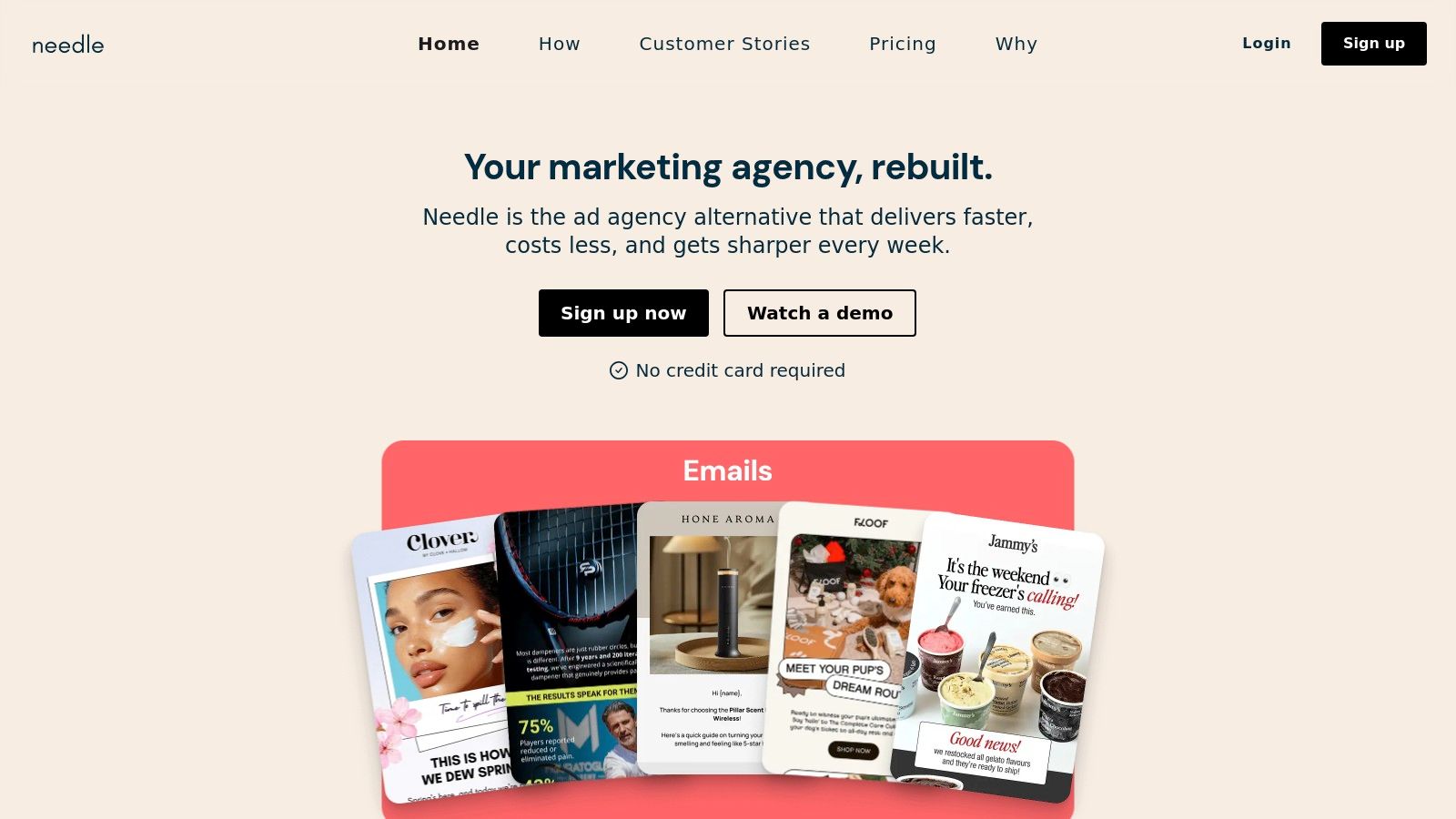
The system reads your store’s data. It automatically generates a weekly marketing calendar. Then it drafts the email and ad creatives.
Here, Needle's hybrid approach is its strength. AI handles data analysis and first drafts. Human strategists and designers refine the output. They ensure it fits your brand and has a purpose.
You keep full control with an approval loop. Nothing goes live without your sign-off. Founders say this cuts creative review time from hours to minutes.
Why It Stands Out
Needle’s value is its blend of AI automation and expert human oversight. This solves major problems for growing brands: speed, cost, and complexity.
It delivers strategy, creative, and campaign execution for one flat monthly fee. Case studies show real results. One brand reported a 12x ROI on email. Another saw a 50% cut in cost-per-order.
The workflow is built for speed and learning. Creative volume is uncapped, revisions are unlimited, and a weekly Momentum Report feeds each week's plan.
If you want a deeper dive, their guide on how to use AI for marketing offers practical applications.
Key Features:
- Integrated Growth Engine: Connects Shopify, Klaviyo, Meta, Google, and TikTok to run marketing from one place.
- AI-Generated Calendar & Creative: Automatically drafts weekly marketing plans for emails and ads.
- Human-in-the-Loop: A dedicated team refines all AI output for quality and brand fit.
- Uncapped Creative: Unlimited creative volume and unlimited revisions on every tier.
- Flat Pricing: Growth is $2,999/month (roughly $5–8K monthly ad spend), Scale is $3,999/month (roughly $8–11K), and Custom pricing covers larger accounts. It is a flat fee set by ad spend and email list size, with no percentage cut of ad spend.
Best For:
DTC founders and marketers at brands with $1M–$10M in revenue. It's for those who want a managed marketing team rather than another tool to run, and whose ad spend fits the first tier (roughly $5–8K a month).
.tbl-scroll{contain:inline-size;overflow-x:auto;-webkit-overflow-scrolling:touch}.tbl-scroll table{min-width:600px;width:100%;border-collapse:collapse;margin-bottom:20px}.tbl-scroll th{border:1px solid #ddd;padding:8px;text-align:left;background-color:#f2f2f2;white-space:nowrap}.tbl-scroll td{border:1px solid #ddd;padding:8px;text-align:left}ProsConsPredictable Pricing: One flat monthly fee with uncapped creative volume and unlimited revisions.Niche Focus: Best for DTC brands in the $1M–$10M revenue band.Rapid Execution: Enables a weekly campaign cadence with uncapped creative volume.Higher Entry Price: The first tier assumes roughly $5–8K in monthly ad spend, so smaller brands may fall below it.Hybrid Model: Combines AI efficiency with human strategic and creative oversight.Managed, Not Self-Serve: Execution is handled with a Needle strategist rather than a do-it-yourself tool.
Website: https://www.askneedle.com
2. Omnisend
Omnisend delivers Klaviyo-comparable email and SMS automation at up to 35% lower cost for ecommerce brands. It holds a 4.6/5 rating on G2 and includes a free plan to start.
This makes it one of the best AI tools for ecommerce brands that want enterprise-grade marketing automation without enterprise-grade pricing. The platform connects natively to Shopify, BigCommerce, and WooCommerce, pulling store data straight into campaigns and automations.
The standout feature is Omnisend's AI-assisted campaign builder. It drafts subject lines and email copy based on a brand's own product and sales data. Merchants can generate full email and SMS content from a single prompt. Pre-built automation workflows, like abandoned cart and welcome series, run on top of this data without extra setup.
Key Features & Use Cases
- AI Content Generation: Generate subject lines, email copy, and SMS messages matched to a brand's tone, directly inside the campaign editor.
- Pre-Built Automations: Deploy ready-made workflows for abandoned cart recovery, welcome series, and post-purchase follow-ups.
- Native Ecommerce Integrations: Connects directly to Shopify, BigCommerce, and WooCommerce for real-time customer and order data.
Pricing and Access
Omnisend offers a free plan for smaller lists, with paid plans priced up to 35% lower than Klaviyo for comparable features. New customers switching from another platform get a 5-day migration completed at no cost.
- Pros: Klaviyo-comparable feature set at a lower price point, free migration support, free plan available for smaller stores.
- Cons: Smaller third-party app ecosystem than Klaviyo; brand recognition is still building in some markets.
Website: https://www.omnisend.com
3. Shopify Magic and Sidekick (Shopify)
For merchants on Shopify, the best AI tool might be the one already built-in. Shopify Magic is a set of AI features embedded in the admin.
This means zero integration friction. The system uses your own store's data for suggestions. This makes it one of the best AI tools for ecommerce brands looking to simplify their tech.

The standout feature is Sidekick. It's a conversational AI assistant in your admin panel. You can ask it to analyze sales trends. Or draft a blog post. It can even put a product collection on sale.
Key Features & Use Cases
- Sidekick Assistant: Ask, "Which products had the highest return rate last month?" Or say, "Draft an email announcing our summer sale." Sidekick acts on your data.
- AI Content Generation: Generate product descriptions and email subject lines. It matches your brand’s tone. It also assists with replies in Shopify Inbox.
- Image Editing: Includes AI-powered tools to remove or generate backgrounds. Useful for clean product photos without separate software.
Pricing and Access
Shopify Magic features are included with all paid Shopify plans. Access to the more advanced Sidekick is currently in an early access program.
While base AI features are great, you can add more marketing power. Look for tools among the best Shopify marketing apps on the app store.
- Pros: Seamlessly integrated, uses your shop’s data, reduces the need for third-party apps.
- Cons: Most valuable if you are fully in the Shopify ecosystem; some features are still in early stages.
Website: https://www.shopify.com/magic
4. Klaviyo
Klaviyo is a powerful email and SMS tool for ecommerce. It uses AI to predict customer behavior. This makes it one of the best AI tools for ecommerce brands focused on retention.
Its deep integration with Shopify allows it to pull rich customer data. This creates highly targeted segments for personalized messages.
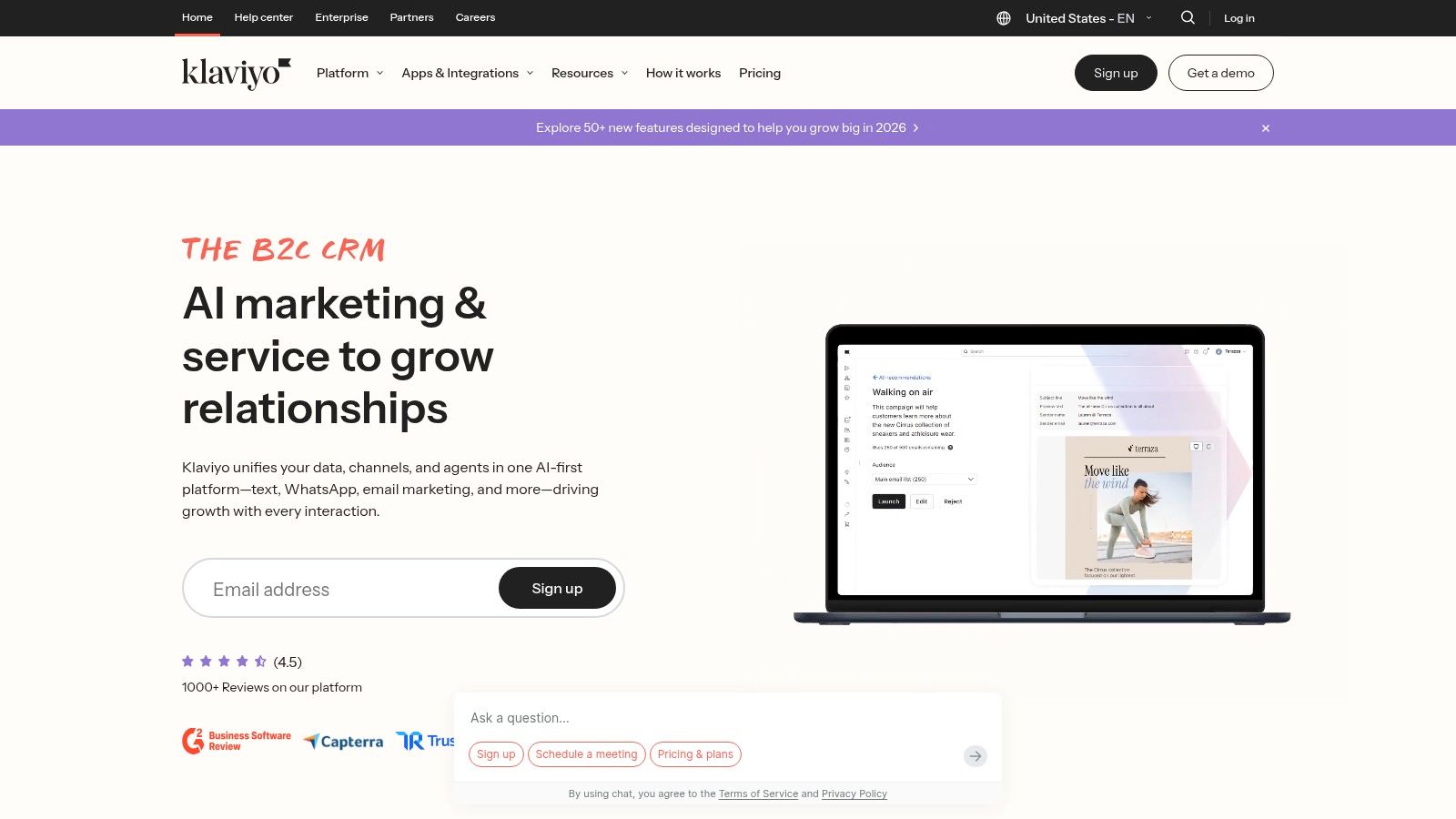
The AI features are core to its function. It predicts the next purchase date. It finds customers at risk of churning. Klaviyo helps you act on data.
A 2023 Shopify report stated, "For repeat customers, the probability of a purchase is 60-70%." Tools like Klaviyo help you capitalize on this.
Key Features & Use Cases
- Predictive Analytics: Build segments based on predicted customer lifetime value (CLV) and churn risk. Use this for a VIP campaign or a win-back series.
- AI Content & Send Time Optimization: Generate on-brand email subject lines and SMS copy. The system also finds the best time to send messages to each user.
- Cross-Channel Automation: Build flows that combine email, SMS, and push notifications. For example, an abandoned cart flow that starts with an email and follows up with an SMS.
- AI-Powered Customer Service: The new Customer Hub offers AI-assisted responses to help support teams. Read more in this Klaviyo AI agent analysis.
Pricing and Access
Klaviyo offers a free plan for up to 250 contacts. Paid plans scale based on contacts and SMS credits. The core AI features are included. Newer add-ons increase the cost.
- Pros: Deep ecommerce data model, predictive audiences drive ROI, free tier for small brands.
- Cons: Profile-based pricing gets expensive as lists grow, and add-ons increase the total spend.
Website: https://www.klaviyo.com/
5. Algolia AI Search and Discovery
For brands focused on product discovery, Algolia provides a search and recommendation engine. It delivers fast, relevant results. It replaces native search with a more powerful, AI-driven system.
This makes it one of the best AI tools for ecommerce businesses with large catalogs. Many of these tools use capabilities found in modern AI search engines to deliver relevant results.
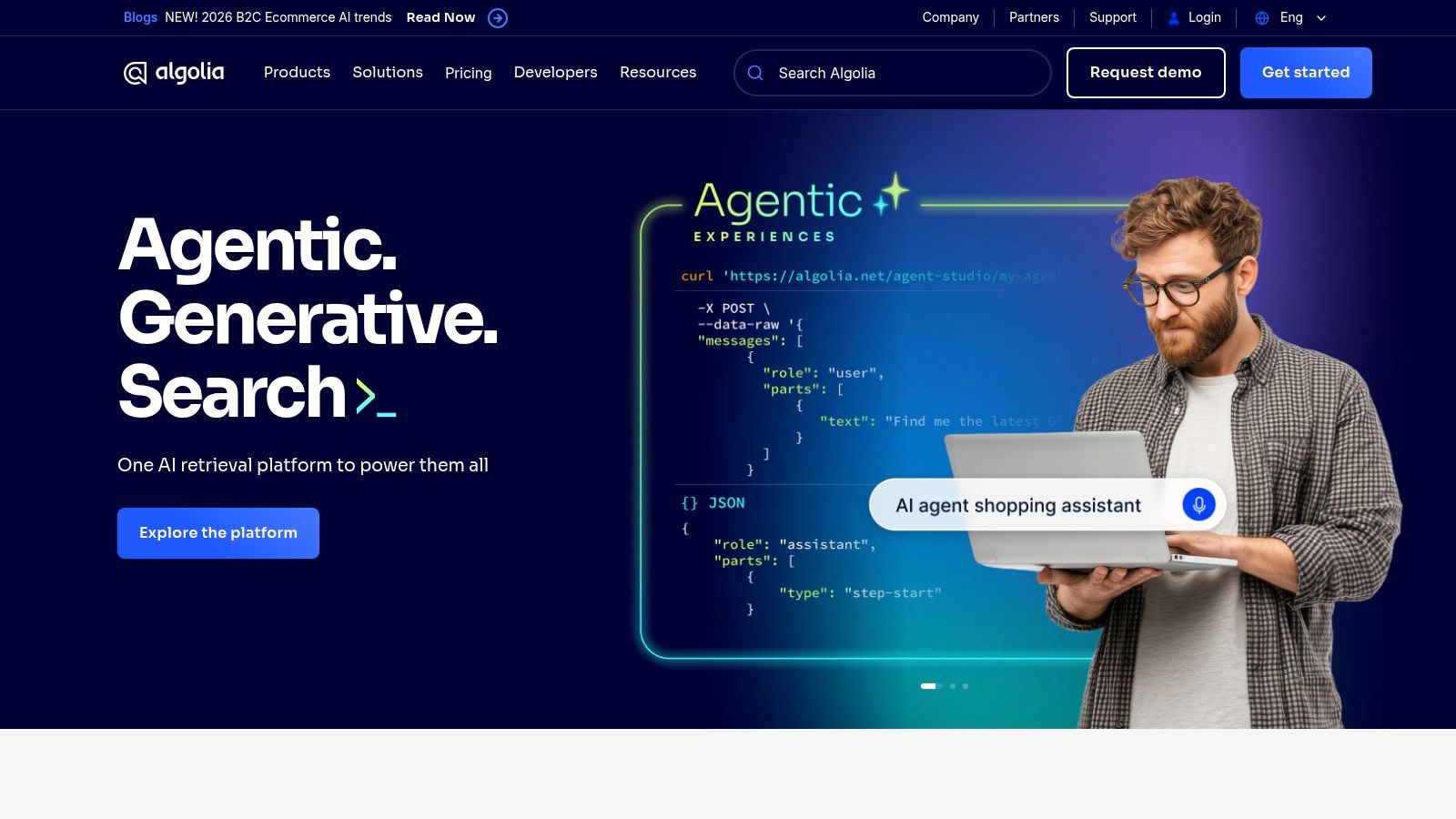
Unlike simple search apps, Algolia gives merchandisers control. Its dashboard allows for creating rules and promoting specific products. You can run A/B tests to optimize search performance. This combines AI automation with manual control.
Key Features & Use Cases
- AI Ranking & Synonyms: The system understands user intent, even with typos. It uses AI to rank results and find synonyms. This reduces zero-result pages.
- Dynamic Re-ranking: Search results can be re-ordered based on real-time data like sales or inventory.
- Personalization: Algolia creates user profiles to personalize search results for each shopper.
- Analytics & A/B Testing: A robust analytics suite shows what customers search for. Use this data to run A/B tests and improve discovery.
Pricing and Access
Algolia offers usage-based pricing with a free 'Build' tier. Paid plans scale based on the number of products and search requests. This model works for growing stores but requires monitoring costs.
- Pros: Exceptional search speed and relevance, strong documentation for developers, and a free starting tier.
- Cons: Requires developers for implementation; costs can become high for high-traffic stores.
Website: https://www.algolia.com/
6. Bloomreach Discovery
For enterprise-level brands, generic search is not enough. Bloomreach Discovery offers a specialized AI engine for search, merchandising, and product discovery.
It is built on massive volumes of ecommerce data. This gives it a deep understanding of shopper intent. It goes beyond simple keyword matching.
Bloomreach’s strength is interpreting vague queries and personalizing results in real time. It analyzes a user's behavior to re-rank products. This moves your site search from a basic utility to an intelligent conversion tool.
Key Features & Use Cases
- AI-driven Ecommerce Search: The search is tuned for commerce. It handles long-tail keywords and conceptual queries. Shoppers find products even with vague terms.
- Real-time Personalization: It adjusts search results and category pages on the fly. It uses a visitor's clicks, past purchases, and site trends.
- Merchandising Insights & Tooling: It provides analytics on search performance. Merchandisers can use tools to create rules and boost products.
Pricing and Access
Bloomreach does not list public pricing. It is a solution for mid-market and enterprise brands. Costs reflect its powerful features. Getting started usually involves a consultation.
- Pros: Uses insights from a huge ecommerce dataset, offers strong merchandiser tools, scales for complex catalogs.
- Cons: Enterprise-level pricing is out of reach for smaller brands, and implementation can be complex.
Website: https://www.bloomreach.com/
7. Nosto
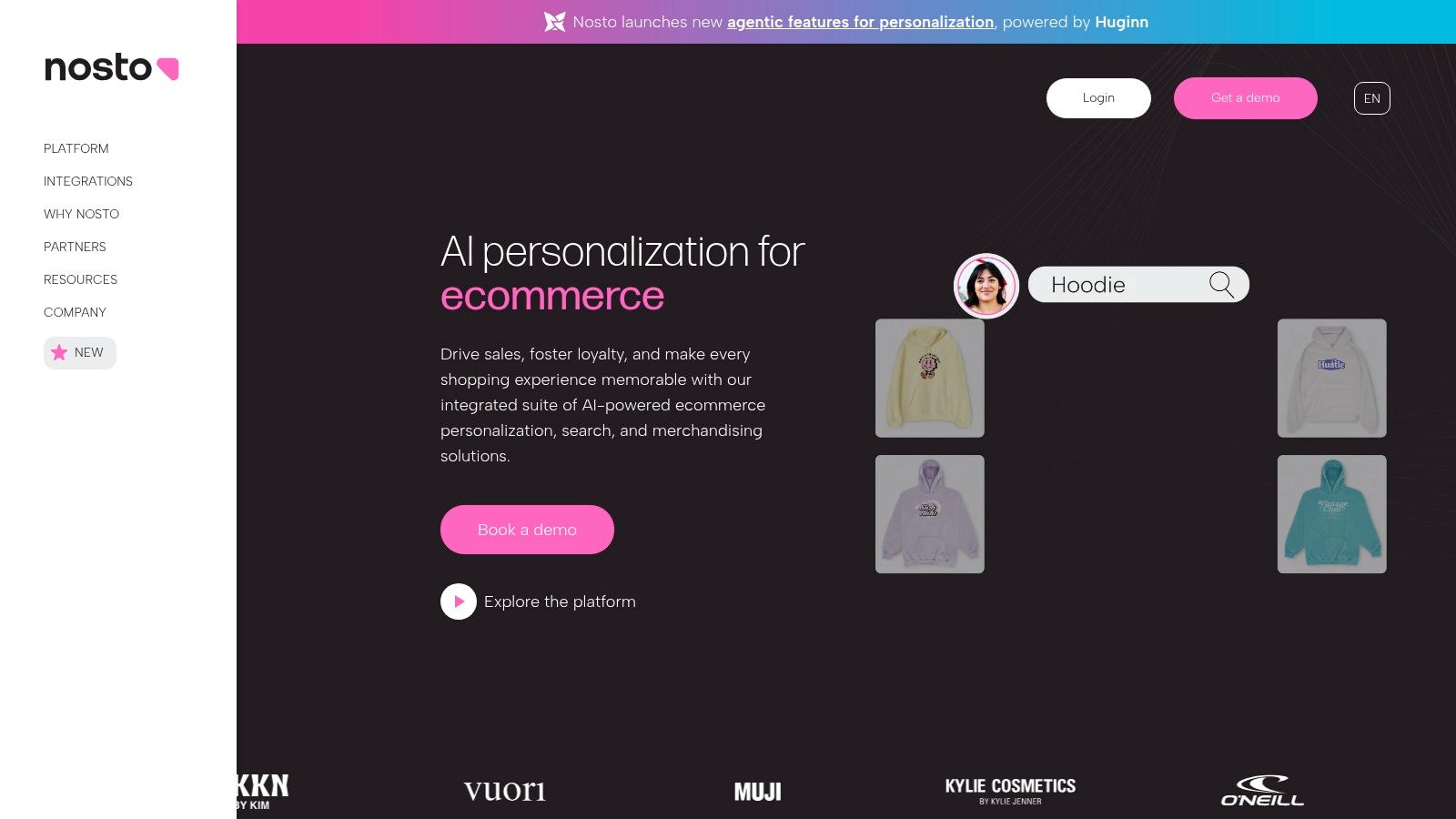
Nosto is a commerce experience tool that combines AI-driven personalization, search, and merchandising. It's built for DTC brands that want to automate how customers discover products.
The tool uses "experience.AI" to understand customer intent. It displays the most relevant products and content. This bundles multiple AI functions that would otherwise require separate apps.
This makes it one of the best AI tools for ecommerce brands on Shopify Plus looking to improve conversions. As Nosto's CEO, Jim Lofgren, stated, "The ability to truly personalize at scale is what separates the winners from the losers in ecommerce."
Key Features & Use Cases
- Predictive Recommendations: Nosto analyzes browsing behavior to power personalized product carousels and pop-ups.
- Category Merchandising: Automatically sorts products on category pages based on rules or AI. You can also A/B test different sorting strategies.
- Personalized Search: The search uses natural language processing to understand intent and show visually similar items.
- Post-Purchase Upsells: Display targeted upsell offers on the order confirmation page to increase average order value.
Pricing and Access
Nosto’s pricing is not public. It is based on a brand's site traffic and required modules. It is positioned for mid-market to enterprise businesses. For stores focused on improving their site experience, learning about Shopify conversion rate optimization can highlight the value of such tools.
- Pros: Combines multiple personalization tools, integrates deeply with major ecommerce platforms, strong case studies.
- Cons: Pricing is not transparent and can be high; realizing full value requires using multiple modules.
Website: https://www.nosto.com/
8. Dynamic Yield by Mastercard
For enterprise brands, Dynamic Yield by Mastercard offers a powerful personalization engine. It’s an AI solution built for scale. It unifies customer data to deliver individual experiences.
Its strength is combining your first-party data with Mastercard's transaction insights. This gives you a wider lens for predictive modeling.
Recognized as a leader by Gartner and Forrester, Dynamic Yield goes beyond basic recommendations. It includes sophisticated A/B/n testing and tools like Shopping Muse for conversational product discovery. This makes it one of the best AI tools for ecommerce businesses ready to invest in a top-tier system.
Key Features & Use Cases
- AdaptML Personalization: The machine learning engine automatically tests and selects the best experience for each user segment.
- Algorithm Studio: Advanced teams can build their own custom recommendation models. This allows you to tailor algorithms to your business goals.
- A/B Testing and Optimization: Run deep experiments across your website, app, and email campaigns. The tool provides strong governance features.
- Shopping Muse & Element: Shopping Muse offers a conversational search experience. Element uses Mastercard's data to inform audience creation.
Pricing and Access
Dynamic Yield is an enterprise solution with pricing tailored to large businesses. Costs are significant and require a dedicated onboarding process. It is not for small businesses.
- Pros: Proven at enterprise scale, deep experimentation capabilities, backed by Mastercard data.
- Cons: High cost and complexity; may be more powerful than what most SMBs need.
Website: https://www.dynamicyield.com/
9. Rebuy
For Shopify merchants focused on maximizing every transaction, Rebuy is an AI personalization engine. It's built to increase average order value (AOV).
It replaces generic upsell apps with an intelligent system. It analyzes site behavior to suggest relevant products. This makes it one of the best AI tools for ecommerce brands looking to add immediate revenue.
Rebuy’s AI gets smarter over time. It can power recommendations on product pages, in the cart, and post-purchase. Its Smart Cart can be customized with progress bars for free shipping and in-cart upsells.
Key Features & Use Cases
- AI-Powered Upsells & Cross-Sells: Automatically recommend complementary products. Suggest a matching accessory on a product page or a bundle in the cart.
- Smart Cart & Checkout: Enhance the Shopify cart with features to boost order size. This includes in-cart offers and gift-with-purchase promotions.
- Post-Purchase Offers: Capture more revenue by presenting one-click offers on the thank you page. Rebuy's AI determines the best product to show.
- A/B Testing: Test different offers and placements to see what drives the highest lift in AOV.
Pricing and Access
Rebuy's pricing is tiered and scales with your store's order volume. Plans start around $99/month. Advanced features are on higher-tier plans. Its tight integration provides a near-native experience.
- Pros: Deep Shopify integration, strong focus on delivering measurable AOV lift, highly rated support.
- Cons: Pricing can be a significant expense for high-volume stores; mostly beneficial for Shopify brands.
Website: https://www.rebuyengine.com/
10. Gorgias + AI Agent
Gorgias is a helpdesk built for ecommerce. Its AI Agent turns customer support into a revenue driver. It integrates with Shopify and Klaviyo to resolve common questions automatically.
It can handle order edits, subscription management, and even suggest products. This makes it one of the best AI tools for ecommerce brands aiming to automate support.

Unlike general chatbots, Gorgias's AI Agent understands the context of a customer's order history. It can perform actions like issuing refunds. It operates within your brand’s voice for a consistent experience. In fact, Gorgias reports that brands using its automation see up to a 30% reduction in ticket volume.
Key Features & Use Cases
- AI Agent: Automates responses to questions like "Where is my order?" It can also proactively engage customers and process returns.
- Omnichannel Inbox: Consolidates customer communications from email, chat, SMS, and social media into one view.
- Revenue Attribution: Tracks sales generated from support interactions. This shows how your support team and AI Agent contribute to the bottom line.
- Deep Integrations: With over 150 integrations, it connects with tools like Recharge and Klaviyo.
Pricing and Access
Gorgias uses a ticket-based pricing model. Plans start from around $50 per month. The AI Agent is an add-on priced per resolved interaction. You pay for the value it delivers.
- Pros: Built for ecommerce with deep Shopify integration, turns support into a measurable revenue channel.
- Cons: Ticket-based billing can get expensive for high-volume stores; AI Agent cost adds another layer.
Website: https://www.gorgias.com/
11. Attentive
Attentive is a leader in SMS marketing. Its expansion into AI makes it a strong contender for brands focused on mobile engagement.
Attentive offers modular AI tools to optimize different parts of the marketing funnel. This makes it one of the best AI tools for ecommerce for DTC brands that need results from owned channels.
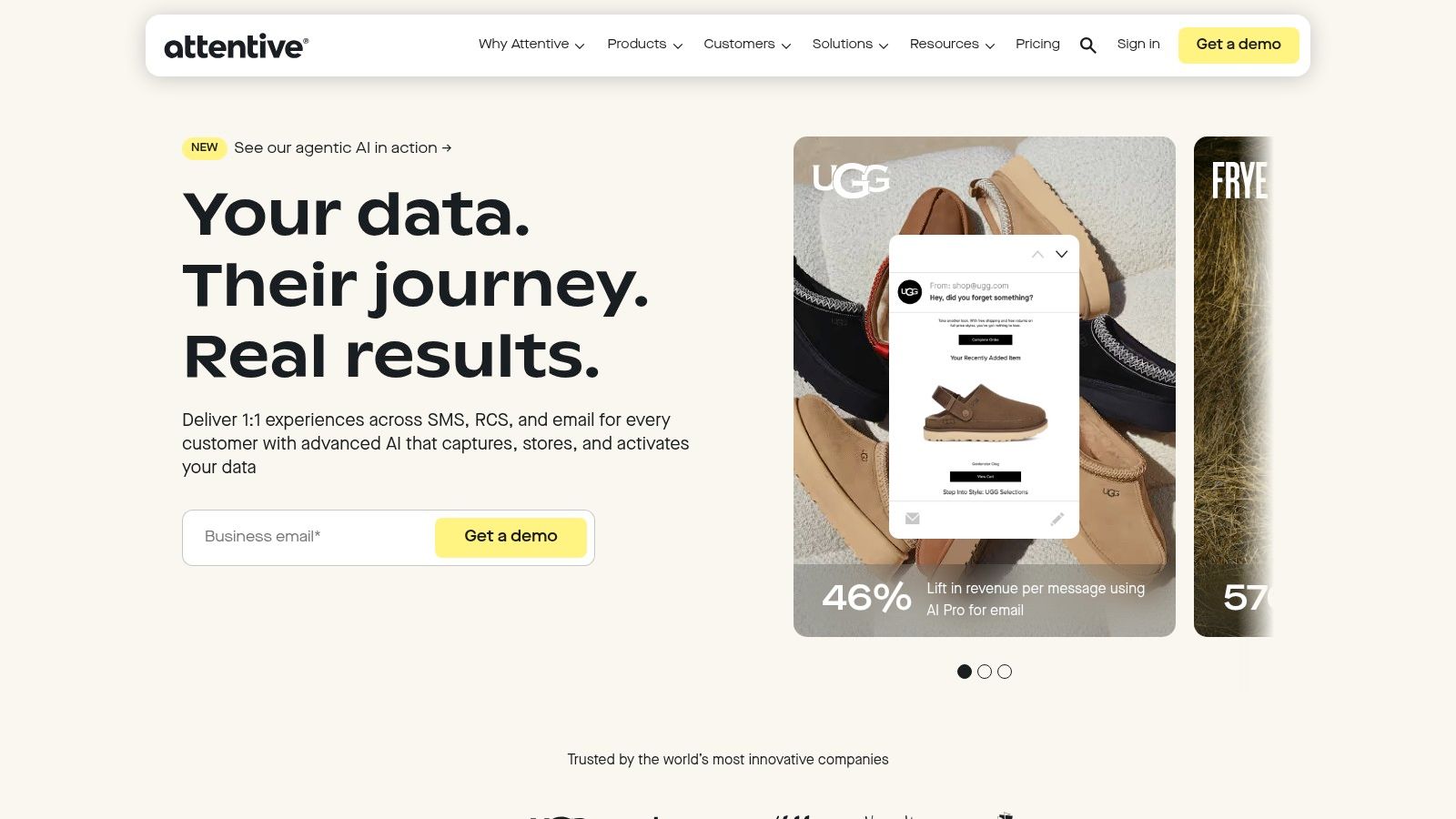
The system is built on SMS compliance and deliverability. Its AI layers then work to personalize the customer journey. It can identify anonymous visitors and send messages at the right moment.
Key Features & Use Cases
- AI-Powered Messaging: Use AI to generate campaign copy and A/B test different versions. Predictive sending delivers messages at each subscriber's optimal engagement time.
- AI Grow: This feature focuses on list growth with personalized on-site units. The AI can change pop-up offers based on a visitor's behavior.
- AI Journeys: Create 1:1 messaging flows that span SMS and email. This is a core part of building a solid email marketing automation strategy.
Pricing and Access
Attentive's pricing is primarily usage-based, tied to SMS volume and email contacts. AI features are bundled into different packages. This model requires brands to watch their ROI.
- Pros: Deep expertise in SMS compliance, powerful list growth tools, strong integrations with Shopify and Klaviyo.
- Cons: Usage-based SMS costs can add up quickly. Its email capabilities are newer compared to dedicated email providers.
Website: https://www.attentive.com/
12. Octane AI
Octane AI helps brands with AI-assisted product quizzes. It's a guided selling tool that captures zero-party data from your customers.
It asks questions about their needs and preferences. This is effective for categories like beauty, supplements, and pet products where advice is key.

The tool's strength is piping this data into your marketing stack, like Klaviyo. A quiz taker with "sensitive skin" can be added to a specific segment and get a tailored email flow. This makes Octane AI one of the best AI tools for ecommerce brands focused on deep personalization.
Key Features & Use Cases
- AI-Powered Quizzes: Build smart quizzes that recommend products based on customer answers. Embed them on your homepage or landing pages.
- Deep Klaviyo & Attentive Integration: Sync quiz responses to create hyper-segmented lists. This lets you trigger specific email and SMS flows.
- A/B Testing & Analytics: Test different quiz questions and designs to optimize completion rate. The dashboard provides clear analytics on performance.
Pricing and Access
Octane AI uses a tiered, credits-based model. Each quiz engagement consumes credits. The cost scales with your traffic and AI usage. The ROI is tied to how well your quiz converts browsers into buyers.
- Pros: Excellent for capturing high-intent data, works without custom code, pricing scales with engagement.
- Cons: ROI depends on a good quiz strategy, advanced AI features will increase costs.
Website: https://www.octaneai.com/
13. Klevu (now part of Athos Commerce)
For mid-market brands, Klevu offers an AI suite for site search, merchandising, and recommendations. It goes beyond basic search by using natural language processing to understand customer intent.
This connects shoppers with the right products faster. It's one of the best AI tools for ecommerce businesses that have outgrown their native platform's search.
Now part of Athos Commerce, Klevu gives merchandisers control. Its admin UI allows them to visually merchandise pages and adjust search rankings without needing developers.
Key Features & Use Cases
- AI-Powered Search: Klevu enriches product data and uses predictive autocomplete. It understands synonyms and personalizes search results.
- Visual Merchandising: Merchandisers can use a drag-and-drop interface to pin or boost products. This aligns with inventory goals or campaigns.
- Personalized Recommendations: Deploy smart recommendation carousels across the site, like "Frequently Bought Together."
- Key Integrations: Connects with Klaviyo to sync data and with review providers like Yotpo to display content in search.
Pricing and Access
Klevu offers transparent pricing tiers through its Shopify app. Plans start based on catalog size and search volume. This makes it accessible for growing brands. Custom pricing is available for larger businesses.
- Pros: Built for ecommerce product discovery, merchandiser-friendly admin panel, clear starting prices on Shopify.
- Cons: The recent rebrand to Athos Commerce could cause confusion; some integrations may have limitations.
Website: https://www.klevu.com/
Top 13 AI Tools for eCommerce — Feature Comparison
.tbl-scroll{contain:inline-size;overflow-x:auto;-webkit-overflow-scrolling:touch}.tbl-scroll table{min-width:600px;width:100%;border-collapse:collapse;margin-bottom:20px}.tbl-scroll th{border:1px solid #ddd;padding:8px;text-align:left;background-color:#f2f2f2;white-space:nowrap}.tbl-scroll td{border:1px solid #ddd;padding:8px;text-align:left}ToolCore featuresSpeed & user experiencePricing & valueBest for / TargetUnique selling pointNeedleAI+human marketing: connects Shopify, Klaviyo, Meta, Google, TikTok; auto weekly calendar; creative generationWeekly cadence; uncapped creative and unlimited revisions; 5-min approval flowFlat monthly fee: $2,999 (Growth), $3,999 (Scale), Custom for larger accountsDTC brands $1M–$10M; 5–50 person teamsHybrid AI automation + dedicated strategists — agency-style execution with a weekly learning loopOmnisendAll-in-one email & SMS marketing for ecommerce; AI content generation, pre-built automations, native ecommerce integrationsSingle dashboard for email, SMS & pop-ups; AI drafts full campaigns and subject lines in secondsFree plan available; paid tiers up to 35% cheaper than Klaviyo; free 5-day migration supportSmall ecommerce brands wanting Klaviyo-level features at a lower costKlaviyo-comparable feature set at a lower price point; native Shopify/BigCommerce/WooCommerce integrationsShopify Magic & Sidekick (Shopify)Store-aware assistant: analysis, task execution, copy, image edits, Inbox repliesNative in-Admin; instant store context and actionIncluded in Shopify tiers / product-dependent; reduces tool sprawlShopify merchants wanting native AI without extra vendorsZero-integration friction; in-store AI that can execute tasksKlaviyoEmail/SMS automation, predictive analytics, AI copy, send-time optimizationStrong deliverability; robust flow templates and reportingProfile-based pricing; free tier for small listsDTC brands focused on lifecycle & retention revenueDeep ecommerce data model and proven ROI from flowsAlgolia AI Search & DiscoveryAI ranking, synonyms, recommendations, personalization, connectorsFast, developer-optimized search; requires implementationTransparent self-serve pricing; costs scale with records/requestsStores needing best-in-class site search & discoveryHigh performance + A/B testing and merchandiser controlsBloomreach DiscoveryEnterprise AI search, merchandising, real-time personalizationReal-time personalization at scale; implementation-heavyEnterprise pricing (mid-market/enterprise fit)Large brands with complex catalogs & merchandising teamsAggregated ecommerce learnings + deep merchandiser analyticsNostoOn-site personalization, recommendations, merchandising, A/B testingRapid time-to-value with templates and integrationsModule-based pricing; mid-market positioningShopify / Shopify Plus DTC seeking full personalization suiteCommerce-specific toolkit blending visual & generative AIDynamic Yield (Mastercard)Personalization, experimentation, recommendations, custom modelsRobust experimentation and governance for scaleEnterprise pricing and services; heavier implementationEnterprise brands needing advanced modeling & testingIndustry-recognized experimentation + aggregated insightsRebuyAI upsells/cross-sells, Smart Cart, checkout/post-purchase offers, A/B testsPlug-and-play Shopify widgets; quick installsPricing scales with order volume and featuresMid-market Shopify merchants focused on AOV & LTVClear path to AOV lifts via checkout & post-purchase offersGorgias + AI AgentEcommerce helpdesk, AI agent for replies, order actions, revenue attributionOmnichannel inbox; AI handles common tickets and actionsTicket-based billing; AI priced per resolved interactionMerchants converting support into revenue (Shopify integr.)Deep Shopify/Klaviyo integrations turning support into revenueAttentiveSMS-first messaging, AI copy, predictive send, on-site personalizationMobile-first workflow; proven deliverability & complianceUsage-based SMS costs; modular AI tiersDTC brands prioritizing SMS & mobile list growthTwo-tap signups, Mobile ID, strong US SMS complianceOctane AIAI quizzes, guided selling, zero-party data capture, Klaviyo integrationNo-code quiz flows; quick to launch; credit-based usageCredits-based model; higher tiers for agentic featuresBeauty, fashion, supplements, pet — fit-driven categoriesHigh-intent zero-party data capture that feeds flows & segmentsKlevu (Athos Commerce)Product discovery: predictive autocomplete, 1:1 search & recs, merchandisingMerchant-friendly admin; Shopify app for faster setupTransparent starting tiers; mid-market positioningMid-market DTC needing merchandiser tools for searchVisual merchandising + merchandiser-first admin UX
Final Thoughts
You’ve seen the landscape. From Shopify Magic to Nosto, AI is no longer a "nice to have." It's a core part of the modern ecommerce stack.
But buying a subscription isn't the answer. The real challenge is making the tools work together. An AI search tool like Algolia is powerful. It becomes better when it learns from segments in Klaviyo. A service bot from Gorgias is more effective when it can see a customer’s purchase history.
The common thread is data. These tools run on data. A brand’s success hinges on connecting these data points into one journey. Without that, you just have a collection of expensive, isolated tools.
How to Choose the Right AI Tools
So, where do you start? The choice is paralyzing. As a founder, you don't have time for a dozen demos.
Here’s a simple framework:
- Identify Your Biggest Bottleneck: Are you spending too much time on product descriptions? Is your ad ROAS tanking? Find the tool that solves that problem first.
- Audit Your Current Stack: What do you already use? If you’re on Shopify, exploring Shopify Magic is a no-brainer. If you run on Klaviyo, find tools with deep integrations.
- Consider Your Team's Capacity: Be honest about your team’s skills. Some tools, like Dynamic Yield, require significant setup. Others, like Rebuy, are plug-and-play.
- Start Small and Measure: Pick one tool. Set a specific goal. (e.g., increase AOV by 5% with Rebuy). Run it for 30-60 days. Measure the result.
The goal isn't to use the most AI tools. It's to use the right ones. The best ai tools for ecommerce are the ones that solve your problems without adding complexity.
This tech should help you build a better business. It should free up your time to focus on brand and product. Choose wisely. You’ll build a brand that’s not just surviving, but thriving.
Frequently Asked Questions (FAQ)
What is the best AI for ecommerce marketing?
There is no single "best" tool. The right one depends on your biggest problem. For automating creative and strategy, Needle's hybrid model is strong. For retention marketing, Klaviyo's predictive analytics are powerful. For on-site conversions, Rebuy's AOV-focused widgets work well. Start by identifying your main bottleneck.
How can AI improve my Shopify store?
AI can help in many ways. Shopify Magic can write product descriptions and blog posts. Rebuy can increase your average order value with smart upsells. Gorgias can automate customer support answers. The key is integrating tools that solve specific issues, like low conversion rates or high support costs.
Are AI tools for ecommerce expensive?
Prices vary widely. Some tools like Shopify Magic are included in your existing plan. Others like Klaviyo have free starting tiers. More advanced systems like Dynamic Yield are enterprise-level investments. Focus on ROI. A tool that costs $500/month is cheap if it generates $5,000 in new revenue.
Do I need a developer to use these AI tools?
Not always. Many modern AI tools are built for marketers and founders. Tools like Rebuy, Klaviyo, and Octane AI are "low-code" or "no-code." They can be set up without a developer. However, more complex tools like Algolia or Dynamic Yield often require technical help for the initial setup and customization.
How do I measure the ROI of an AI tool?
Look for direct attribution. For example, Rebuy and Gorgias track the revenue generated through their widgets and support chats. For other tools, you may need to run A/B tests. Compare a period with the tool active against a period without it. Measure key metrics like conversion rate, AOV, or customer lifetime value.
Tired of juggling a dozen tools? Needle acts as your AI-powered operating system. It integrates your stack and gives you the strategic expertise of a seasoned operator. Stop guessing. Start executing with confidence. Visit Needle to see how we turn your tools into a cohesive growth engine.