
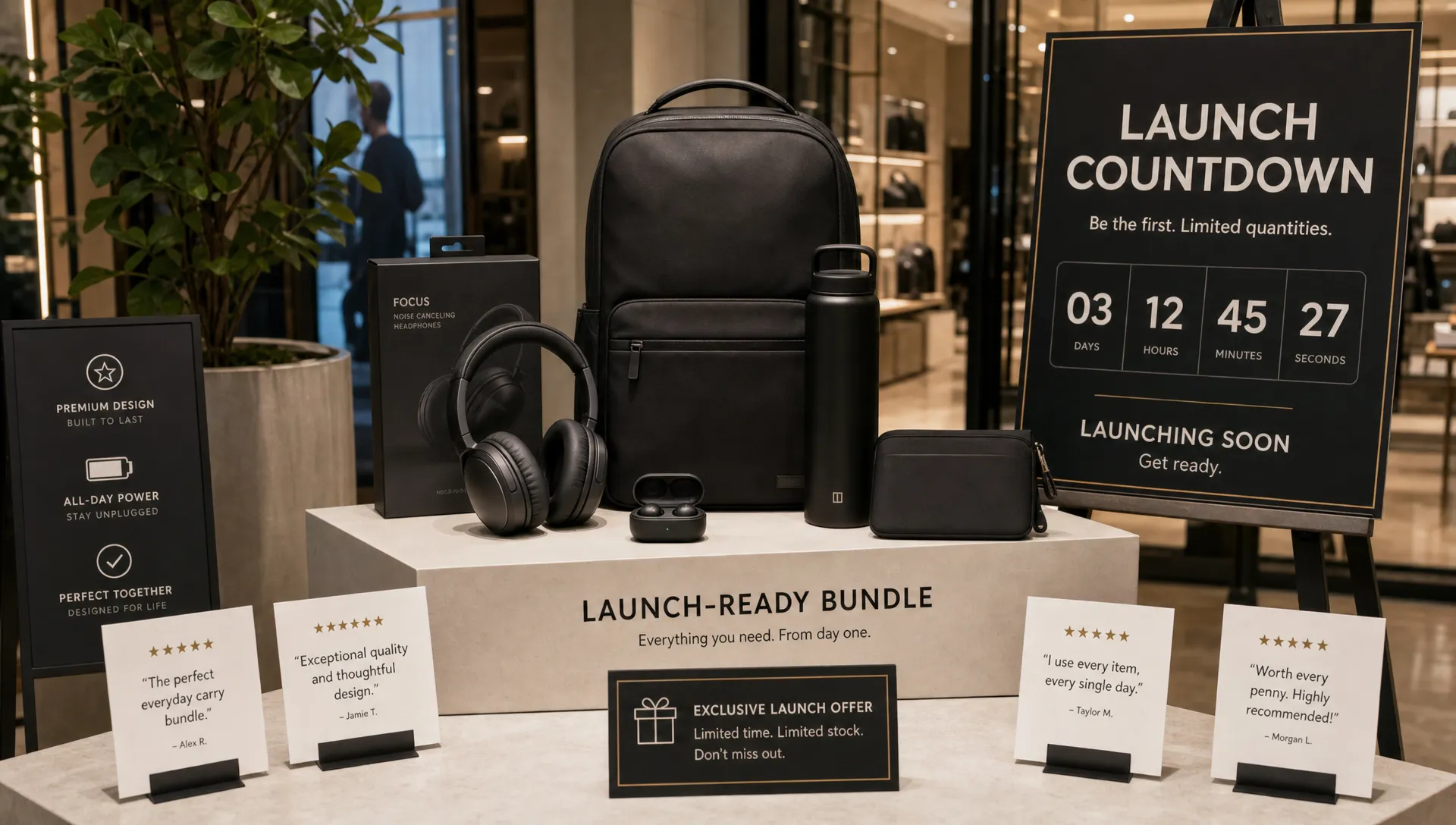
A successful launch campaign does not need to be loud, complicated, or built around the biggest discount you can afford. It needs a clear reason to care, a clear reason to buy now, and enough creative variation to keep your audience engaged across email, paid social, organic, SMS, and your site.
That is where strong promotional campaign ideas matter. The right promotion gives your next launch a shape. It tells your team what to say, what to create, which customers to prioritize, and how to measure whether the campaign actually worked.
Below are seven launch-ready ideas for ecommerce and DTC brands. Each one can be adapted for a new product, seasonal drop, limited collection, restock, subscription push, or brand refresh.
Before you pick an idea, define the launch job
Not every launch has the same goal. Some campaigns are built to sell out inventory quickly. Others are built to collect leads, validate a new product category, reactivate past buyers, or create proof before scaling paid spend.
Before choosing a promotion, answer three questions:
- Who is the campaign for: new prospects, VIP customers, past buyers, or a specific segment?
- What action matters most: joining a waitlist, buying on day one, increasing AOV, sharing with friends, or coming back after launch?
- What is the strongest incentive: access, savings, exclusivity, education, proof, personalization, or convenience?
If you are still building the broader launch structure, Needle’s guide to brand launch campaign ideas that actually work is a useful companion because it explains how to treat launch marketing as a system, not a one-off announcement.
Here is a quick way to match each promotional angle to a business goal.
Promotional campaign idea | Best launch goal                               | Primary incentive        | Main KPI
VIP early access          | Reward loyal customers and drive day-one sales | Exclusivity              | Revenue from VIP segment
Waitlist unlock           | Build demand before launch                     | Access or bonus          | Waitlist conversion rate
Launch bundle             | Increase AOV and simplify purchase decisions   | Value and convenience    | Average order value
Proof-first campaign      | Reduce buyer hesitation                        | Reviews, UGC, demos      | Conversion rate
Partner-led promotion     | Reach a new aligned audience                   | Trust transfer           | New customer acquisition
Deadline bonus            | Create urgency without deep discounting        | Time-limited added value | Sales by deadline
Post-launch use-case push | Extend momentum after launch week | Relevance | Repeat traffic and retargeting ROASA VIP early access campaign gives your best customers the first chance to buy before the full public launch. This works especially well when you have limited inventory, a loyal email list, a strong SMS audience, or a product that customers have requested for months.
The key is to make early access feel earned, not generic. Instead of saying “shop early,” frame it around the customer relationship: “You asked for this first,” “our community gets first pick,” or “past customers get 24-hour access before everyone else.”
A simple structure works well. Send a teaser three to five days before launch, open early access for 12 to 24 hours, then follow with a public launch once VIP demand has been captured. If inventory is limited, say so clearly. If sizes, colors, flavors, or bundles are likely to sell through, make that visible in your product page and email copy.
This campaign does not need a discount. In many cases, early access is the offer. If you do add an incentive, keep it light: free shipping, a small gift, loyalty points, or a first-pick bonus.
Measure VIP conversion rate, revenue per recipient, sell-through by SKU, and the number of customers who buy before the general launch. These numbers help you forecast future drops more accurately.
2. Waitlist unlock with a shareable milestone
A waitlist campaign turns pre-launch interest into measurable demand. It is especially useful when you are launching something new and want proof before investing heavily in paid ads.
The basic idea is simple: people join the waitlist, then unlock a benefit when they take another action. That action might be referring a friend, answering a product preference question, joining SMS, or choosing their favorite variant.
The best waitlist promotions do more than collect emails. They teach you what the market wants. For example, a skincare brand could ask waitlist subscribers to choose their main concern. A supplement brand could ask about routines. A fashion brand could let people vote on a colorway. This turns the campaign into both a demand engine and a research tool.
Your unlock does not have to be expensive. It could be a launch-day reminder, early access, a bonus sample, entry into a giveaway, or access to a limited bundle. The important part is that the reward feels tied to the launch, not randomly attached.
If your team is moving fast, a compressed plan like Needle’s launch campaign in a week can help you sequence the landing page, emails, ads, and creative assets without overcomplicating the build.
3. Launch bundle that solves the “what should I buy?” problem
A launch bundle is one of the most practical promotional campaign ideas because it increases perceived value while reducing decision fatigue. Instead of asking shoppers to compare every product or variant, you present a curated set that feels like the easiest path to the outcome they want.
Bundles work particularly well for products with complementary use cases: skincare routines, supplements, apparel sets, home goods, pet care kits, food and beverage samplers, or accessories.
The best launch bundles have a clear theme. Avoid vague names like “Launch Pack” if you can make the outcome more specific. “The 7-Day Reset Kit,” “The Office-to-Weekend Set,” “The First-Time Routine,” or “The Summer Travel Bundle” tells the customer why the combination exists.
You can also use bundles to protect margin. Instead of offering a blanket 25 percent discount on everything, create a bundle with a lower effective discount, a gift-with-purchase, or a limited bonus item. The shopper still feels they are getting a special launch offer, but you are not training your entire audience to wait for sitewide markdowns.
Track bundle attachment rate, AOV, gross margin, and return rate. A bundle that sells well but drives returns may need clearer product education or better expectation-setting.
4. Proof-first campaign using testers, creators, or early customers
Many launches underperform because brands spend too much time announcing the product and not enough time proving why it matters. A proof-first campaign flips the order. Before asking for the purchase, you show real use, real reactions, and real reasons to believe.
This can be done with beta testers, creator seeding, customer panels, founder demos, before-and-after content, comparison posts, unboxing videos, or live Q&A. The format depends on the product, but the strategy is the same: answer the objections your audience will have before they say them out loud.
For a beauty brand, proof might be texture shots, application videos, and customer routines. For an apparel brand, it might be fit videos on different body types. For a food brand, it might be taste tests and recipe use cases. For a tech accessory, it might be a simple demonstration that shows the product solving a daily annoyance.
The campaign works best when you collect proof before launch week. Then you can turn that proof into paid ads, product page modules, email blocks, SMS snippets, and organic posts.
5. Partner-led promotion with a brand your audience already trusts
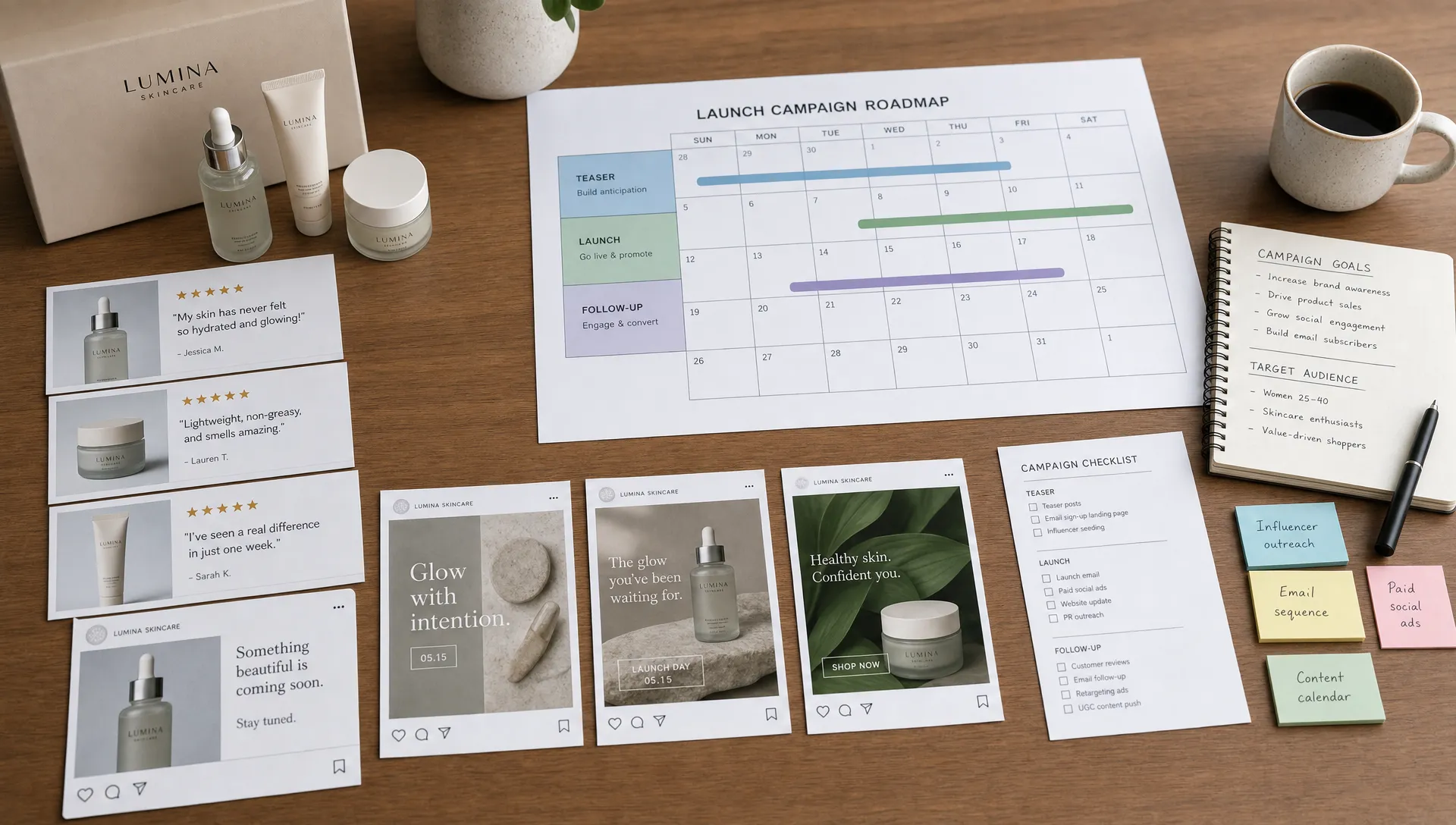
A partner-led launch campaign lets you borrow trust from a complementary brand, creator, expert, community, or publisher. This is not the same as a generic influencer post. The goal is to create a promotion that makes sense for both audiences.
For ecommerce brands, good partners often sit adjacent to the product rather than directly inside the same category. A hydration brand might partner with a fitness coach. A travel accessory brand might partner with a packing newsletter. A coffee brand might partner with a productivity creator. If you sell a product that supports learning, productivity, or career development, pairing a launch with useful resources from a platform like MindMesh Academy’s certification exam prep tools can make the promotion feel helpful instead of purely transactional.
The strongest partner campaigns have a clear shared concept. Examples include a co-branded giveaway, a limited routine, a challenge, a bundle insert, a bonus guide, or a live event. The promotion should give both audiences a reason to participate now.
Make tracking easy. Use dedicated landing pages, partner-specific codes, UTM links, and post-purchase survey options. Measure not only sales, but also email signups, customer quality, refund rate, and repeat purchase behavior from that partner audience.
6. Deadline-based bonus instead of a bigger discount
Urgency works, but only when it is credible. A deadline-based bonus gives shoppers a reason to act during the launch window without forcing you into aggressive discounting.
Instead of “20 percent off this week only,” consider “order by Friday and receive the launch bonus,” “first 500 orders get the limited add-on,” or “buy during launch week to access the founder’s setup guide.” The bonus can be physical, digital, experiential, or service-oriented.
This is especially useful for premium brands that want to maintain price integrity. The customer gets more value, while the core product price stays intact.
A strong deadline campaign needs clear communication. Put the deadline in your email subject lines, site banner, product page, cart, SMS, and retargeting ads. If the bonus is limited by quantity, update the audience as inventory decreases. If it is limited by time, avoid extending it casually, because repeated fake urgency weakens trust.
The most important metrics are conversion rate by day, sales velocity, bonus redemption rate, and margin impact. If the final 24 hours drive a large share of sales, you may want to build stronger countdown creative for future launches.
7. Post-launch use-case campaign to keep momentum alive
Launch week is not the end of the campaign. It is the point where you finally have fresh data: who clicked, who bought, who almost bought, which objections appeared, which creative worked, and which use cases resonated.
A post-launch use-case campaign turns that data into a second wave of promotion. Instead of repeating “new product just launched,” segment your follow-up around specific customer needs.
For example, a home goods brand might create separate ads and emails for small apartments, gifting, and family organization. A supplement brand might segment by morning routines, gym recovery, or travel. An apparel brand might promote the same launch through workwear, weekend styling, and holiday outfits.
This is where email becomes especially valuable. Browse abandoners, cart abandoners, past buyers, and non-clickers should not all receive the same message. If you need inspiration for the lifecycle side of the launch, Needle’s guide to email marketing campaign examples DTC founders actually use can help you map follow-up flows around real customer behavior.
Your goal is to extend the revenue curve after the initial announcement spike. Track returning visitor conversion rate, retargeting performance, email revenue by segment, and the winning use cases that should become evergreen campaigns.
How to choose the best campaign for your next launch
The best idea is not always the most creative one. It is the one that matches your audience, margin, inventory, and timeline.
If your list is warm and loyal, start with VIP early access. If your audience is cold, build proof before pushing urgency. If your product has several use cases, plan the post-launch segmentation before launch day. If your team is short on time, choose one strong promotional mechanic and execute it cleanly across every channel.
A simple launch stack often looks like this:
Launch phase | What to run                               | What to create
Pre-launch   | Waitlist, teaser, partner preview         | Landing page, teaser emails, short-form videos
Launch day   | VIP access, bundle, bonus deadline        | Product page updates, launch email, paid ads, SMS
Launch week  | Proof-first content and urgency reminders | Reviews, demos, objection-handling creative
Post-launch | Use-case retargeting and segmented email | New angles, customer stories, replenishment offersCommon launch promotion mistakes to avoid
The first mistake is making the discount the entire campaign. Discounts can help, but they rarely explain why the product matters. Pair every offer with a story, use case, proof point, or customer problem.
The second mistake is creating only one version of the message. A launch campaign needs multiple angles because different customers buy for different reasons. One person cares about convenience, another cares about ingredients, another cares about gifting, and another needs social proof.
The third mistake is waiting until launch day to produce creative. Your campaign should have assets ready for teaser, launch, urgency, objection handling, and post-launch follow-up. That does not mean you need a giant production budget. It means you need the right messages in the right formats.
The fourth mistake is failing to capture learnings. After the launch, document which subject lines, hooks, bundles, audiences, and offers performed best. Those insights should shape your next campaign, not disappear into a dashboard no one revisits.
Frequently Asked Questions
What makes a promotional campaign successful for a launch? A successful launch promotion combines a clear audience, a compelling reason to buy, a time-sensitive incentive, strong creative, and measurable follow-up. The offer matters, but the message and execution matter just as much.
Do I need to offer a discount for my next launch? No. Many strong launch campaigns use early access, bonuses, bundles, gifts, limited editions, partner perks, or exclusive content instead of discounts. This can protect margin while still giving customers a reason to act quickly.
How early should I start promoting a launch? For most ecommerce launches, start teasing one to three weeks before launch day. A shorter timeline can still work if your audience is warm and your offer is simple, but you need enough time to build anticipation and create assets.
Which channels should I use for a launch promotion? Email, SMS, paid social, organic social, your website, and retargeting are the core channels for most DTC launches. The right mix depends on where your audience already engages and which channels have historically driven revenue.
How do I know which promotional campaign idea to choose? Start with your main constraint. If you need demand, use a waitlist. If you need urgency, use a deadline bonus. If you need trust, use proof-first content. If you need higher AOV, use a bundle.
Turn your next launch into a repeatable growth system
A good launch should produce more than short-term sales. It should give you sharper positioning, better creative, stronger audience segments, and learnings you can use in the next campaign.
Needle helps ecommerce brands move from idea to execution faster by generating tailored marketing ideas, creating on-brand assets, publishing content directly, automating campaign workflows, tracking results, and turning performance into actionable learnings.
If your team wants to launch more often without adding agency bloat or juggling more freelancers, Needle can help you build, ship, and optimize campaigns with a tighter weekly rhythm.