

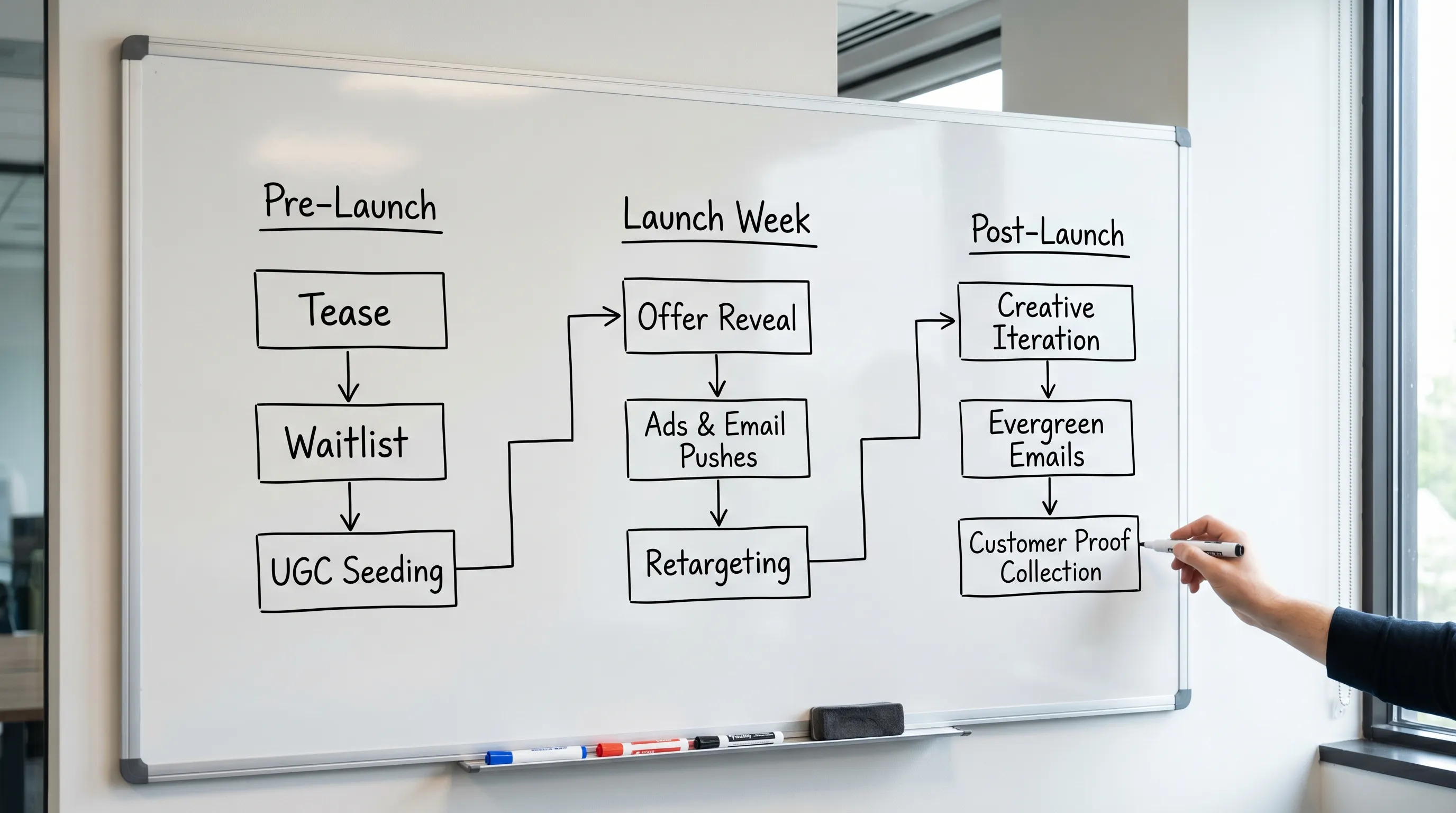
Most brand launches fail for the same unsexy reason: the team treats “launch” like a single post, a single email, or a single ad set. Real launches are a system: pre-launch demand creation, launch-week demand capture, and a post-launch learning loop that turns your first 30 days into an evergreen acquisition engine.
Below are brand launch campaign ideas that actually work for ecommerce brands, plus how to deploy them across ads, email, and organic without creating a messy, one-off sprint you can’t repeat.
What makes a launch campaign idea “work” (in ecommerce)
A launch idea is only as good as the behavior it drives. In DTC, that usually means one of four things:
- Qualified attention (the right people stop scrolling)
- Signal capture (email/SMS opt-in, quiz completion, waitlist signup)
- First purchase (with a clean offer and low-friction checkout)
- Repeatable learnings (angles and creatives you can keep running)
When a “cool launch” underperforms, it’s often because it optimized for vibes: views, likes, PR mentions, or a spike that doesn’t convert.
Before you choose campaign ideas: 5 launch foundations to lock
You do not need a 40-slide launch plan. You need these five basics.
1) A single, sharp value proposition
If you can’t finish this sentence, your campaign ideas will be random:
“We help [specific person] get [specific outcome] without [specific pain].”
Write it in plain language, then use it as the source material for every hook, subject line, and landing page headline.
2) One primary conversion goal per phase
Pick the “one metric that matters” for each phase:
- Pre-launch: email/SMS signups (or quiz completions)
- Launch week: purchases (or first orders for a specific SKU)
- Post-launch: blended efficiency and retention (MER, CPA, repeat rate, email revenue)
3) An offer that is not just a discount
Discounting can work, but it’s rarely your best first lever. Strong launch offers usually look like:
- Early access window
- Limited bundle (value add)
- Gift with purchase (margin-friendly)
- Limited edition colorway/scent/flavor
- Founder’s guarantee (risk reversal)
4) Landing page alignment (ad scent)
Your best creative will still lose if the page does not immediately confirm:
- Who it’s for
- What it does
- Why it’s different
- What to do next
5) Operational readiness (inventory and systems)
If your launch can cause stockouts, delayed shipping, or customer support overload, fix that before you pour gas on acquisition. For larger brands with more complex ops (multi-warehouse, wholesale, subscriptions, NetSuite), tightening integrations and automation can be a launch lever in itself. If you’re in that mid-market zone, it can be worth talking to an AI and NetSuite consulting partner to reduce “launch chaos” across ERP, ecommerce, and marketing systems.
Brand launch campaign ideas (by what they’re meant to accomplish)
Use these like building blocks. The best launches combine 2–3 ideas in pre-launch, 2–3 in launch week, then keep 1–2 running as evergreen campaigns.
1) The “Problem First” teaser series (ads + email)
Instead of teasing your product, tease the problem moment your customer recognizes instantly.
Why it works: People buy solutions, but they stop scrolling for problems they feel.
How to run it:
- Create 3–5 short videos (10–20 seconds) that show the frustration, the failed alternatives, and the “this shouldn’t be so hard” moment.
- Drive to a waitlist or “notify me” page (pre-launch), then retarget engagers on launch day.
Example angles:
- Beauty: “Why does my makeup separate by noon?”
- Apparel: “The ‘I have nothing to wear’ closet, but it’s full.”
- Home: “The kitchen tool drawer that hates you back.”
2) The waitlist that gives a real reason to join
“Join our waitlist” is not a reason.
A waitlist converts when it answers: What do I get for raising my hand early?
High-performing waitlist hooks:
- Early access (24–72 hours)
- First dibs on limited inventory
- Founder’s pricing for the first batch
- VIP bundle only for waitlist
Execution tip: Add a post-signup page that asks one question (“What are you trying to solve?”). Those answers become your best ad copy and FAQ language.
3) The “Beta customers” micro-launch (small, then loud)
Run a controlled early cohort (50–300 customers) and treat it like a productized beta.
Why it works: You trade a slightly smaller day-one spike for stronger conversion assets: reviews, testimonials, UGC, and objections.
What to ship with it:
- A beta-only onboarding email sequence
- A simple feedback form after delivery
- A clear ask for UGC (“record a 15-second before/after or unboxing”)
Then your public launch is powered by proof, not promises.
4) The creator “embargo drop” (UGC seeding that looks coordinated)
Send product to creators early, with a clear posting window (an “embargo”) so content lands around the same 48–72 hours.
Why it works: The algorithm loves concentrated bursts, and your brand looks “everywhere” quickly.
How to make it perform (not just look good):
- Give creators one job (demo, comparison, routine, unboxing)
- Require a strong first 2 seconds (hook)
- Ask for raw footage rights so you can cut paid versions
If you can’t afford big creators, prioritize many small creators with strong on-camera clarity.
5) The “Founder POV” narrative launch
This works best when your differentiator is mission, method, or obsession.
Creative concept: The founder explains the “why,” but anchors it in a customer pain, not personal biography.
Where it wins:
- Paid social (UGC-style founder video)
- Welcome emails (origin story + proof)
- Product page hero section
What to test:
- “I built this because…” vs “I built this after watching customers…”
- “Here’s what we changed” vs “Here’s what we removed” (simplicity sells)
6) The launch quiz (segmentation plus conversion)
A quiz is one of the most reliable launch mechanics because it turns cold traffic into first-party data.
Why it works: It gives shoppers a reason to engage before they trust you, and it personalizes the offer.
Launch quiz examples:
- Skincare: “Find your routine in 60 seconds”
- Coffee: “Find your roast profile”
- Pet: “What’s your dog’s daily needs stack?”
Critical detail: Your quiz results page should recommend a specific SKU or bundle and capture email/SMS before showing the final answer (or offer a “send results” option).
7) The “limited bundle” launch (value-add instead of margin burn)
If you only have one hero SKU, your launch is fragile. Bundles create a second reason to buy now.
Bundle formats that convert in launches:
- Starter kit (hero product + accessory)
- “Complete routine” (3-step system)
- Two-pack with a friend angle
- Seasonal limited pairing
Why it works: You increase AOV, simplify decision-making, and create urgency without training customers to wait for 20% off.
8) The retargeting sequence that matches intent (not one generic ad)
Most brands run one retargeting ad that says “Still thinking?” and call it a funnel.
Instead, match retargeting creative to what the user did:
- Viewed product: hit them with benefits + proof
- Added to cart: remove risk (shipping, guarantee, returns)
- Engaged with video: continue the story, then present the offer
Best practice: Rotate 3–5 creatives in retargeting during launch week to prevent fatigue and to learn which objections actually matter.
9) The “launch week content stack” (one message, many formats)
This is the fastest way to look bigger than you are.
Pick one core message for the week (for example, “the only X that solves Y without Z”), then publish it in multiple formats:
- 2–3 paid videos (different hooks, same claim)
- 1 product demo carousel
- 1 creator testimonial cut
- 2–4 emails (tease, open cart, last call, proof)
- Daily organic short-form (behind the scenes, FAQs, packaging, use cases)
Why it works: Consistency drives recall. Variation drives performance.

10) The post-launch “evergreen conversion engine” (the idea most brands skip)
The best launches do not end. They become evergreen.
Within 7–14 days after launch, identify:
- Your top 2–3 winning hooks
- Your best-performing creator clip
- Your highest-converting offer framing
Then convert them into:
- An evergreen prospecting campaign
- A welcome series refresh (built around the winning angle)
- A recurring weekly email theme that is not promotional (education, routines, use cases)
This is how you avoid the common launch cycle: spike, crash, panic discounting.
A simple way to choose the right ideas (without doing everything)
If you’re a small team, pick based on your constraint:
If you lack attention
Choose:
- Problem-first teaser ads
- Creator embargo drop
- Founder POV narrative
If you lack trust
Choose:
- Beta customers micro-launch
- Proof-first retargeting
- Quiz with personalized recommendation
If you lack urgency
Choose:
- Limited bundle
- Early access waitlist
- Gift with purchase
Where Needle fits (when you want speed without agency bloat)
Launches are execution-heavy: you need angles, creatives, emails, and a weekly optimization rhythm. Needle is built for that kind of work.
Needle connects to your tools, generates tailored campaign ideas, creates on-brand creative assets, and can publish directly to platforms. You stay in control by approving what goes live, then Needle executes and tracks results so each week gets smarter.
Frequently Asked Questions
How early should I start a brand launch campaign? Most ecommerce brands benefit from 2–4 weeks of pre-launch (list building + creative testing), then a focused 7–10 day launch push, then a 30-day optimization loop.
What’s the best launch offer if I don’t want to discount? Early access, limited bundles, and gifts with purchase usually outperform blanket discounts because they add urgency without training customers to wait for sales.
How many ads should I launch with? A practical starting point is 3–6 distinct creatives (different hooks) and 2–3 versions of primary text. You’re trying to learn fast, not perfect everything.
Should I focus on email or ads for a launch? Both, but for different jobs. Ads create demand and bring new people in. Email converts the demand you already captured and lets you control frequency and messaging.
What should I measure during launch week? Prioritize purchases and efficiency metrics (CPA, MER, conversion rate) and monitor creative signals (CTR, thumb-stop rate) to decide what to scale and what to cut.
Launch faster, and keep what works
If you want to run a launch without juggling freelancers, ad hoc briefs, and endless revisions, Needle can help you turn these ideas into a repeatable system. Connect your stack, get campaign concepts and creatives tailored to your brand, approve what you like, and let Needle handle execution and weekly optimization.
Explore Needle at askneedle.com.