

AI driven marketing only matters if it moves revenue. Generating ten campaign ideas in a chat window is useful, but it does not lower CAC, improve MER, or make your next product drop profitable by itself.
For ecommerce brands, the real advantage is the operating system behind the idea: connect customer data, generate campaign concepts, turn them into on-brand assets, publish quickly, measure results, and feed the learnings back into the next round.
That is the difference between “using AI” and building an AI driven marketing engine.
What AI driven marketing actually means
AI driven marketing is the use of artificial intelligence to make marketing decisions and execute campaigns based on real business data, not guesswork. It can help with ideation, segmentation, creative production, publishing, reporting, and optimization.
The key phrase is based on real business data.
A generic AI prompt can produce generic ideas. A true AI marketing workflow uses inputs like:
- Product margins and inventory constraints
- Shopify customer behavior and purchase history
- Email engagement and customer segments
- Meta, Google, TikTok, or other ad performance data
- Brand voice, visual rules, offers, and past creative winners
- Business goals such as CAC, MER, AOV, retention, or contribution margin
This is why the best AI driven marketing systems do not start with “write me an ad.” They start with “what growth problem are we solving this week?”
For a founder, that might mean turning a slow-moving SKU into a bundle campaign. For a marketer, it might mean refreshing Meta creative before fatigue hits. For an email lead, it might mean identifying a segment of one-time buyers who should receive a reorder campaign instead of another blanket discount.
The idea-to-ROI loop
Most marketing teams do not have an idea problem. They have an execution and learning problem.
Ideas sit in docs. Creative waits on freelancers. Campaigns launch late. Reporting happens after the insight is already stale. Then the next campaign starts from scratch.
AI driven marketing works best when you treat every campaign as a loop.
Step 1: Start with one business problem
The fastest way to waste AI is to ask it for broad ideas without a commercial target.
A better starting point is one measurable problem, such as:
- New customer CAC is too high
- Returning customer revenue is down
- AOV is flat despite strong traffic
- Email revenue depends too heavily on discounts
- Paid social creative is fatiguing after seven days
- A product launch needs demand before inventory lands
This forces the AI to generate ideas inside useful constraints. Instead of “give me campaign ideas for skincare,” the brief becomes: “Generate retention campaign ideas for customers who bought a cleanser once but have not purchased again in 60 days. Goal: increase repeat purchase rate without using a sitewide discount.”
That difference matters. One prompt creates content. The other creates a revenue hypothesis.
Step 2: Feed the system useful inputs
AI output is only as strong as the inputs behind it. In ecommerce, the most useful inputs usually live across disconnected tools: Shopify for orders, Klaviyo for email behavior, Meta for ad performance, analytics tools for traffic and conversion, and internal brand docs for positioning.
At minimum, your AI marketing workflow should understand:
- Who the customer is
- What they bought or considered
- Which products have margin room
- Which offers are allowed
- Which creative angles have worked before
- Which channels are active
- What KPI defines success
This is also where data hygiene matters. If product names are inconsistent, UTM tracking is messy, customer segments are stale, or ad naming conventions are chaotic, the AI may still produce assets, but it will struggle to produce accurate recommendations.
For more examples of how companies can apply AI across marketing maturity levels, this practical guide to AI in marketing use cases for SMEs is a useful companion read.
Step 3: Turn ideas into campaign hypotheses
An AI-generated idea is not ready to launch until it becomes a testable hypothesis.
A strong campaign hypothesis has five parts: audience, promise, proof, asset, and KPI.
For example, a weak idea would be: “Run a summer sale campaign.”
A stronger hypothesis would be: “If we target recent email clickers who viewed linen products but did not purchase, with a comfort-first summer styling angle and UGC proof, we can improve email revenue per recipient and lower retargeting CPA.”
Now the campaign has shape. The team knows who it is for, why it should work, what creative angle to build, and how to judge the result.
This is where AI can be especially powerful. It can generate multiple angles from the same insight, such as:
- Problem-solution angle
- Founder-led story angle
- Social proof angle
- Comparison angle
- Education-first angle
- Bundle or value angle
The marketer’s job is not to accept every idea. It is to choose the hypotheses most likely to move the business.
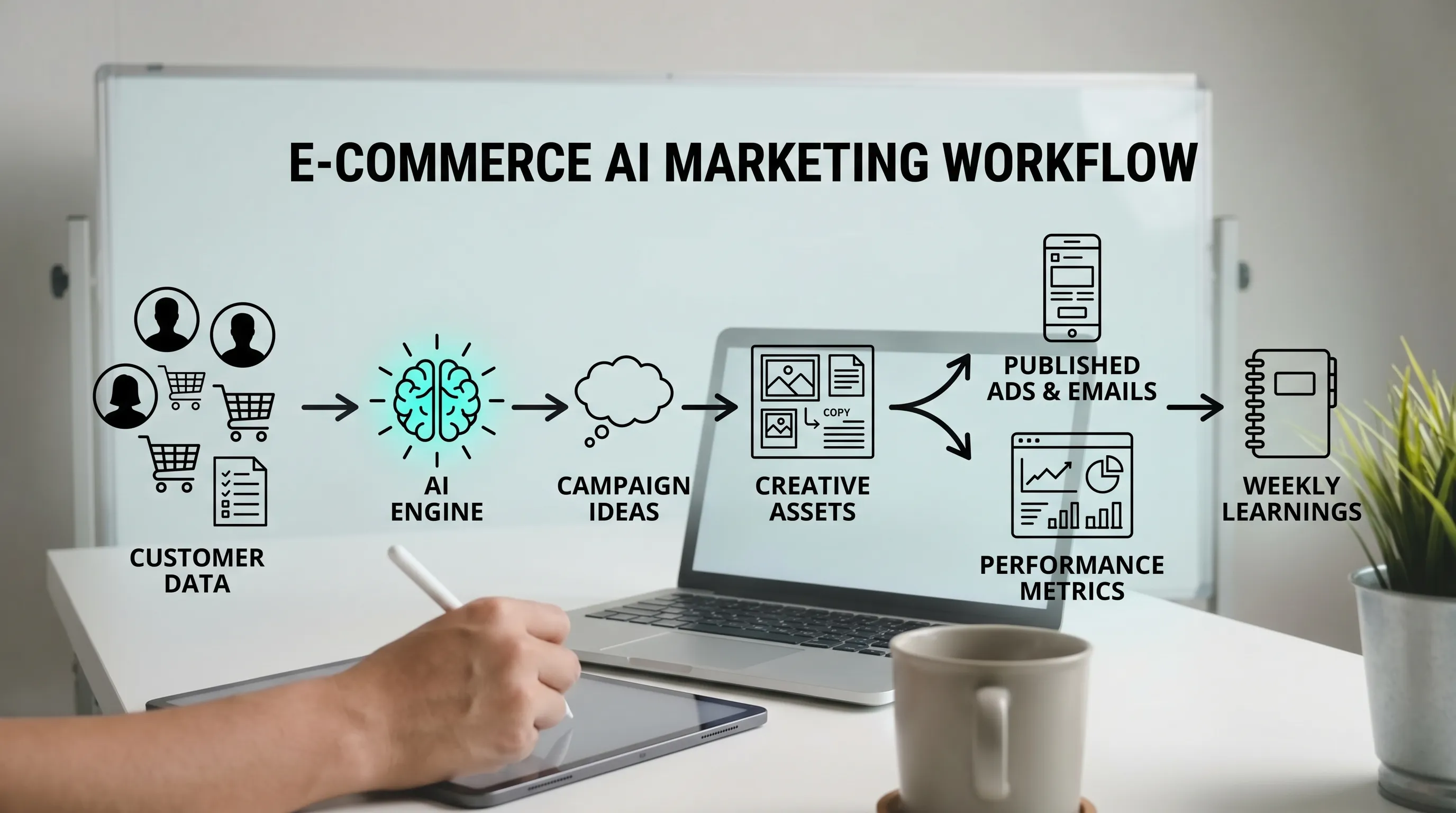
Step 4: Produce assets without losing brand control
Creative velocity is one of the clearest benefits of AI driven marketing. Instead of waiting weeks for one polished concept, teams can generate multiple on-brand versions of ads, emails, videos, and campaign copy quickly.
But speed without guardrails creates another problem: inconsistent brand voice.
Before AI creates assets, it needs clear rules. These should include your tone of voice, product claims, visual style, forbidden phrases, discount rules, compliance limits, and examples of strong past campaigns.
Human review still matters. The strongest teams use AI to produce the first 70 percent faster, then rely on human judgment for positioning, taste, claims, and final approval.
That approval layer is not a bottleneck. It is how you keep the brand intact while scaling output.
Step 5: Publish quickly and keep the workflow tight
The ROI gap often appears between “asset approved” and “campaign live.”
A small ecommerce team might create a strong campaign concept, then lose days exporting files, resizing creative, writing captions, uploading ads, checking links, building emails, QAing flows, and coordinating approvals across tools.
AI driven marketing should reduce that drag. The goal is not just asset generation. The goal is campaign execution.
A modern workflow should help move from brief to live campaign with fewer handoffs. That means generating tailored assets, adapting them by channel, publishing to platforms where possible, and keeping the team focused on decisions rather than repetitive production tasks.
This is where all-in-one systems can outperform a pile of disconnected AI tools. A copy tool, image tool, reporting dashboard, and automation app may each help individually, but the real leverage comes when the workflow is connected.
Step 6: Measure ROI with the right scorecard
A campaign that gets clicks but loses money is not a win.
To connect AI driven marketing to ROI, you need a scorecard that goes beyond surface metrics. CTR, open rate, and engagement can help diagnose creative fit, but they do not prove profitable growth.
For ecommerce brands, the core scorecard should include:
- Revenue from the campaign, segment, or channel
- Gross profit after product costs, shipping, discounts, and fees
- CAC or CPA for new customer acquisition
- ROAS for channel-level ad performance
- MER for blended efficiency across the business
- AOV to understand order quality
- Repeat purchase rate and LTV to measure long-term value
- Revenue per recipient for email and SMS campaigns
- Creative fatigue signals such as rising frequency, falling CTR, or climbing CPA
If you are calculating return manually, use profit-aware math whenever possible. Revenue-based ROI can make campaigns look healthier than they are. A campaign with strong sales but deep discounts, high shipping cost, or low-margin products may not be profitable.
Need a deeper breakdown? Needle’s guide on how to calculate marketing ROI walks through the founder-level math in more detail.
Step 7: Turn results into next week’s campaign
The learning loop is where AI driven marketing compounds.
After a campaign runs, the question should not be “did it work?” The better question is “what did we learn that changes next week’s action?”
A useful post-campaign review should identify:
- Which audience responded best
- Which hook drove qualified traffic
- Which offer improved conversion without hurting margin
- Which product angle produced higher AOV
- Which asset format should be scaled, cut, or remixed
- Which objections appeared in replies, comments, or support tickets
Those learnings should become the next brief. If a founder-led video lowered CPA, turn that script into email copy, landing page sections, and retargeting creative. If a bundle email improved AOV, test the same value stack in paid social. If a specific objection kept appearing, create a proof-led campaign around it.
This is how AI moves from a content assistant to a growth system.
Where AI creates the most leverage
AI does not need to own every part of marketing to create ROI. It creates the most value when it removes bottlenecks from repeatable, data-heavy work.
Campaign ideation
AI can scan customer behavior, product trends, and past performance to suggest campaign angles your team might miss. Instead of brainstorming from scratch, you start with data-backed options.
Creative variation
Paid social performance depends heavily on creative testing. AI can create variations of hooks, headlines, product visuals, UGC scripts, and calls to action so teams can test more ideas without increasing headcount.
Email and retention campaigns
For many ecommerce brands, email is one of the highest-ROI channels, but it is often underused because campaigns take time to plan and build. AI can help turn segments into specific campaigns, adapt messaging by customer stage, and repurpose winning ad angles into inbox-ready content.
Workflow automation
The hidden cost of marketing is coordination. AI can reduce repetitive tasks like brief writing, resizing, copy adaptation, reporting, campaign QA, and weekly recommendation summaries.
Reporting and learnings
Dashboards show what happened. AI can help explain what changed, why it matters, and what to do next. That is especially valuable for founders who do not have time to dig through every platform each week.
For a broader operating model, see Needle’s guide to AI driven marketing automation.
Common mistakes that kill ROI
AI can make good marketing faster, but it can also make bad marketing louder. These are the most common failure points.
Chasing output instead of outcomes
More ads, more emails, and more posts are not automatically better. If assets are not tied to a business goal, AI simply increases noise.
Using vague prompts
“Write an ad for my product” will produce generic creative. Strong prompts include the audience, product truth, customer objection, proof point, offer, channel, format, and KPI.
Ignoring margins
AI may recommend campaigns that increase revenue but hurt profit if it does not understand contribution margin, discount limits, shipping cost, or product economics.
Trusting platform ROAS blindly
Meta, Google, Klaviyo, and Shopify may each tell a different story. Platform attribution is useful, but it should be checked against blended metrics like MER, CAC, and gross profit.
Skipping human approval
AI can move quickly, but ecommerce brands still need humans to approve claims, protect taste, check legal risk, and make strategic tradeoffs.
Treating AI as a one-time setup
AI driven marketing is not “set it and forget it.” It needs a weekly cadence of review, approval, launch, measurement, and optimization.
A simple 30-day rollout plan
If your team is starting from scratch, do not try to automate everything at once. Start with one channel, one goal, and one repeatable workflow.
Week 1: Choose the ROI target
Pick one primary metric. For acquisition, that might be CAC, CPA, or MER. For retention, it might be repeat purchase rate, revenue per recipient, or LTV. Audit the data sources that influence that metric and clean the obvious issues first.
Week 2: Generate campaign hypotheses
Use your customer, product, and performance data to create a short list of campaign ideas. Turn each idea into a hypothesis with a target audience, message, offer, channel, and KPI.
Week 3: Build and launch assets
Create the first campaign kit. For ecommerce, that might include Meta ad variations, an email campaign, a short video script, product page copy blocks, and retargeting creative. Keep the test controlled so you can understand what changed.
Week 4: Review and repeat
Measure results against the original KPI. Do not only ask what won. Ask why it won, where it should be reused, and what the next test should be.
By the end of 30 days, your team should have a repeatable loop, not just a folder full of AI-generated assets.
How Needle helps teams go from idea to ROI
Needle is built for ecommerce brands that need marketing execution without agency bloat. It connects to your existing tools, generates tailored marketing ideas, creates on-brand creative assets, publishes directly to platforms, tracks results, and turns performance into actionable learnings.
That means your team is not stuck stitching together strategy docs, freelancers, AI tools, and dashboards. Needle helps streamline the whole campaign workflow: idea, asset, launch, measurement, and weekly optimization.
The practical shift is simple. Instead of spending hours producing every campaign manually, founders and marketers can spend more time approving the right work, making strategic calls, and scaling what performs.
If you want a more connected approach to campaign execution, explore how Needle helps ecommerce teams scale faster at askneedle.com.
Frequently Asked Questions
What is AI driven marketing? AI driven marketing uses artificial intelligence and business data to plan, create, publish, measure, and optimize marketing campaigns. For ecommerce brands, that often includes ads, emails, videos, customer segments, and weekly performance recommendations.
How is AI driven marketing different from basic marketing automation? Traditional automation usually follows fixed rules, such as sending an abandoned cart email after a shopper leaves checkout. AI driven marketing can analyze patterns, generate ideas, personalize creative, recommend next steps, and improve campaigns based on performance data.
Can AI driven marketing improve ROI? Yes, but only when it is tied to clear KPIs and clean data. AI can improve ROI by reducing production time, increasing creative testing velocity, improving segmentation, and helping teams act faster on performance insights.
What data do ecommerce brands need before using AI for marketing? Start with order data, product data, customer segments, email performance, ad performance, brand guidelines, and margin constraints. You do not need a perfect data warehouse, but your core tools should be connected and reasonably clean.
Does AI replace marketers or agencies? Not entirely. AI is strongest at repetitive, data-heavy, and production-heavy work. Humans still need to own strategy, positioning, taste, approvals, customer empathy, and major budget decisions.
How quickly can a brand see results from AI driven marketing? Teams can often see workflow improvements within days or weeks, especially in ideation and asset production. Revenue impact depends on traffic volume, budget, offer quality, tracking, and how quickly the team launches and learns from campaigns.