

Creative is no longer a “nice to have” layer on top of ecommerce marketing. In 2026, it is the operating system for growth.
Meta, TikTok, Google, Klaviyo, and every other major platform are getting better at automating delivery. That means the brands that win are not always the ones with the most complex targeting structure. They are the ones that can turn customer insight into sharp, on-brand creative faster than competitors.
But there is a catch: AI only scales what you teach it. If your brief is vague, your output becomes generic. If your brand guardrails are scattered across old PDFs, Slack threads, and founder intuition, your AI-generated ads and emails will drift. If your creative testing has no learning loop, you will produce more assets without getting smarter.
The goal is not just to make more brand creative with AI. The goal is to build a repeatable system that briefs, produces, launches, measures, and improves creative every week.
What “brand creative” means for ecommerce teams
Brand creative is every customer-facing asset that communicates why someone should care, click, trust, and buy. For an ecommerce brand, that usually includes ad creatives, product videos, landing page sections, email campaigns, SMS copy, UGC edits, creator briefs, static images, GIFs, launch graphics, and retention content.
Good brand creative sits at the intersection of two jobs.
First, it has to be recognizable. A customer should feel the same brand personality whether they see your Instagram ad, open your abandoned cart email, or land on a product page. That consistency builds memory and trust.
Second, it has to perform. The creative should move a specific customer segment toward a measurable action, such as viewing a product, joining a list, starting checkout, buying, repurchasing, or sharing.
This is where many teams split in half. Brand teams protect consistency, while performance teams chase conversion. AI can help close that gap, but only when the briefing process includes both brand rules and commercial context.
Why AI changes the creative briefing process
Traditional creative workflows were built for scarcity. You would brief one agency, wait days or weeks, receive a handful of concepts, debate subjective preferences, launch, then repeat when performance dropped.
AI changes the economics. You can now generate more campaign angles, copy variants, video scripts, static layouts, email drafts, and repurposed assets in a fraction of the time.
That does not make the brief less important. It makes the brief more important.
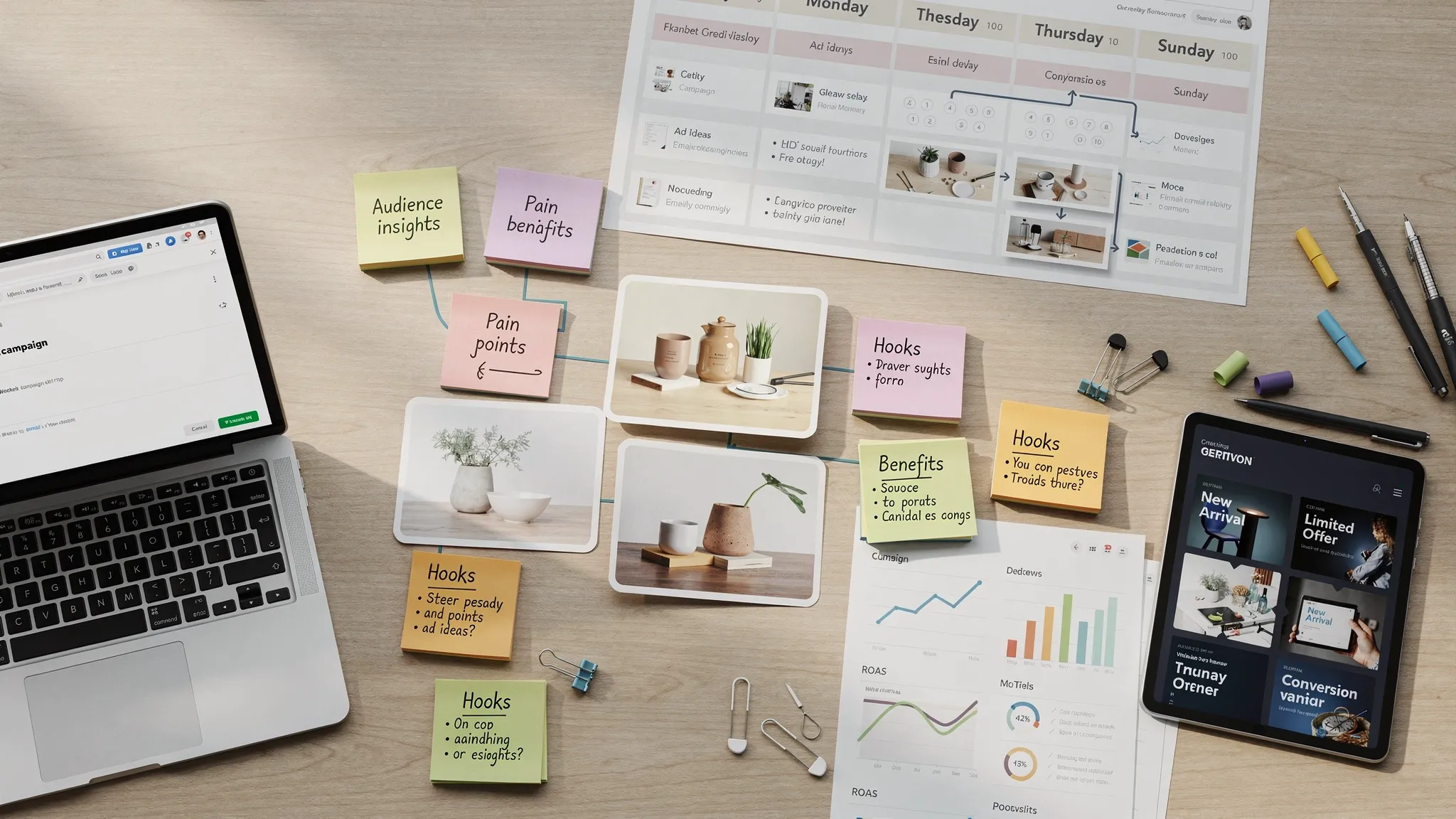
A strong AI creative brief gives the system the inputs it needs to create work that is relevant, differentiated, and testable. Instead of saying “make a Mother’s Day ad,” the brief explains the target segment, product promise, customer objection, proof points, channel, visual style, claims to avoid, offer structure, and hypothesis being tested.
Think of the brief as the strategy layer. AI can accelerate production, but the brief decides what gets produced and why.
The AI-ready creative brief: what to include
A good brief should be short enough to use weekly, but specific enough to prevent generic output. If your team needs 45 minutes to fill it out, it will not stick. If it takes 5 minutes and contains no useful direction, it will not work.
Use these elements as your baseline.
Business goal
Start with the commercial outcome. Are you trying to acquire new customers, increase first-order conversion, recover abandoned carts, lift repeat purchase rate, raise AOV, or promote a new product launch?
AI needs this context because the same product can be framed in different ways depending on the goal. A prospecting ad may lead with the problem and emotional payoff. A retention email may lead with a complementary product, replenishment timing, or VIP access.
Tie the brief to one main KPI. For ads, that may be CPA, ROAS, CTR, thumb-stop rate, or landing page conversion rate. For email, it may be revenue per recipient, click rate, conversion rate, or flow revenue.
Target audience and buying moment
Do not brief “women 25 to 45” unless that is truly all you know. A useful AI brief describes the customer’s situation.
For example: “First-time visitors who viewed the best-selling serum but did not add to cart. They are problem-aware, price-sensitive, and comparing us to cheaper drugstore options.”
That level of context helps AI generate more relevant hooks, objections, proof points, and calls to action.
If you have Shopify, Klaviyo, Meta, or survey data, use it. Pull real patterns from purchase history, email behavior, reviews, support tickets, comments, and return reasons. AI performs better when it is grounded in first-party signals instead of assumptions.
One core promise
Every asset should have one dominant promise. Not five benefits, not a full founder manifesto, not every product feature.
A strong promise connects the product to a customer outcome. For example, “hydrated skin without a greasy finish” is more useful than “contains hyaluronic acid.” “Work pants that feel like leggings but look office-ready” is stronger than “four-way stretch fabric.”
When briefing AI, state the promise clearly and ask for creative variations around that promise. This keeps volume from turning into chaos.
Proof points and constraints
AI can help with copy, but it should not invent proof. Give it the specific evidence it is allowed to use.
Useful proof points include reviews, before-and-after examples, clinical claims you can substantiate, ingredient details, founder expertise, press mentions, customer counts, UGC quotes, sustainability practices, guarantees, or shipping policies.
Just as importantly, include what the creative must not say. This is especially important for beauty, wellness, supplements, skincare, finance, children’s products, and any category with compliance risk.
Your brief should include claims to avoid, required disclaimers, prohibited phrases, competitor comparison limits, and any visual rules that matter.
Brand voice and visual direction
AI needs more than “make it on-brand.” Give it usable rules.
For voice, include a few practical opposites. For example: “confident, not hypey,” “expert, not clinical,” “playful, not childish,” or “direct, not aggressive.” If you have a deeper brand system, turn it into a living creative reference. Needle has written more on this in its guide to creating brand guidelines your team will actually use.
For visuals, include image style, product treatment, color usage, typography constraints, layout preferences, UGC style, and examples of past winners. If you do not have formal guidelines, start by collecting your top-performing ads, emails, and social posts, then identify what they have in common.
Channel and format
A creative idea is not the same as a finished asset. The brief should specify where the asset will run and what format it needs.
A Meta Reels ad, a carousel, a Klaviyo email, a homepage hero, and a TikTok Spark Ad all need different pacing, copy density, aspect ratio, and CTA placement. If AI is generating drafts without channel constraints, the output will look polished but may fail in execution.
Include format requirements such as 9:16 video, 1:1 static, email hero section, three-frame GIF, product page module, or SMS copy. Also include the stage of funnel: awareness, consideration, conversion, retention, or win-back.
Learning hypothesis
This is the part most brands skip.
A creative brief should not only say what to make. It should say what you expect to learn.
For example: “We believe price-sensitive first-time buyers will respond better to cost-per-use framing than to a percentage discount.” Or: “We believe founder-led product demos will outperform polished studio videos for cold audiences.”
This turns AI creative production into a testing system, not a content treadmill.
A simple brand creative brief template
Use this as a lightweight starting point for ads, emails, and campaign assets.
- Campaign goal: What business outcome are we driving?
- Primary KPI: What metric determines success?
- Audience: Who is this for, and what do they already know?
- Buying moment: What action did they take, or what context are they in?
- Core promise: What is the single main message?
- Customer objection: What doubt or friction should the creative address?
- Proof: What evidence can we use?
- Offer or CTA: What should the customer do next?
- Brand rules: What voice, visual, and claims guidelines must be followed?
- Format: Where will this run, and what dimensions or copy lengths are needed?
- Hypothesis: What are we trying to learn from this creative?
The template looks basic, but it creates the structure AI needs. Over time, your team can store winning briefs and reuse them as creative playbooks for launches, holidays, evergreen acquisition, abandoned cart recovery, and retention campaigns.
How to scale brand creative with AI without losing control
Scaling creative does not mean asking AI for 100 random ad ideas. It means building a controlled system where each new asset is tied to a strategy, brand rules, and performance feedback.
Turn customer data into creative angles
The best creative usually starts with what customers already say.
AI can help summarize thousands of reviews, support tickets, survey responses, post-purchase answers, and ad comments into repeatable themes. You can use those themes to create an angle bank: problem angles, transformation angles, comparison angles, objection angles, lifestyle angles, urgency angles, and proof angles.
For example, a skincare brand may discover that customers keep mentioning “doesn’t pill under makeup.” That phrase could become a Meta hook, an email subject line, a product page bullet, and a creator talking point.
This is one of the biggest advantages of AI for ecommerce teams. It helps you mine customer language at scale, then convert it into creative that feels specific instead of manufactured.
Build modular creative assets
A scalable creative system is modular. Instead of creating each ad from scratch, you build reusable components.
Those components might include hooks, product shots, customer quotes, benefit statements, founder clips, offer overlays, FAQ answers, comparison frames, CTA cards, and lifestyle visuals. AI can help generate variations of each module while preserving the strategic direction.
This works especially well for short-form video and static ads. You can test three hooks against the same body, or three proof points against the same visual format. That makes performance data easier to interpret.
If every creative changes the hook, audience, offer, format, and product at once, you may get a result, but you will not know why it happened.
Use human review where it matters
AI should not remove approval. It should move approval to the right points.
The founder or brand lead should not need to inspect every comma in every draft. They should approve the strategy, the brand fit, and the risk areas. The operator should approve channel fit and production readiness. The performance lead should approve the testing structure.
For most teams, the best review process has three gates: brief approval, asset approval, and learning approval. Brief approval confirms the strategy. Asset approval confirms the creative is safe and on-brand. Learning approval confirms what the team will do next based on results.
That last gate matters. Without it, your team will keep producing creative without compounding knowledge.
Connect creative production to publishing and reporting
The biggest bottleneck is rarely idea generation alone. It is the handoff between idea, draft, design, approval, launch, reporting, and iteration.
This is where an all-in-one workflow becomes valuable. Needle is built to help ecommerce brands generate tailored marketing ideas, create on-brand creative assets, publish content directly to platforms, automate campaign workflows, track results, and turn performance into actionable learnings. Instead of treating AI as a separate writing tool, the stronger approach is to connect creative production to the systems where campaigns actually run.
That matters because creative only becomes useful when it ships, gets measured, and informs the next round.
Track brand presence beyond ads and email
Brand creative is also expanding into AI search. Customers increasingly ask AI assistants for product recommendations, comparisons, and category advice before they ever reach your site. That means your positioning, metadata, reviews, and content footprint can influence how your brand is described in AI-generated answers.
If this is becoming a meaningful acquisition surface for your category, tools like CapstonAI’s AI visibility platform can help teams understand how assistants mention the brand and where the brand’s AI search presence has blind spots. That insight can feed back into creative briefs, especially for positioning, comparison content, and proof-led messaging.
A weekly AI creative operating rhythm
You do not need a massive team to make this work. You need a repeatable cadence.
Here is a practical weekly rhythm for a lean ecommerce team.
- Monday: review performance: Look at last week’s ads, emails, and site metrics. Identify what improved, what declined, and what creative pattern stands out.
- Tuesday: choose hypotheses: Pick one to three creative hypotheses for the week. Keep them narrow enough to test.
- Wednesday: generate and refine: Use AI to create angles, copy, scripts, layouts, and variants. Apply brand and compliance review before production.
- Thursday: approve and launch: Publish the assets to the right channels, keeping tests controlled so you can interpret results.
- Friday: capture learnings: Document early signals, creative notes, and next actions. Do not wait until the end of the month to learn.
This cadence turns AI into a compounding system. Every week, the brand gets clearer on what customers respond to, what assets convert, and which ideas deserve more budget.
What to measure when scaling brand creative
If you only measure output volume, AI will make you feel productive while hiding whether the work is improving the business.
Track creative efficiency and commercial performance together.
Useful creative efficiency metrics include time from brief to launch, number of approved assets per week, approval revision rate, percentage of assets launched, and number of learnings documented.
Useful performance metrics include CTR, thumb-stop rate, CPA, ROAS, MER, conversion rate, revenue per recipient, add-to-cart rate, and customer acquisition cost.
The best signal is not “we made 50 assets this week.” The best signal is “we tested three hypotheses, found one new winning angle, reduced CPA, and turned the learning into next week’s campaign.”
For more on connecting creative to performance, Needle’s guide to AI-powered ad creative breaks down how creative generation, testing, and iteration work together.
Common mistakes to avoid
The first mistake is treating AI like a magic content machine. If you give it thin prompts and no customer data, it will produce familiar, average marketing language. The output may look fine, but it will not differentiate your brand.
The second mistake is scaling variations before clarifying the strategy. More creative volume helps only when each variation is attached to a reason. Otherwise, your team ends up with more files, more approvals, and less clarity.
The third mistake is ignoring brand memory. Performance creative still needs consistency. If every AI-generated ad looks like a different company, customers may click once, but you lose the repetition that builds trust over time.
The fourth mistake is skipping the learning loop. AI can help you produce faster, but speed without analysis just accelerates waste. Every campaign should create a reusable insight, even when it underperforms.
The fifth mistake is over-automating approvals. AI can draft, remix, and recommend, but humans should still own positioning, customer empathy, legal claims, and final judgment.
Where Needle fits into the workflow
Needle is designed for ecommerce brands that want the speed of AI without turning marketing into a pile of disconnected tools.
Instead of using one tool for ideas, another for design, another for publishing, and another for reporting, Needle helps streamline the campaign workflow in one system. It can generate marketing ideas, create on-brand assets, publish directly to platforms, automate workflows, track results, and surface learnings that guide the next round of optimization.
For founders and lean teams, that shift matters. The goal is to move from operator mode to approver mode. You should not be stuck rewriting every email, chasing freelancers, pulling reports manually, or guessing what creative to test next.
A strong AI creative system lets your team focus on the decisions that actually require human judgment: what the brand stands for, which customers matter most, what claims are true, what offers protect margin, and what growth bets deserve attention.
Frequently Asked Questions
Can AI really create on-brand creative? Yes, but only if it has strong inputs. AI needs brand guidelines, examples of past creative, customer data, product details, approved claims, and clear review rules. Without those inputs, it will default to generic marketing patterns.
What should I brief first, ads or emails? Start with the channel where creative velocity is currently limiting growth. For many ecommerce brands, that is paid social because fatigue happens quickly. For others, it is email because campaigns are inconsistent or too promotion-heavy. The same briefing system can apply to both.
How many creative variants should we generate with AI? Generate enough to test a clear hypothesis, not so many that your team cannot review or interpret them. A practical starting point is three to five variants per angle, with one main variable changed at a time.
How do I stop AI creative from sounding generic? Feed it real customer language, reviews, objections, founder notes, product proof, and examples of your best-performing assets. Generic inputs create generic outputs. Specific inputs create useful creative.
Should AI replace designers, copywriters, or agencies? AI can reduce repetitive production work and speed up first drafts, but human judgment still matters for strategy, taste, storytelling, compliance, and final approval. Many brands get the best results from a hybrid workflow where AI accelerates execution and humans guide direction.
What is the biggest benefit of scaling brand creative with AI? The biggest benefit is faster learning. More assets are useful, but the real advantage is being able to test customer angles, identify winners, and turn performance data into better creative every week.
Turn your creative process into a growth system
AI will not fix a weak brief, a vague brand, or a disconnected workflow. But with the right system, it can help your team create better ads, emails, videos, and campaigns at a pace that used to require a much larger team.
If you want to brief, create, publish, and optimize brand creative without agency bloat, Needle can help. Connect your tools, approve the work, and let Needle execute the campaign workflow while your team stays focused on strategy and growth.