

Campaign marketing is how you turn “we should promote something” into a coordinated push that actually moves revenue. For busy ecommerce teams, the problem is not ideas, it’s execution: too many channels, too many tasks, and not enough time to ship quality creative consistently.
This guide covers campaign marketing basics (with a practical, lightweight process) so you can plan faster, launch cleaner, and learn what to do next without living in spreadsheets.
What “campaign marketing” means in ecommerce (and why it’s different from always-on)
A marketing campaign is a time-bound, goal-driven set of messages and assets that work together across channels (ads, email, site, social) to create a single outcome.
Always-on marketing is everything that runs continuously: evergreen prospecting, automated flows (welcome, cart recovery), SEO content, and baseline retargeting.
You need both:
- Always-on keeps the machine running.
- Campaigns create spikes, accelerate learning, and give customers a reason to buy now.
If your team is stretched thin, the fastest wins usually come from doing fewer campaigns, but doing them with tighter focus.
The 4 building blocks of a campaign that performs
Most ecommerce campaigns fail for one of two reasons: the goal is fuzzy, or the story is inconsistent across channels. These four pieces keep you honest.
1) One goal (and one primary KPI)
Pick a single goal per campaign. Examples:
- Launch a new product (primary KPI: purchases or cost per purchase)
- Move inventory for a hero SKU (primary KPI: contribution margin or MER)
- Increase repeat purchases (primary KPI: repeat purchase rate or revenue per recipient)
When you stack goals, you stack creative requirements, landing page requirements, and measurement complexity.
2) One audience segment to prioritize
You can target everyone later. Start with one segment that makes the campaign easier to win.
Common ecommerce segments:
- First-time buyers who need proof and a clear “why now”
- Existing customers who need a reason to come back
- High-intent site visitors who need the last nudge
This isn’t about limiting reach forever. It’s about making the message sharp enough to convert.
3) One promise (your campaign’s “why”)
A campaign promise is one sentence that explains the outcome customers should expect.
Examples:
- “Clear skin in 7 days without drying your barrier.”
- “A complete summer capsule wardrobe in 3 pieces.”
- “Better sleep tonight, not a month from now.”
A strong promise makes every asset easier: your hook, your email subject line, your landing page headline, and your ad variations.
4) One channel plan that matches how people buy
In ecommerce, most purchases are not purely “ad-driven” or purely “email-driven.” Customers see an ad, check reviews, bounce, come back from an email, and purchase later.
A simple, effective channel plan looks like:
- Paid to create demand and retarget intent
- Email/SMS to convert and re-convert
- Website (landing page, PDP, collection) to reduce friction
If you only have bandwidth for two channels, pick the two where you can control output and measure quickly (often Meta ads + email).
A “busy team” campaign brief you can write in 10 minutes
If your campaign brief takes hours, it will not get used. Keep it short, but specific.
Write this and you are already ahead of most brands:
- Campaign name:
- Dates:
- Goal + primary KPI:
- Hero product / collection:
- Target segment:
- One-sentence promise:
- Offer (if any):
- Proof to include: (reviews, UGC, before/after, founder story, guarantees)
- Where it lives onsite: (PDP, collection, landing page)
Tip: proof is where campaigns often break. If you do not have proof, your “creative” becomes only claims, and claims rarely scale.
Creative basics: build an asset kit, not one perfect ad
High-performing ecommerce campaigns are rarely won by one masterpiece. They’re won by having enough good variations to let platforms and customers respond.
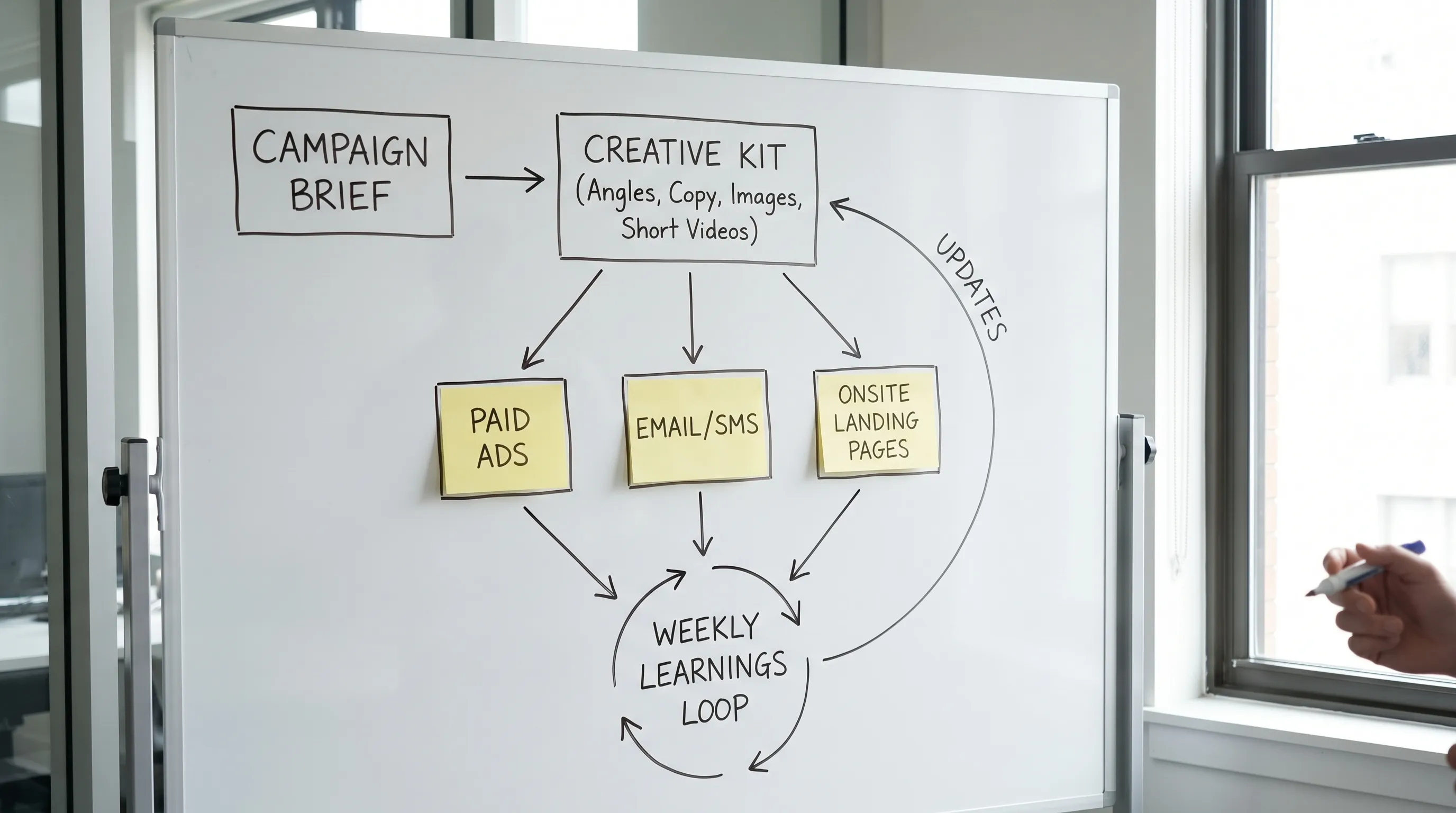
A practical campaign “creative kit”:
- 3 angles (different reasons to believe)
- 6 hooks (first 2 seconds of video, first line of copy)
- 3 CTAs (purchase-focused, learn-more, quiz/find-your-fit)
- 2 formats (short video + static or carousel)
This kit becomes:
- Your paid ad variations
- Your email campaign(s)
- Your onsite headline and subhead
If you want an example outside pure DTC, look at how service-led ecommerce brands communicate a clear outcome and back it with expertise, like Lumina Skin Sanctuary’s customized facials and clean skincare products. The same principle applies whether you sell a physical product, a treatment, or both: one promise, consistent proof, and a clear next step.
Campaign structure across the customer journey (without overcomplicating it)
You do not need 12 ad sets and 9 email sends to be “sophisticated.” You need the right message at the right intent level.
Top of funnel (ToF): earn attention with a clear problem
ToF creative should be simple and fast:
- Problem-first hook
- Outcome-based promise
- Lightweight proof
- Clear CTA to a page that matches the ad
Your job here is not to persuade everyone. It’s to attract the right people and create intent.
Middle of funnel (MoF): answer objections
MoF is where you earn the purchase:
- Comparisons (before/after, “this vs that”)
- Education (how it works, why ingredients matter, how sizing works)
- Social proof (reviews, UGC, press)
This is also where email campaigns can outperform discounts if the content is truly useful.
Bottom of funnel (BoF): reduce risk and friction
BoF is about removing reasons to hesitate:
- Shipping and returns clarity
- Guarantees and policies
- Bundles that make the choice easier
- Strong PDP and checkout experience
If BoF is weak, your campaign will look like a “traffic” problem when it’s actually a conversion problem.
Measurement basics: what to track each week (and what to ignore)
Busy teams get buried in metrics. Keep a tight set that connects to profit.
The core metrics most ecommerce teams should watch
- MER (marketing efficiency ratio): a blended view of revenue vs marketing spend
- CPA / cost per purchase (or cost per order): especially for paid
- Conversion rate: onsite, by landing page / PDP
- Email revenue per recipient (or per send): more stable than opens
Platform ROAS can still be useful for directional changes, but it should not be the only decision-maker (privacy and attribution gaps make it noisy).
The simplest campaign learning loop
Every week, capture:
- What won (creative angle + format + audience)
- What lost (and why you think it lost)
- One decision for next week (scale, pause, iterate, or replace)
If you only do this, your campaigns will compound over time.
The 90-minute weekly campaign workflow (built for small teams)
You do not need more meetings. You need a repeatable cadence.
1) Review (20 minutes)
Look at the 3 to 5 metrics that matter. Identify one bottleneck: creative, audience, offer, or onsite conversion.
2) Decide (10 minutes)
Choose one primary action:
- Refresh creative
- Shift budget
- Improve landing page
- Change offer or positioning
3) Produce (45 minutes)
Create a small batch, not one asset. Use the creative kit approach so you ship variations.
4) Launch + log (15 minutes)
Publish, then document what you launched so next week’s learnings are real, not vibes.

Where AI fits (and where it should not)
AI is best used to remove production bottlenecks, not to replace strategy.
Use AI to:
- Generate campaign angles and variants quickly
- Draft ad copy and email outlines
- Produce creative variations at higher volume
- Automate repetitive publishing and reporting steps
Keep humans in control of:
- Offer decisions and margin constraints
- Brand voice and sensitive claims (especially in categories like health and beauty)
- Final approvals
For busy ecommerce teams, the real win is shifting from “operator mode” to “approver mode,” while still keeping standards high.
Frequently Asked Questions
What is campaign marketing in ecommerce? Campaign marketing is a coordinated, time-bound push across channels (ads, email, site, social) designed to hit a specific goal, like a launch, promo, or retention play.
How long should an ecommerce marketing campaign run? Many campaigns run 7 to 21 days, but the right length depends on purchase cycle and creative fatigue. The key is a weekly learning loop so you can iterate.
What channels should I include in a campaign? Start with the channels you can execute consistently and measure quickly, often paid social plus email, then align your landing page or PDP so the message matches.
What should a campaign brief include? At minimum: goal and KPI, target audience, one-sentence promise, hero product, proof, offer, and where the campaign lives onsite.
How do I know if my campaign creative is the problem? If you have stable traffic costs (CPM/CPC) but low conversion rates, it’s often an onsite or offer issue. If conversion is fine but CPA is high, it’s often creative angles, hooks, or targeting.
Make campaign marketing easier to execute with Needle
If your team has good products and decent data but struggles to ship campaigns consistently, Needle is built for that reality. Needle helps ecommerce brands generate marketing ideas, create on-brand assets, publish directly to platforms, automate campaign workflows, and track results with actionable learnings.
Explore Needle here: Needle | AI-Powered Marketing for Ecom Brands