
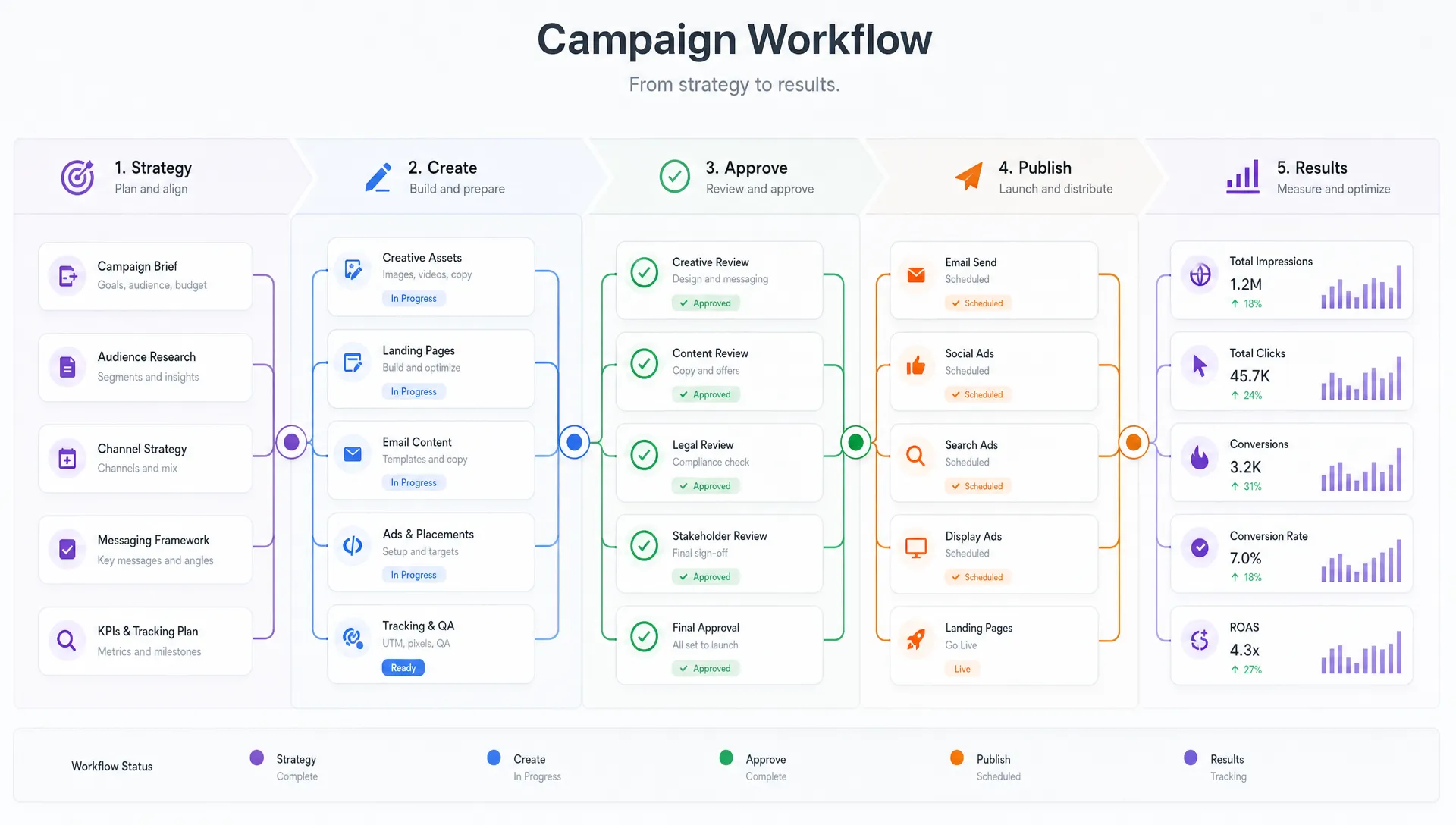
Lean ecommerce teams usually do not lose time because they lack ideas. They lose time in the handoffs between idea, brief, creative, approval, publishing and reporting. A campaign that should take one week turns into three because the team is chasing files, rewriting copy for every channel and waiting for someone to explain what worked last time.
The right campaign tools solve that problem by compressing the path from strategy to live assets. They do not simply add another dashboard. They reduce the number of steps between a customer insight and a published campaign.
For lean teams, especially DTC and ecommerce brands, speed matters because windows are short. A product drop, creator collaboration, seasonal promotion or inventory push often has a narrow moment of relevance. If your tools make launch slower, they are not campaign tools in any useful sense. They are storage.
If you are still clarifying what belongs inside a campaign versus always-on marketing, start with Needle’s guide to campaign marketing basics for busy ecommerce teams. Once that foundation is clear, the next question is practical: which tools actually help a small team launch faster?
What “faster” should mean for campaign tools
A faster launch is not just an earlier publish date. A rushed campaign can still waste spend if the message is vague, the creative is off-brand or no one knows how results will be judged.
For lean teams, faster should mean four things:
- The campaign brief is clear enough that creative, email, paid social and landing page work can happen in parallel.
- Assets are adapted by channel instead of rebuilt from zero every time.
- Approval happens inside a repeatable workflow, not across scattered chats and comments.
- Performance learnings feed the next campaign quickly enough to matter.
That last point is often the difference between a team that gets faster over time and a team that stays busy. Campaign speed improves when each launch creates reusable inputs: winning angles, useful objections, customer language, creative patterns and audience learnings.
The campaign tool categories that actually matter
Most lean teams do not need a huge marketing stack. They need a small set of connected tools that cover the campaign lifecycle without creating unnecessary operational drag.
| Campaign tool category | What it helps you do faster | What to avoid |
|---|---|---|
| Planning and briefs | Align the team on offer, audience, message and launch timing | Long documents nobody reads after kickoff |
| Customer insight tools | Turn reviews, support tickets, surveys and purchase behavior into usable angles | Data dumps without clear takeaways |
| Creative production | Generate and adapt copy, images, ads, emails and video concepts | One-off assets that cannot be reused across channels |
| Publishing and scheduling | Push approved content to the right platforms at the right time | Manual uploads that invite mistakes |
| Approval workflows | Keep brand, legal and founder feedback organized | Feedback split across email, Slack and docs |
| Analytics and learning | Identify which assets, offers and messages moved results | Reports that arrive after the next campaign is already planned |
The best stack is not the one with the most features. It is the one that removes the most friction from your specific bottleneck.
If your founder is still approving every Instagram caption manually, you need a better review flow. If your team has strong ideas but cannot produce enough variants, you need creative automation. If every post-launch recap feels like detective work, you need cleaner tracking and learning loops.
Start with the brief, because every slow campaign starts messy
Campaign tools work best when the source material is sharp. Before choosing software, make sure your team has a repeatable brief that answers the basics: who is the campaign for, what are they being asked to do, why should they care now and what proof makes the offer credible?
A good brief does not need to be long. It needs to be decisive. Lean teams benefit from a one-page campaign brief that includes the core offer, target customer, main message, objection handling, channel plan, asset list, owner and launch date.
From there, the tools can do their job. AI can generate campaign ideas. Creative systems can produce variants. Email and ad platforms can publish. Analytics can surface learnings. Without the brief, all of those tools create more output but not necessarily more progress.
A simple rule helps: if a tool cannot use the campaign brief as an input or improve the brief with real learnings, it probably sits too far away from the work that determines launch speed.
Use proof libraries, not scattered inspiration folders
Lean teams often keep inspiration everywhere: screenshots in Slack, TikTok links in messages, review snippets in spreadsheets, product claims in old launch docs and founder notes in Notion. That might work when the team is tiny, but it becomes slow as soon as campaign volume increases.
A proof library gives your campaign tools better raw material. It can include customer reviews, before-and-after language where appropriate, product benefits, objections, comparison points, creator quotes, press mentions, FAQs and support insights.
Campaign tools are faster when they can pull source material from the places shoppers already trust: product pages, support pages, reviews and FAQs. For example, the official Dr. Pen Store keeps authenticity, FDA-cleared A20 messaging, expert support and product guidance close to the buying path. A lean team can translate that kind of proof into ad angles, welcome emails, comparison content and post-purchase education without rewriting every claim from scratch.
This is especially useful for categories where shoppers need reassurance before buying. Beauty devices, supplements, apparel with fit concerns, high-consideration home products and premium accessories all benefit from proof that moves across the campaign, not just proof that sits on a product page.
Connect creative production to publishing
Many teams treat creative production and distribution as separate worlds. One tool makes images. Another writes copy. Another stores files. Another schedules posts. Another sends emails. This setup can work, but only if the handoffs are smooth.
For lean teams, the faster approach is to connect creative creation as closely as possible to channel execution. That means campaign assets should be generated with the final placement in mind, not cleaned up later by a tired marketer at 11 p.m.
An ad concept should become multiple paid social variants. A launch angle should become an email subject line, hero section, SMS hook and organic post. A product benefit should become both a creator talking point and a landing page module. The more your tools can reuse the campaign’s core message across formats, the less your team has to rebuild.
This is where AI-powered campaign tools can be useful, as long as they are grounded in your brand, products and performance data. Generic AI output still requires heavy editing. A tool that understands your existing assets, customer language and channel context can get much closer to publish-ready work.
Needle is built around that execution gap. It helps ecommerce brands generate tailored marketing ideas, create on-brand assets, publish directly to platforms, track results and turn performance into actionable learnings. For a lean team, that matters because the same system can support campaign creation and campaign improvement, rather than adding another disconnected step.
Choose tools by bottleneck, not by category hype
A lean team should not buy campaign tools because they are popular. It should buy them because they shorten a specific part of the launch cycle.
| If your bottleneck is... | Prioritize tools that... | Example outcome |
|---|---|---|
| Unclear campaign direction | Turn goals, audiences and offers into a structured brief | Fewer revisions before creative starts |
| Not enough creative variants | Generate channel-specific copy and assets from one message map | More tests without more freelancers |
| Slow approvals | Centralize comments, versions and final sign-off | Less confusion before launch day |
| Manual publishing | Push approved assets into email, social, ad or content platforms | Fewer last-minute upload errors |
| Weak post-campaign learning | Connect results to creative, offer and channel decisions | Better next campaigns, not just more reports |
This bottleneck-first approach prevents tool sprawl. It also makes ROI easier to judge. If the problem was approval speed, measure approval time. If the problem was creative volume, measure the number of usable assets produced per campaign. If the problem was unclear learning, measure whether each campaign produces decisions for the next one.
Build a minimum viable campaign stack
A minimum viable campaign stack should help your team move from idea to learning without forcing everyone to manage ten separate systems.
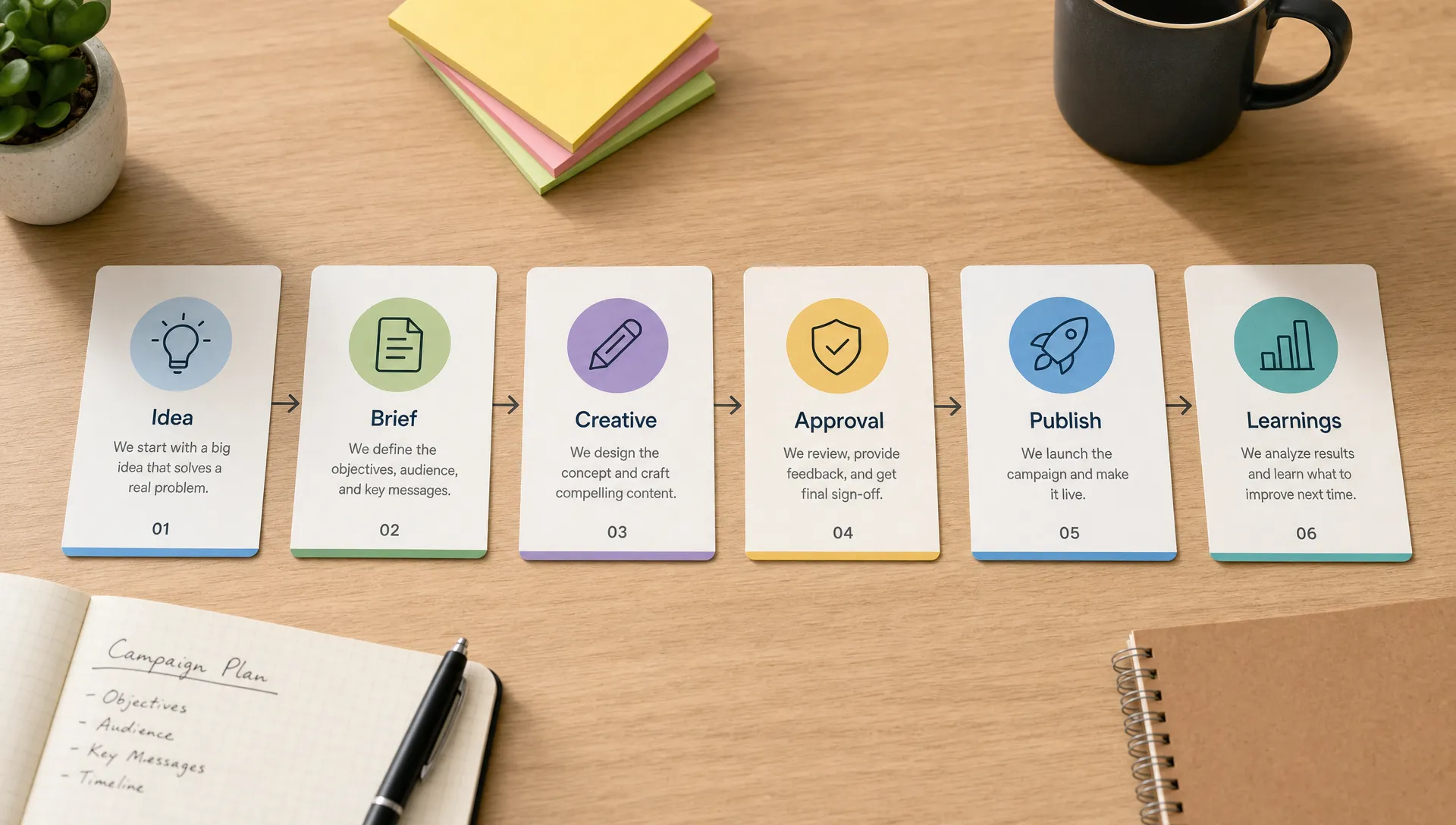
At the simplest level, you need a place to plan, a way to create, a way to publish and a way to learn. The exact tools depend on your channels and budget, but the workflow should stay consistent.
The planning layer captures the brief, offer, audience and launch calendar. The creative layer turns that plan into assets. The publishing layer sends those assets into market. The learning layer shows what happened and what to do next.
Needle can sit across several of those functions for teams that want one AI-powered marketing platform to generate ideas, create assets, publish content and track campaign results. For brands already using specialized tools, the key is integration. Your campaign system should connect to existing tools rather than force a full rebuild of the marketing operation.
A practical test is simple: after the campaign brief is approved, how many separate places does the team need to go before the campaign is live? If the answer is more than a few, launch speed is probably being lost in the gaps.
Create reusable campaign systems, not one-off launches
The fastest teams do not start from a blank page every time. They build reusable campaign systems.
A launch campaign might have a standard structure: teaser, early access, launch announcement, objection handling, social proof, last chance and post-purchase education. A sale campaign might follow a different structure: offer reveal, best sellers, bundles, urgency, cart recovery and final reminder.
Once those systems exist, campaign tools can fill them faster. AI can adapt the message to the offer. Creative templates can shift for the product. Publishing workflows can follow familiar timing. Analytics can compare performance against similar campaigns.
This is why templates are useful, but only when they are connected to execution. A static template that sits in a folder helps once. A repeatable campaign workflow helps every week.
If you need a tighter operating rhythm, Needle’s practical plan to launch a campaign in a week is a helpful companion. Use it to pressure-test whether your current tools support a fast sequence from brief to assets to publish to learnings.
Watch for tool stack warning signs
Campaign tools should make your team calmer, not more fragmented. If the stack creates more coordination work than it removes, it is time to simplify.
Common warning signs include:
- Your team has strong campaign ideas but no single owner for launch readiness.
- Assets are approved in one place but published from another without a clear final version.
- Every campaign requires a new folder structure, new naming system and new status tracker.
- Reports are produced, but no one turns them into creative or offer decisions.
- Freelancers or agencies are waiting on internal feedback more than they are producing work.
None of these problems are solved by adding another tool on top. They are solved by choosing tools that match the way lean teams actually operate: fewer handoffs, clearer ownership, reusable assets and a short feedback loop.
How to measure whether campaign tools are working
The goal is not to feel more organized. The goal is to launch more effective campaigns with less wasted effort.
Track a few operational metrics alongside performance metrics. Time from brief to first draft shows whether planning inputs are clear. Time from first draft to approval shows whether feedback is efficient. Number of usable creative variants shows whether production is scaling. Time from campaign end to learning summary shows whether the team is improving quickly enough.
Then connect those operational metrics to business results: revenue, contribution margin, conversion rate, email revenue, ad efficiency, repeat purchase behavior or whatever metric matches the campaign goal.
A campaign tool is doing its job when the team can say, “We launched faster, learned something specific and used that learning in the next campaign.” Without that final step, speed becomes activity.
Frequently Asked Questions
What are campaign tools? Campaign tools are software systems that help teams plan, create, approve, publish and measure marketing campaigns. For lean ecommerce teams, the most useful tools reduce handoffs and make it easier to reuse ideas, assets and learnings across channels.
Which campaign tools should a lean team choose first? Start with the tool that solves your biggest bottleneck. If briefs are unclear, fix planning first. If creative production is slow, prioritize tools that generate on-brand assets and variants. If learnings are weak, improve tracking and reporting before adding more channels.
How do AI campaign tools help teams launch faster? AI campaign tools can turn briefs into ideas, copy, creative concepts and channel-specific assets faster than manual workflows. They work best when connected to brand guidelines, product information, past performance and existing marketing tools.
How many campaign tools does a small ecommerce team need? Most small teams need fewer tools than they think. A lean stack should cover planning, creation, publishing and learning. If one platform can handle several of those jobs well, it can reduce coordination work and make launches faster.
What is the biggest mistake teams make with campaign tools? The biggest mistake is buying tools without fixing the workflow. A new tool will not solve unclear ownership, vague briefs or slow approvals. Define the launch process first, then choose tools that make that process faster.
Launch faster without adding more marketing overhead
Lean teams do not need agency bloat or a larger tool stack to move faster. They need a campaign system that turns strategy into approved assets, published content and clear learnings with fewer handoffs.
Needle helps ecommerce brands do exactly that with AI-powered campaign creation, on-brand creative assets, direct publishing, result tracking and continuous optimization. If your team has the ideas but not the bandwidth, Needle can help you launch more often without making the workflow heavier.