
Let's be real. Your email list is one of the few things your brand truly owns. You control it. No algorithm change from Meta or Google can take it away. This is your direct line to customers. Winging it isn't an option.
An "ecommerce email marketing strategy" isn't just jargon. It's your roadmap for turning one-time buyers into repeat customers. It moves you from sending random sale emails to building a system that grows customer lifetime value.
The goal is to build a machine that works for you. Even when you're busy with a million other things.
The Three Pillars You Cannot Skip
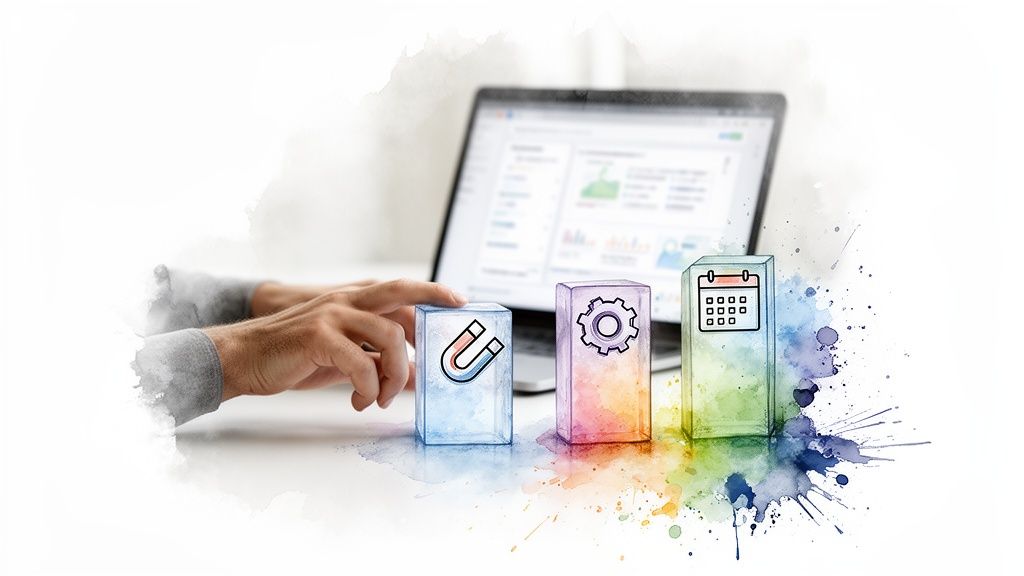
Every successful email program we've built—and we've done this over 200 times—stands on three pillars. Get these right, and you'll have a reliable revenue channel. Skip one, and the whole thing is guesswork.
Audience Capture: This is more than a newsletter form in your footer. It's about capturing emails from high-intent visitors at the right moment.
Essential Automations: These are the flows that run 24/7. They turn subscribers into first-time buyers and first-time buyers into fans. Your highest ROI emails live here.
Campaign Calendar: This is your game plan for promotions, new product drops, and storytelling. It keeps your brand top-of-mind.
"Your automations are your revenue baseline. Your campaigns are your revenue spikes. You need both to build a healthy ecommerce business." - Ryan O'Donnell, Co-founder at Needle
Think of these pillars as the blueprint for your entire program.
Core Email Marketing Pillars for DTC Brands
This table boils it down. Each part has a clear job and a metric to tell you if it's working. Nail these three. You'll already be ahead of most competitors.
Why This Channel Still Dominates
Despite the noise from other channels, email still delivers. The data is clear. According to the Data & Marketing Association, email marketing generates an average ROI of $42 for every dollar spent.
This isn't just about sending emails. It's about building an owned channel you control completely. A solid email strategy is your best defense against rising ad costs. It’s the engine for profitable growth.
For those on Shopify, picking the right tools is a critical first step. You might find our guide on the best Shopify email marketing apps helpful for getting set up.
Now, we'll break down how to build this foundation. No more theory. Just actionable steps.
Smarter Segmentation to Know Your Customers
Sending the same email to everyone is a waste of time. Your customers aren't the same. Your marketing shouldn't be either. This is where you move beyond a single list. Start talking to people based on who they are and what they've done.
It’s the difference between shouting into a crowd and having a conversation.
The goal isn't to create dozens of complex segments. It's about focusing on the few that drive revenue. Start with the groups that matter most.
This boils it down to the essentials: your best customers, potential buyers, and those you're about to lose. Nail these three. You're ahead of the game.
The Segments That Drive Real Revenue
You can slice your list a million ways. But starting with these three gives you the biggest impact. They cover the most critical parts of the customer journey.
Your VIPs (Best Customers): These people buy from you again and again. They love your brand. Treat them like gold. Think early access, exclusive offers, and behind-the-scenes content.
Potential Buyers (High Intent): This group has shown serious interest. They've browsed products or added items to their cart but haven't bought. They just need a nudge.
At-Risk Customers (Fading Away): These are customers who haven't purchased or opened an email in a while. Ignoring them is letting money walk out the door. A targeted winback campaign can reactivate them.
Of course, you have to be clear on identifying your target audience first. That foundational work makes every segment more powerful.
Putting Segmentation into Practice
Theory is useless without action. Let's talk about building these in a tool like Klaviyo. Use dynamic segments that update automatically based on customer behavior. You set the rules once. The system does the work.
For example, a "Potential VIP" segment could be:
Placed order at least once over all time.
AND Placed order zero times in the last 60 days.
AND has an Average Order Value over $100.
Just like that, you have a group of valuable first-time buyers to nurture.
"Stop batching and blasting. The data proves it: sending relevant messages to smaller groups simply works better. It feels more personal to the customer and drives far better results for you." - Neil Patel, Co-founder of NP Digital
The impact isn't small. Mailchimp data shows segmented campaigns get 14.31% higher open rates and 100.95% higher click-through rates than non-segmented campaigns. Building this system is about working smarter. That leads to more sales.
The Automated Flows That Drive Revenue 24/7
Your automated email flows are your best salesperson. They work around the clock. They never ask for a day off. They know what to say at the perfect moment. Campaigns give you sales spikes. Flows build a reliable baseline of revenue. They are the engine.
These aren't typical email blasts. Automations fire based on a customer's actions. Or their inaction. That’s what makes them so effective. Data from Klaviyo shows that automated flows can generate up to 30x more revenue per recipient than a standard campaign. Why? They're a direct response to a customer signal.
This is the playbook for the core flows every DTC brand needs. We've built these for over 200 brands.
The Welcome Series: First Impressions Are Everything
Your welcome series is your one shot to make a great first impression. It’s the first real conversation a new subscriber has with your brand. The numbers show how critical it is. According to GetResponse, welcome emails have an average open rate of over 82%.
This is about more than a discount code. A great welcome series tells your story, sets expectations, and guides the subscriber toward their first purchase.
Here’s a simple three-email structure that works:
Email 1 (Immediate): Deliver the Goods & Say Hello. Get to the point. A subject line like "Welcome. Here’s 10% Off" is perfect. Deliver the discount and remind them why they signed up.
Email 2 (Wait 1 Day): Share Your Story. Build a connection. Talk about why you started the company or what makes your products different. "Here's Why We Started [Your Brand Name]" works wonders.
Email 3 (Wait 2 Days): Show Them the Proof. Use social proof. Showcase best-sellers alongside customer reviews. This builds trust. Subject: "See What Everyone's Talking About."
"Your welcome series shouldn't just sell. It has to educate, build trust, and turn a curious browser into a confident buyer. Get this right, and you're setting the foundation for years of loyalty." - Val Geisler, Customer Evangelist at Klaviyo
Browse and Cart Abandonment: The Money-Makers
If you only set up two flows, make them these two. They target subscribers with undeniable buying intent. They are your highest-leverage automations.
Cart abandonment flows are the champs. They are responsible for recovering between 3% and 14% of lost sales, according to SaleCycle. Browse abandonment catches people a step earlier. It's a slightly weaker signal, but still powerful.
Cart Abandonment Flow (2 Emails):
Email 1 (Wait 1-2 Hours): The Gentle Reminder. Be helpful, not pushy. "Did you forget something?" works. Show them the items they left behind.
Email 2 (Wait 24 Hours): Add a Nudge. If they still haven't bought, a little urgency or a small offer can work. Try "Your cart is about to expire."
Browse Abandonment Flow (1-2 Emails):
- Email 1 (Wait 2-4 Hours): The Soft Touch. This needs to be subtle. "Still thinking it over?" works well. Remind them of the product they viewed.
These flows are non-negotiable. They are ruthlessly effective at recovering sales you would have otherwise lost.
Post-Purchase and Winback: The Long Game
The job isn't done after the first sale. The post-purchase flow turns a first-time buyer into a repeat customer. Winback flows re-engage anyone who has gone quiet.
Customers are most engaged right after they buy. Your post-purchase series has one of the highest open rates. Use that momentum to build the relationship.
Post-Purchase Flow (3 Emails):
Email 1 (Immediately After Purchase): Order Confirmation. This is a transactional email, but it's a huge opportunity. Make it clean and on-brand.
Email 2 (Wait 7-14 Days): Check-In & Ask for a Review. A simple "How are you enjoying the product?" shows you care. It's also the perfect moment to ask for a review.
Email 3 (Wait 30-60 Days): The Cross-Sell. Plant the seed for purchase #2. Recommend a complementary product based on what they bought.
Winback Flow (Trigger after 90-120 days of inactivity):
Email 1: We Miss You. Keep it simple. Remind them what they loved about your brand.
Email 2: An Offer They Can't Refuse. Give them a compelling reason to come back. Think a significant discount or a free gift.
Setting up these flows is core to getting any ecommerce marketing automation software to work for you. They maximize what each customer is worth to your brand.
Planning a Simple and Effective Campaign Calendar
Automated flows are your revenue baseline. One-off campaigns create revenue spikes, build hype, and keep your brand from feeling stale.
Staring at a blank calendar is a founder's nightmare. Let's build a simple process to fill it.
This isn't about mapping out 52 weeks of ideas. It’s about finding a rhythm. A solid calendar balances promotions, new products, and content. The goal is to be strategic, not reactive.
The Three Campaign Types to Rotate
To avoid just blasting "15% OFF!" every week, you need to think in terms of three campaign types. Mixing these up keeps your list engaged. It prevents "discount fatigue," where customers only buy when you're on sale.
Promotional Campaigns: These are your sales drivers. Think seasonal events (Black Friday, Mother's Day), flash sales, or tiered offers. Use them to hit revenue targets.
Launch Campaigns: Announcing a new product is a huge opportunity. Build anticipation with a multi-email sequence. Start with teasers, then a "coming soon" email, then the big launch. Give your VIP segment early access.
Content Campaigns: These build your brand without always asking for the sale. Think a styling guide, a behind-the-scenes look, or a roundup of best-sellers. These emails build trust.
This mix is key to a healthy email program. You're not just another discount bin in their inbox.
Structuring Your Monthly Plan
Let's get this on paper. You don't need a complicated tool. At the start of each month, map out your sends for the next four weeks. This prevents last-minute scrambles.
We've used this simple structure with hundreds of brands.
Monthly Campaign Planning Template
This structure helps organize your emails and avoid chaos.
This template is a starting point. If you have a product launch in Week 2, that becomes your focus. The framework provides structure. You provide the context.
Nail the Creative Brief
Once you know what you're sending, you need to define how it should look and feel. A sloppy brief leads to sloppy creative. Your copy and design do the selling.
Your brief doesn't need to be a ten-page document. It can be a few bullet points answering these key questions:
What's the goal? (e.g., Drive $10k in sales for our new shoe collection.)
Who are we talking to? (e.g., Our VIP segment who has purchased shoes before.)
What is the single most important message? (e.g., Our best-selling shoe is back in three new colors.)
What is the offer and call to action? (e.g., No discount. CTA is "Shop The New Collection.")
Any specific design notes? (e.g., Use customer photos, keep the design clean.)
This simple exercise forces clarity. It gets your team on the same page. It’s the bridge between your calendar and an email that converts.
Figuring out how often to send campaigns is another piece of the puzzle. You can learn more by reading up on email marketing frequency best practices.
Measuring What Matters to Optimize Performance
If you don't measure it, you can't improve it. That old cliché is true. But most founders get bogged down in vanity metrics. They build complex dashboards that don't tell them if their email program is healthy.
Let's cut through the noise. This isn't data science. It's about a simple feedback loop: launch, learn, and make the next one better. That's it.
The KPIs That Actually Show Health
Stop obsessing over every minor metric. Focus on the numbers that connect directly to revenue and customer engagement.
Open Rate: Is your audience listening? While Apple's privacy updates have made this metric fuzzier, it’s still a crucial directional signal. A sudden drop is a huge red flag.
Click-Through Rate (CTR): This tests your email's content. A high open rate but low CTR means your subject line wrote a check your email couldn't cash.
Conversion Rate (CVR): The bottom line. Of the people who clicked, how many bought? This tells you if your email and landing page are working together.
Revenue Per Recipient (RPR): My favorite metric for judging a campaign's true impact. It boils everything down to a single dollar value. Even $0.10 shows you're moving in the right direction.
List Growth Rate: Your email list is an asset, but it decays. You must add new subscribers faster than you lose old ones. A healthy list is a growing list.
"Don't just stare at the data. Your job is to find the story behind the numbers. A low conversion rate isn't just a percentage; it's a signal that something in your offer or on your product page is creating friction for your customers." - Avinash Kaushik, Digital Marketing Evangelist
Getting a handle on the right ecommerce performance metrics connects your email sends to business results.
Your Simple Weekly Optimization Routine
Building a great email program is about consistency, not complexity. Set aside 30 minutes every week to review data, find one opportunity, and test it.
Here’s the routine that works:
Review Last Week's Sends: Pull up your dashboard in Klaviyo. Look at the five core KPIs for every campaign. Which one crushed it? Which one bombed?
Ask "Why?": This is the most important step. Did the winning email have a killer subject line? Was the offer too good to pass up?
Form a Hypothesis: Create a simple "if-then" statement. For example: "If we use an emoji in the subject line, then our open rate will increase."
Set Up an A/B Test: This is non-negotiable. Stop guessing and start testing. In Klaviyo, setting up a test takes less than five minutes. It is the fastest way to get a clear answer.
This simple loop—review, question, hypothesize, test—is the engine that drives optimization. It turns email marketing from a guessing game into a system. If you want to go deeper on tracking, our guide to email campaign performance metrics has you covered.
Frequently Asked Questions
Here are quick answers to the questions we hear all the time from founders.
What is a good open rate for ecommerce?
Honestly, with Apple's Mail Privacy Protection, this is a moving target. But a healthy brand should still aim for open rates between 25-40%. If you're consistently below 20%, it's a clear sign you need to clean your list or rethink your subject lines.
How do I know if my A/B test results are significant?
Most platforms like Klaviyo flag a result once it hits "statistical significance," meaning the outcome wasn't just random chance. As a quick rule, you want a clear winner (at least a 5%+ difference in open or click rate) and a decent-sized audience (a few thousand people, minimum).
Should I measure unsubscribes?
Yes, but don't panic. A healthy unsubscribe rate is below 0.5%. A sudden spike after a campaign means your message missed the mark. A small, steady stream of unsubscribes is a good thing—it keeps your list clean.
How often should I email my list?
There’s no magic number. A blend of your core automated flows plus 2-4 campaigns a month is a great starting point. Watch your unsubscribe and open rates. If opens are tanking, you’re sending too frequently or your content isn’t connecting. Your best customers might love a weekly email, but a new subscriber might be fine with one solid offer a month.
What is a realistic email revenue target?
For a healthy brand, aim for 20-30% of your total online revenue to come from email. If you're just starting, that number will be lower. The first thing to do is get your core automations live. They create a predictable revenue baseline.
Is Klaviyo better than Mailchimp for ecommerce?
For any serious DTC brand, yes. Mailchimp is fine for a simple newsletter. But Klaviyo was built to make ecommerce stores money. Its deep integration with Shopify is a game-changer. It pulls in real-time data on what customers have viewed, added to their cart, and purchased. This fuel is what you need for profitable, behavior-based automations. If you plan to generate real revenue from email, investing in a tool like Klaviyo from day one will save you a massive headache later.
Ready to stop juggling a dozen tools and get back to building your brand? Needle combines agency-level strategy with AI-powered execution to help you launch winning campaigns in a fraction of the time. Get a demo and see how it works.