
A good Meta ads strategy isn't a lottery ticket. It’s an engine. It's a system that predictably turns ad spend into revenue. It shows the right message to the right person at the right time. It’s about building a full-funnel machine that gets new customers and brings them back.
Your No-Fluff Introduction to Meta Ads That Actually Work
Let's cut to it. You're a founder. You need a strategy that drives sales, not just likes. Forget the jargon and complex frameworks. This is the real-world playbook we built from the trenches, running ads for DTC brands like yours. We’ve lived the chaos of Ads Manager. We built a system that works.
This guide lays out our exact framework for brands in the $1M-$10M range. You'll learn how to structure campaigns, what creative converts, and how to read the data. This is the founder-to-founder advice you've been looking for.
The Foundation of a Winning Strategy
A successful Meta ads strategy isn't about one "magic" ad. It’s about building a machine that attracts, converts, and retains customers. First, accept that not all customers are the same. Some have never heard of you. Others are a click away from buying.
Your strategy must speak to each group differently. That’s where the funnel comes in.
Most brands get this wrong. They throw money at "buy now" ads targeting cold audiences. Then they wonder why their costs are so high. It’s like asking a stranger for their credit card on a first date. You have to build trust first.
"The core idea is simple: You can't ask a stranger for a sale on the first date. Most brands fail because they only focus on the bottom of the funnel, ignoring the millions of potential customers who just haven't heard of them yet."
— Common Thread Collective
To keep it actionable, we organize everything into three core campaign types.
The Simple 3-Part Funnel for Ecommerce Meta Ads
This table breaks down the three essential campaigns you need. It clarifies the goal, the audience, and what to measure at each stage.
| Funnel Stage | Campaign Objective | Primary Audience | Core KPI |
|---|---|---|---|
| Top of Funnel (TOFU) | Reach / Awareness | Cold Audiences (Lookalikes, Interests) | CPM, Cost Per Landing Page View |
| Middle of Funnel (MOFU) | Traffic / Engagement | Warm Audiences (Website Visitors, Engagers) | CTR, Cost Per Add to Cart |
| Bottom of Funnel (BOFU) | Sales / Conversions | Hot Audiences (Add to Cart, Initiated Checkout) | ROAS, Cost Per Purchase |
This structure ensures you're not just hunting for immediate sales. You are building a pipeline of future customers. Each stage feeds the next. It creates a sustainable growth loop.
Tracking What Actually Matters
None of this works if you're flying blind. Before you spend a dollar, your tracking must be locked in. For running Meta ads, a proper Meta Pixel setup is non-negotiable. It’s the only way to track website actions and measure performance.
Once the Pixel is firing, you can see what happens after a click. Did they add to cart? Did they buy? This data feeds Meta's algorithm. It helps find more people like your best customers.
Without clean data, you're just guessing. This is the foundation of a profitable ad engine. It is a core part of all modern DTC marketing strategies.
Building a Campaign Structure for Predictable Results
Your ad account structure is your foundation. A messy setup is the fastest way to burn cash. You lose all visibility into what’s working. We build clean, scalable structures that mirror the customer journey. It makes diagnosing problems simple and scaling winners easy.
Think of it this way. If your warehouse is one giant bin, finding a product is a nightmare. With aisles and shelves, you grab what you need in seconds. Your ad account needs that same logic.
Top of Funnel (TOFU): Finding New Customers
This is where you go hunting for new people. The goal isn't an immediate sale. It's introducing your brand to a cold audience. You're filling the top of your funnel so other campaigns have someone to talk to.
Your best bets are broad and lookalike audiences.
Broad Audiences: Trust the algorithm. Give Meta minimal constraints—maybe just age, gender, and location. Let its machine learning do the work. With strong creative, this is often the most effective way to find new customers.
Lookalike Audiences (LALs): Create these from your highest-value customer lists. We’re talking your top 10% of spenders. This tells Meta to find more people who behave like your best customers. Start with a tight 1% lookalike. Test wider percentages (3%, 5%) as you need more scale.
Don’t judge these TOFU campaigns on Return on Ad Spend (ROAS). You'll go crazy. Focus on leading indicators like Cost Per Click (CPC) and Cost Per Landing Page View. Low costs here mean your creative is resonating. You're driving fresh traffic efficiently.
Middle of Funnel (MOFU): Warming Up Your Leads
Here you nurture people who've shown interest but aren't ready to buy. They’ve visited your site or engaged with your brand. Your job is to build trust and nudge them toward a purchase.
Your MOFU audiences are people who have:
Visited your website in the last 30-90 days.
Engaged with your Facebook or Instagram page.
Watched a significant portion of your video ads.
This is the critical transition point. You stop introducing a problem. You start positioning your product as the only logical solution. Your ads should answer questions, show use cases, and build credibility with social proof.
The goal isn't just a sale yet. It’s a micro-commitment. Here, your key metric might shift to Cost Per Add to Cart.
Bottom of Funnel (BOFU): Closing the Deal
This is where the money is made. The bottom of the funnel targets people on the edge of buying. They’ve added a product to their cart or started checkout. These are your hottest leads. Your campaigns must focus on one thing: closing the deal.
Your BOFU audiences should be segmented by intent:
Viewed Content/Product Page Visitors: People who looked at products but didn't add to cart. Retarget them within 7-14 days.
Add to Cart (ATC): Users who added items to their cart but bailed. A high-intent group. Hit them again within 3-7 days.
Initiate Checkout (IC): The highest-intent audience. They started to give you their money but got distracted. Go after them hard within 1-3 days.
Your ads for this segment need to be direct. Remind them what they left behind. A dynamic product ad often works wonders. If you need a push, create urgency with a small offer like free shipping. This is where you should see your highest ROAS. Our guide on creating a Facebook ad for Shopify dives deeper into tactics for this stage.
The Advantage+ Shopping Campaign Factor
No modern Meta ads strategy is complete without Advantage+ Shopping Campaigns (ASC). These campaigns are Meta's AI workhorse. They automate targeting and delivery across the entire funnel. You feed it creative, budget, and country. It finds customers for you.
ASC simplifies your account structure. Frankly, it often delivers incredible results. It’s not about replacing your manual funnel, but complementing it. We've seen ASC become the single highest-performing campaign for dozens of DTC brands.
Meta still dominates the DTC channel mix: channel-mix data from Triple Whale and Common Thread Co puts Meta at 61-72% of total DTC ad spend, well ahead of Google and TikTok. Retargeting is where that spend pays off — benchmark data shows Meta retargeting averaging roughly 3.6x ROAS, well above the ~2.2x typical of cold prospecting. Abandoned-cart audiences remain one of the highest-converting segments you can build a retargeting campaign around.
A solid start is to run an ASC campaign alongside your manual TOFU, MOFU, and BOFU campaigns. Let them compete. You'll often find ASC acquires new customers at a lower cost. This frees your manual campaigns for more granular retargeting.
Your Creative: How to Stop the Scroll and Actually Sell
Your campaign structure gets you in front of the right people. Your creative makes them care. In a crowded feed, average creative is a donation to Meta. You might as well light your ad spend on fire.
We've found 4 core types of creative that work for DTC brands. These aren't theories. They're the workhorses driving results in countless ad accounts. They don't look like traditional ads. They feel like native content. That's what people want.
The Creative Concepts That Convert
First, forget needing a huge production budget. The creative that wins on Meta is often scrappy, direct, and real. This is a huge advantage for nimble teams.
Here are the four pillars for your creative mix:
Authentic User-Generated Content (UGC): This is your most powerful asset. Nothing sells a product better than a real customer loving it. It’s social proof on steroids. A simple video of someone unboxing your product is more believable than a polished studio ad.
Simple Before-and-Afters: If your product delivers a visible transformation, show it. Don't overcomplicate it. This works for skincare, cleaning products, or anything with a clear result. Keep it simple and honest.
Unboxing Videos: The unboxing experience is part of your product. A good unboxing video builds anticipation. It shows the quality and care you put into every order. It transforms a delivery into an event.
Direct-to-Camera Founder Stories: People connect with people, not logos. A raw video of you, the founder, talking to the camera about why you started the company creates a powerful bond. It’s authentic, builds trust, and is something your big-box competitors can't do.
The magic happens when you mix lo-fi, phone-shot content with polished studio shots. The raw content builds trust. The polished shots reinforce brand quality. This approach prevents ad fatigue and appeals to different buyers.
Writing Copy That Sells
Your visual stops the scroll. Your copy makes the sale. The biggest mistake brands make is writing copy that’s all about them.
Frankly, your customer doesn't care about you. They care about their problems.
Great ad copy follows a simple formula: Problem, Agitate, Solution.
Problem: Call out the specific pain point your customer feels. Use their words.
Agitate: Pour salt in the wound. Remind them why this problem is frustrating.
Solution: Introduce your product as the clear, simple answer. Focus on the end benefit, not the features.
Don't say, "Our new moisturizer contains hyaluronic acid." Instead, try, "Tired of that tight, dry-skin feeling by midday? Our formula keeps you comfortable and confident, from morning coffee to evening commute." The first is a feature. The second is a solution.
Build a Creative Testing Rhythm
Winning on Meta is about iteration. You need a system for constantly shipping and testing new creative. A "set it and forget it" strategy is a path to failure.
We recommend a simple weekly testing cadence. It’s predictable. It stops you from making emotional decisions.
Monday: Review the last 7 days of performance. Pinpoint winners and losers.
Tuesday: Brainstorm new creative concepts. How can you riff on the winners? What new angles can you test?
Wednesday & Thursday: Produce the assets and launch new test campaigns.
Friday: Monitor the launches to make sure everything is running smoothly.
This rhythm turns creative development from a chaotic fire drill into a predictable process. It’s how you build a powerful ecommerce meta ads strategy and a library of proven ads. For a closer look, check our deep-dive on high-performing Meta ad creatives. This consistent testing finds the winners that drive results.
Mastering Your Budget, Bidding, and Scaling
How much to spend and where to spend it. This question trips up most founders. A great Meta ads strategy lives or dies by its budget allocation. Get it wrong, and you'll starve your funnel or light money on fire.
Don't overcomplicate it. You need a simple framework.
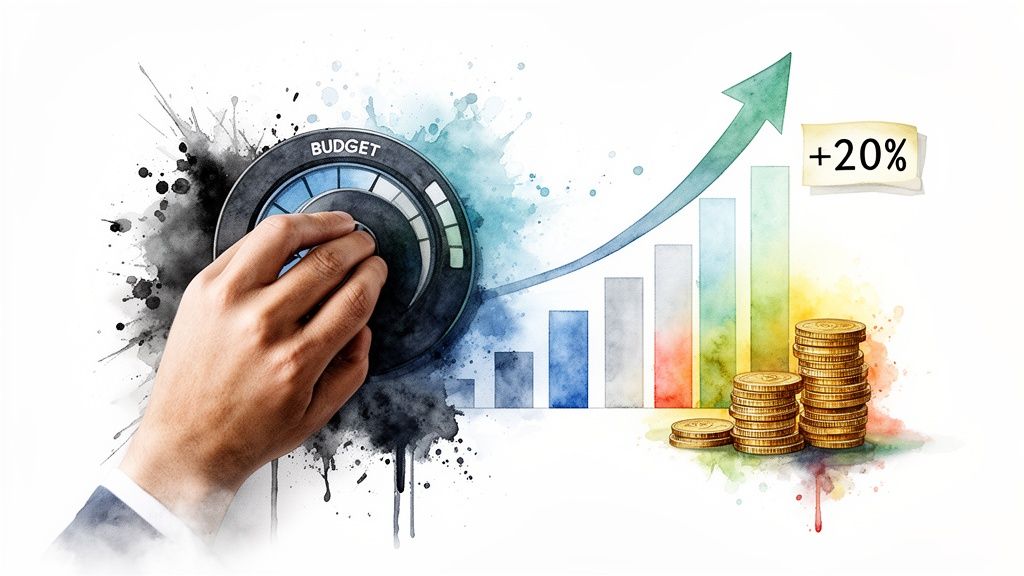
Start by dedicating the bulk of your budget—around 60-70%—to your top-of-funnel (TOFU) prospecting campaigns. This is your growth engine. It keeps your funnel full of new potential customers.
The other 30-40% goes toward your middle-of-funnel (MOFU) and bottom-of-funnel (BOFU) retargeting. This is where you’ll see your highest ROAS. You’re talking to people who already know you, so conversion is an easier lift.
Choosing Your Bidding Strategy
Once you've split your budget, tell Meta how to spend it. Your bidding strategy decides if you chase the most conversions or control your cost per conversion. There are really only two ways to go.
Highest Volume (or Lowest Cost): This tells Meta to get as many conversions as possible within your budget. It’s perfect for TOFU campaigns where the goal is feeding the algorithm data.
Cost Per Result Goal (or Cost Cap): This tells Meta not to bid over a specific amount for a conversion. Use this when you have a hard target CPA to stay profitable. It’s more common in BOFU campaigns.
For most brands starting out, Highest Volume is the way to go. Especially with Advantage+ Shopping Campaigns. Just give Meta’s AI the reins. It has more data than you ever will. Let it work for you.
"AI is supercharging performance for advertisers, especially in e-commerce. It is making campaigns more efficient and more profitable."
— Meta for Business
Benchmark data shows Advantage+ Shopping campaigns averaging roughly a 4.5x ROAS, versus 3.7x for comparable manually-built campaigns — though that gap narrows once you account for the existing retargeting pools ASC tends to lean on. Zooming out, ecommerce advertisers overall are averaging around a 2.87x ROAS, with the median sitting closer to 2x — a reminder that the average gets pulled up by a smaller group of high performers. These numbers show why trusting the algorithm is a core part of any modern playbook.
How to Scale Without Killing Your ROAS
So, you have a winning ad set. ROAS is strong. CPA is low. The first instinct is to dump more money into it.
Don’t.
Sudden, big budget increases will shock the algorithm. It often resets the learning phase and wrecks your performance. Scaling is a methodical process.
We use a simple rule for vertical scaling (increasing spend on a winner): increase the budget by no more than 20% every 2-3 days. This slow increase lets the algorithm adjust without spiking costs. If performance holds, repeat the process.
This works, but it has a ceiling. Eventually, you’ll saturate your audience.
Go Horizontal for Sustainable Growth
That’s when you need horizontal scaling. This isn’t about spending more. It’s about finding new audiences and testing new creative to find your next winner. This is how you build a resilient ad account.
Horizontal scaling looks like this:
Testing new lookalike audiences: If your 1% purchaser LAL is crushing it, test a 3% or 5% version.
Exploring new interest groups: Look at adjacent interests your customers might have.
Launching new creative angles: If your UGC is winning, test founder-to-camera videos or before-and-afters.
This dual approach is key to sustainably growing your ad spend from $100 a day to $1,000 a day and beyond. You’re always optimizing current winners while searching for the next ones. Our guide on how to scale Facebook ads gives a deeper tactical breakdown.
Your Weekly Rhythm: How to Actually Manage and Optimize Meta Ads
Success on Meta isn't about secret hacks. It’s a weekly game of disciplined iteration. Founders who win build a simple, repeatable rhythm. It stops them from making emotional, reactive decisions.
A chaotic approach—checking stats every hour—is the fastest way to burn your budget and your sanity. You need a process. This is the exact weekly workflow we've used to keep hundreds of ad accounts on track.
Here's a simple planner to ground your strategy. It turns ad management into a proactive growth loop.
This schedule isn't just about managing tasks. It's about managing your own psychology as a founder.
Your Weekly Operations Cadence
This rhythm is predictable. You create time for analysis, creativity, and execution. You make smart decisions based on data, not panic.
Monday Analysis: Dive into the last 7 days of performance. Look at your key metrics. What worked? What tanked? Document your takeaways.
Tuesday Ideation: Brainstorm new creative angles based on Monday's findings. If UGC ads crushed it, get more. If an angle failed, try the opposite approach.
Wednesday Creation: This is production day. Shoot videos, edit images, write copy. Get your assets ready.
Thursday Launch: It's time to execute. Kill underperforming ads. Launch new creative tests. Shift budget to winners.
Friday Monitoring: A quick check-in. Make sure new campaigns are delivering. Put out any fires before the weekend.
Adopting this simple cadence brings order to your ad account. Our guide on structuring an ecommerce weekly meeting can help formalize this process.
KPIs That Actually Matter
Don't get lost in Ads Manager metrics. Most of it is noise. For a DTC brand, your success boils down to a few core numbers.
Your north star isn't likes or comments. It's profitability. Are you making more than you're spending to acquire a customer? Everything else is secondary.
Focus on these three essential KPIs:
Cost per Purchase (CPA): How much does it cost to get one customer? This is your most critical efficiency metric. You have to know your target CPA.
Return on Ad Spend (ROAS): For every dollar you put into Meta, how many dollars in revenue come out? This measures the direct return from your ads.
Marketing Efficiency Ratio (MER): This is your blended ROAS, or "true ROAS." It's Total Revenue / Total Ad Spend. This gives you a high-level view of your marketing’s health. It smooths out attribution gaps.
Platform-reported ROAS is useful. MER is your bullshit detector. It tells you the real-world truth about your profitability.
Reporting Without the Spreadsheets
As a founder, you don't have time to fight with spreadsheets. Your reporting needs to be fast, clear, and actionable.
The goal is a single source of truth. Connecting your Shopify, Meta, and Klaviyo data is a necessity. Modern tools pull all your data into one clean dashboard.
This unified view helps you see not just ROAS, but New Customer ROAS. You know if you're acquiring new buyers or just selling to your existing list. To do this right, using specialized e-commerce growth data analysis tools for LTV, CAC, and cohorts is essential.
This is how you get instant clarity. It’s how you operationalize your strategy for repeatable success.
Your Ecommerce Meta Ads Questions Answered
Every founder we talk to asks the same questions. They're the same anxieties we had. Here are straight answers, pulled from our experience.
How Long Does It Take to See Results with a New Meta Ads Strategy?
There's no magic switch. Be patient. The first 1-2 weeks are for the algorithm to get its bearings. You'll see early data, but don't expect instant profits.
By the 30-day mark, you should have a clear read on your initial ROAS and CPA. The brands that win commit to a weekly rhythm of testing. They don't panic.
Don't pull the plug after a few bad days. Let the data guide you over a 7- to 14-day window. The algorithm needs time and data to find your people.
What Is a Good Starting Budget for a DTC Brand?
This comes down to your product's price. $50-$100 per day is the absolute minimum. This gives Meta's algorithm enough fuel to exit the learning phase.
Think of it this way. If your target CPA is $50, you need to spend at least that much daily to get one sale. Most brands we work with start closer to $5,000/month. That budget allows for real testing and gets you data fast.
Should I Use Advantage+ Shopping Campaigns or Manual Campaigns?
Use both. It's not an either/or debate. A healthy ad account runs them in tandem.
Advantage+ (ASC) is a beast. Start by feeding your best creative into an ASC campaign with broad targeting. Benchmark data shows ASC campaigns outperforming comparable manual campaigns on ROAS by a meaningful margin, though results vary by brand and the size of your existing retargeting pool. You can't ignore that.
But don't give up manual control. Manual campaigns are essential for granular retargeting. Targeting 7-day cart abandoners with a specific discount is a classic, high-return tactic. A solid setup involves an "always-on" ASC campaign for prospecting, with manual campaigns layered on top.
My ROAS Is Low. What Should I Fix First?
Don't panic. Diagnose the problem methodically.
Start with the ad. Is the creative compelling? Is the offer clear? Check your Click-Through Rate (CTR). A CTR below 1% is a red flag that your creative isn't landing.
Then, look at your landing page. If your CTR is high but your conversion rate is low, the problem is likely what happens after the click. Is the page slow? Does the page message match the ad?
Finally, check your audience. If the creative and landing page are solid, you might be talking to the wrong people.
Isolate one variable. Test new creative first. If that doesn't work, test a new offer. Still stuck? Test a new audience. This is how you systematically fix the weak link in your funnel.
Ready to stop guessing and start growing? Needle is your AI marketing agency in one tab. We build your strategy, create the assets, launch the campaigns, and deliver weekly learnings—at a fraction of the cost of a traditional agency.
Book your demo and see how Needle can transform your marketing workflow.
Frequently Asked Questions (FAQ)
What is a good ROAS for ecommerce on Meta ads?
A "good" ROAS depends on your profit margins. A general benchmark is a 3:1 ROAS (or 3x), meaning you make $3 in revenue for every $1 spent. However, for top-of-funnel prospecting, a lower ROAS is acceptable. For bottom-of-funnel retargeting, you should aim for a much higher ROAS, often 5x or more. Your true north star is Marketing Efficiency Ratio (MER).
How often should I test new ad creative?
You should have a weekly rhythm. Launch new creative tests every week. This allows you to constantly fight ad fatigue and find new winning angles. A simple cadence is: Analyze performance on Monday, brainstorm ideas on Tuesday, create assets on Wednesday, and launch tests on Thursday.
What's the difference between Advantage+ Shopping and manual campaigns?
Advantage+ Shopping Campaigns (ASC) use Meta's AI to automate targeting, ad placement, and delivery across the entire funnel. You give it a budget, creative, and location. Manual campaigns give you granular control over audience targeting (e.g., retargeting specific website visitors), placements, and bidding. A strong strategy uses both.
How do I calculate my Marketing Efficiency Ratio (MER)?
MER is your total store revenue divided by your total ad spend across all channels for a specific period (e.g., a month). The formula is: MER = Total Revenue / Total Ad Spend. This gives you a "blended ROAS" that shows the true health of your marketing efforts, smoothing out attribution issues.
Why is my Cost Per Purchase (CPA) so high?
A high CPA can be caused by several factors. The most common are: 1) Your creative isn't effective (low CTR), 2) your landing page isn't converting (slow, confusing, or bad offer), or 3) you're targeting the wrong audience. Systematically test each of these variables to diagnose and fix the problem.