
Running a DTC brand is chaos. You're the founder, marketer, and janitor, all at once. The last thing you need is to burn cash on Facebook ads that don't convert. Yet, many founders watch their ad spend disappear with nothing to show for it.
The average cost per click (CPC) for retail on Facebook is around $1.35. Without a tight strategy, those clicks add up fast and rarely turn into sales.
We've been there. We've managed ad accounts for over 200 DTC brands. We’ve spent millions learning what actually moves the needle. This isn't theory. These are the exact, no-fluff Facebook ad tips we use to turn ad spend into profit. We've distilled our experience into a practical guide that gets straight to the point.
This article gives you a blueprint for fixing a leaky ad budget. We cover ten critical areas with actionable steps for each.
Let's fix your ads and plug the leaks in your marketing budget.
1. Nail Your Audiences Before You Spend a Dollar
Spending money on ads without a defined audience is like shouting into a hurricane. You’re making noise, but no one who matters can hear you. The most fundamental of all Facebook ad tips is to use the data you already own. Start with Custom Audiences.
Custom Audiences are your warmest leads. These people have already engaged with your brand. They’ve visited your site, subscribed to your newsletter, or bought from you. Facebook lets you upload these lists to target them directly.
Actionable Steps for Implementation:
Start by creating Custom Audiences from your most valuable sources. Don't just upload a giant, messy list. Segment it.
High-LTV Customer List: Upload a CSV of your top 10% of customers. These are your VIPs.
Recent Purchasers: Create an audience of people who bought in the last 30-60 days to upsell them.
Email Subscribers: Sync your email list to target engaged subscribers who haven't bought yet.
A Meta-commissioned study by Nielsen found campaigns using Custom Audiences saw a 14% higher return on ad spend. They also had a 37% lower cost-per-acquisition than campaigns using only demographic targeting. This isn't a small lift. It's a foundational advantage.
Once you have these high-quality seed audiences, create Lookalike Audiences from them. A Lookalike based on your top buyers is far more powerful than one based on all website visitors. This focused approach ensures your budget targets prospects who mirror your best customers. It’s the single best way to ensure your creative and budget aren't wasted.
2. Implement Strategic Ad Placement and Format Selection
Relying on a single ad placement is like fishing with only one hook in the ocean. You're missing most of the opportunities. Facebook's ecosystem is diverse, spanning Feed, Stories, Reels, and Messenger. A top Facebook ad tip is to choose placements and formats that align with your goals and where your audience lives online.
Your ad format dictates how your story is told. A static image works for a clear, bold offer. A Carousel ad lets you showcase an entire collection. A video on Reels can capture attention with authentic, short-form content. The right combination ensures your creative resonates in each placement, preventing your ad from feeling disruptive.
Actionable Steps for Implementation:
Start with Meta's Advantage+ Placements to gather initial data. After a few days, analyze the performance breakdown by placement and begin optimizing.
Analyze and Refine: Dive into your Ads Manager reporting. If Reels deliver a low cost-per-purchase while the Audience Network burns cash, manually adjust your placements to fund the winners.
Match Format to Placement: Don't run a square feed video in a vertical Stories placement. Create dedicated vertical assets (9:16 ratio) for Stories and Reels.
Test Dynamic Formats: Use Carousel ads to tell a sequential story. For e-commerce, Collection ads are powerful for driving product discovery directly from the ad.
A 2022 study by Socialinsider analyzed over 51 million Facebook posts and found that video content consistently got the highest engagement. When applied to ads, this format can lead to higher reach and interaction for a lower cost.
While letting the algorithm do the initial work is a solid start, the real gains come from manual analysis. Review your placement data weekly. Double down on what's driving results and cut what isn't. This refinement turns a good campaign into a great one.
3. Leverage Video Content for Higher Engagement
In the crowded, fast-scrolling world of social media, static images often blend in. Video, however, commands attention. It’s dynamic, engaging, and favored by Meta's algorithm. That translates to better reach and lower costs. Video lets you tell a story, show product value, and build a connection far more effectively than a single image.
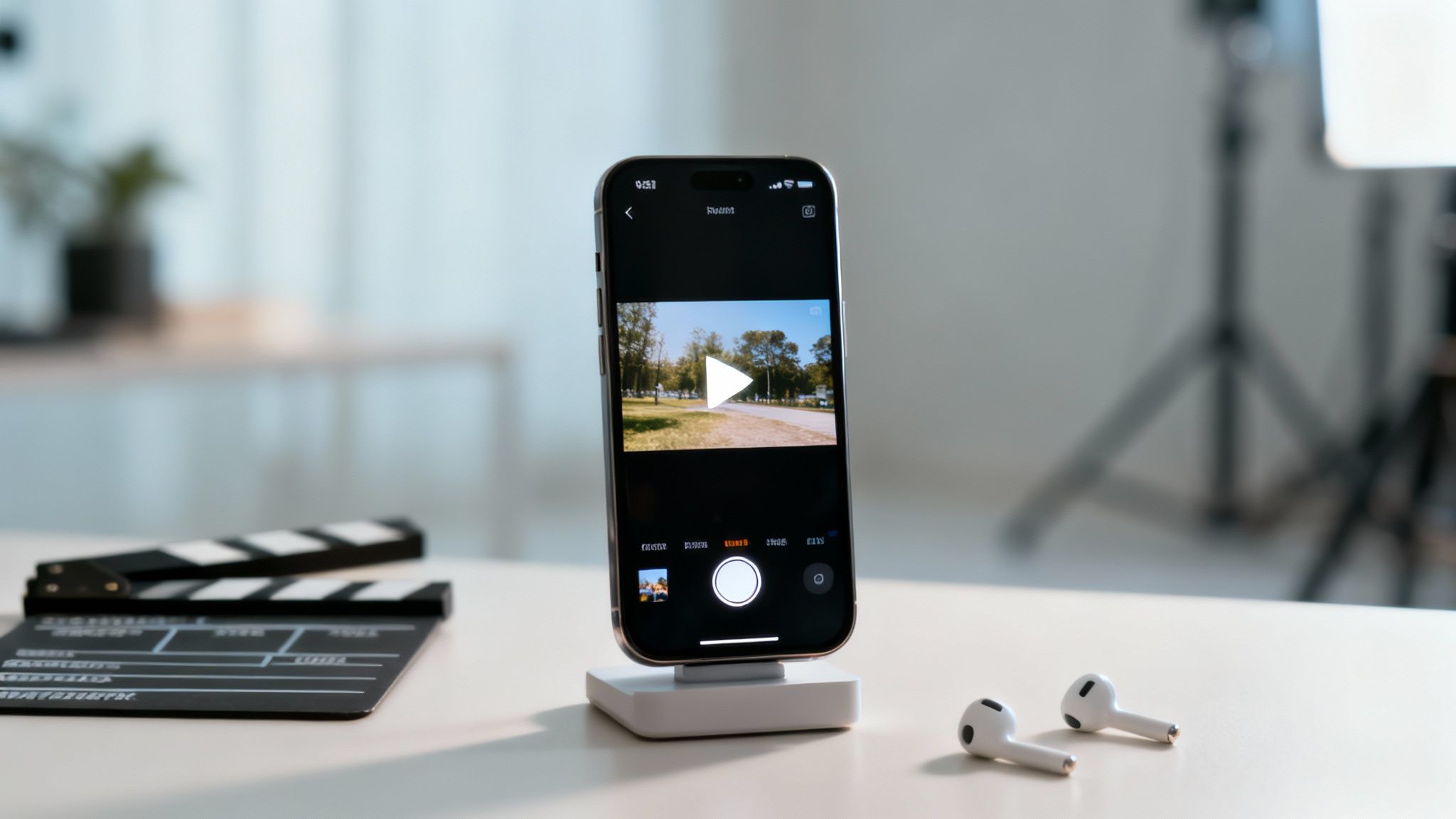
From short clips that grab users in three seconds to longer testimonials that build trust, video is a versatile tool. Brands like Dollar Shave Club built empires on the back of one viral video. The right creative can redefine a business. This is one of the most crucial facebook ad tips for modern advertisers.
Actionable Steps for Implementation:
To make your video ads work, build them for the platform. This means optimizing for mobile, silent viewing, and short attention spans.
Hook Immediately: Capture attention in the first 3 seconds with a bold claim, a surprising visual, or a direct question. You have no time to waste.
Design for Sound-Off: A staggering 85% of Facebook videos are watched without sound. Use clear, easy-to-read captions to convey your message.
Optimize for Mobile: Shoot and edit in a vertical 9:16 aspect ratio. This format fills the entire screen on mobile devices.
Keep It Concise: For most top-of-funnel ads, aim for a 6-15 second runtime. Get to the point quickly and finish with a strong call-to-action.
According to a study by Meta, ads with motion consistently outperform static-only campaigns. They found adding motion to static assets led to a median 17% lift in conversion rates. Even simple animation can impact your bottom line.
Creating a constant stream of high-quality video can be expensive. To keep your creative fresh and cost-effective, exploring modern AI video generator tools can help produce variations at scale. Test different hooks, thumbnails, and CTAs to find what works.
4. Master A/B Testing and Statistical Significance
Running ads without A/B testing is like navigating blindfolded. You’ll waste time and money. Split testing is the process of comparing ad variations to see what truly resonates. It allows data, not guesswork, to guide your choices.
A/B testing isolates a single variable between two or more ads. This could be the creative, headline, call-to-action, or audience. By changing only one element at a time, you can confidently attribute performance differences to that specific change. This method is fundamental to any high-performing Facebook ad strategy.
Actionable Steps for Implementation:
Start with high-impact variables first. Don't waste time testing minor copy tweaks when a different image could produce a far greater lift. Isolate your tests and document everything.
Creative First: Pit your best product shot against a user-generated content (UGC) video. This test often reveals what creative format your audience prefers.
Headline Hooks: Test a benefit-driven headline ("Get glowing skin in 30 days") against a feature-driven one ("Contains 2% Hyaluronic Acid").
Audience Segmentation: Run the same ad to two different Lookalike Audiences. Test a 1% Lookalike of your high-LTV customers against a 1% Lookalike of your email subscribers.
According to research, consistent A/B testing can increase lead generation by as much as 25% for the same ad spend.
Don't end a test too early. For a test to be valid, it needs to reach statistical significance. Run your tests for at least 7-14 days with an adequate budget. Once you have a clear winner, turn off the losing variation and build your next campaign around the insights you’ve just proven. This iterative process compounds small wins into massive gains.
5. Optimize for Conversion with Pixel Implementation
Advertising without tracking conversions is like flying a plane blind. You’re moving forward but have no idea if you’re heading toward your destination. The Meta Pixel is the code that connects your website’s activity to your ad account. It makes data-driven decisions possible.
It’s a snippet of code that tracks user actions, like an "Add to Cart" or a "Purchase." This data feeds back into Ads Manager. It allows Meta’s algorithm to optimize your campaigns for actions that matter to your business, not just clicks. Without it, you're guessing.
Actionable Steps for Implementation:
Proper Pixel setup is non-negotiable. It's the first thing you should do before launching a campaign. For a full guide on setting up accurate data collection, review a modern Facebook ad tracking guide.
Install the Base Code: Place the Meta Pixel base code on every page of your website. This is typically done in the
<head>section.Track Key Standard Events: Go beyond page views. Implement events for actions like
ViewContent,AddToCart,InitiateCheckout, andPurchase.Include Value Parameters: For purchase events, always pass back the currency and value. This lets you accurately measure ROAS directly in Ads Manager.
Test and Verify: Use Meta’s Events Manager and the Pixel Helper browser extension to test that your events are firing correctly.
A study by Facebook IQ revealed that advertisers using both the Pixel and Conversion API saw a 13% median decrease in cost per action. This highlights the power of sending clean, reliable conversion data to Meta’s optimization engine.
Once your Pixel is collecting high-quality data, you can unlock powerful strategies. You can retarget users who abandoned their cart and build value-based Lookalike Audiences. This is one of the most essential Facebook ad tips for building a profitable advertising engine. These insights also help with improving your overall e-commerce conversion rate.
6. Use Audience Insights and Detailed Targeting Filters
Guessing your audience’s interests is a recipe for burning cash. Stop assuming and start using data. Facebook’s detailed targeting filters let you move beyond broad demographics. You can target specific interests, behaviors, and job titles. This is how you find pockets of high-intent buyers others miss.
This tool allows you to build audiences based on what people do, like, and where they work. A fitness brand can target users interested in "CrossFit" and "Organic Food," not just people aged 25-34. This precision ensures your ad creative speaks directly to a relevant audience, boosting engagement and lowering costs.
Actionable Steps for Implementation:
Start with a clear hypothesis of who you're trying to reach, then use targeting to test it. Don't be afraid to get granular.
Layer Interests and Behaviors: Don't just target "Adventure Travel." Layer it with a behavior like "Frequent International Travelers." This finds people with both desire and means.
Target by Job Title: For B2B or high-ticket items, directly target professionals. A company selling project software should target "Project Managers" and "Operations Directors."
Use Purchase Behavior: Target users classified as "Engaged Shoppers." This Meta-defined behavior identifies people who have clicked the "Shop Now" button in the past week.
A study in the Journal of Interactive Marketing found that ads tailored with behavioral data achieved a 670% higher conversion rate than those using only demographic data. This shows that understanding customer intent is more effective than just knowing their age and location.
Use these detailed filters to build specific personas for testing. Create one ad set for the tech-savvy early adopter and another for the budget-conscious professional. Let performance data tell you which persona is your true ideal customer. This is one of the most effective Facebook ad tips for finding scalable new audiences.
7. Craft Compelling Ad Copy and Headlines
Your creative might stop the scroll, but your copy seals the deal. Poorly written ad copy is a guaranteed way to waste ad spend. Effective copy grabs attention, states the value, and tells the user what to do next. It bridges the gap between seeing your ad and clicking.
The headline is your first impression. The body copy needs to address a pain point. The call-to-action (CTA) must be a clear directive. This is one of the most vital Facebook ad tips because it directly controls your click-through rate. Don't treat it as an afterthought.
Actionable Steps for Implementation:
Start with a simple framework: Headline (Hook), Body (Benefit), and CTA (Action). Test multiple variations of each component.
Hook with Benefits: Lead with the strongest benefit, not a feature. Instead of "Our shoes have orthopedic soles," try "End Foot Pain With Every Step."
Use Specific Numbers: Quantify your claims. "Increase Sales by 40% in 30 Days" is more powerful than "Boost your sales."
Create Urgency: Use time-sensitive language. "Only 3 Items Left" or "50% Off Ends Tonight."
Copywriting expert Joanna Wiebe of Copyhackers says, "Listen to how your customers describe their problems and desired outcomes. Use their exact words in your ads for instant resonance."
Once you have your core message, refine it with direct language ("You"). Inject social proof where possible, like a short customer quote. This approach ensures your copy isn't just well-written; it's engineered to convert.
8. Implement Retargeting and Sequential Messaging Strategies
Letting a first-time website visitor leave is a massive missed opportunity. Most people don't convert on their first visit. Retargeting serves ads to people who have already engaged with your brand. It guides them from interest to purchase. This is one of the highest-ROI Facebook ad tips because you're talking to a warm audience.
This multi-touch approach builds brand familiarity and trust. You serve different creative and messaging at each stage. An abandoned cart deserves a different message than a first-time blog reader. This strategy acknowledges their context and increases the likelihood of conversion.
Actionable Steps for Implementation:
Start by mapping out a simple three-stage sequence. You're not just reminding them you exist; you're actively guiding them.
Awareness/Engagement (Visited site, 7-14 days ago): Show them a brand video or a testimonial. The goal is to reinforce brand value, not a hard sell.
Consideration (Viewed Product or Added to Cart, 3-7 days ago): Use Dynamic Product Ads to show them the exact items they viewed.
Conversion (Abandoned Cart, last 3 days): Get direct. Offer a small incentive like free shipping or a 10% discount to close the deal.
According to a study by Criteo, retargeted visitors are 70% more likely to convert on a retailer's website. This highlights the power of re-engaging users who have already shown intent. For a deeper dive, explore our guide on what retargeting is in digital marketing.
Always exclude recent purchasers from your general retargeting campaigns. By segmenting your audience based on their last action, you create a personalized ad experience that feels helpful, not intrusive. This methodical follow-up is key to maximizing the value of every website visitor.
9. Optimize Budget Allocation and Bidding Strategies
Throwing your entire budget at a single campaign is a recipe for wasted spend. Strategic budget allocation and smart bidding control costs and maximize efficiency. It’s about telling Facebook what outcome you value most and how much you're willing to pay for it.
Your bidding strategy tells Facebook's algorithm what to optimize for. "Highest Volume" lets the algorithm get the most results possible. A "Cost Per Result Goal" or "ROAS Goal" gives it stricter cost parameters. This choice directly impacts who sees your ads.
Actionable Steps for Implementation:
Start with a structured budget allocation and the right bid strategy. Actively manage your spend based on performance.
Implement the 70/20/10 Budget Rule: Allocate 70% of your budget to proven, top-performing campaigns. Put 20% toward scaling promising ad sets. Dedicate the final 10% to pure testing of new audiences or offers.
Match Bid Strategy to Objective: For conversion campaigns with over 50 conversions per week, use a "ROAS Goal" to focus on profitability. For lead generation, a "Cost Per Result Goal" can keep your CPL in check.
Use Campaign Budget Optimization (CBO): Enable CBO to let Facebook automatically distribute your budget to the best-performing ad sets within a campaign.
According to Meta's own guidance, advertisers using a ROAS goal bidding strategy saw a median 17% increase in return on ad spend compared to those using a cost cap. This highlights the power of aligning your bid strategy with your business objective.
Once your campaigns are live, monitor performance daily. Shift budget from underperforming campaigns to your winners. For a deeper dive into managing spend, learn how to scale Facebook ads. This disciplined approach is one of the most critical Facebook ad tips for turning ad spend into predictable revenue.
10. Build Brand Recognition Through Consistent Creative and Messaging
Running disconnected ads is a fast way to burn cash and confuse customers. When a prospect sees your ads, they should instantly know it’s you. Consistent creative and messaging build a mental shortcut, so your brand becomes familiar and trustworthy. This builds brand equity with every impression you pay for.
Brand consistency means using the same visual identity and messaging tone across every touchpoint. Think of Apple's minimalist design or Coca-Cola's iconic red. You know their ads before you read them. This ensures that even if a user doesn't click immediately, the ad still contributes to long-term brand recall.
Actionable Steps for Implementation:
Start by codifying your brand identity. Consistency doesn't mean boring; it means creating a strong, recognizable framework.
Create Brand Guidelines: Develop a simple document outlining your official logo usage, color palette, and typography. This is your brand's rulebook.
Establish Core Messaging Pillars: Define 2-3 key value propositions that appear consistently in your ad copy. For Nike, it's empowerment and athletic achievement.
Use Creative Templates: Design a few core ad templates in tools like Canva or Figma. This ensures your team can produce on-brand creative quickly.
According to a Lucidpress report, consistent brand presentation across all platforms can increase revenue by up to 23%. Customers are more likely to buy from brands they recognize and trust. Consistency is the foundation of that trust.
This approach is one of the most vital Facebook ad tips for long-term success. A one-off viral ad might bring a short-term sales spike, but a consistent brand presence builds a moat around your business. It turns passive scrollers into loyal customers who choose you because they know and trust your brand.
Facebook Ads: 10-Point Comparison
Stop Tinkering and Start Systematizing
We've covered a lot. You now have a comprehensive playbook of Facebook ad tips. The path to profitable scaling isn't a secret hack. It’s built on the consistent, disciplined execution of these fundamentals.
True mastery isn't about frantically tweaking campaigns. It's about building a reliable system that executes proven strategies, learns from data, and adapts. The goal is to move from a reactive campaign manager to a proactive brand builder.
Key Takeaways: From Theory to Action
If you remember nothing else, focus on these three pillars:
Audience is Everything: Your creative can be brilliant, but if you're showing it to the wrong people, you're burning cash. Consistently refine your custom audiences and never stop digging into Audience Insights. Your targeting is the foundation.
Creative is the Variable: Your creative is your most powerful lever. A relentless testing cadence for video, images, and copy isn't optional; it's mandatory. Always be testing new hooks and angles to fight ad fatigue and find your next winner.
Data-Driven Decisions, Not Guesses: Stop relying on gut feelings. Use A/B testing to validate your ideas. Monitor your key KPIs daily and use that information to guide your budget. As Peter Drucker famously said, "What gets measured gets managed."
Building Your Marketing Engine
Think of these Facebook ad tips as components of a machine. Each tip is a gear. When they work together, they create a powerful engine for growth.
The problem for most DTC founders is the manual effort required to keep this engine running. Juggling spreadsheets, creative briefs, and Ads Manager is a full-time job. It pulls you away from product, customers, and brand strategy.
This is where operationalizing your strategy becomes critical. You need to move beyond tinkering and start systematizing. The most successful brands don't just have better ads; they have better systems. They've figured out how to consistently launch, test, and optimize without getting bogged down. This is their true competitive advantage.
Ready to turn these Facebook ad tips into an automated growth engine? Needle connects to your store data, suggests high-impact campaigns, and automates the creative production and launch process. Get the strategic power of a seasoned agency with the speed and efficiency of software by visiting Needle.
Frequently Asked Questions (FAQ)
What is the most important Facebook ad tip for beginners?
Nail your audience first. Use Custom Audiences from your existing customer or email lists to create high-quality Lookalike Audiences. Showing a great ad to the wrong people is the fastest way to waste money.
How much should I spend on Facebook ads per day?
Start small and scale with what works. A common starting point is $20-$50 per day per ad set for testing. Once you find a winning combination of creative and audience that is profitable, you can begin to increase the budget by 15-20% every few days.
Why are my Facebook ads not converting?
Common reasons include:
Wrong Audience: You're targeting people who aren't interested.
Weak Creative: Your ad doesn't stop the scroll or communicate value.
Poor Offer: Your product, price, or call-to-action isn't compelling.
Bad Landing Page: Your website is slow, confusing, or untrustworthy.
Start by A/B testing your creative and audience to identify the weak link.
How long should you run a Facebook ad before deciding if it's working?
Let an ad run for at least 3-5 days before making major decisions. This gives Facebook's algorithm time to exit the "learning phase" and stabilize performance. You need enough data (at least 1,000 impressions) to make an informed choice. Don't turn off an ad after just one bad day.