
Shopify marketing automation is about making your store sell for you, 24/7. It's software that sends the right message to the right person at the right moment. All on autopilot. This is how you stop sending one-off campaigns. You start building automated relationships that guide customers from their first look to their tenth purchase.
What Is Shopify Marketing Automation Really

Let's cut the fluff. Shopify marketing automation isn't about complicated tech you'll never use. It's about building a machine that runs your marketing while you're asleep, shipping orders, or designing your next product.
Think of it as your best salesperson, cloned. This salesperson knows every customer's name. They know what they just browsed, and what they bought last time. Then, it sends perfectly timed, personal messages that drive sales. That's it.
It's the difference between shouting one message to your entire list and sending a specific offer to someone who left a product in their cart two hours ago. One is marketing at people. The other is a real conversation.
How Automation Changes The Game
Without automation, you're stuck on a hamster wheel. You constantly build one-off email campaigns. You post to social media by hand. You try to track customers in a messy spreadsheet. It’s exhausting. It doesn't scale.
With automation, you build the systems once. They run for you indefinitely. This frees you up to work on the business, not just in it. You can focus on your products, your brand, and your big-picture goals.
According to a study by EmailMonday, businesses using automation see up to a 14.5% increase in sales productivity. Core automated flows, like abandoned cart reminders, often generate significant revenue per email.
"Automation is not about being lazy. It is about being smart and efficient." - Andrew Youderian, Founder of eCommerceFuel.
Manual Marketing vs. Automated Marketing
Here’s a quick look at how automation changes your daily tasks. It’s a complete shift from reactive operator to proactive strategist. For an even deeper dive, check out our complete guide to marketing automation for ecommerce.
Instead of just keeping up, you finally get ahead.
This isn't magic. It’s just a smarter way to run your business. Once you set it up, you can scale revenue without scaling your workload.
The Four Automation Flows That Drive 80% Of Revenue
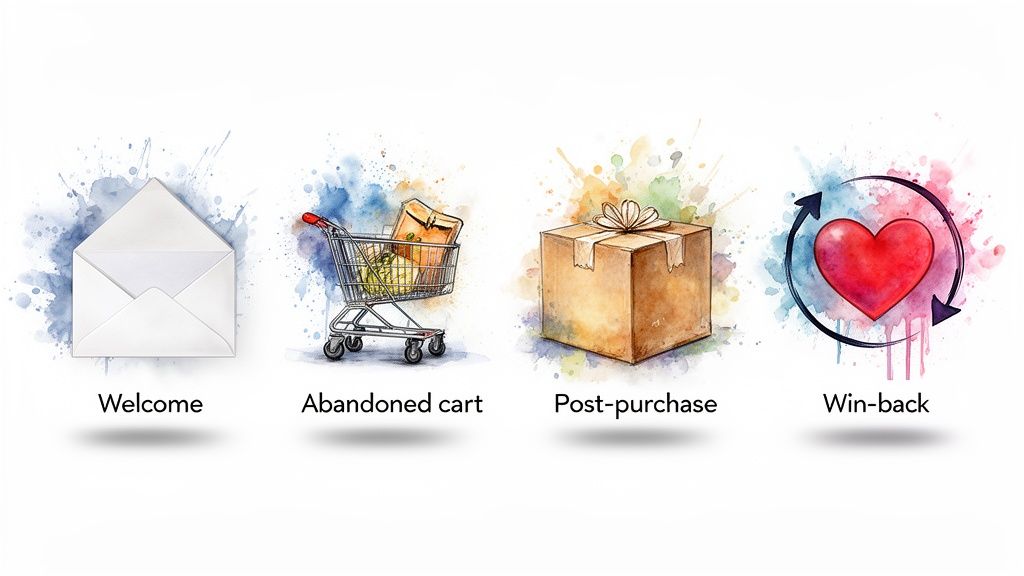
Don't try to boil the ocean. If you’re just getting started with Shopify marketing automation, stop worrying about dozens of complicated workflows. Focus on the few flows that actually make you money.
We’ve seen it time and again. These four automated series are the engine of a successful DTC brand.
Get these right. You've built a system that mints cash on autopilot. Here’s the blueprint for each one.
1. The Welcome Series
The goal here is simple: turn a new subscriber into a paying customer. Someone just gave you their email. They're warm, but they aren't sold yet. This is your one chance to make a killer first impression. Guide them straight to checkout.
Don't just send one lame "thanks for signing up" email. A real welcome series is 3-5 emails dripped out over a week. Welcome emails generate 4x the open rates and 5x the click rates of other emails.
Email 1 (Immediately): Deliver the goods. If you promised a discount, give it now. Introduce your brand’s mission. Keep it short. Stick to one call-to-action.
Email 2 (Day 2): Show off your greatest hits. Feature best-selling products. Add social proof like customer quotes or "As Seen In" logos.
Email 3 (Day 4): Tackle their hesitations head-on. Answer common questions. Explain what makes your products different.
Email 4 (Day 6): Light a fire. Remind them their welcome offer is expiring. A little urgency goes a long way.
Your tone should be helpful and confident, not desperate. You're starting a relationship.
2. The Abandoned Cart Flow
This is the single most profitable automation you can build. Full stop. Baymard Institute finds the average cart abandonment rate is nearly 70%. That’s a massive pile of money on the table. This flow goes and scoops it back up for you.
An effective cart recovery sequence is a smart mix of timing and offers. It's usually a 3-part series over 24-48 hours.
This flow is pure profit recovery. These shoppers showed high intent by adding an item to their cart. You just need to give them a gentle shove over the finish line.
Timing is everything. The first email needs to hit their inbox within 1-2 hours. The next messages can follow over the next day. To capture high-intent visitors before they leave, a lead generation chatbot can engage users on your site.
For a masterclass on this, read our guide on the Shopify abandoned cart email strategy.
3. The Post-Purchase Series
The sale isn’t the end of the conversation. It’s the beginning. A customer just trusted you with their money. Your job now is to make them feel brilliant for doing so. Kill any buyer's remorse. And set up the next sale.
Think beyond the default order confirmation.
Email 1 (Immediately after purchase): A genuine "thank you." Reiterate your brand's mission. Remind them what their purchase supports.
Email 2 (When the order ships): Build the hype. Let them know the good stuff is on its way.
Email 3 (7-14 days after delivery): Ask for a review. Offer a small incentive if you have to. This generates the social proof you need.
Email 4 (30-60 days later): Time for the cross-sell. Suggest a product that pairs with their first purchase. Or remind them to restock.
This flow forges brand loyalty. The tone should feel grateful and supportive.
4. The Customer Win-Back Flow
It's a fact of life in ecommerce: some customers go quiet. This flow is your automatic system for waking them up. It is far cheaper to keep a customer than to find a new one. Acquiring a new customer can cost 5x more than retaining an existing one.
This automation usually kicks in when someone hasn't bought in 90 or 120 days. The goal is simple: remind them you exist. Give them a good reason to come back.
Email 1 (e.g., at 90 days): A gentle nudge. "We miss you." Show them what’s new since their last visit.
Email 2 (14 days later): Bring out the big guns. This is where you deploy a steeper discount, like 20% off. Frame it as an exclusive "come back" offer.
Email 3 (7 days later): The final notice. Create real urgency around the expiring offer. If they still don't bite, you can move them to a "sunset" segment that gets fewer emails.
Your tone here can be more direct. You’re trying to win back their business with a clear, valuable offer. Nail these four flows. You’ll have a rock-solid foundation for your Shopify marketing automation strategy.
How To Measure The Real ROI Of Your Automation
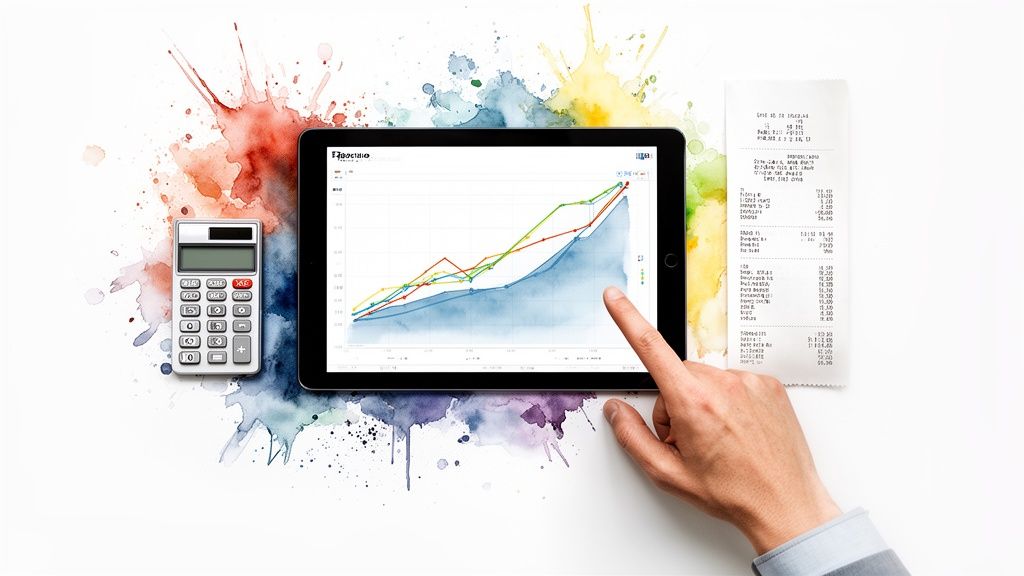
It’s easy to get lost in vanity metrics. Open rates and click rates are clues, not conclusions. The only question that matters is this: is your Shopify marketing automation making you money?
Your job is to connect every marketing dollar to your bottom line. We need to talk about revenue.
When you can prove your automations drive sales, the cost of the tools is an afterthought. If your tech costs $500 a month but your abandoned cart flow brings in $5,000, that's a clear win. That’s the clarity we’re aiming for.
The KPIs You Should Obsess Over
Your dashboard is probably overflowing with numbers. Ignore most of them. For every automated flow you build, obsess over three core metrics. They tell the entire story.
Attributed Revenue: This is the money in the bank. It's the total sales directly credited to a specific email or flow.
Conversion Rate: Of all the people who got the email, what percentage actually bought something? This shows how effective your copy, offer, and timing are.
Revenue Per Recipient (RPR): This shows you how much each email is worth on average. It’s a powerful way to compare the financial impact of different flows.
These three metrics are your north stars. If they’re climbing, your automation is working. If they’re flat, it’s time to start testing.
A healthy automation program isn’t a cost center. It’s a revenue-generating machine. Mature DTC brands often see automated flows drive 25-40% of their total store revenue.
This isn't a "set it and forget it" game. You need to be in these numbers weekly. A tiny tweak to a subject line can have a massive impact on your revenue over a year.
Calculating Your Return On Investment
ROI is a simple idea: Did you make more than you spent? To figure it out, you need two numbers. The money your automations generated and the total cost of the tools you used.
The formula is dead simple:
(Attributed Revenue - Total Cost) / Total Cost = ROI
Let's run a quick example.
Your abandoned cart flow generated $5,000 last month.
Your welcome series brought in another $2,500.
Your Klaviyo subscription cost $400.
Total Revenue from Automation = $7,500
Total Cost = $400
($7,500 - $400) / $400 = 17.75
Multiply that by 100 to get the percentage. That’s a 1,775% return on your investment. When you frame it like that, the software cost is a no-brainer. For a more detailed look, check our guide on how to calculate marketing ROI.
What Does ‘Good’ Look Like?
Knowing your numbers is the first step. Knowing how they stack up is the next. We’ve worked with hundreds of brands. We have a good idea of what's possible.
Top-performing email marketers see an average ROI of 3,600%, or $36 for every $1 spent. The quickest win is almost always the abandoned cart flow. It can lift a store’s total revenue by 5-15% on its own.
Here are some typical performance benchmarks to aim for.
Typical Flow Performance Benchmarks
If your numbers are below these, don’t panic. It just means you have a clear, data-backed opportunity to grow. Start by testing your offers. Tweak your email copy. Adjust your timing. Small improvements build a profitable automation engine.
Integrating Your Core Tools Without The Headache

Here's the truth: if your marketing tools don't talk to each other, you're creating more work and leaving cash on the table. A disconnected tech stack is like a sales team where nobody speaks the same language. Total chaos.
This integration is the central nervous system of your Shopify marketing automation. It’s not about buying more software. It's about forcing your core systems—your Shopify store, your Klaviyo account, and your Meta ads—to work together.
When these are linked up properly, marketing stops being guesswork. You’re no longer just throwing spaghetti at the wall. Instead, you're making decisions backed by real data. For any brand that wants to scale, getting this right is non-negotiable.
Why Your Tools Must Be Connected
Imagine a retail shop where the front door, the register, and the stockroom aren't connected. That's what it feels like to run a Shopify store when your tools operate in silos.
The goal is a seamless flow of data between your tools.
Shopify to Klaviyo: This connection is mission-critical. When Klaviyo knows what a customer viewed, added to cart, or bought on Shopify, you can trigger insanely relevant emails. Without this, you’re just sending generic blasts that get ignored.
Klaviyo to Meta: This is your secret weapon for smarter ads. By syncing your best customer segments from Klaviyo (like VIPs) to Meta, you can build powerful lookalike audiences. You’re telling Meta, "go find more people who look just like my best customers."
This turns a random collection of apps into a real marketing engine. The ecommerce marketing automation software you choose should make this connection feel effortless.
The Power Of A Connected System
When your systems are in sync, you unlock a new level of marketing precision. The data from one tool feeds the next. This creates a powerful feedback loop that gets smarter over time.
Think about this flow:
A customer buys a dog leash from your Shopify store.
That purchase data syncs instantly to Klaviyo.
Thirty days later, Klaviyo automatically sends an email suggesting the matching collar.
They are now a high-value customer and are added to a "VIP" segment. That segment is then synced to Meta to build a high-performing lookalike audience.
This isn’t a complicated theory. It's the practical reality of how modern DTC brands are built. Each piece of data informs the next action. This creates a customer journey that feels intentional and helpful.
The market for this tech is exploding. A report from Statista projects the marketing automation market will reach over $11.9 billion by 2029. Klaviyo has cemented its place in the Shopify ecosystem. It has grown massively because its integration is so deep and effective.
We’ve been in the trenches running a brand. We know where founders go wrong with Shopify marketing automation. We’ve made every mistake. Learning to sidestep these landmines separates an automation strategy that makes money from one that burns time and cash.
Most brands trip over the same few hurdles. They get too ambitious and build a machine that’s too complex. They send robotic, generic messages that ignore customer data. Or, worst of all, they fall into the “set it and forget it” trap.
This isn’t about building a flawless system overnight. It’s about being effective, dodging time-sinks, and building real momentum. Let’s walk through the traps we see every day and how to avoid them.
Over-Complicating Your Flows From The Start
The single biggest mistake we see is trying to build a 20-step, hyper-segmented masterpiece on your first go. You’ll get lost, burn out, and end up with a half-finished flow that never runs.
Start simple. Your only goal should be to get the four core flows live: Welcome, Abandoned Cart, Post-Purchase, and Win-back. Each one only needs 2-3 emails to start. That’s it.
A simple, working automation is infinitely more valuable than a complex, perfect one that never launches. You can add more sophistication later, once you have a baseline of revenue and data coming in.
Get a functional version running first. You can always add more branches, A/B tests, and complex segments once the basic version is working. Don't let perfect be the enemy of profitable.
Sending Generic, Lifeless Messages
The second major pitfall is sending messages that feel like they were written by a robot from 2005. You have a goldmine of data in Shopify and Klaviyo. Sending the same generic "Hey, you forgot this!" email to every shopper is a wasted opportunity. It feels lazy. Your customers know it.
Your automation tool knows what someone looked at, what’s in their cart, and what they bought before. Use that information.
Instead of: "You left items in your cart."
Try: "Still thinking about the [Product Name]?" with a big picture of the exact item.
Instead of: "Check out our new arrivals."
Try: "Since you loved the [Previous Purchase], we thought you'd like this."
This personalization shows you’re paying attention. It turns a cold, automated message into a helpful, one-on-one recommendation. This is how you build a real relationship, even on autopilot.
The ‘Set It And Forget It’ Trap
Yes, automations run on autopilot. But that doesn't mean you should ignore them. Markets change, tastes evolve, and your flows get stale. An email that crushed it six months ago might be dead today.
You have to review the numbers. It takes 15 minutes a week. Look at the three key metrics for your core flows: attributed revenue, conversion rate, and revenue per recipient.
If you see a dip, that’s your signal to dig in. Maybe your discount code isn’t competitive. Maybe your subject line has lost its punch. Continuous, small tweaks keep your automation engine humming and profitable.
An Automation Sanity Checklist
Before you build a flow, run through this checklist. It will save you hours of headaches.
Map the Customer Journey: Grab a piece of paper. Sketch out the path a customer should take. What's the first email they get? The second? What is the one job of each message?
Start With One Flow: Pick one. The Abandoned Cart flow is the best place to start. It has the fastest and most direct ROI. Build it, launch it, and get a quick win.
Keep Branding Consistent: Your automated emails need to look and sound like your brand. Use the same fonts, colors, and tone. Inconsistency feels cheap and kills trust.
Test Everything: Before you flip the switch, send every email to yourself. Click every link. Check for typos. View it on your phone and laptop. A broken link in an abandoned cart flow is literally throwing money away.
How AI Can Accelerate Your Automation Strategy
Building and managing automated marketing is a ton of work. As a founder, time is the one resource you can't get back. This is where AI completely changes the game for your Shopify marketing automation strategy.
It's not about replacing you with a robot. It's about giving you a powerful assistant to do the heavy lifting. You can stay focused on the big picture. This is how you get quality execution without the insane time commitment or agency price tag.
AI can instantly tear through your customer data. It can spot opportunities and spit out campaign ideas. From there, it can draft the initial emails, ad copy, and even the images for your flows.
Let AI Handle The Repetitive 80%
Think of AI as your junior marketer. It handles the tedious, time-sucking tasks that make up 80% of the work. The data crunching, the first drafts, and the basic setup.
A human strategist—that's you—then comes in to handle the final, critical 20%. This is where you add your brand’s unique voice. You fine-tune the messaging. You make sure everything feels authentic.
The result is a powerful hybrid approach. You get high-level execution in a fraction of the time. Instead of spending weeks building a post-purchase flow, you can review and launch one in a few days.
This isn't about cutting corners. It's about using technology to get both speed and quality. AI generates the starting point; you provide the final polish and strategic direction.
This combination of AI speed and human oversight is what makes modern marketing so effective. To really push things forward, consider leveraging AI apps for your Shopify store, which can handle everything from content creation to SEO.
From Ideas To Live Campaigns In Days
This faster workflow completely changes how you operate. The cycle of thinking, creating, and launching a campaign shrinks from weeks down to days.
Here’s what that looks like:
Monday: The AI analyzes your store data. It suggests three campaign ideas for your win-back flow. You review the concepts and pick one.
Tuesday: The AI drafts the copy and images for the 3-email sequence. You look over the assets. You make a few tweaks to the tone and give the green light.
Wednesday: The campaign is set up in Klaviyo and goes live.
This is the new reality. You’re no longer the bottleneck. You get to act as the creative director, not the technician bogged down in manual tasks. This lets you get more high-quality marketing live. You can test more ideas and drive more revenue. If you want to see this in action, exploring how a Klaviyo AI agent can manage this process is a great next step.
By letting AI handle the bulk of the execution, you free yourself up to do what only a founder can do: build the brand, connect with customers, and steer the ship.
Shopify Marketing Automation FAQ
All the talk about "automation" can feel overwhelming. Like another complicated thing to add to your plate. We get it. Let's cut the jargon and get straight to the questions we hear from founders every single day.
What Is The Best Marketing Automation Tool For Shopify?
Nine times out of ten, the answer for a DTC brand on Shopify is Klaviyo.
It’s not just about features. It’s about the seamless connection. Klaviyo plugs directly into Shopify and just gets it. It pulls in all the rich data you need—who bought what, what they looked at, and what they left in their cart—and makes it simple to act on. While other tools can do the job, Klaviyo was built for e-commerce from the ground up. That makes it the most practical choice for driving revenue.
How Long Does It Take To See Results From Marketing Automation?
You’ll see an impact faster than you think. This isn't a six-month strategy with your fingers crossed.
An Abandoned Cart flow can start winning back sales within 24 hours of going live. The moment you activate your Welcome Series, it starts working to turn new subscribers into first-time customers.
A fully-dialed-in automation engine takes a few months to perfect. But you should see real, measurable ROI from your core flows within the first 30 days. We're talking quick wins that build real momentum.
Can I Do This Myself Or Do I Need An Agency?
You can absolutely get this started on your own. The secret is to keep it simple.
Don’t try to build a 20-email masterpiece on day one. Just focus on the four essential flows we covered: Welcome, Abandoned Cart, Post-Purchase, and Win-back. Start with just 2-3 emails for each. Get them live and let them work.
Down the road, as you scale and your needs get more complex, bringing in an agency or an AI-assisted service like ours can help you accelerate. But getting the foundation in place is completely manageable for a founder who’s willing to roll up their sleeves.
How Much Does Shopify Marketing Automation Cost?
The cost depends on your tool and the size of your contact list. A tool like Klaviyo has a free plan to get you started. Paid plans kick in around $20-$45 per month. As your list of subscribers grows, so does the price.
But here’s the right way to think about it: this is an investment, not an expense. A solid automation strategy should pay for itself many times over. If you’re paying $100 a month but it’s generating $2,000 in sales you wouldn't have otherwise captured, the cost becomes a rounding error.
Needle delivers agency-level strategy and creative at a fraction of the cost and time. We blend expert human strategists with a powerful AI engine to produce the emails, images, and ads that fuel your growth. Get better results, faster—without the agency headaches. Learn more at askneedle.com.