

You don't have time for ad copy that misses. You're a founder, not a full-time copywriter. The right AI tool feels like adding a seasoned media buyer to your team. The wrong one burns cash on generic, low-converting ads. Most tools are either too simple to matter or too complex to use without a dedicated operator.
This guide cuts through the noise. We’ve managed over $50 million in ad spend for DTC brands. We know what works. This isn't a theory list; it's a practical breakdown based on campaign performance. We'll show you the top AI tools for ad copy generation, who they’re for, and when you need an AI-first system like Needle instead.
We will cover the essentials: core features, pricing, and key integrations. You'll get our honest take on pros, cons, and specific use cases for DTC brands. This is a resource to help you find the best tool for your needs. Let's get to it.
1. Needle
Needle is an AI-powered marketing team in one tab for DTC brands in the $1M–$10M revenue range. It's a hybrid service. It merges AI automation with human oversight. This makes it a strong choice for brands needing high-quality creative and ad management without typical agency overhead. Needle connects to your marketing stack (Shopify, Klaviyo, Meta, Google, TikTok) to analyze data and generate campaign ideas.
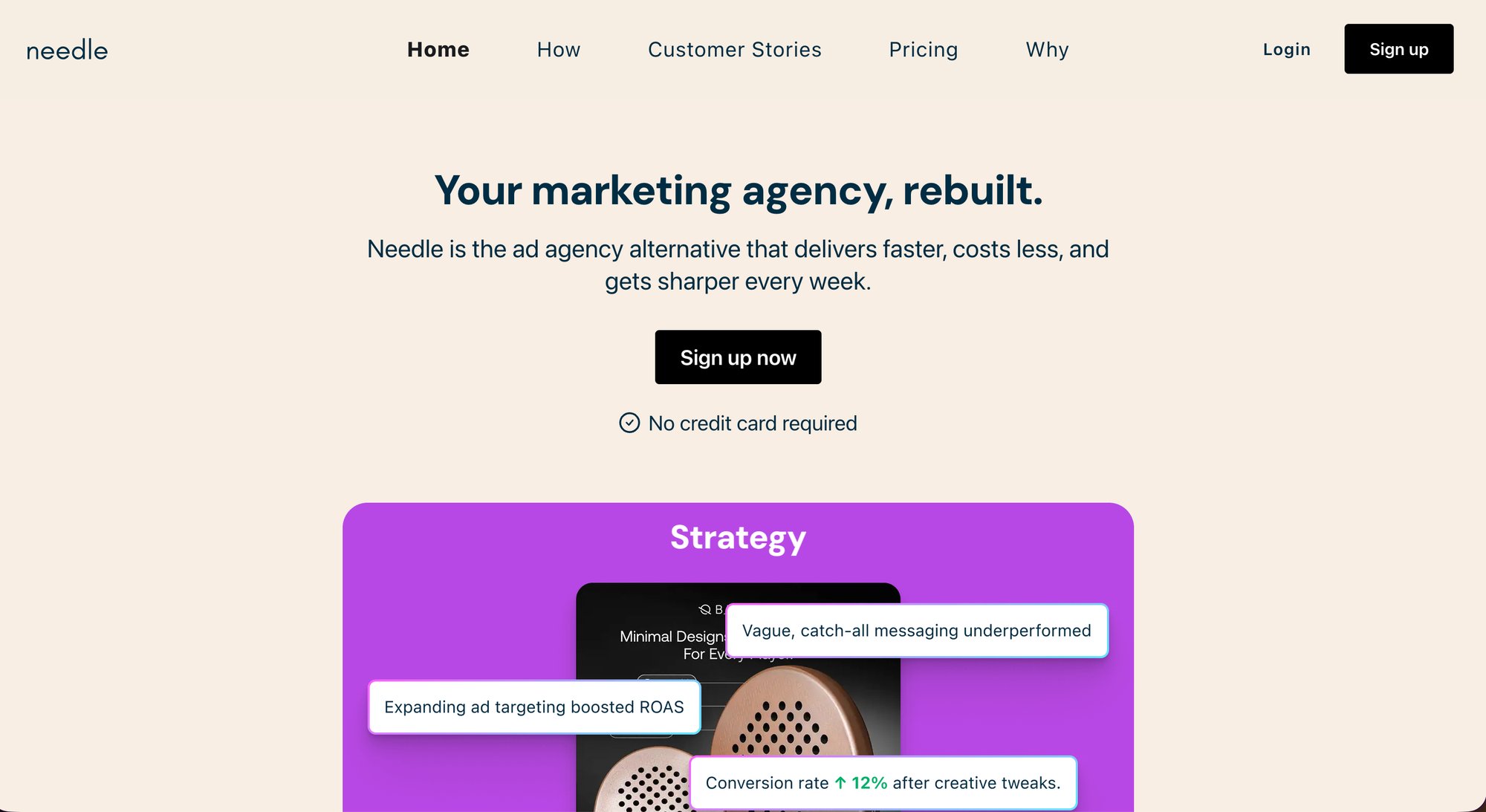
Unlike pure SaaS tools, Needle doesn't just write copy. It manages the entire workflow. The AI handles repetitive tasks like data analysis and drafting creative. But a human strategist and creative editor refine and approve every asset. This ensures outputs are on-brand and strategically sound. Creative volume is uncapped and revisions are unlimited. It launches campaigns directly from its interface to Meta, Google, TikTok, and Klaviyo.
Key Strengths & Features
Needle's core advantage is its blended model. It delivers agency-level strategy with a dedicated strategist and a weekly optimization loop. Brands get a preloaded content calendar with data-backed ideas. Nothing goes live without final approval. The service has helped over 200 DTC brands. One case study showed a 6x ROAS sustained over eight months.
AI + Human Expertise: AI automates grunt work. Human strategists ensure brand alignment and quality control.
Direct Integrations: Plugs into Shopify, Klaviyo, Meta, Google, and TikTok for data analysis and campaign launches.
Rapid Execution: Delivers a weekly cadence of creative, with uncapped volume and unlimited revisions.
Flat Monthly Pricing: Growth is $2,999/month (roughly $5–8K in monthly ad spend, ~5K email subscribers), Scale is $3,999/month, and Custom pricing covers $11K+ in ad spend. There is no percentage cut of ad spend, but the entry tier is a large commitment for smaller brands.
Who Is It Best For?
Needle is built for founders at DTC brands tired of the slow agency model. It's a good fit if you want to scale marketing with a system that learns and compounds performance weekly. Case studies show strong results, including a cost-per-order drop from $41 to $19 for TWOOAK.
Website: https://www.askneedle.com
Pros & Cons
Pros:
Fast, repeatable execution with a weekly campaign cadence.
Flat monthly pricing with uncapped creative and a dedicated strategist, with no percentage cut of ad spend.
Hybrid AI and human approach maintains high quality and brand consistency.
Proven ROI demonstrated through client case studies.
Cons:
Highly optimized for DTC brands in the $1M–$10M range. May not fit smaller or larger businesses.
The entry tier assumes roughly $5–8K in monthly ad spend, so very small budgets fall below it.
Some manual work is still required for channels without API access.
2. Jasper
Jasper is a pro-grade AI marketing tool. It’s for teams needing on-brand ad copy at scale. It moves beyond simple generation. It has robust features for maintaining brand consistency across campaigns. Its core strength is balancing rapid copy creation with the governance established brands need.
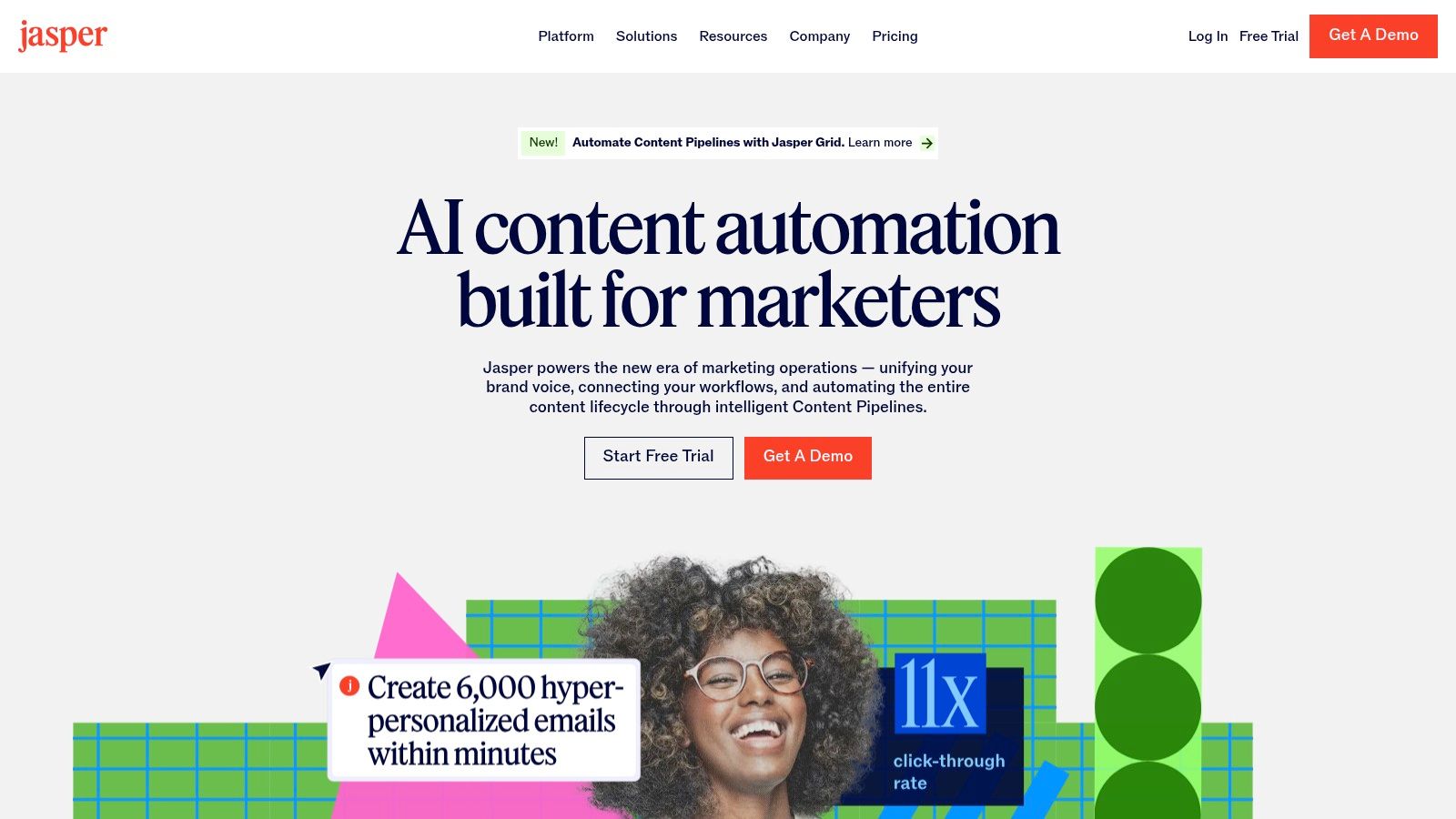
Unlike basic generators, Jasper offers ad-specific templates and workflows for Google, Meta, and LinkedIn. The “Brand Voice” feature lets you upload style guides and product info. This ensures outputs are aligned with your brand. The interactive “Canvas” editor also provides a flexible space for refining copy.
The Business plan adds collaboration and security features, including SOC 2 compliance. This makes it a standout choice for paid media teams. They need both speed and brand safety from their AI tools. You can get familiar with similar top AI tools by checking out our guide on AI marketing tools for small businesses.
Key Details & Best Use Case
Best For: DTC brands and marketing teams that need to produce high-volume, on-brand ad copy with strong governance.
Pricing: Starts at $39/month (Creator plan). The Pro plan offers a 7-day free trial. Seat-based pricing on higher tiers can get costly.
Pros: Excellent for brand consistency. Enterprise-grade security (SOC 2). Powerful campaign-level workflows.
Cons: Requires upfront setup of Brand Voice to see the best results. The pricing model can be expensive for teams with many users.
3. Copy.ai
Copy.ai is a versatile AI content tool. It's known for its quick-start templates and accessible chat interface. This makes it ideal for rapid, short-form ad copy generation. It helps marketing teams quickly produce a high volume of creative variants for headlines and primary text. This is essential for A/B testing on Meta and Google.

Its strength lies in simplicity and speed. Users can leverage pre-built ad copy tools or use the chat to iterate on ideas. Copy.ai provides access to multiple LLMs, including models from OpenAI and Anthropic. This lets you select the best engine for a specific task. For advanced needs, the tool offers workflow automations that turn simple prompts into repeatable processes.
While it's user-friendly for individual creators, more powerful brand governance features are reserved for higher-tier plans. This positions it as a great tool for teams that prioritize creative speed over strict brand controls. Its approachable design makes it one of the top AI tools for ad copy generation for those new to AI.
Key Details & Best Use Case
Best For: Small marketing teams and solo founders who need to quickly generate many ad copy variations for A/B testing.
Pricing: Starts with a free plan. Paid plans begin at $36/month (Pro plan) when billed annually. Enterprise plans are custom-priced.
Pros: User-friendly interface with an accessible free plan. Excellent for rapid iteration and testing creative angles.
Cons: Advanced automation and brand voice features are gated behind premium pricing tiers. Governance features are less robust than competitors.
4. Writesonic
Writesonic is a versatile AI writing assistant. It packages dedicated ad copy generators with a broader suite of content creation tools. It's a budget-friendly option for startups and small teams. It helps produce copy for ads, social media, and SEO-focused articles without multiple subscriptions. Its strength is its accessibility and wide range of templates.

The service provides dozens of templates for Google, Facebook, and LinkedIn ads. This allows you to generate multiple variants quickly. Writesonic also includes Chatsonic, a conversational AI chat interface. This lets you refine copy in a more interactive way. This is useful for moving from an initial concept to a final version without leaving the app.
For teams looking to scale, higher-tier plans offer team seats and API access. While its brand voice controls are less extensive than enterprise competitors, Writesonic provides a powerful and affordable entry point into AI ad copy generation. It's a top choice for those with diverse content needs.
Key Details & Best Use Case
Best For: Solopreneurs, freelancers, and small marketing teams needing an all-in-one tool for ad copy and other content on a budget.
Pricing: Offers a free trial with limited words. Paid plans start at $13/month (billed annually). Business plans are available at higher price points.
Pros: Very budget-friendly entry point with a functional free trial. The broad selection of templates covers multiple ad platforms.
Cons: Pricing and features across tiers can change, so verify current plans. Advanced brand governance and analytics are more limited.
5. Anyword
Anyword is a data-driven AI writing tool for performance marketers. It moves beyond simple text generation. It actively predicts how ad copy variations will perform. Its core feature is a Predictive Performance Score. This estimates audience engagement before you spend a dollar on ads. The feature is designed to de-risk ad creative testing and optimize budgets.
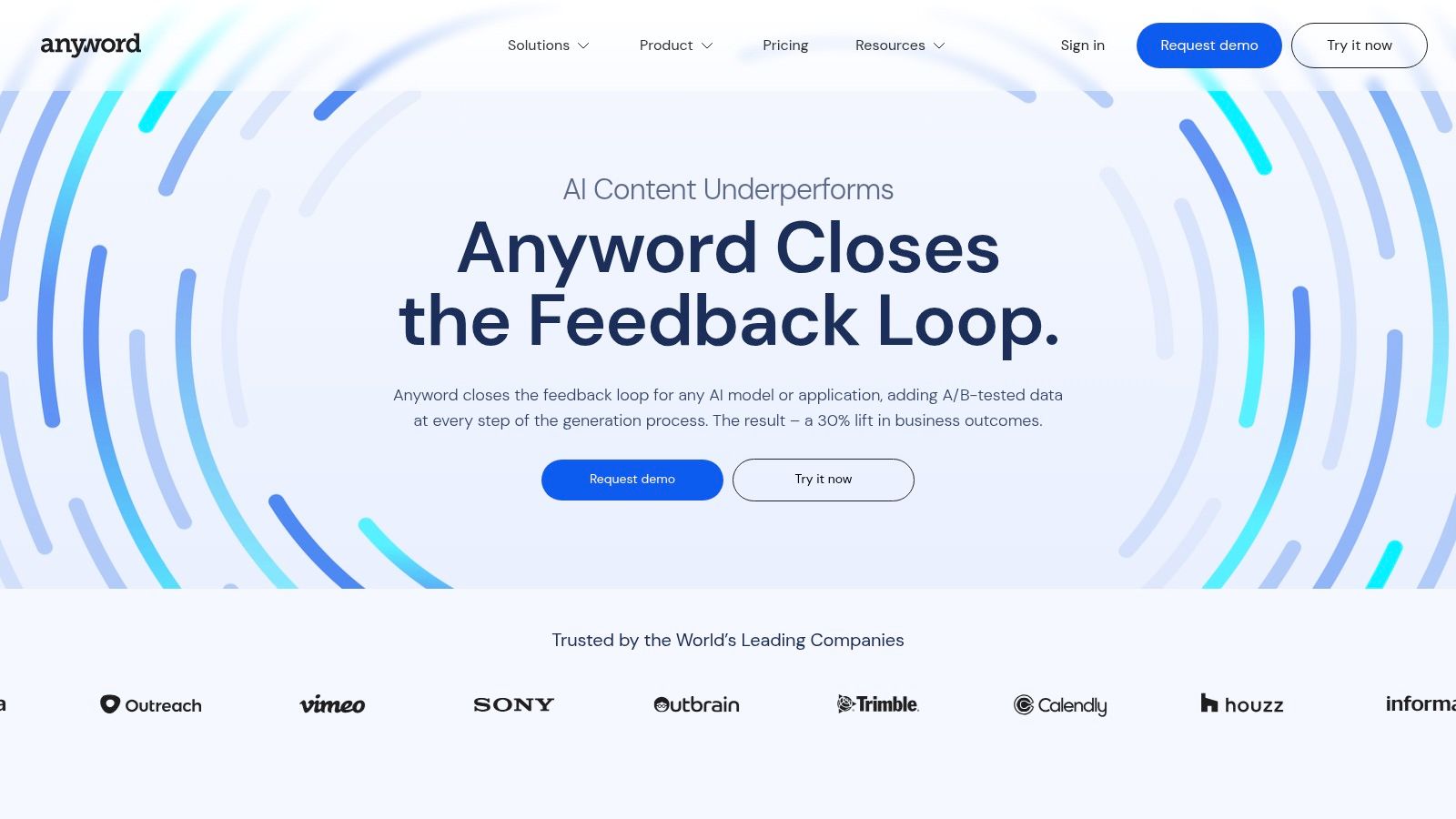
The tool offers a suite of ad-specific templates for Meta, Google, and other channels. Users can train the AI on brand voice, target audiences, and top-performing past ads. This improves the relevance of its suggestions. This focus on performance data makes Anyword a top choice for teams obsessed with conversion rates and return on ad spend (ROAS).
Instead of guessing which copy will resonate, Anyword provides a data-backed starting point. This helps paid media teams prioritize the most promising variants for their A/B tests. For brands sharpening their paid media approach, it’s worth exploring other specialized tools. You can see a direct comparison in our guide to the top 5 AI ad generators for ecommerce.
Key Details & Best Use Case
Best For: Performance marketing teams and DTC brands focused on maximizing ROAS. Good for using data to guide creative decisions before launch.
Pricing: Starts with a free plan. Paid plans start at $39/month (billed annually). The Predictive Performance Score is only on higher-tier plans.
Pros: Pre-launch performance scores help prioritize promising ad variants. The tool is designed around paid ad outcomes.
Cons: The most valuable features are locked behind more expensive plans. There is a learning curve to fully leverage the predictive insights.
6. Hypotenuse AI
Hypotenuse AI is an AI writing suite for ecommerce brands managing large product catalogs. It excels at generating ad and social media copy at scale. It's a powerful tool for teams that need to create numerous ad variants for testing or covering extensive inventories. Its strength is its bulk generation capabilities.

The standout feature is its ability to import a CSV or XLSX file of product details. It then generates corresponding ad copy for each item in bulk. This is a big time-saver for catalog-driven businesses on Shopify. While it offers templates for Google and Facebook ads, its interface is broader than just ad copy. You may need a moment to navigate to the specific tools you need.
For paid media teams focused on efficiency, the bulk workflow support in Hypotenuse AI is a key differentiator. It's one of the more practical AI tools for ad copy generation when your main challenge is volume and speed.
Key Details & Best Use Case
Best For: Ecommerce brands and marketing teams that need to generate ad copy for large product catalogs or run high-volume A/B tests.
Pricing: Starts at $24/month (Individual plan). A 7-day free trial is available. Bulk generation features are on the Teams plan.
Pros: Excellent for scaling ad creation for extensive product catalogs. The bulk CSV/XLSX generation tools are a major workflow accelerator.
Cons: The most valuable features for teams are reserved for higher-priced plans. Its broad interface can require some exploration to find specific features.
7. Rytr
Rytr is an accessible and budget-friendly AI writer. It’s a great starting point for generating ad copy variations quickly. It offers a straightforward interface with over 40 templates, including specific use cases for Facebook, Google, and LinkedIn ads. It's a solid choice for teams that need to test multiple creative angles without a big upfront investment.
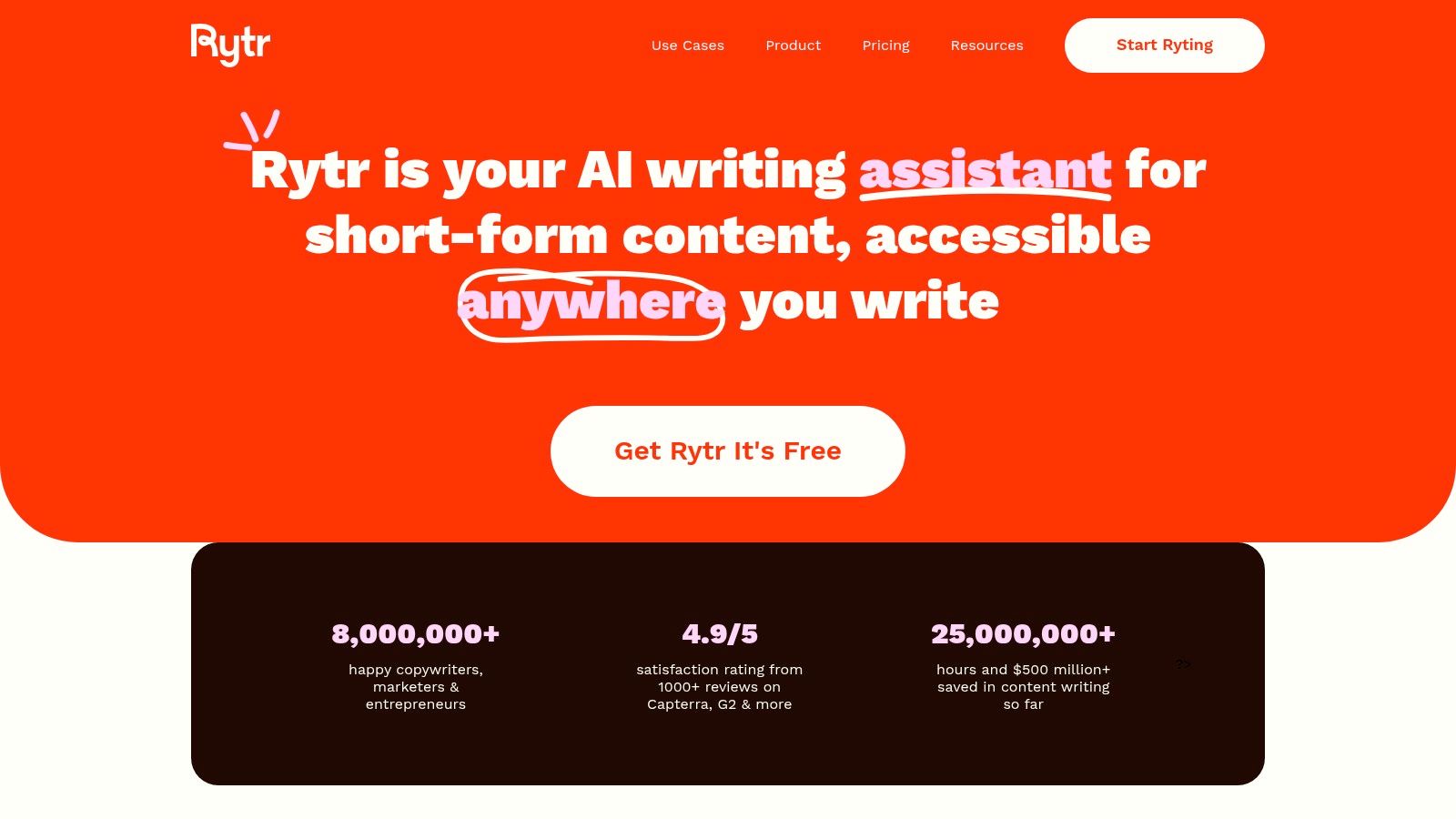
Rytr's strength is its simplicity and speed. You select a use case, input basic product details, choose a tone, and generate copy in seconds. Its support for over 30 languages is a key benefit for brands targeting international markets. While it lacks deep brand governance features, its Chrome extension and built-in plagiarism checker (on paid plans) add practical value.
The generous free plan allows for experimentation. The paid tiers remain among the most affordable on the market. This makes Rytr a low-risk option for early-stage DTC brands. However, it's important to note the FTC finalized an order in December 2023 restricting Rytr's testimonial generation features. This is a point of consideration for brands focused on compliance.
Key Details & Best Use Case
Best For: Freelancers and small marketing teams needing a simple, fast, and low-cost tool for generating a high volume of short-form ad copy.
Pricing: Offers a free plan. Paid plans start at a very affordable $7.50/month (Saver plan).
Pros: Extremely cost-effective with a functional free tier. Very easy to learn and supports a wide range of languages.
Cons: Lacks advanced brand voice and collaboration features. The recent FTC order on testimonials may be a concern for compliance-sensitive organizations.
8. Unbounce Smart Copy
Unbounce Smart Copy is an AI writing assistant. It's designed to integrate with landing page creation. Originally a standalone tool called Snazzy AI, it now provides its greatest value as part of the Unbounce ecosystem. It helps marketers create consistent messaging from ad to landing page without switching tools.

Its tight integration is its key differentiator. It offers over 45 templates for ads and taglines. But its standout features are the in-builder AI assistance and the URL-to-Ad Copy tool. This allows you to point the AI at a landing page. It will then generate platform-specific ad variants for Meta or Google. This ensures message matching is locked in from the start.
The tool is available as a web app and a handy Chrome extension. For brands already invested in Unbounce for their landing page strategy, Smart Copy is a natural and efficient extension for creating ad copy that supports their conversion goals.
Key Details & Best Use Case
Best For: Marketing teams and DTC brands that already use Unbounce for landing pages.
Pricing: A limited free plan is available. Included with Unbounce subscriptions, which start at $74/month. Standalone plans are also offered.
Pros: Excellent integration with the Unbounce tool. Strong free plan for getting started. The URL-to-Ad feature simplifies campaign creation.
Cons: Offers less value as a standalone product if you don't use Unbounce. The free and lower-tier plans have usage credit limits.
9. Persado
Persado is a "Motivation AI" tool. It moves beyond simple ad copy generation. It focuses on language that drives a specific action. It is an enterprise-grade solution for large organizations. It's designed for personalizing marketing language at a massive scale across email, web, SMS, and paid media. Its core differentiator is a data-backed approach to predicting creative performance before it goes live.
Unlike self-serve tools, Persado is built for complex marketing stacks. It integrates deeply with analytics and delivery tools. It uses a vast knowledge base of marketing language and emotional triggers to generate and personalize messages. This system is engineered for measurable lift, with a strong emphasis on enterprise compliance.
The focus on performance prediction and its ability to operate within strict regulatory frameworks makes it unique. However, this power comes with complexity. The enterprise sales motion means no public pricing or free trials. It is a solution for mature marketing organizations that can invest significant resources.
Key Details & Best Use Case
Best For: Large enterprise brands, especially in regulated industries like finance and healthcare. Good for needing AI-generated language with performance predictions and compliance features.
Pricing: Custom enterprise pricing only. Available upon request through a sales demo. Not a self-serve tool.
Pros: Proven focus on measurable performance lift. Excellent for maintaining brand voice and compliance in regulated sectors. Deep integrations with existing marketing stacks.
Cons: The enterprise sales process and custom pricing make it inaccessible for small businesses. Can be overkill for teams without complex compliance needs.
10. Phrasee
Phrasee is an enterprise-grade AI tool for large brands. It's for those that need high-performing, brand-safe marketing language at scale. It specializes in generating and optimizing copy across email, push notifications, and paid social channels. The tool's core value is its focus on performance. It uses a combination of natural language generation and deep learning to create language that drives engagement.
Unlike general-purpose AI writers, Phrasee uses a controlled generation model. This ensures all outputs align with a brand’s specific voice and guidelines. Its technology moves beyond simple creation. It provides real-time optimization and performance insights. This allows marketing teams to understand which phrases resonate most with their audience.
For large retailers and established brands, this focus on controlled, brand-safe language is a key differentiator. The ability to deliver measurable lifts in engagement has made it a go-to choice for enterprise marketing teams. Exploring the benefits of AI in marketing can provide more context on how specialized tools like Phrasee drive results.
Key Details & Best Use Case
Best For: Enterprise retailers and large brands needing to generate and optimize on-brand marketing copy at scale with a focus on performance analytics.
Pricing: Custom pricing based on a sales-led engagement. This is not a self-serve SaaS tool and is targeted at enterprise-level budgets.
Pros: Strong brand-safety controls. Proven performance with major retailers. Deep language performance insights for optimization.
Cons: Enterprise-only focus with high cost of entry. Requires a dedicated enablement process to maximize the value of its insights.
11. G2 — AI Writing Assistants Category
G2 is not a generation tool. It's a B2B software marketplace and review hub. It’s an essential research stop for comparing the top AI tools for ad copy generation. You can see verified user reviews, side-by-side feature comparisons, and satisfaction scores. It helps you cut through marketing claims and see how tools perform in the real world.
Unlike a simple blog list, G2 provides dynamic data. You can filter AI writing assistants by market segment (small business, mid-market, enterprise) and pricing models. The unfiltered user reviews offer practical insights into a tool’s actual strengths and weaknesses. This is invaluable when assessing its fit for your team.
For marketers evaluating how different AI applications fit into their broader strategy, G2 is a powerful resource. It contextualizes individual tools within the larger market. To get a better handle on the strategic side, our guide explains how to use AI for marketing across different functions.
Key Details & Best Use Case
Best For: Marketing teams and founders shortlisting vendors and validating AI tool choices with recent, unbiased peer reviews before purchasing.
Pricing: Free to browse and compare reviews. Vendors pay for premium placement and features.
Pros: Excellent for comparing tools with real user feedback. Covers a wide range of vendors. Offers powerful filtering options.
Cons: Be mindful of sponsored placements that can influence search results. The category is broad, so you must filter for ad copy use cases.
12. Capterra — AI Writing Assistant Software
Capterra is not a generation tool. It's a massive B2B software marketplace. It’s an essential research hub for discovering and comparing the hundreds of AI writing assistants available. Think of it as a starting point to build your own shortlist of top AI tools for ad copy generation based on verified user reviews.
The site lists over 300 AI writing products. You can filter by specific features like "A/B testing" or "brand voice analysis." This filtering capability is its core strength. It helps you cut through the noise and identify tools that fit your exact advertising needs. Instead of relying on a single list, you can use Capterra to get a broader view of the market.
For DTC brands, this is a powerful way to vet potential tools before committing to a trial or subscription. You can directly compare pricing models and user ratings. Just be mindful that sponsored listings often appear at the top. It’s wise to sort by "highest rated" or "most reviewed" to get a more objective picture.
Key Details & Best Use Case
Best For: Marketing teams in the initial research phase. Good for comparing a wide range of AI ad copy tools based on specific features and user reviews.
Pricing: Free to use for research. Pricing for individual software tools varies and is listed on their respective product pages.
Pros: Extensive database of over 300 tools with robust filtering. User reviews provide real-world insights.
Cons: Sponsored profiles can influence search results. Review quality can be inconsistent. All pricing and feature details should be verified on the vendor’s official site.
Top 12 AI Ad-Copy Tools — Quick Comparison
The Right Tool vs. The Right System
We’ve walked through the top AI tools for ad copy generation. You've seen the features of writers like Jasper and Copy.ai. You've also seen how specialized tools like Persado and Phrasee tackle enterprise-level messaging. Each tool offers a specific solution to a specific problem: writing faster.
But for a DTC brand owner, speed is only part of the equation. The real challenge isn't just writing copy. It's connecting that copy to the right creative, audience, and campaign strategy. It’s a full system, not just a single step.
Making the Right Choice for Your Brand
Choosing the best AI tool depends on where your biggest bottleneck is. A founder’s time is their most valuable asset. The crucial question is: where are you spending it?
If you’re a strong copywriter who just needs to scale output, a tool like Jasper or Writesonic is a perfect co-pilot. You can feed it your core ideas and get variations back in seconds.
If you need to produce a high volume of diverse copy for many channels, tools like Anyword or Hypotenuse AI can help manage that workflow. They streamline the process from product description to ad headline.
If you’re spending hours piecing together copy, creative, and campaign settings, a simple copy tool won't solve your core problem. This is where the distinction between a tool and a system becomes critical.
A tool helps you perform a task faster. A system performs the entire workflow for you.
From Task Automation to System Operation
Standalone AI copy generators are powerful task automators. They excel at writing. But they still require you to be the strategist, the creative director, and the media buyer. You still need to:
Analyze your Shopify and Meta data to find winning angles.
Develop a campaign hypothesis based on that analysis.
Brief the AI with the right context, tone, and goals.
Pair the generated copy with compelling visuals.
Build the campaign, ad sets, and ads inside Meta Ads Manager.
Monitor performance and decide when to iterate.
This is the operational drag that consumes a founder's time. A 2022 Constant Contact survey found that small business owners spend nearly 20 hours per week on marketing activities. An AI copy tool shaves a few hours off that total. An AI operator system gives you most of those hours back.
A system like Needle connects directly to your data sources. It doesn't wait for your brief. It analyzes performance and proposes entire campaigns, complete with data-backed copy and creative. You move from being the hands-on operator to the strategic approver. Your job becomes guiding the strategy, not wrestling with the execution.
The future of DTC marketing isn't just about using smarter tools. It’s about building smarter, more automated operating systems for growth. As you evaluate the top AI tools for ad copy generation, ask yourself: Do I need a better hammer, or do I need a fully automated assembly line? The answer will determine where you invest your time and capital.
Tired of juggling tools and just want results? Needle acts as your AI-powered growth operator, connecting your store data to campaign execution to launch complete, on-brand ads you just approve. See how it works at Needle.
Frequently Asked Questions
What is an AI ad copy generator?
An AI ad copy generator is a tool that uses artificial intelligence, specifically natural language processing, to create written content for advertisements. You provide a prompt—like product details, target audience, and desired tone—and the AI produces various options for headlines, body text, and calls to action.
How do these AI tools improve ad performance?
They improve performance in two main ways. First, they allow for rapid A/B testing. You can generate dozens of copy variations in minutes, helping you find what resonates with your audience faster. Second, some advanced tools like Anyword analyze data to predict which copy is most likely to convert before you spend money on ads. As David Ogilvy famously said, "five times as many people read the headline as read the body copy." AI helps you test more headlines, faster.
Can AI completely replace a human copywriter?
Not yet. AI is a powerful assistant for generating ideas, overcoming writer's block, and scaling output. However, it still lacks the nuanced understanding of brand voice, emotional connection, and strategic thinking that an experienced human copywriter provides. The best approach is a hybrid one: use AI to generate the raw material and have a human refine and approve the final copy.
Are there free AI tools for generating ad copy?
Yes, many tools on this list, like Copy.ai, Rytr, and Writesonic, offer free plans or free trials. These are great for experimenting and generating a limited amount of copy. However, the most powerful features, like advanced brand voice controls and unlimited generation, are typically reserved for paid plans.
What should I look for when choosing an AI ad copy tool?
Look for a tool that fits your specific workflow. Key factors include:
Integrations: Does it connect with the tools you already use, like Shopify or Google Ads?
Brand Voice Controls: Can you train the AI to write in your specific brand style?
Use Case: Is it built for your primary need, whether that's bulk product ads, social media campaigns, or performance-driven copy?
Cost: Does the pricing model scale with your needs and budget?