
You don't need another 'ultimate guide' filled with theory. You need ad copy examples that work.
This is a swipe file of frameworks we've used over 200 times for DTC brands. These are direct, proven, and ready to use.
We've run brands. We've lived the chaos of finding creative that converts. We're skipping the fluff.
Creative quality drives 47% of an ad's sales lift. According to Nielsen, it's the single most important factor for success. Your copy isn't just an asset. It's the driver of your ROI.
This article gives you ad copy examples you can use today. For each one, we'll break down the strategy:
Objective: Top, middle, or bottom of the funnel?
Audience: Who is this copy for?
Why It Works: The psychology or unique selling proposition driving sales.
A/B Test Variants: Simple tweaks to find what works for you.
Quick Templates: Plug-and-play formats you can adapt right away.
This is a practical playbook. Let's get into the creative that counts.
1. Product-Focused Email Copy for DTC Fashion Brands
Product-focused emails drive sales for DTC fashion brands.
They showcase specific items: new arrivals, bestsellers, or seasonal collections. They use great visuals and benefit-driven copy. This direct approach is a core driver of consistent income.
The strategy is simple. Lead with your best product photos. Connect them to a clear desire or need. Don't just list features. Sell a lifestyle, a feeling, or a solution.
Why It Works
This type of ad copy example works because it matches customer intent. Subscribers expect to see products from a fashion brand they follow. These emails use urgency and visual appeal. The path from inbox to checkout is short.
Objective: Middle-of-Funnel (MOF) and Bottom-of-Funnel (BOF). It re-engages subscribers and pushes them to buy.
Audience: Warm leads, existing customers, and subscribers who have shown interest.
Psychology: Taps into Fear of Missing Out (FOMO) with new drops. Uses visual persuasion through high-quality lifestyle imagery.
Actionable Takeaways & Templates
Focus on segmentation and personalization. A new customer should see your bestsellers. A repeat buyer might get an exclusive look at a new collection.
Segment Your List: Create segments for new subscribers, repeat customers, and high-AOV shoppers.
Write Punchy Subject Lines: Keep them under 50 characters. Use brackets to stand out. Examples:
[NEW] The Spring Collection is HereorBack in Stock: Your Favorite Tee.Use Dynamic Content: Personalize product blocks based on a user’s browsing history. This simple tactic can lift conversion rates.
Craft a Clear CTA: Use direct, action-oriented language like "Shop The Collection" or "Get Your Size."
Explore these techniques by reviewing high-performing email marketing campaign examples.
2. Abandonment/Recovery Meta Ads for Ecommerce Checkout
Abandonment and recovery ads on Meta are a high-return play. These campaigns target users who added items to their cart but left without buying.
The global average cart abandonment rate is nearly 70%. This is one of the most efficient ways to recapture lost revenue.
The strategy is to remind them what they left behind. Give them a reason to return. This could be a small discount, a free shipping offer, or a simple reminder.
Why It Works
This ad copy example is powerful because it targets the warmest possible audience. These shoppers are one step away from converting. A well-timed ad can overcome their hesitation. It's a helpful nudge.
Objective: Bottom-of-Funnel (BOF). The goal is to recover a lost sale.
Audience: A hyper-targeted segment of users who initiated checkout but didn't buy in the last 3-14 days.
Psychology: Leverages retargeting to re-engage warm leads. Uses incentivization to overcome purchase barriers.
Actionable Takeaways & Templates
Success here comes from timing and relevant offers. Understanding the root causes is key. Review these strategies to reduce cart abandonment.
Segment by Time: Create different ad sets for 2 hours ago, 24 hours ago, and 3+ days ago. The 2-hour reminder should be gentle (
Still thinking it over?). The 3-day ad can be more direct (Your cart is about to expire!).Test Your Offer: A/B test a 15% discount against free shipping. Free shipping often converts better. It removes an unexpected final cost.
Use Dynamic Creative: Use carousel ads to show the exact products a user left in their cart.
Reinforce Trust: Include trust signals in your copy. Use "Free Returns," "100% Satisfaction Guarantee," or a customer testimonial.
Explore a deeper dive into these Facebook ad strategies.
3. Lifestyle/Brand Story Content for Instagram Reels & TikTok
Short-form video is a primary channel for brand storytelling. This content builds affinity by showing a product's lifestyle context. It shares the brand's mission instead of a hard sell.
It’s about creating an emotional connection. This drives long-term consideration.
The strategy is to entertain, educate, or inspire first. Sell second. A beauty brand might show a quick skincare routine. A pet supply company could capture a candid moment. This approach builds community.
Why It Works
This ad copy example works because it meets users where they are. They are in a discovery and entertainment mindset. You become part of the content they want to watch. It’s a powerful way to build brand equity.
Objective: Top-of-Funnel (TOF) and Middle-of-Funnel (MOF). It builds brand awareness and nurtures interest.
Audience: Broad cold audiences based on interests, or warm audiences who have engaged but not purchased.
Psychology: Leverages social proof through user-generated-style content. Builds brand affinity by telling relatable stories.
Actionable Takeaways & Templates
Success here hinges on authenticity and speed. Your hook needs to land in the first one to two seconds to stop the scroll.
Hook Immediately: Start with a surprising visual, a problem-solution statement, or bold text overlay.
Use Trending Audio Wisely: Pick sounds that align with your brand's voice. A forced trend feels inauthentic.
Show, Don't Just Tell: Integrate your product naturally. Show it being used in a real-life scenario that highlights its benefits.
Repurpose Organic Winners: Identify your top-performing organic Reels or TikToks. Run them as paid ads. They have proven engagement. For impactful Reels, consider using an AI Reel generator to streamline your video ad creation.
Dive deeper into how top brands use fashion marketing on social media.
4. Social Proof, Testimonials & Case Study Ads
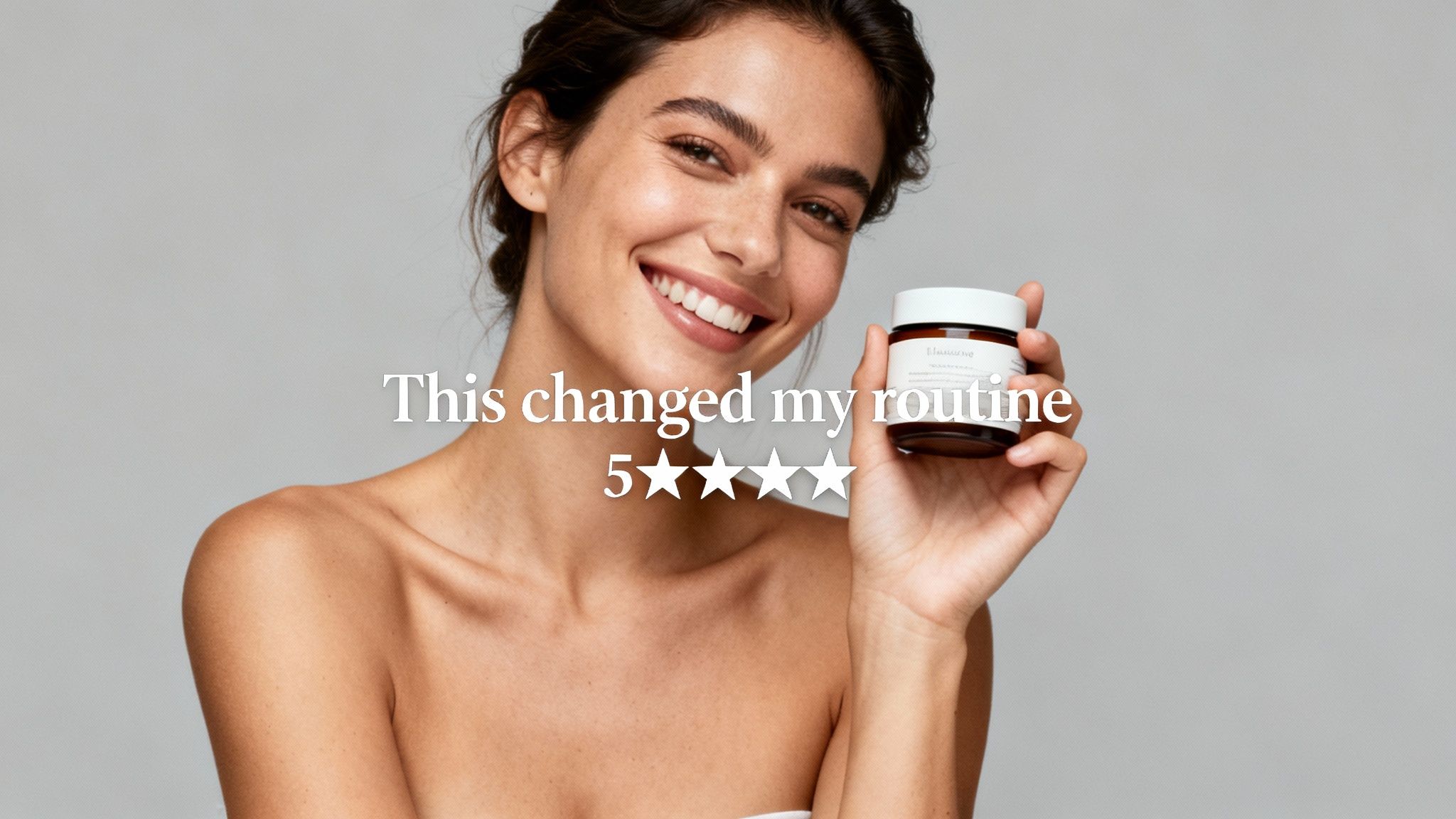
Social proof ads use real customer experiences to build trust. Instead of the brand making claims, satisfied customers do the selling. They do it through testimonials, reviews, or user-generated content (UGC).
For DTC brands, this means showing before-and-after videos, customer photos, or quantified results. This strategy builds authenticity. It bypasses the skepticism of traditional ads.
According to a BrightLocal survey, 88% of consumers trust online reviews as much as personal recommendations. This makes social proof a critical tool.
Why It Works
This ad copy example is effective because of social proof. People conform to the actions of others. A third-party endorsement feels more genuine than a brand's own claims.
Objective: Top-of-Funnel (TOF) and Middle-of-Funnel (MOF). Excellent for building trust with cold audiences.
Audience: Cold traffic, retargeting audiences, and shoppers who have viewed products but not purchased.
Psychology: Leverages Social Proof to reduce purchase anxiety. Uses Authenticity to build a genuine connection.
Actionable Takeaways & Templates
You need a system for collecting and repurposing customer feedback. Proactively ask for testimonials.
Systematize Your Asks: Set up automated post-purchase emails. Ask for reviews and photos or videos. Offer a small incentive like a 10% discount.
Prioritize Video: Video testimonials have higher engagement. Test short, 15-second clips against longer, 30-second versions.
Focus on Quantified Results: Guide customers to provide specific feedback. Instead of "Great product," aim for "I lost 12 lbs in 8 weeks." Specifics sell.
Pair Testimonials with Claims: If your ad claims your product is "dermatologist-tested," feature a dermatologist's endorsement.
Read our collection of customer stories to see how powerful social proof can be.
5. Competitor Comparison/Feature Benefit Ads
Competitor comparison ads are powerful. They work for brands with a clear value proposition. You directly or indirectly contrast your product with an alternative. This shows customers why you’re the better choice.
This educational approach wins over customers in the research phase. A DTC meal kit might compare its cost to grocery runs. A clean beauty brand can contrast its safe ingredients with mass-market alternatives. The goal is to frame the purchase as a logical decision.
Why It Works
This ad copy example shortcuts the customer's research. You provide the comparison for them. You position your brand as a transparent, confident authority. This builds trust and accelerates the path to purchase.
Objective: Middle-of-Funnel (MOF). It targets prospects who are aware of their problem and evaluating solutions.
Audience: Research-focused shoppers, consideration-stage leads, and customers of competing brands.
Psychology: Leverages logic and justification by presenting a data-backed argument. It also uses the framing effect to control the comparison.
Actionable Takeaways & Templates
Success with comparison ads hinges on credibility. Focus on benefits. Avoid aggressive attacks.
Frame it as 'New vs. Old': Compare your solution to "the old way." This avoids naming competitors and positions you as the modern choice.
Use Data and Social Proof: Back up your claims with numbers or testimonials. A simple "Them vs. Us" graphic can be very persuasive.
Focus on Value, Not Just Price: Highlight differences in quality, ingredients, ethics, or convenience.
Create a Clear 'Why Us' CTA: Your call to action should reinforce the benefit. Use phrases like "See The Difference," "Choose Clean Ingredients," or "Upgrade Your Routine."
For a deeper dive, review these strategies for competitor ad analysis.
6. Educational/How-To Content Ads (Top-of-Funnel Awareness)
Educational ads lead with value, not a sales pitch. They offer useful information like how-to guides or tutorials. This strategy builds brand authority with cold audiences. It's a top-of-funnel play to attract customers before they think about buying.
The goal is to solve a problem or answer a question. This earns their attention and trust. For instance, a supplement brand might create an ad for a guide on "Understanding Key Ingredients." You're building an audience you can later retarget.
Why It Works
This ad copy example bypasses sales resistance. By providing value upfront, you create a positive first impression. The consumer feels helped, not sold to. This makes them more receptive to your brand later.
Objective: Top-of-Funnel (TOF). The goal is to generate awareness, build trust, and capture leads.
Audience: Cold audiences who are problem-aware but not yet solution-aware.
Psychology: Leverages the principle of reciprocity. People feel inclined to give back after receiving value. It also builds brand authority.
Actionable Takeaways & Templates
Success depends on providing real value and having a solid retargeting strategy. The initial ad is just the first step.
Lead with the Problem: Frame your ad around a common pain point. Example:
Tired of guessing which supplements work? We broke it down.Simplify Complex Topics: Use formats that are easy to digest. Numbered lists, videos, and infographics work well.
Use a Soft Call-to-Action (CTA): Instead of "Shop Now," use CTAs like "Download The Free Guide" or "Learn More." The goal is engagement.
Create a Retargeting Sequence: Plan your follow-up. Retarget users who engaged with your content with a special offer 7–14 days later. This moves them down your funnel.
7. First-Purchase/New Customer Incentive Ads
First-purchase incentive ads are a cornerstone of customer acquisition. These campaigns target cold audiences with an irresistible offer. A discount, free shipping, or a gift lowers the barrier to the first purchase.
The strategy is direct: capture attention with a clear incentive. This is essential for acquiring new customers. The long-term value comes from converting those first-time buyers into loyal customers.
As marketing pioneer John Wanamaker said, "Half the money I spend on advertising is wasted; the trouble is I don't know which half." Incentive ads help solve this by offering a directly trackable ROI.
Why It Works
This ad copy example directly addresses the hesitation of a new buyer: price and risk. By offering an immediate benefit, you reduce friction. It's a proven method to accelerate the journey from awareness to conversion.
Objective: Top-of-Funnel (TOF) and Middle-of-Funnel (MOF). Designed to acquire new customers.
Audience: Cold traffic, new website visitors, and email/SMS signups who have not yet purchased.
Psychology: Leverages Reciprocity (offering a discount to encourage a purchase) and Loss Aversion (fear of missing a limited-time offer).
Actionable Takeaways & Templates
Success depends on the offer's value and your retention strategy. Make sure the math works for your unit economics.
Test Your Offer Structure: A/B test different incentives. Some audiences prefer
20% Off, while others wantFree Shipping.Create Urgency in Your Copy: Use time-sensitive language. Examples:
Your 15% Off Welcome Offer Expires TonightorClaim Your Free Gift - New Customers Only.Make Redemption Frictionless: Auto-apply discount codes at checkout. Fewer steps mean a higher conversion rate.
Pair with a Strong Welcome Sequence: An incentive gets the first sale. A powerful email and SMS welcome series turns that one-time buyer into a repeat customer.
8. Personalized Dynamic Product Ads (Retargeting & Segmentation)
Personalized dynamic product ads (DPAs) are the workhorses of bottom-funnel marketing. They use data from your website pixel to show users products they have viewed or added to their cart. This is a highly effective retargeting strategy.
The approach is data-driven and personal. If a user browsed for a specific dog breed's food, the ad shows that food. It turns ad space into a personalized shopping experience.
Why It Works
This ad copy example is powerful because it's extremely relevant. The user has already expressed interest. The DPA reminds them and makes it easy to complete the purchase. It’s a low-friction path from browsing to buying.
Objective: Bottom-of-Funnel (BOF). Designed for conversion and cart recovery.
Audience: Website visitors who have viewed products, initiated checkout, or added items to their cart.
Psychology: Leverages the Mere-Exposure Effect (familiarity breeds liking) and personalization.
Actionable Takeaways & Templates
Success with DPAs hinges on sharp segmentation and a clean product feed. Don't just retarget everyone with everything.
Create Micro-Segments: Go beyond "all website visitors." Build audiences for 'Viewed Product A, Not Purchased' or 'Added to Cart in Last 7 Days.'
Exclude Past Purchasers: In your campaign settings, exclude recent buyers. This avoids wasted spend and annoyance.
Test Carousel vs. Single Image: A carousel can showcase a range of items. A single-image ad provides intense focus. Test which format drives a lower cost-per-purchase.
Use Smart Sequencing: Build rules based on behavior. If a customer buys a razor, your next retargeting ad in 30 days should feature blade refills. This turns a one-time purchase into a habit.
9. Bundle/Cross-Sell Ads (Average Order Value Increase)
Bundle and cross-sell ads are designed to increase your Average Order Value (AOV). You package complementary products together, often at a slight discount. This strategy is essential for improving margins.
The goal is to present a complete solution. Think of skincare brands offering a "Complete Morning Routine" or a fashion brand selling a "Weekend Getaway Outfit." It simplifies the customer's decision-making process.
Why It Works
This ad copy example shifts the focus from cost to value. Bundling frames the purchase as a smart choice. A study by Forrester found that product recommendations like bundles are responsible for 10-30% of e-commerce revenues. It also introduces customers to more of your product line.
Objective: Middle-of-Funnel (MOF) and Bottom-of-Funnel (BOF). It targets users considering a purchase and convinces them to spend more.
Audience: Warm prospects and existing customers who trust your brand.
Psychology: Leverages loss aversion (fear of missing a deal) and the paradox of choice (making the decision easier).
Actionable Takeaways & Templates
Success hinges on creating logical, desirable combinations. Build kits that solve a specific problem.
Name Bundles by Benefit: Instead of "Bundle #3," use a name that sells the outcome. Examples: "The 5-Minute Glow Kit" or "The New Puppy Starter Pack."
Clearly Show the Value: The copy must state the savings. Use phrases like "Save $25 When You Bundle" or "A $120 value, yours for $95."
Use Lifestyle Imagery: Show the bundle in use. This helps customers visualize how the products work together.
Test Your Discount Depth: Find the sweet spot between conversion and margin. Test discounts at 10%, 15%, and 20% to see what drives the highest net profit.
9 Ad Copy Types Comparison
From Examples to Execution: Your Next Step
We've shown you dozens of high-performing ad copy examples. You have a strategic blueprint. You've seen how successful brands use psychology, social proof, and direct response to get customers.
Great ad copy isn't about clever wordplay. It's about clarity, empathy, and a focus on the customer's problem. Every example spoke directly to a specific audience. They highlighted a clear benefit. They made the next step obvious.
Key Takeaways for Your Brand
To move from theory to results, focus on these three pillars:
Audience-Centricity: Always start with who you're talking to. The language for a cold audience is different from the copy for a warm lead who abandoned their cart.
Benefit Over Feature: Customers don't buy drills; they buy holes. Don't just list what your product is. Explain what it does for the customer. How does it save them time or solve a problem? That's where the conversion happens.
Systematic Testing: The best ad copy is discovered, not written. The brands you admire are constantly testing headlines, body copy, and CTAs. Data, not ego, should drive your creative decisions.
Mastering these ad copy examples is crucial. Effective copy directly impacts your Cost Per Acquisition (CPA) and Return on Ad Spend (ROAS).
The biggest challenge isn't knowing what to do. It’s the execution. Founders spend hours wrestling with Ads Manager, trying to design assets, and second-guessing copy. It's a slow, costly cycle.
An agency can help, but they often charge $5,000 to $10,000 per month. A freelancer might be cheaper, but quality can be inconsistent. You need a system, not just more tools. You need a process that gets campaigns live, fast.
This is the system we built for ourselves and now offer to other brands. It combines agency-level strategy with the speed of AI-powered creation. We’ve seen it work for brands like TWOOAK, which cut their cost-per-order from $41 to $19.
Ad Copy FAQ
Here are answers to common questions about writing and testing ad copy.
Q: What makes for good ad copy?
A: Good ad copy is clear, direct, and speaks to a specific customer need. It focuses on the benefit, not just the feature. It uses social proof and addresses objections. Most importantly, it's tested.
Q: How do you A/B test ad copy effectively?
A: Test one variable at a time: headline, primary text, or CTA. Run the test long enough to get statistically significant results (at least 1,000 impressions). Focus on metrics that matter, like click-through rate and conversion rate, not just likes.
Q: How is Needle different from hiring an agency or using a tool like Jasper?
A: Agencies are slow and expensive ($5K+/month). Tools like Jasper give you copy, but you still have to do all the strategy, design, and campaign management. Needle is the hybrid. We provide the agency-level strategy and execution, powered by AI for speed. You get dedicated strategists and 48-hour turnarounds for 1/3 the cost of an agency.
Q: How often should I refresh my ad copy?
A: For retargeting ads, refresh creative every 1-2 weeks to avoid ad fatigue. For top-of-funnel campaigns, you can run winning creative for 3-4 weeks. Monitor your frequency and cost-per-result metrics. When performance dips, it's time for a refresh.
Stop the endless cycle of guessing and manual work. Needle turns these ad copy examples into ready-to-launch campaigns for your brand in 48 hours. Let our team of ex-DTC founders handle the creative execution so you can focus on growth.