
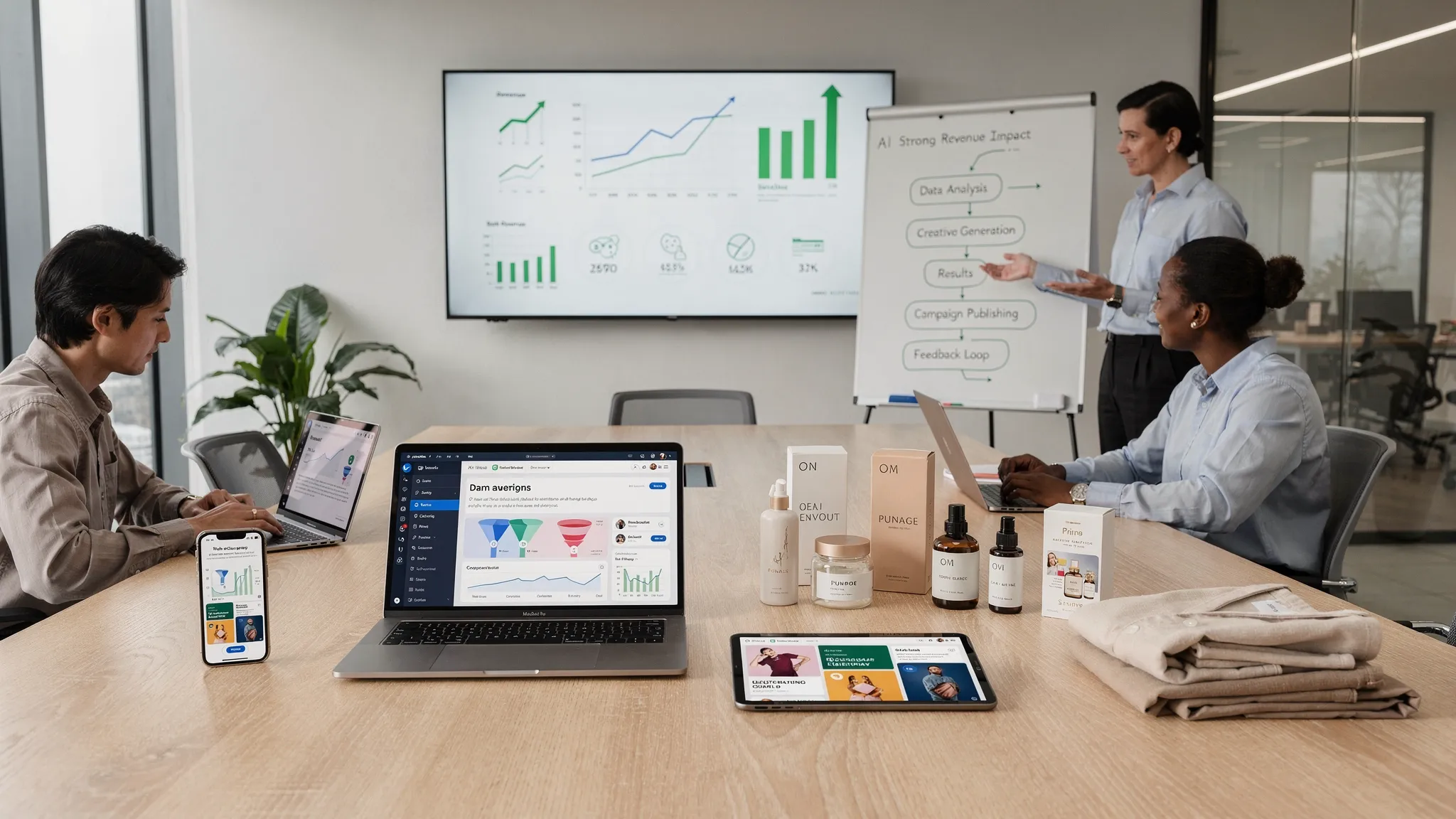
AI for marketing has a simple test: does it move a revenue metric, or does it just create more content?
That distinction matters. In 2026, most ecommerce teams already have access to tools that can write captions, generate images, summarize data, and draft emails. The hard part is turning those outputs into profitable campaigns, lower customer acquisition costs, higher conversion rates, and more repeat purchases.
McKinsey has estimated that generative AI could add trillions of dollars in annual economic value, with marketing and sales among the highest-potential areas. But for DTC and ecommerce brands, the value is not created by prompts alone. It is created when AI plugs into the weekly growth loop: find the opportunity, make better assets, launch faster, measure results, and repeat.
Below are practical AI for marketing examples that can drive revenue, plus the workflow that turns AI from a novelty into a growth system.
What counts as revenue-driving AI for marketing?
Revenue-driving AI does more than help a team work faster. It connects customer data, product data, brand positioning, and campaign performance to better marketing decisions.
For ecommerce brands, the most useful AI marketing examples usually improve one of four levers:
- Acquisition: Lowering CPA, improving ROAS, increasing qualified traffic, or increasing click-through rate with better creative.
- Conversion: Turning more visitors into buyers through better landing pages, product pages, offers, and checkout recovery.
- Retention: Increasing repeat purchase rate, customer lifetime value, email revenue, and win-back performance.
- Efficiency: Reducing time, freelancer dependency, manual reporting, and slow campaign production cycles.
If an AI use case cannot be connected to one of those levers, it may still be useful, but it is probably a productivity tool rather than a revenue engine.
Example 1: AI ad creative testing that lowers acquisition cost
Paid social performance is increasingly driven by creative quality. Meta and TikTok can automate a lot of targeting, but they still need strong creative inputs: hooks, angles, visuals, offers, formats, and proof points.
AI helps by turning a small number of strategic inputs into many testable creative variations. Instead of asking a designer or freelancer to produce one or two assets per week, a brand can use AI to generate multiple versions of the same core idea.
For example, a skincare brand could test these angles from the same product data:
- A before-and-after problem angle focused on dry skin.
- A founder-led ingredient education angle.
- A customer review angle using real testimonial language.
- A routine-based angle showing how the product fits into a morning habit.
The revenue impact comes from faster learning. If the brand tests 12 hooks instead of 2, it has more chances to find a winner before ad fatigue sets in. The winning hook can then be turned into videos, static ads, carousels, email creative, and product page copy.
The key is not volume for volume's sake. AI should help isolate variables. Test one primary difference at a time, such as hook, offer, proof point, or format. That gives the team a clear learning instead of a messy pile of assets.
Example 2: AI-generated email campaigns based on buying behavior
Email is one of the clearest places where AI for marketing can drive direct revenue, especially for Shopify brands using tools like Klaviyo.
A typical manual workflow starts with a blank calendar. Someone has to decide what to send, who to send it to, what the angle should be, which products to feature, and how to write the subject line. That is why many brands default to generic promos.
AI can make the process data-backed. It can look at purchase history, browse behavior, customer segments, product categories, and campaign performance to suggest emails that are more likely to convert.
Examples include:
- A replenishment email for customers who bought a consumable product 30 days ago.
- A cross-sell email for buyers of a hero product who have not purchased the matching accessory.
- A VIP early-access email for the top 10 percent of customers by lifetime spend.
- A win-back email for customers whose usual repurchase window has passed.
The revenue lever is not simply better copy. It is relevance. A customer who bought running socks does not need the same email as someone who browsed trail shoes and never purchased. AI can help tailor the campaign idea, product selection, subject line, and call to action to the segment.
This is also where AI can reduce founder bottlenecks. Instead of spending hours building one campaign, a founder can approve a strategy, review the generated creative, and let the system publish.
Example 3: Predictive segmentation that makes campaigns more profitable
Many brands segment too broadly. They send to all subscribers, all purchasers, or all abandoned carts. AI can help create more useful segments based on likelihood to buy, predicted lifetime value, churn risk, product affinity, and engagement level.
For example, an apparel brand might identify customers who:
- Bought once, engaged with the last three emails, and are likely to buy again.
- Purchased full-price items and should be excluded from heavy discounting.
- Bought from one category but have never seen the best-selling complementary category.
- Are high-value customers whose engagement is dropping.
That segmentation can be activated across email, SMS, and ads. The first group may receive social proof and a limited-time bundle. The second group may receive new arrivals without a discount. The third group may receive educational content. The fourth group may receive a loyalty-focused reactivation campaign.
Good segmentation depends on clean underlying customer data. If your customer information is scattered, start with the basics: customer records, pipeline or lifecycle stage, task history, communication history, reporting, and automation rules. This practical guide to a CRM system for small businesses is a useful checklist for the type of structure AI needs, even if your ecommerce stack lives in Shopify, Klaviyo, Meta, and analytics tools.
The revenue impact of predictive segmentation is simple: fewer irrelevant sends, better conversion rates, less discount leakage, and stronger customer lifetime value.
Example 4: AI-powered bundles and product recommendations that raise AOV
AOV is often easier to improve than traffic volume. If a brand can increase average order value without hurting conversion rate, it creates more room to spend on acquisition.
AI can help by analyzing product combinations, purchase sequences, margin data, seasonality, and customer behavior. It can surface patterns that are hard to see manually.
A few examples:
A beauty brand discovers that customers who buy a cleanser and toner are much more likely to return for moisturizer within 21 days. Instead of waiting for that second purchase, AI suggests a starter routine bundle with a small incentive.
A food brand finds that gift buyers usually purchase two low-margin items together. AI suggests a higher-margin gift box that includes the same products with better packaging and a clear gifting message.
A fashion brand sees that first-time buyers of a hero dress often add accessories on the second purchase. AI suggests a cart upsell and post-purchase email that feature the best-matching accessory.
The goal is not random product recommendation. It is revenue-aware merchandising. The best AI recommendations consider margin, inventory, customer intent, and buying sequence, not just what is popular.
Example 5: AI landing page optimization from reviews, ads, and support tickets
Most conversion problems are message problems. The product page answers the questions the brand wants to answer, not the questions customers are actually asking.
AI can mine customer reviews, support tickets, ad comments, post-purchase surveys, and competitor reviews to find recurring objections and purchase triggers. Then it can help turn that language into product page improvements.
For example, if customers keep asking whether a supplement is safe for daily use, that answer should not be buried in a generic FAQ. It should appear near the buying decision, supported by proof and clear language. If ad comments repeatedly mention sizing confusion, the landing page should surface fit guidance earlier.
AI can help generate:
- Stronger product page headlines.
- Objection-handling FAQ sections.
- Benefit-led product descriptions.
- Landing page variants for different ad angles.
- Social proof blocks matched to buyer concerns.
The revenue lever is conversion rate. When the ad promise, landing page message, and customer objection all line up, paid traffic becomes more efficient. Even a small conversion rate lift can change the economics of a campaign.
Example 6: Content repurposing that turns winners into full campaigns
Many brands underuse their best creative. A strong customer testimonial appears once in an Instagram post, then disappears. A founder video performs well organically but never becomes an ad. An educational email gets clicks but is not repurposed into a landing page or carousel.
AI can identify promising assets and repurpose them across formats. One winning customer review can become a Meta ad, email hero section, SMS angle, product page proof block, and short-form video script.
This matters because revenue rarely comes from one isolated asset. It comes from message repetition across the customer journey. A shopper may see the same core idea in an ad, then again in an email, then again on the product page before buying.
The best AI content repurposing systems preserve the strategy while adapting the execution. An email cannot simply be copied into an ad. The hook needs to be shorter, the proof needs to be visual, and the CTA needs to match the buyer's stage.
AI helps marketing teams move from one-off content to campaign systems.
Example 7: Retention and win-back campaigns that do not rely on blanket discounts
The easiest win-back campaign is a discount. It is also often the least strategic.
AI can help brands understand why different customers lapse. Some customers need a replenishment reminder. Some need education. Some need product recommendations. Some need proof. Some may need an incentive, but not all of them.
For example, a pet brand might create different win-back paths for:
- Customers who bought a one-month supply and have not reordered.
- Customers who clicked recent emails but did not buy.
- Customers who only purchase during promotions.
- Customers who bought a puppy product and may now need the adult version.
Each group deserves a different message. That is where AI can improve both revenue and margin. Instead of sending the same 20 percent off email to everyone, the brand can use behavior and timing to choose the right next step.
The best retention AI examples are not loud. They are timely. They make customers feel understood without requiring a massive internal team to manually build every variation.
Example 8: AI as a weekly marketing analyst
Reporting is one of the most underrated AI for marketing examples. Many teams have dashboards, but dashboards do not automatically tell you what to do next.
A useful AI analyst should answer three questions every week:
What changed? Why did it likely change? What should we test next?
For an ecommerce brand, that might look like this:
Meta CPA rose 18 percent, but CTR stayed stable. That suggests the issue may be post-click conversion, not ad creative. Check the landing page, product availability, offer clarity, and checkout flow.
Email revenue increased, but revenue per recipient dropped. That may mean the campaign drove sales through a large send size rather than stronger relevance. Test tighter segmentation next week.
A new UGC video has a lower CPM and higher add-to-cart rate than other creatives. Turn the hook into three new variations and build a matching email campaign.
The revenue value comes from speed and discipline. AI can shorten the time between performance data and action, but the team still needs a weekly operating rhythm.
A revenue-first AI marketing workflow for ecommerce teams
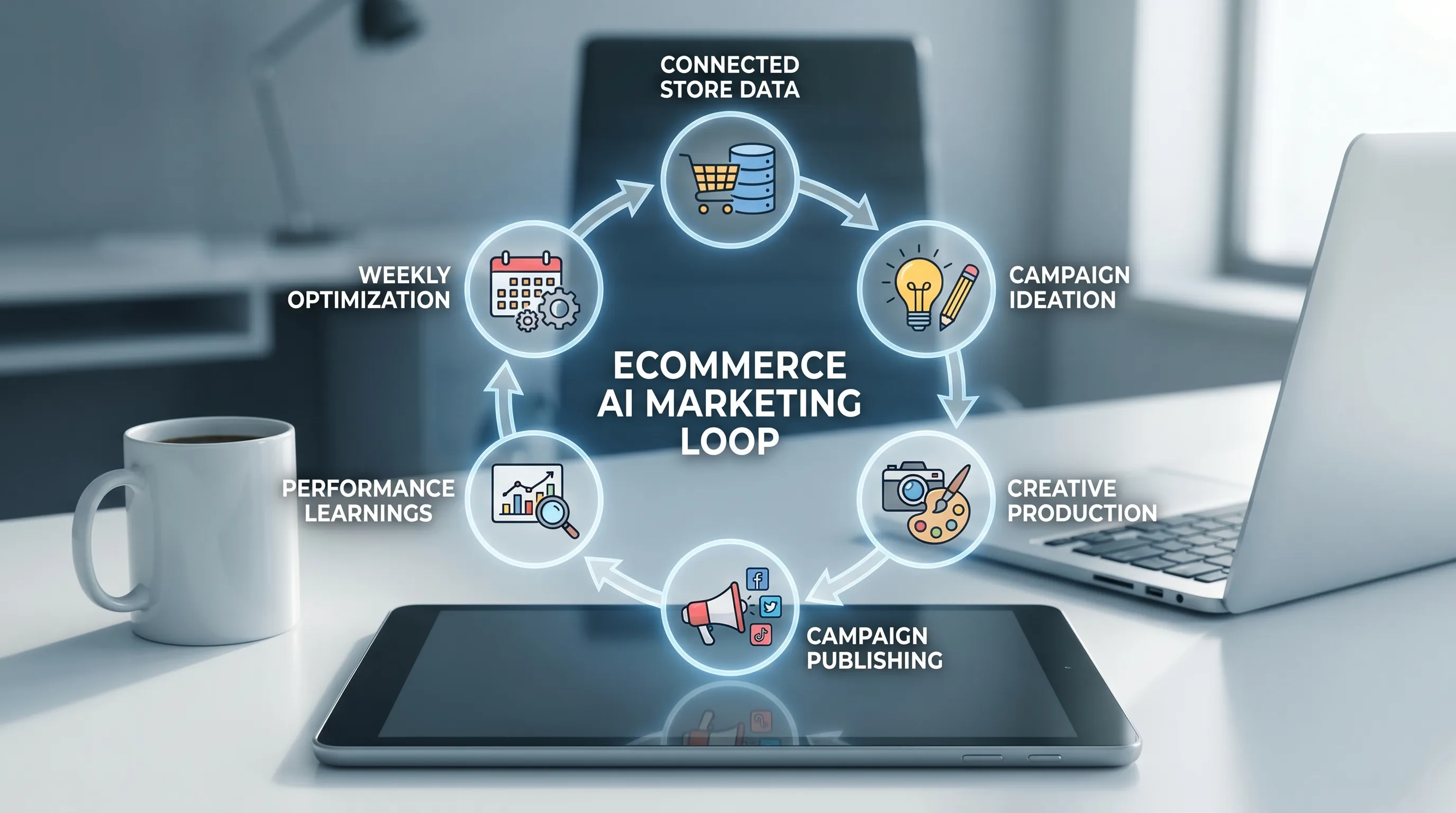
The examples above work best when they are part of a repeatable process. AI should not sit outside your marketing workflow as a random tool. It should sit inside the weekly cadence your team already uses to grow revenue.
- Pick one revenue goal: Choose a primary metric such as CPA, MER, conversion rate, revenue per recipient, AOV, or repeat purchase rate. Do not ask AI to improve everything at once.
- Connect real business inputs: Use product data, customer segments, reviews, campaign performance, brand guidelines, and margin information. Better inputs produce better recommendations.
- Generate campaign angles and assets: Ask AI to create multiple angles, not just multiple versions of the same copy. A hook test, proof test, and offer test are more useful than 20 nearly identical headlines.
- Approve with human judgment: Humans should review strategy, brand voice, claims, offers, and customer sensitivity. AI can accelerate execution, but it should not own final judgment.
- Measure and convert results into next steps: At the end of the week, decide what to scale, what to cut, and what to test next. The learning loop is where AI compounds.
This is the difference between using AI as a content assistant and using AI as a marketing operating system.
Where Needle fits into AI for marketing
Needle is built for ecommerce brands that want AI-assisted execution, not just AI-generated drafts.
The platform connects to existing tools, generates marketing ideas, creates on-brand creative assets, publishes directly to platforms, automates campaign workflows, tracks marketing results, and turns performance into actionable learnings. Instead of juggling freelancers, ad tools, email tools, and spreadsheets, the goal is to help founders move into an approval role while Needle executes and optimizes weekly.
That model is especially useful when the bottleneck is not strategy alone, but speed of execution. A founder may know they need more ads, better emails, and a tighter campaign calendar. The problem is getting those assets created, launched, measured, and improved every week.
Needle's public case studies show the pattern. RTPTennis used Needle to reduce email creation time and reported 12x ROI in the first month. Heliotrope achieved 6x ROI on evergreen email campaigns after Needle helped analyze Klaviyo, implement evergreen campaigns, and shift focus toward higher-return retention work.
The broader lesson is not that AI magically creates revenue. It is that connected data, faster creative production, automated publishing, and weekly learning can make marketing execution much more efficient.
Common mistakes that stop AI marketing from driving revenue
AI marketing fails when teams use it as a shortcut around strategy. The tool can make more assets, but it cannot fix unclear positioning, weak offers, poor product-market fit, or broken tracking.
Watch for these mistakes:
- Automating before your data is usable. If Shopify, Meta, Klaviyo, and analytics data are inconsistent, AI recommendations will be weaker.
- Measuring only platform ROAS. Platform dashboards are useful, but they can over-credit campaigns. Track MER, contribution margin, CPA, AOV, and LTV as well.
- Generating too many assets without a testing plan. More creative does not help if you cannot tell what worked.
- Removing human review from brand-sensitive work. Claims, discounts, tone, and customer promises still need human approval.
- Treating AI as set-and-forget. The best systems learn weekly. They do not launch once and disappear.
A good rule: automate the repetitive work, accelerate the analytical work, and keep humans in control of strategic judgment.
Frequently Asked Questions
What are the best examples of AI for marketing? The best examples are ad creative testing, email personalization, predictive segmentation, product recommendations, landing page optimization, content repurposing, retention campaigns, and automated reporting. These use cases directly connect AI output to revenue metrics.
Can AI replace a marketing agency? AI can replace parts of slow manual execution, but most brands still need strategy, brand judgment, and performance interpretation. Many ecommerce teams benefit from a hybrid model where AI handles production and analysis while humans approve direction and quality.
How fast can AI marketing drive revenue? It depends on the channel and data quality. Email and retention campaigns can often show results faster because they use existing traffic and customers. Paid ads may take longer because creative tests need enough spend and conversion data to prove performance.
What data do I need before using AI for marketing? Start with ecommerce orders, product catalog data, customer segments, email engagement, ad performance, reviews, and brand guidelines. The more complete and accurate your inputs are, the more useful AI recommendations become.
Which metrics should I track when using AI for marketing? Track revenue metrics such as CPA, ROAS, MER, conversion rate, AOV, revenue per recipient, repeat purchase rate, LTV, and contribution margin. Also track production metrics like time to launch and number of meaningful tests per week.
Turn AI marketing examples into weekly revenue tests
The brands getting the most from AI are not just creating faster. They are learning faster.
If your team is still stitching together campaign ideas, creative briefs, freelancers, email drafts, ad uploads, and reporting by hand, Needle can help turn that workflow into a connected growth system. You approve the strategy and creative direction, while Needle helps generate ideas, create assets, publish campaigns, track results, and optimize weekly.
See how Needle can help your ecommerce brand move from scattered marketing tasks to revenue-focused execution at askneedle.com.