
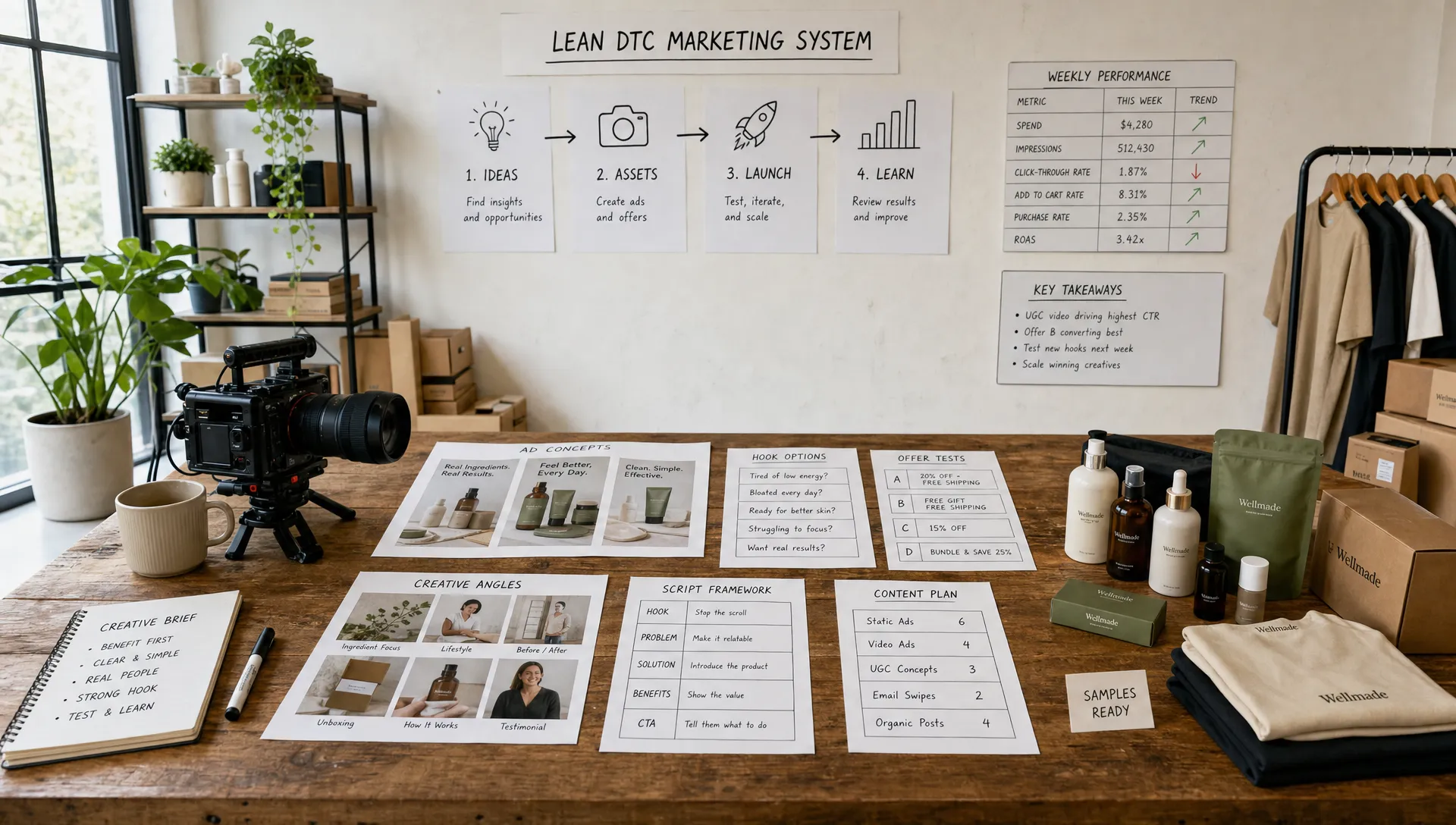
For a lean DTC team, the best advertising tools are not the ones with the longest feature list. They are the tools that help a small team make better decisions, create more winning assets, launch faster, and learn what to do next without drowning in dashboards.
That distinction matters in 2026. Paid social is more automated, creative fatigue happens faster, and attribution is still imperfect. If your team is small, every extra tool has a hidden cost: setup time, reporting confusion, duplicated workflows, and another login someone has to check.
The goal is not to build a giant marketing stack. The goal is to build a sharp advertising operating system.
Below is a practical guide to the best advertising tools for lean DTC teams, organized by the work they actually need to do: choose channels, produce creative, launch campaigns, measure results, and keep improving every week.
What lean DTC teams should look for in advertising tools
Before comparing tools, get clear on the buying criteria. A bootstrapped skincare brand, a funded apparel startup, and a seven-figure supplement brand may all run ads, but they do not need the same stack.
Lean teams should prioritize tools that reduce manual work and increase learning speed. A tool is worth considering if it helps you answer one of these questions faster:
- Which offer, angle, or product should we test next?
- Can we produce enough creative to keep campaigns fresh?
- Are we spending into profitable customers or just buying revenue?
- What did we learn from the last test, and how do we apply it this week?
- Can this workflow run without hiring another freelancer or agency?
A good advertising tool should either drive revenue, save meaningful execution time, or improve decision quality. If it does none of those things, it is probably just software clutter.
Start with the channel, not the tool
The most common mistake lean teams make is buying tools before deciding what role each channel plays. Meta, Google, TikTok, email, creator content, and landing pages all contribute differently. If you do not know what job a channel has, a tool cannot fix the strategy.
For example, Meta may be your primary demand-generation engine, while Google Search captures high-intent demand. TikTok may be useful for creative discovery, while email and SMS turn paid traffic into repeat revenue. Your tool stack should support that system.
If you are still building your acquisition plan, use a simple 90-day structure: define your best-fit customer, choose one primary paid channel, decide your creative testing cadence, and set clear profitability thresholds. Even though it is built with SaaS companies in mind, this free 90-day acquisition diagnostic is a useful example of how to narrow focus before adding more tools.
For DTC brands specifically, Needle’s guide to building a profitable ecommerce ad strategy is a helpful next step if you need to align channels, budgets, and conversion goals before choosing software.
Best advertising tools by job to be done
Instead of ranking every tool in one generic list, it is more useful to group them by the work a lean DTC team needs to accomplish. The best stack is usually a combination of a few strong tools, not one tool for every possible marketing activity.
Needle: best for AI-assisted campaign execution
Needle is built for DTC teams that need to move faster without adding agency overhead. It helps generate marketing ideas, create on-brand creative assets, publish content directly, automate campaign workflows, track results, and turn performance data into actionable learnings.
For lean teams, the value is not just “AI creative.” It is reducing the distance between idea, asset, launch, and learning. Many teams lose momentum because creative strategy lives in one doc, assets are made by a freelancer, publishing happens somewhere else, and performance analysis gets reviewed too late. Needle is designed to streamline that loop.
This makes it especially useful for brands that already know they need more campaigns and more creative variation, but do not want to manage a larger team of media buyers, designers, copywriters, and coordinators. If your bottleneck is execution speed, Needle belongs near the center of the stack.
For a broader breakdown of how AI can support DTC marketing workflows, see this guide to AI-powered marketing tools.
Meta Ads Manager: best for scalable paid social
Meta remains one of the core advertising tools for DTC brands because it combines broad reach, strong optimization, and mature ecommerce campaign formats. For lean teams, Meta Ads Manager is often the first serious paid acquisition platform because it can support prospecting, retargeting, product catalog ads, and creative testing in one place.
The challenge is that Meta’s automation has shifted the team’s job. You are no longer manually controlling every audience lever. Your main advantage comes from better creative inputs, stronger offers, clean tracking, and disciplined testing.
Use Meta Ads Manager when you have enough conversion data, a product with visual appeal, and a clear offer. Do not use it as a substitute for positioning. If your hooks are vague and your landing page is weak, Meta will simply spend faster on a broken message.
Google Ads: best for capturing existing demand
Google Ads is often less glamorous than paid social, but it can be one of the most efficient channels for DTC brands with search demand. Search campaigns capture people who are already looking for a product, solution, brand, or competitor. Shopping and Performance Max campaigns can also support ecommerce growth when product feeds and conversion tracking are set up properly.
Lean teams should be careful with Google because it can blend very different types of demand. Branded search may look profitable, but it is not the same as acquiring new customers. Non-brand search may be more incremental, but also more competitive.
The best use of Google Ads for a small team is focused coverage: protect branded demand, test a small number of high-intent non-brand terms, and make sure your product feed is accurate. If Google becomes your main growth channel, then feed optimization and landing page testing become much more important.
TikTok Ads Manager: best for creative discovery
TikTok can be powerful for DTC brands with products that benefit from demonstration, transformation, humor, education, or social proof. Its biggest value for many lean teams is not only direct conversions. It is the speed at which you can learn what kinds of hooks and formats make people stop scrolling.
TikTok Ads Manager is worth testing if your team can produce native-feeling creative consistently. Repurposed polished ads often underperform. Simple product demos, founder-led clips, creator-style testimonials, and problem-solution videos can work better than studio-heavy production.
The catch is volume. TikTok rewards frequent creative testing, so a lean team should only prioritize the platform if it can maintain a steady creative pipeline. If you cannot produce new angles regularly, start with organic testing or creator content before scaling paid spend.
Creative tools matter more than ever
In a more automated ad environment, creative is one of the few levers DTC teams still control directly. The best advertising tools for creative help you move from “we need more ads” to a repeatable system for generating, producing, and evaluating new concepts.
Canva and CapCut: best for fast production
Canva and CapCut are useful because they let non-designers produce assets quickly. Canva works well for static ads, simple motion, offer graphics, and landing page visuals. CapCut is strong for short-form video editing, subtitles, cuts, and mobile-first formats.
These tools are not a replacement for creative strategy. They are production accelerators. A weak hook in a nice template is still a weak ad. But when paired with a strong testing plan, they help lean teams increase creative output without waiting days for revisions.
Foreplay and Motion: best for creative research and analysis
Foreplay is commonly used to save and organize ad inspiration. For a lean team, this can be valuable because good creative strategy often starts with pattern recognition. What hooks are competitors using? Which formats keep showing up? How are brands framing objections, proof, and offers?
Motion is more focused on creative performance analysis. It helps teams understand which assets, hooks, and formats are contributing to results. This matters because ad account-level reporting often hides creative patterns. You may know which campaign worked, but not which opening line, visual style, or message drove the lift.
If you are spending modestly, you may not need both tools right away. Start with a lightweight creative library, then add deeper analysis when creative volume and spend justify it.

Video production tools: best for making more usable assets
Video ads are now a core part of most DTC advertising stacks. The best video tools help you produce variations quickly: different first three seconds, captions, proof points, formats, and calls to action.
For lean teams, the winning approach is usually modular production. Instead of producing one “perfect” video, create multiple hooks, product shots, testimonials, and offer endings that can be recombined. This lets you test more without multiplying production cost.
If video is a major bottleneck, Needle’s guide on how to create video ads that drive real sales covers the strategy behind stronger DTC video creative, not just the editing process.
Measurement tools: choose clarity over complexity
Attribution is one of the hardest parts of DTC advertising. Platform dashboards over-credit themselves, privacy changes limit tracking, and customer journeys are rarely linear. The right measurement tool helps your team make better decisions without pretending the data is perfect.
GA4 and Shopify analytics: best for a baseline view
Google Analytics 4 and Shopify analytics are often enough for very small teams to establish a baseline. They help you monitor traffic, revenue, conversion rate, average order value, and channel-level patterns.
The key is to avoid treating any single dashboard as absolute truth. Meta, Google, Shopify, and GA4 may all report different numbers. That does not mean the data is useless. It means you need a consistent decision framework.
For example, a lean team might review platform ROAS, blended MER, contribution margin, new customer revenue, and returning customer revenue together. This gives a more balanced view than optimizing only for in-platform ROAS.
Triple Whale or Northbeam: best for higher-spend DTC teams
As spend increases, dedicated attribution and ecommerce analytics tools can become more valuable. Triple Whale is popular with Shopify-focused DTC brands because it brings ecommerce metrics, attribution views, and performance reporting into a more operator-friendly dashboard. Northbeam is often used by brands that want more advanced attribution modeling across channels.
These tools make the most sense when your spend is large enough that better allocation decisions will outweigh the cost and setup time. If you are spending a few thousand dollars per month, you may not need advanced attribution yet. If you are spending six figures per month, relying only on platform dashboards can become expensive.
Lean does not mean cheap. Lean means buying the level of measurement your decision volume requires.
Landing page and CRO tools: where ad performance becomes revenue
A lot of “ad problems” are actually conversion problems. If your landing page is slow, unclear, or misaligned with the ad promise, no advertising tool will save the campaign.
For Shopify brands, your first CRO tools may already be built into your theme, analytics, and product page setup. As you scale, tools like Replo, Shogun, Unbounce, Hotjar, or Microsoft Clarity can help you build landing pages, observe user behavior, and test different page experiences.
The lean approach is to focus on the highest-leverage pages first. These usually include your hero product page, best-selling collection page, advertorial page, quiz page, or offer-specific landing page. Do not test button colors before testing the core message.
A strong landing page should answer the questions your ad creates:
- What is this product and who is it for?
- Why should I believe it works?
- What makes it different from alternatives?
- What do I get, and why should I buy now?
- What happens if I am not satisfied?
When ads and landing pages are planned together, creative testing becomes much more useful. You are not just testing ads. You are testing a complete buying journey.
Retention tools make paid ads more profitable
Advertising tools should not stop at the click. For DTC brands, profitability often depends on what happens after the first visit or first purchase. Email, SMS, and lifecycle marketing tools help convert paid traffic that does not buy immediately and increase customer lifetime value after acquisition.
Klaviyo is one of the standard tools for DTC email and lifecycle automation. Attentive and Postscript are common SMS options. The important point is not which one you choose first, but whether your paid acquisition strategy connects to retention.
At minimum, lean teams should have flows for welcome, abandoned checkout, post-purchase education, replenishment or cross-sell, winback, and review generation. These flows make your paid media more forgiving because not every click has to convert immediately to create value.
When evaluating advertising tools, ask whether they help you improve the whole revenue system. A cheaper CPA is great, but a stronger second purchase rate can be just as important.
Workflow tools: the hidden layer of a lean ad stack
Many DTC teams do not fail because they lack ideas. They fail because ideas do not become shipped tests. A lean advertising system needs workflow tools that keep the team moving.
Notion, Airtable, Slack, Zapier, and project management tools can all help, but only if the process is simple. The workflow should make it obvious what is being tested, who owns it, when it launches, and what result will determine the next step.
A useful weekly ad workflow might include these stages:
- Review last week’s performance and creative learnings.
- Choose the next angles, offers, or products to test.
- Produce creative variations.
- Launch campaigns or refresh existing ones.
- Document results and decide what to scale, iterate, or stop.
This is where all-in-one platforms can reduce friction. If strategy, creative, publishing, tracking, and learnings are disconnected, the team spends too much time coordinating. If those steps are connected, a small team can act with the rhythm of a much larger one.
The lean DTC advertising stack by stage
The “best” advertising tools depend on your stage. A brand spending $5,000 per month should not copy the stack of a brand spending $500,000 per month. As a rough benchmark, DTC brands under $1M in revenue often spend 25% to 35%+ of revenue on ads, while brands past $50M typically spend closer to 7% to 15%, according to Eightx’s 2026 DTC ad spend benchmarks — that ratio should decline as a brand scales, driven by growing brand awareness and repeat revenue.
For early traction, keep the stack simple. Use one or two ad platforms, a fast creative production tool, Shopify analytics, GA4, and email capture. Your goal is to validate offers, audiences, hooks, and conversion paths.
For growth stage, add better creative organization, stronger landing page tools, and more reliable reporting. This is where tools like Needle, Foreplay, Motion, Replo, Triple Whale, or advanced Klaviyo segmentation can become more valuable.
For scaling stage, invest in deeper attribution, creative systems, feed management, incrementality testing, and retention analytics. At this point, the cost of bad decisions is higher, so more specialized tools can pay for themselves.
The mistake is buying scale-stage tools while you are still searching for product-channel fit. The opposite mistake is running a mature ad program with spreadsheets and guesswork long after the complexity has outgrown them.
Advertising tools to avoid if your team is lean
Some tools are impressive but unnecessary for small teams. Be cautious with any platform that requires heavy implementation, a dedicated operator, or a long onboarding cycle before it creates value.
Avoid tools that create more reporting than action. A dashboard that shows 80 metrics but does not help you decide what to launch next will not improve performance. Also avoid overlapping tools. If three platforms all claim to solve attribution, your team may end up debating numbers instead of improving campaigns.
The biggest red flag is a tool that does not fit your weekly operating cadence. If you only review creative once a month, a creative analytics tool will not magically make you more agile. If you do not have traffic, a CRO platform will not produce meaningful test results. If you do not have a clear offer, an ad platform will simply amplify confusion.
Buy tools for the system you are committed to running, not the system you imagine having someday.
How to choose the best advertising tools for your team
A simple decision filter can prevent most stack bloat. Before adding a new tool, ask:
- What decision will this help us make faster?
- What manual work will it remove from the team?
- Which existing tool will it replace or improve?
- Who will own it every week?
- What metric should improve within 30 to 90 days?
If you cannot answer those questions, wait. The best advertising tools create leverage quickly. They help a lean team do more of the work that drives growth and less of the work that creates internal drag.
For many DTC teams, the highest-leverage stack is surprisingly focused: one or two acquisition channels, one creative execution engine, one landing page system, one retention platform, and one source of truth for performance. Everything else should earn its place.
Frequently Asked Questions
What are advertising tools for DTC brands? Advertising tools are platforms that help DTC brands plan, create, launch, measure, and optimize campaigns. They can include ad platforms, creative tools, attribution software, landing page builders, email and SMS tools, and workflow automation platforms.
What is the best advertising tool for a small DTC team? The best tool depends on the bottleneck. If execution speed is the problem, an AI-powered platform like Needle can help streamline campaign creation. If measurement is the issue, analytics or attribution tools may matter more. If creative volume is low, production and creative research tools should come first.
How many advertising tools does a lean team need? Most lean DTC teams need fewer tools than they think. A practical starting stack includes an ad platform, a creative production workflow, basic analytics, email capture, and a simple reporting process. Add specialized tools only when spend, complexity, or team capacity justify them.
Should DTC teams use AI advertising tools? Yes, if the tool improves speed, quality, or learning. AI is especially useful for generating campaign ideas, producing creative variations, identifying patterns, and automating repetitive workflows. It should support strategy, not replace clear positioning and disciplined testing.
When should a DTC brand invest in attribution tools? Dedicated attribution tools are most useful when monthly ad spend is high enough that better budget allocation can meaningfully improve profit. Smaller teams can often start with platform data, Shopify analytics, GA4, and blended performance metrics before moving to advanced attribution.
Build a leaner advertising engine with Needle
The best advertising tools do not just add capabilities. They help your team execute faster, learn faster, and scale without unnecessary headcount.
If your DTC team is tired of juggling disconnected tools, freelancers, and slow campaign cycles, Needle can help. It generates tailored marketing ideas, creates on-brand creative assets, publishes directly to platforms, automates campaign workflows, tracks results, and turns performance into actionable weekly learnings.
Lean teams do not need more bloat. They need a sharper system for growth.