
Ecommerce ads are your engine for finding new customers. Period. It's not about marketing theory. It’s about putting the right message in front of the right person at the right time. For any DTC brand, getting this right is non-negotiable.
What Are Ecommerce Ads, Really?
Think of ecommerce ads as renting a billboard where your customers already hang out. Places like their social media feeds or Google search results. But these ads are designed for immediate, measurable action.

This isn’t just about getting eyeballs. It’s about performance. Every click, every dollar, every sale is tracked. You know exactly what's working and what isn't. This lets you ditch the guesswork and scale profitably.
Why Your Ad Strategy Matters More Than Ever
The game has changed. Boosting a few posts won't cut it anymore. Competition is fierce. Costs are rising. Global social commerce is projected to hit $2.9 trillion by 2026. That means more opportunity, but also more noise.
A smart ad strategy isn't just a marketing thing. It’s a core part of your business. It’s your system for:
Finding new customers: Reaching people who’ve never heard of you and turning them into buyers.
Driving repeat business: Reminding past customers why they loved you and bringing them back for more.
Testing new products: Getting real market feedback before you sink cash into inventory.
"Your brand is what other people say about you when you’re not in the room.” – Jeff Bezos, Founder of Amazon
Your ads are often the first thing people hear about you. They’re your introduction. To make that first impression count, you need to increase your website conversion rate so traffic actually turns into sales.
Moving Beyond Single-Channel Thinking
Relying on one ad platform is a mistake. What works on Meta today might not work tomorrow. Modern brands build their ad strategies on multiple channels.
Each platform has a different job. You might use TikTok to grab attention, Google to capture searches, and email to close the sale. We break this down in our guide on effective cross-channel campaign management. It’s a playbook for building an ad strategy that scales.
Choosing the Right Ad Channels to Drive Sales
Not all ad channels are created equal. Wasting money on the wrong one is the fastest way to kill your budget. Think of your ad budget like a special forces team. Every dollar needs to be deployed with precision.
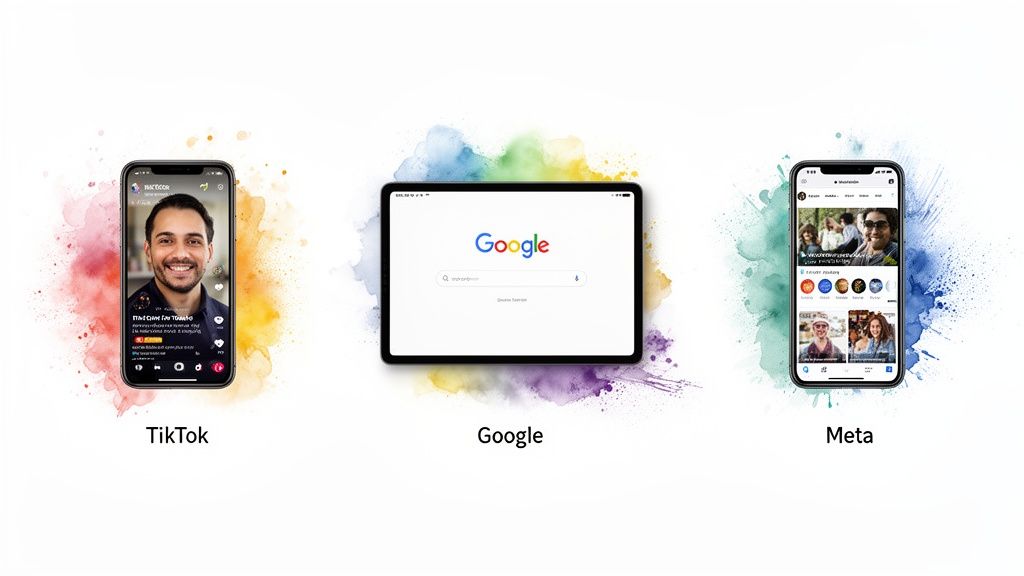
We've run the playbook for over 200 DTC brands. The lesson is always the same. You don't need to be everywhere. You just need to be on the channels that matter for your customer.
Let's break down the heavy hitters.
Meta Ads for Demand Generation
Meta (Facebook and Instagram) is still the king of creating demand. People aren't scrolling to shop for your specific product. But they are open to discovery. This is where you introduce your brand and make them want what you're selling.
Its strength is its powerful audience-building tools. Meta's algorithm is great at finding pockets of customers you didn't know existed. You feed it great creative, and it finds buyers. This is your top-of-funnel workhorse. Learn more in our guide to Instagram advertising for 2026.
Best For: Brands in fashion, beauty, home goods, and lifestyle.
Creative Focus: High-quality lifestyle images, user-generated content (UGC), and short videos that stop the scroll.
Cost: Can get expensive, but it's effective when dialed in.
Google Ads for Capturing Intent
While Meta creates demand, Google Ads captures it. Someone searching "buy black leather boots" wants to make a purchase. Your job is to show up at that exact moment.
This is bottom-of-funnel, high-intent advertising. It's as close to a sure thing as you can get.
Google Shopping Ads are non-negotiable for product businesses. They account for 65% of all clicks on Google Ads for retail. Why? They put your product, price, and picture directly in front of someone ready to buy.
"You can’t just open a website and expect people to flood in. If you really want to succeed, you have to create traffic.” - Joel Anderson, former CEO of Walmart
This quote nails it. Google Ads is your most direct tool for creating high-quality, purchase-ready traffic. It’s less about inspiration and all about conversion.
TikTok for Reach and Culture
TikTok is a different beast. It's not just another social app; it’s a culture engine. Nearly 50% of TikTok users say they have bought something after seeing it promoted on the platform.
Success here isn't about polished ads. It’s about fitting the native feel of the platform. Authentic, entertaining, and lo-fi content works best. UGC-style videos and creator collaborations crush it. It’s the place to build brand awareness at scale and connect with customers genuinely.
Owned Channels for Profitability
Don't forget your most profitable channels: email and SMS. You own this audience. You don't have to pay Meta or Google to reach them.
These channels are about retention and lifetime value. A past customer is your warmest lead. Use email and SMS to announce products, run promotions, and build a community. This is where your best margins live.
To make sense of it all, here's a quick cheat sheet for deciding where to put your dollars.
Ecommerce Ad Channel Comparison for DTC Brands
This table breaks down where each channel shines. Match your budget to your goals.
Choosing the right channel isn't about picking one. The best brands use a mix. Start where your customers are, master that channel, and then expand.
How to Create Ad Content That Converts
Great creative is the single biggest lever you can pull in ecommerce ads. Full stop.
You don’t need a Hollywood budget. It's about practical, repeatable formulas that stop the scroll and get people to click.
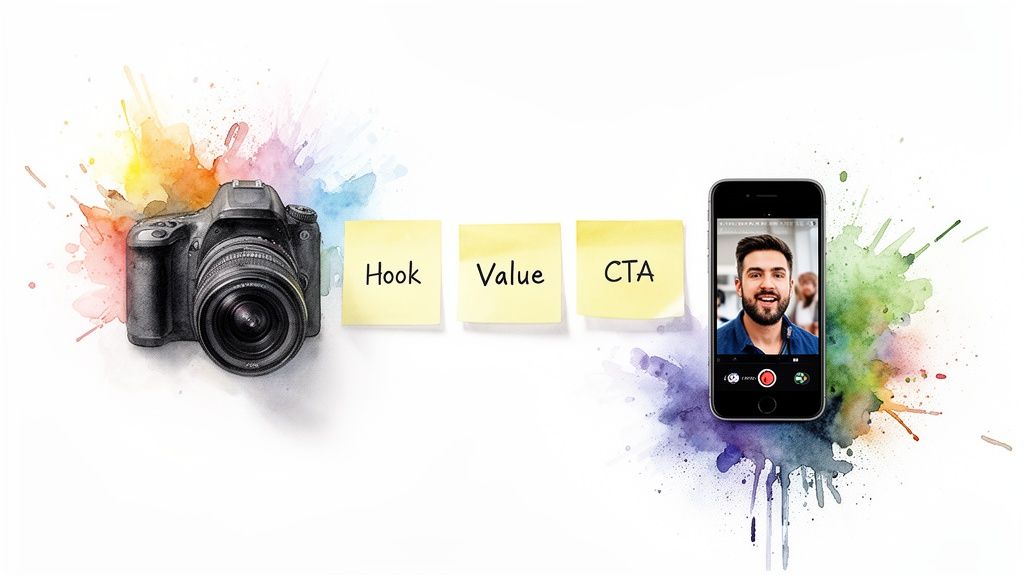
We've seen simple videos and basic images drive millions in revenue. This isn't about chasing viral hits. It's about building a system for producing assets that perform. Here’s how.
The Core Components of Winning Ad Creative
Every great ad has three core parts. Get these right and you’re ahead of 90% of your competition. If an ad is tanking, one of these pieces is broken.
The Hook: The first one to three seconds. Its only job is to stop someone mid-scroll. It needs to be visually jarring, ask a question, or show something unexpected.
The Value Proposition: Once you have their attention, answer their unspoken question: "What's in it for me?" Get straight to the point. Explain the problem you solve or the benefit you deliver.
The Call-to-Action (CTA): Tell them exactly what to do next. "Shop Now." "Learn More." "Get 20% Off." Make it direct and obvious.
"[The customer journey] is no longer linear, but an ongoing cycle of discovery, consideration, and purchase." - Allan Thygesen, President, Americas & Global Partners at Google
This is critical. The gap between seeing an ad and buying is shrinking. Your creative has to move someone from curious to converted in a single glance.
Different Creative Formats for Ecommerce Ads
You don't need to master every format. Focus on these three battle-tested types that drive results.
Static Images That Sell
Never underestimate a simple, clean product shot. A high-quality image that clearly shows your product, often with a bold text overlay, can be very effective.
Think of a skincare brand showing a "before and after" shot. Or a fashion brand displaying a handbag on a plain background. These ads work because they're direct. For a deeper dive, check out our guide on creating high-converting ad banners design.
User-Generated Content (UGC)
UGC is your secret weapon. It feels real and builds trust. Why? Because it’s content from actual customers, and 92% of consumers trust it more than traditional advertising.
This could be an unboxing video, a screenshot of a review, or a photo of a customer using your product. UGC is social proof in its purest form. It’s a real person vouching for your product. That raw authenticity often leads to higher click-through rates.
Simple, Problem-Solution Videos
You don't need a massive production crew. Some of the best-performing video ads are shot on a smartphone. The most effective formula is simple:
Show the problem: Start with a common pain point.
Introduce your product as the hero: Show your product in action, solving that problem.
End with a clear CTA: Tell them how to get it.
This approach works because it speaks to a customer's needs. Forget trying to be clever. Just focus on creating content that solves a real problem.
A Simple Approach to Targeting and Measurement
Targeting is where most founders get lost. Broad, lookalike, interest-based—what works today? Let's cut through the noise.
In today's AI-driven ad world, getting too clever with audiences can backfire. Platforms like Meta and Google have sophisticated algorithms. Your job isn't to micromanage them. It's to feed them clean signals, give them a clear goal, and get out of the way.
Piling on dozens of tiny, hyper-specific audiences often drives up costs. It hamstrings the algorithm's ability to learn. Think of it like giving a world-class chef a recipe with 100 detailed steps. Just give them high-quality ingredients and tell them what to cook.
Simplify Your Targeting
Stop building complicated audience funnels. The old method of stacking interests just doesn't work as well anymore. Today, simplicity wins.
For platforms like Meta, the best place to start is broad targeting. Yes, that means targeting an entire country with only basic demographic filters. It sounds insane, but you have to trust the machine.
"The goal is to turn data into information, and information into insight." - Carly Fiorina, former CEO of Hewlett-Packard
Just like your brand's reputation is built on clear signals, your ad performance relies on clear data. Feed the algorithm your pixel data from actual purchases. Let it find more people like your existing customers. It’s better at this than you are.
Measure What Actually Matters
Once you've simplified your targeting, you have to measure what's working. Forget vanity metrics like clicks or impressions. They don't pay the bills. The only thing that matters is if your ecommerce ads are making you money.
We live by two key metrics that give a true picture of an ad account's health.
Marketing Efficiency Ratio (MER): This is your total revenue divided by your total ad spend. It gives you a 30,000-foot view of how your entire marketing is performing.
Contribution Margin: This is the real profit you bank on each sale after subtracting the cost of goods sold (COGS) and ad spend. This tells you if you are actually profitable per order.
These are the numbers that tell you if your business is healthy. For a deeper dive, learn more about calculating your return on ad spend.
Your Measurement Framework
Stop getting lost in confusing attribution dashboards. They’re often misleading. Here’s a simple framework to track performance.
Set a Clear MER Goal: First, figure out the baseline MER you need to be profitable. If your product margin is 50%, you need a MER of at least 2.0 to break even. A healthy target is usually 3.0 or higher.
Track Daily and Weekly Trends: Keep an eye on your MER daily. Don't panic over one bad day. Pay attention to weekly trends. Is your MER consistently above your target? You can scale. Is it dipping? Dig into your creative.
Analyze Contribution Margin Per Order: Look at your average order value (AOV), your cost of goods, and your customer acquisition cost (CAC). Is each new order putting cash in your pocket? If not, you have three levers: increase AOV, lower COGS, or improve ad efficiency.
This approach gives you a clear line of sight into profitability. Tools like a Conversion Rate Calculator can show how small site improvements have a massive impact. It all works together.
By focusing on broad targeting and profit-driven metrics, you can make confident decisions based on what's actually growing your business.
How to Budget and Scale Your Ads Profitably
Scaling your ad spend shouldn't feel like a casino. It’s a calculated process, not a gamble. Growing your budget without torching profitability is hard, but there’s a simple playbook we’ve used for brands scaling from $1M to $10M.

This isn't about some secret formula. It’s about building a sustainable scaling machine that supports steady, profitable growth. It’s about knowing when to push the gas and when to hit the brakes.
Setting Your Starting Budget
If you’re just starting, a common rule is to put 15-25% of your total revenue toward advertising. But this is just a baseline. The right number depends on your product margins and how fast you want to grow.
A brand with 70% margins can be more aggressive than one with 30% margins. Know your numbers, especially your breakeven point. Don't spend a dollar until you know how much you can afford to acquire a customer and still make money.
A Simple Budget Allocation Framework
Your ad budget shouldn't be dumped into one giant campaign. Split it across three core functions. This gives you a system for finding new customers and testing new ideas.
We recommend this simple allocation for your ecommerce ads:
Prospecting (70%): The bulk of your budget goes here. This is your engine for reaching new customers. These campaigns are all about scaling your proven creative and offers.
Retargeting (20%): This chunk is for re-engaging people who have already shown interest—site visitors, cart abandoners. These are your warmest leads and deliver the highest return.
Testing (10%): This is your R&D budget. Use this slice to test new ad creative, audiences, and offers. The goal here isn't profit; it’s learning. What you discover here fuels your prospecting campaigns next month.
"Growth is never by mere chance; it is the result of forces working together." - James Cash Penney, founder of JCPenney
This framework ensures you're dedicating firepower to what works, while setting aside a safe amount to find your next winning strategy.
Knowing When to Scale and When to Stop
Scaling isn't just cranking up your daily spend. It’s increasing spend while maintaining profitability. The biggest mistake is scaling too fast and watching efficiency fall off a cliff.
So, when do you push harder?
You scale when your campaigns consistently hit your target MER. Increase your budget slowly—no more than 15-20% every few days. This gives the algorithm time to adjust. Big changes can shock the system. For a deeper dive, check out our guide on how to scale Facebook ads profitably.
And when do you pull back?
Keep an eye out for these red flags:
Declining MER: If profitability dips below your target for several days, ease off the gas.
Skyrocketing CAC: Is your Cost to Acquire a Customer (CAC) creeping up? If it eats into your margin, you’re scaling too aggressively.
Ad Fatigue: Are your frequency numbers climbing? If the same people see your ad over and over, its effectiveness will tank. You need fresh creative.
Profitable scaling is a balancing act. It takes patience and a close watch on the metrics that matter.
How We Run Your Ads in 10 Minutes a Week
Let's be honest. Managing all this is a full-time job. Between data, creatives, and launching campaigns, founders get buried. It's chaos. We've been there. It’s why we built Needle.
Needle is an AI marketing tool that automates the entire workflow. You connect your Shopify, Meta, and Klaviyo accounts. Our system gets to work. It reads what's working, suggests new campaigns based on real data, and then creates the emails, images, and videos for you.
You’re never starting from a blank page. The AI handles the first draft. Our human creative experts step in to polish everything. All you do is approve the concepts. We handle the launch. You get weekly reports on what worked and what we're doing next.
From Hours of Chaos to 10 Minutes of Clarity
Think about your current process. It’s probably a mess of spreadsheets and Slack threads. You're constantly trying to connect the dots between ads, creative, and email.
Needle pulls it all into one place. We built the system to handle repetitive, time-sucking tasks. You can get back to focusing on strategy, not busywork. It’s the output of a full agency, without the high costs and slow timelines.
The entire system is designed to compound learnings week after week.
Analyze: Needle plugs directly into your sales and ad data. No more exporting CSVs.
Suggest: Based on what’s working, it proposes new campaign concepts.
Create: Our hybrid AI and human team builds all the creative assets for you.
Launch: You give final approval, and we push campaigns live across your channels.
Here’s a look at how we present your weekly campaign ideas for quick approval. It's designed to be fast and intuitive.
This isn't about generating random assets. It’s a complete loop that runs from insight straight through to execution.
Tying Paid and Owned Channels Together
Efficiency comes from integrating your owned channels. Your email and SMS lists are your most profitable levers. They need to work with your paid ads, not in a separate silo.
Email marketing continues to deliver insane returns, with some studies showing an average ROI of $36 for every dollar spent. SMS marketing sees open rates as high as 98%. For brands doing $1M–$10M, these channels are predictable growth drivers. Needle uses your ad data to inform your email strategy and vice versa. You can dig into more insights about digital commerce trends from recent studies.
Needle is the hybrid: agency brains, software speed, brand control. You get dedicated human strategists who know your brand & AI that handles execution.
We’ve seen this system deliver results. Take the brand TWOOAK—they used Needle to slash their cost-per-order from $41 down to $19. They ditched their slow agency and gained a system that was faster, cheaper, and delivered better outcomes. This isn't a theory; it’s a repeatable process dialed in across hundreds of DTC brands.
Ecommerce Ads: Your Questions Answered
We get these questions from founders almost daily. Here are the straight-up answers.
How much should I spend on ecommerce ads?
Start with 15-25% of your total revenue as a benchmark. But this isn’t a hard rule. It depends on your product margins and how fast you want to grow. The one number you must know is your Marketing Efficiency Ratio (MER). If your overall MER is profitable, that's your green light to scale your budget.
What's the most important factor for successful ads?
Creative. That's it. It’s the biggest lever you can pull. The algorithms on Meta and Google are brilliant at finding the right people. Your job isn’t to outsmart the machine. Your job is to feed it a steady stream of compelling creative—images, videos, and copy—that stops the scroll and gives people a reason to care.
Which platform is best for ecommerce ads?
There is no single "best" platform. It depends entirely on your product and audience. For brands with visual appeal or that require discovery (like fashion or new gadgets), Meta (Facebook & Instagram) is a great starting point. For products people actively search for (like "running shoes" or "coffee makers"), Google Ads is essential for capturing high-intent buyers.
How do I know if my ads are actually working?
Forget vanity metrics like clicks and impressions. Focus on two things: your Marketing Efficiency Ratio (MER) and Contribution Margin. MER (total revenue / total ad spend) tells you if your overall marketing is profitable. Contribution Margin tells you if you're making money on each individual sale after ads and product costs. If those numbers are healthy, your ads are working.
What is a good return on ad spend (ROAS)?
A "good" ROAS is entirely relative to your profit margins. A 3:1 ROAS might be incredible for a high-margin brand but unprofitable for a low-margin one. Instead of chasing a generic ROAS number, focus on your MER. As long as your MER is above your breakeven point, you are scaling profitably. For a deeper analysis, see this Yotpo article on ecommerce advertising.
Trying to manage all of this feels like a full-time job because it is. Needle automates the entire workflow—from brainstorming ideas and creating assets to launching campaigns and learning from the results. You get to run your ads in just 10 minutes a week, not 10 hours. See how we do it at askneedle.com.