
You need to scale ads on Meta. But hiring traditional Meta ad agencies feels like a trap. They often charge $3,500 to $10,000 a month — and up to $15,000+ at the enterprise tier. They take weeks to deliver creative. And they miss performance targets.
And the platform keeps getting more expensive to play on. Meta pulled in $59.4 billion in ad revenue in Q2 2026 alone, up 27% year-over-year, with the average price per ad up 12% YoY on top of that [2026 data]. For ecommerce specifically, median CPM across roughly 35,000 brands sits at $13.48 and median ROAS is 1.93—meaning half of advertisers are barely breaking even on ad spend before factoring in product cost [2026 data]. That’s exactly the environment where a slow, expensive agency does the most damage: every extra week of mediocre creative is money handed to a platform whose ad prices are climbing faster than most brands’ margins.
The gap between average and top-performing accounts is wide, too. Across 1,247 Meta ad accounts analyzed in 2025 ($87M in combined spend), the average account ran a 3.4x ROAS at a $32.22 CPA—but the top 10% of accounts hit 7.1x ROAS at a $16.80 CPA, roughly half the acquisition cost for the same platform and the same auction [2026 data]. Meta advertising pulled in $142 billion in revenue in 2025, with ecommerce brands alone accounting for 41% of that spend, and Advantage+ Shopping Campaigns now drive 62% of conversion spend at roughly 17% lower acquisition costs than manual setups for mature catalogs—meaning an agency still running everything manually in 2026 is leaving real efficiency on the table [2026 data].
That performance gap is also why so many brands end up agency-shopping. Paid advertising has the highest client churn of any agency service line: 49% of PPC/paid social clients leave within a year, more than any other channel, and “delivery dissatisfaction”—not price—is now the top reason cited by 48% of departing clients, up 14 points year-over-year [2026 data]. On the cost side, flat-fee Meta retainers now run $2,500–$6,000/month for management alone, $6,000–$12,000/month once creative production is bundled in, or 10–20% of ad spend under a percentage model—and creative production volume, not raw click costs, is what actually drives most of that bill, since Meta’s fatigue cycle demands dozens of new image, video, and copy variants every month just to hold performance steady [2026 data].
We've been there. We've run direct-to-consumer brands. We know the chaos of managing paid social. You shouldn't have to choose between burning cash on a slow agency or burning out doing it all yourself.
This is a founder-to-founder guide. It's for finding the right help for your Meta ads. We'll show you how to vet traditional agencies. How to find nimble freelancers. And how to explore new hybrid models. These new models combine agency strategy with software speed.
We've done the work for you. This guide covers the best directories, marketplaces, and alternatives. We will cover platforms like Upwork for freelancers. Directories like Clutch for established firms. And innovative models like Needle. Each option breaks down who it's for, what to watch for, and how to get results without the usual headaches. Let's get to it.
1. Needle
Quick disclosure before this one: Needle is our own product. We're listing it first because we built this guide and think it earns the spot for the reasons below—not because we're a neutral judge. The other eleven resources on this list are genuinely useful, independently evaluated options; weigh Needle against them with that bias in mind.
Needle is a new kind of marketing partner. It blends AI efficiency with human expertise. It's built for DTC brands doing $1M–$10M in revenue. These brands need to move faster than traditional meta ad agencies allow. The model automates repetitive tasks. This includes data analysis, idea generation, and campaign setup. This frees up their human strategists and designers to focus on high-value work.
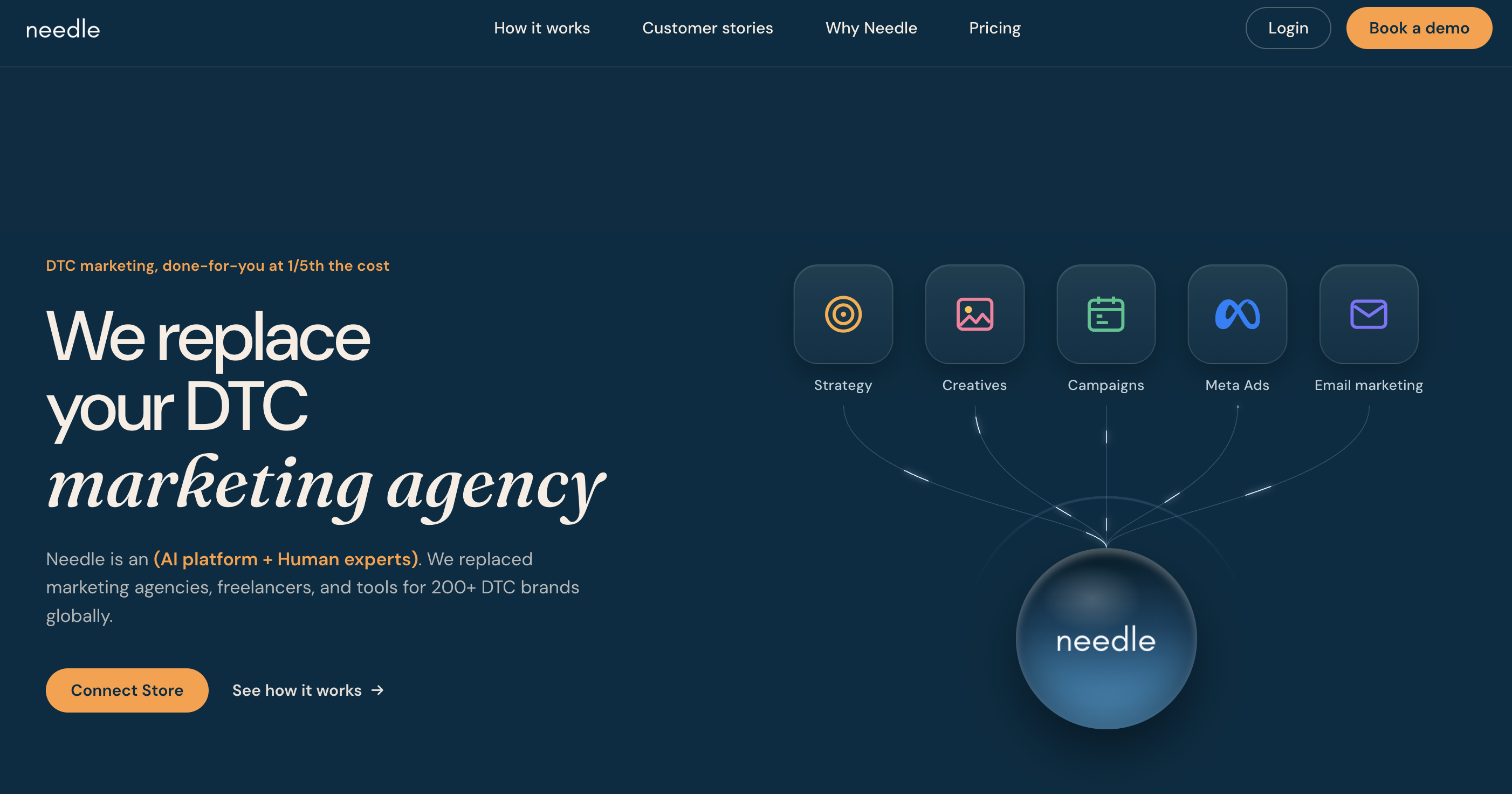
This hybrid approach allows a weekly campaign rhythm. Most in-house teams or agencies can't sustain this. Needle connects to your Shopify, Klaviyo, Meta, Google, and TikTok accounts. It generates a weekly content calendar. You approve the ideas. Their team delivers human-polished creative assets. Creative volume is uncapped and revisions are unlimited. This structure cuts down the back-and-forth that stalls progress. It turns a multi-week process into a weekly workflow.
Why It Stands Out
Needle's main advantage is its blend of speed, predictable cost, and quality. Pricing is a flat monthly fee set by ad spend and email list size, not a percentage of ad spend: Growth is $2,999/month (roughly $5–8K in monthly ad spend), Scale is $3,999/month (roughly $8–11K), and Custom pricing covers $11K+ in ad spend. Creative volume is uncapped, so cost doesn't climb with output. The entry tier assumes meaningful ad spend, so smaller brands may fall below it.
The model is proven. Over 200 DTC brands run on Needle. Across those brands (3+ months in), the published averages are 62% lower agency, freelancer, and tool costs, +91% marketing efficiency, and +177% annualized revenue uplift for top brands — with Meta ROAS ranging 6–40× across customer accounts. Their client Cloud Comfort cut monthly marketing spend from $15K+ to $6K while growing ROAS by +170%.
TWOOAK cut its cost-per-order from $41 to $19. Another client, As Intended, sustained a 6× ROAS for months. These results show Needle can drive growth without high overhead. For a deeper dive, you can read about their approach to AI-powered ad creative on askneedle.com.
Best For: DTC founders and marketing teams who need more creative output and faster campaign tests without hiring a full-scale agency.
2. Meta for Business – Agency Success Center
Meta for Business – Agency Success Center is Meta's official hub for agencies. It's not an agency itself. But it's an essential resource for any brand working with one. Think of it as the source of truth for platform updates, best practices, and official training.
What It's For
This portal centralizes Meta's playbooks, case studies, and news. It provides access to resources tied to your Business Manager. This includes benefits like the Meta Performance Accelerator. For brands, it's a way to verify your agency's information. And to stay current on platform capabilities. Good meta ad agencies use these resources to stay sharp.
"Being a Meta Business Partner gives us access to dedicated support, advanced training, and valuable insights, which directly translates into better performance and strategic advantages for our clients."– Jake Newbould, Head of Marketing, Tusp
Key Considerations
Full access to benefits requires a Meta Business login. Meta's public Partner Directory was taken down for review. You can no longer browse badged agencies there.
Understanding the platform's direction is key. Beyond ad tactics, the bigger picture informs your strategy. For example, getting insights into Meta's regulatory landscape helps you anticipate platform shifts.
3. Meta Blueprint (training and certifications)
Meta Blueprint is Meta’s official education and certification program. It offers structured courses, practice tests, and proctored exams. These lead to verifiable digital badges. The best meta ad agencies use this to prove their teams have mastered the platform.

What It's For
Blueprint provides free courses on planning, targeting, and creative. It's the most reliable way for professionals to learn platform mechanics. For brands, asking a potential agency about their team's Blueprint certifications is a simple vetting technique. It signals a commitment to professional development.
A Meta-commissioned study by Kantar found that 75% of hiring managers prefer candidates with industry-recognized certifications.
Key Considerations
The course content is free. But the proctored certification exams have a fee. These certifications confirm technical knowledge. They do not guarantee strategic excellence. But they are a strong signal of an agency's commitment to quality. Understanding these skills is key for executing effective eCommerce Meta ad campaigns.
4. Upwork – Facebook Ads specialists marketplace
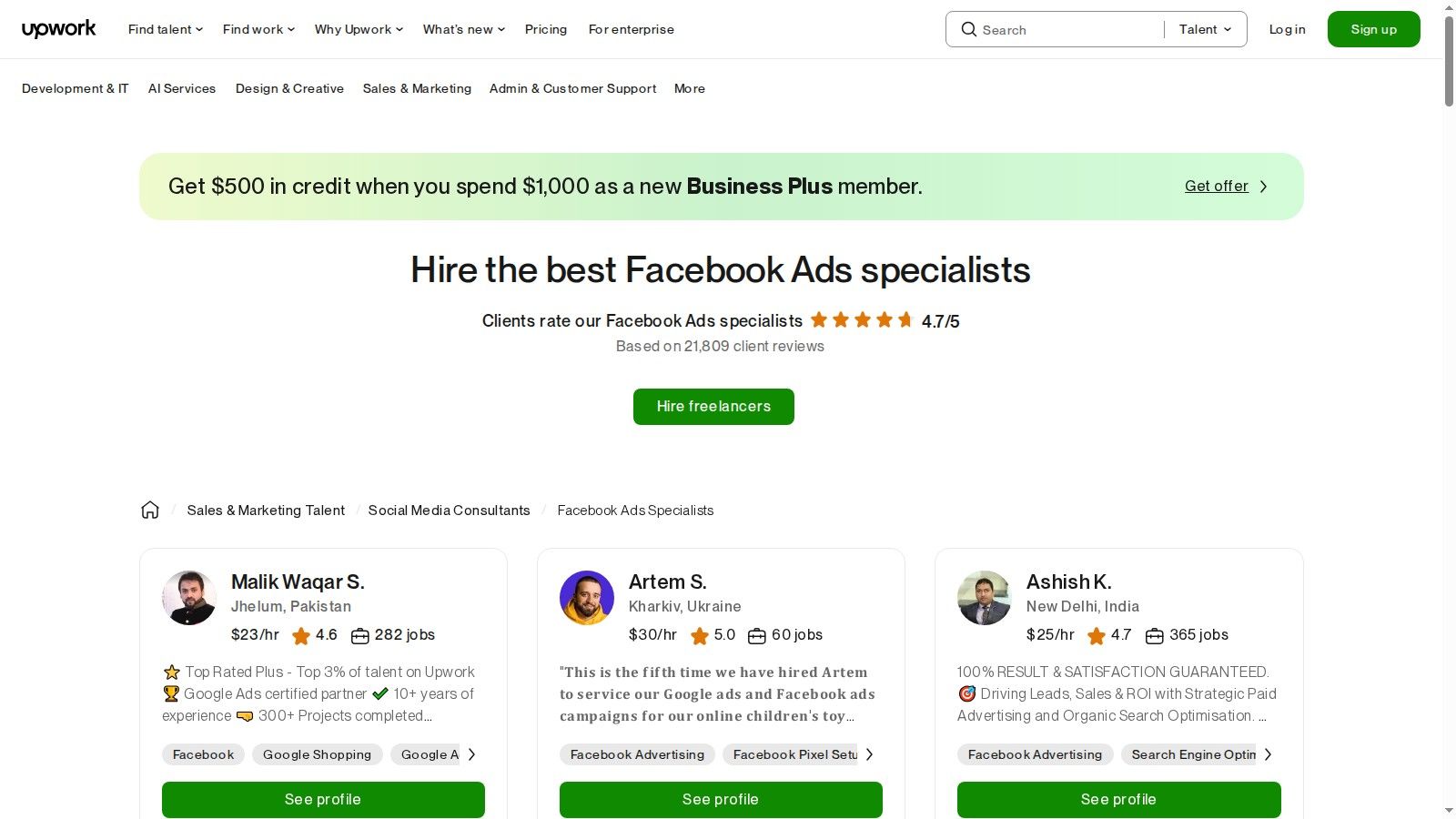
Upwork – Facebook Ads specialists marketplace is a large freelance marketplace. You can hire individual Meta Ads strategists, media buyers, and creatives. Brands can hire talent on hourly or fixed-price terms. It's a flexible option for specific projects.
What It's For
Upwork is for brands that need to add to their team without a full-time hire. You can find experts for short-term tasks. Things like campaign audits, creative production, or setting up tracking. Profiles include work histories, client feedback, and portfolios. This allows for thorough vetting. Its platform-managed payments provide a layer of security.
There are over 48,000 active freelancers specializing in "Facebook Ads" on Upwork, according to the platform's search results.
Key Considerations
The main challenge is the wide variance in quality. Diligent screening is critical. While platform protections exist, keep all communication and payments within Upwork to avoid scams.
For brands that have found a great media buyer but need more support, learning how to scale Facebook Ads effectively can turn a freelance hire into a major growth driver.
5. Fiverr – Facebook Ads gigs
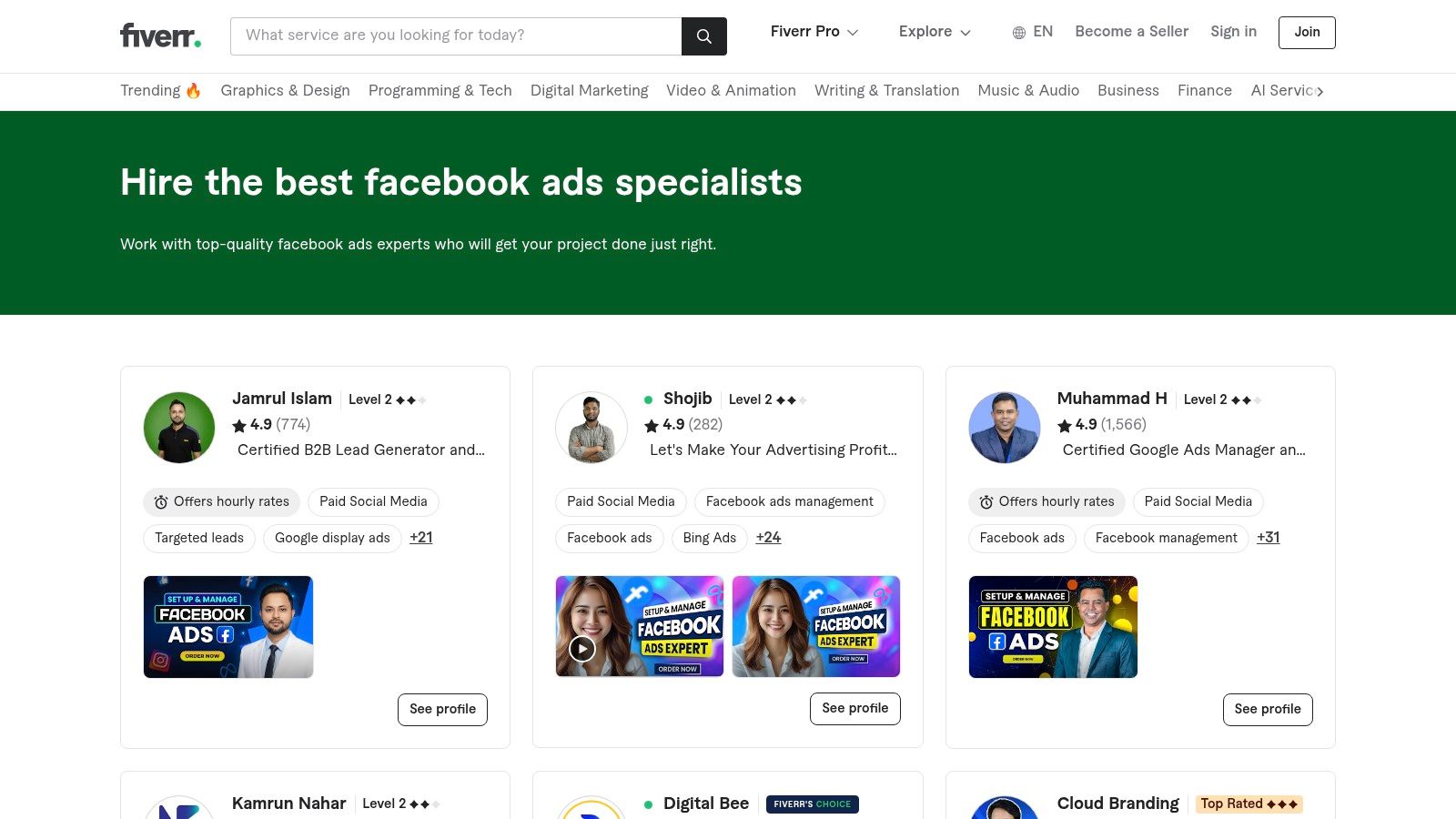
Fiverr – Facebook Ads gigs is a global marketplace for fixed-price services. It's ideal for brands needing specific, one-off tasks. Things like an ad account audit, pixel installation, or a single creative asset. You can do this without committing to a full retainer.
What It's For
Fiverr breaks down complex needs into purchasable "gigs." You can find specialists for campaign setup, audience research, or ad copy. Each gig page details the scope, delivery time, and pricing. It's easy to compare options and find a match for your budget. It provides a transactional way to access talent.
According to Fiverr's Business Trends index, "Social Media Advertising" searches increased by 155% year-over-year, showing high demand for these specific skills.
Key Considerations
Fiverr is less suited for complex, long-term strategic management. The quality and experience of freelancers vary a lot. So, a thorough check of profiles, portfolios, and reviews is essential. For ongoing growth, you might need a different solution. Understanding the pros and cons of freelancers versus agencies is key.
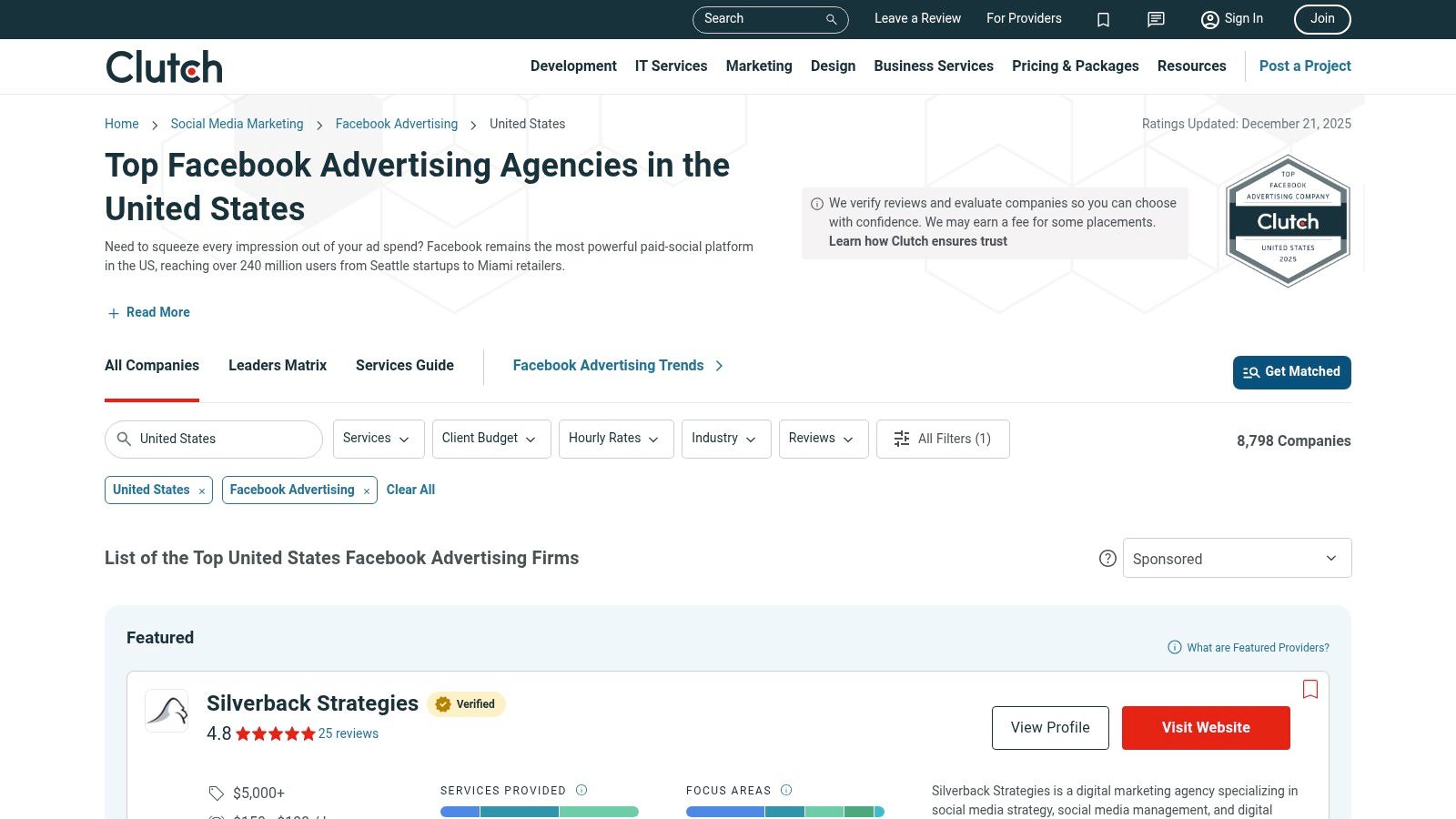
6. Clutch – Facebook Advertising Agencies (U.S.)
Clutch – Facebook Advertising Agencies (U.S.) is a B2B ratings platform known for its verified client interviews. It’s a key resource for shortlisting meta ad agencies. The platform's strength is its comprehensive profiles and rankings.
What It's For
Clutch lets you find and vet partners. Brands can use its filters to sort agencies by location, budget, and industry focus. The platform shines with its detailed review transcripts. These often include project costs, timelines, and direct quotes from former clients.
A 2026 report by Clutch found that 96% of consumers check reviews before buying a product or service they haven't tried — making platforms with verified client feedback like Clutch a key part of the agency vetting process.
Key Considerations
The directory is free, but some agency placements are sponsored. Always check the methodology behind the rankings. Also, top-ranked agencies on Clutch get a lot of outreach. This could affect their responsiveness or minimum project sizes. Using the filters to find a highly-rated but less visible agency can be a smart approach.
7. Sortlist – Facebook Ads agencies (U.S. and global)
Sortlist is an agency matchmaking marketplace. It helps brands find Facebook Ads providers in the U.S. and worldwide. You post a project brief and get proposals from agencies. This approach is efficient for creating a short list.
What It's For
Sortlist is ideal for getting a list of qualified agencies quickly. It displays key signals like minimum project budgets, team sizes, and client reviews. This helps you filter out poor fits from the start. Its strength is its coverage of boutique and mid-sized paid social specialists. This offers alternatives to larger firms. Effective meta ad agencies use platforms like this to connect with clients.
"Platforms like Sortlist are changing how businesses discover agencies, making it easier to find specialists that align with specific project needs and budgets."
– Forbes Agency Council
Key Considerations
The platform is free for brands. But pricing is often listed in EUR, so confirm USD equivalents. While it has reviews, it lacks the deep case studies found on other sites. This makes it harder to gauge an agency’s strategic depth from its profile.
For brands that need a quick, curated list, Sortlist is valuable. If you're exploring discovery methods, check out additional resources on the top Facebook ad agencies.
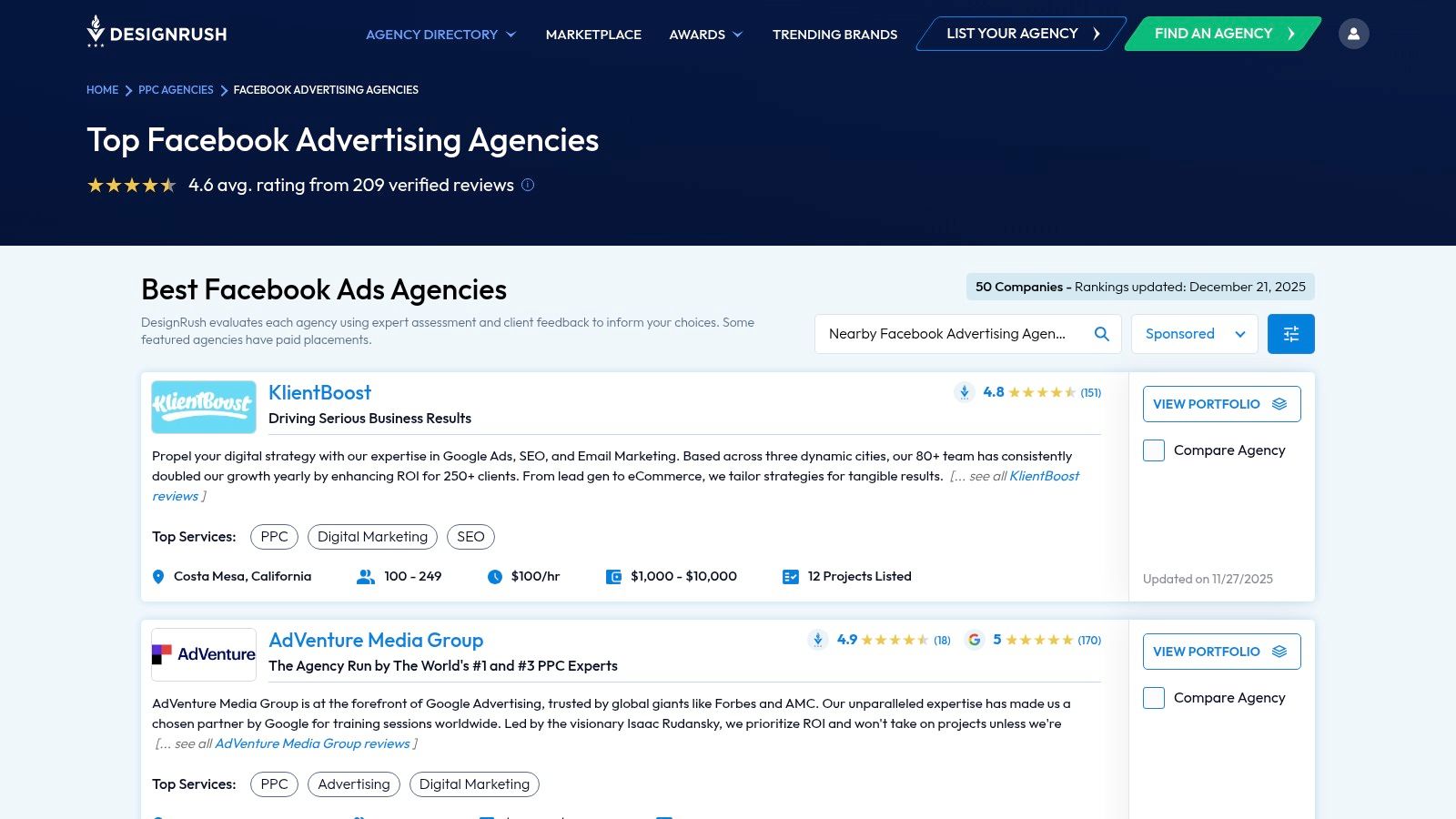
8. DesignRush – Facebook Marketing/Ads agency rankings
DesignRush is a B2B marketplace and directory. It curates rankings for service providers, including Facebook and Meta agencies. Its value is in presenting key agency details clearly. This includes hourly rates, project budgets, and team size.
What It's For
DesignRush is built for quick comparisons. You can use its filters to shortlist partners based on budget and specialization. The platform often highlights specific capabilities. For example, an agency's expertise with Advantage+ Shopping Campaigns. This helps you find a better fit. These lists are useful for discovering vetted meta ad agencies without endless searching.
According to thier website, DesignRush lists over 30,000 agencies across dozens of service categories, offering a wide but curated selection.
Key Considerations
The platform's business model includes sponsored placements. So, it's important to independently verify any agency you find. The level of detail on each profile can also vary. Use DesignRush as a starting point. Then conduct your own deeper diligence on the most promising candidates.
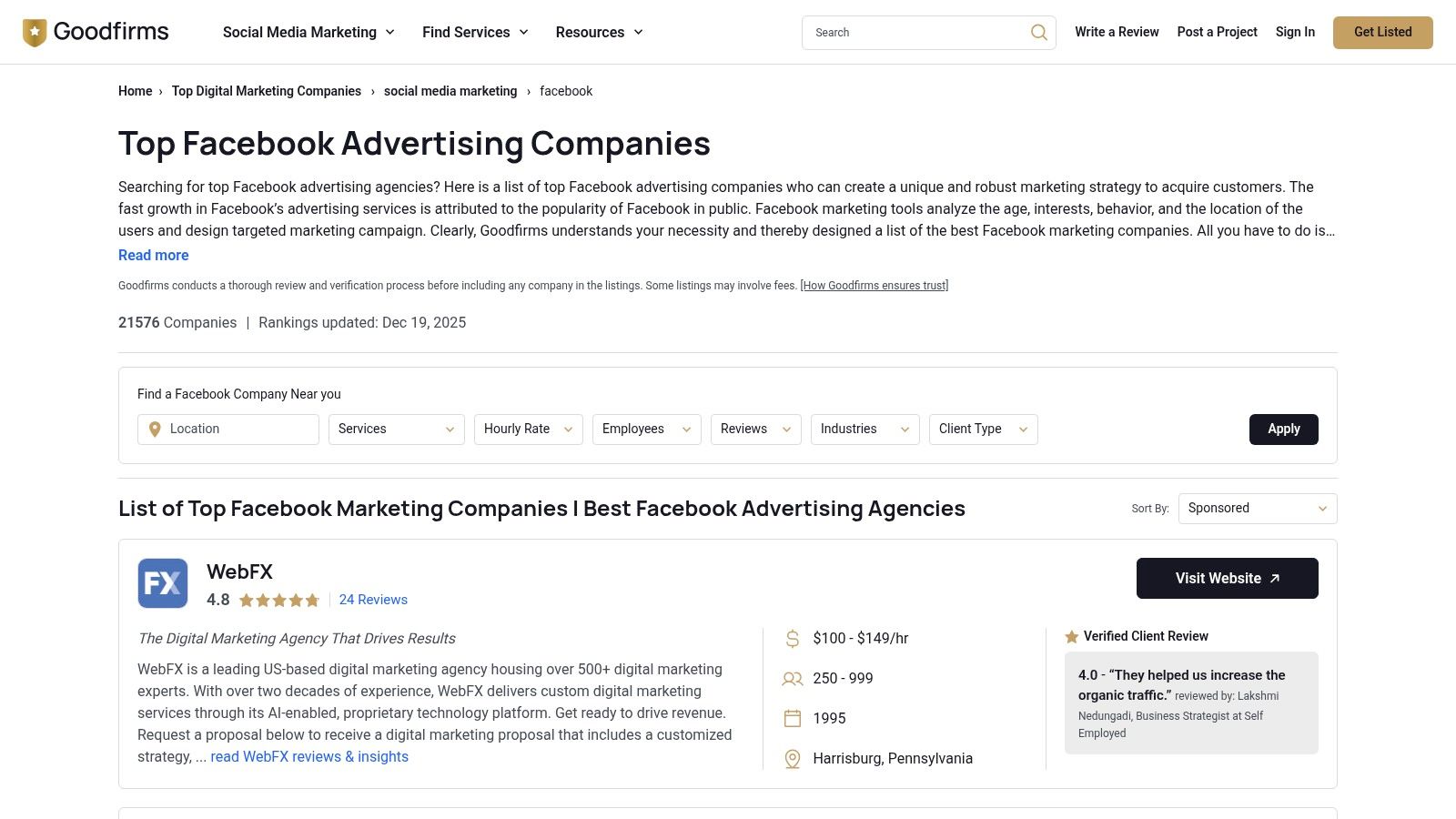
9. GoodFirms – Facebook Advertising Companies
GoodFirms – Facebook Advertising Companies is a B2B research and review platform. Its directory for Facebook advertising companies uses human-vetted reviews. It also uses a proprietary scoring system to rank agencies. It's a useful resource for initial discovery.
What It's For
GoodFirms is designed for quick, high-level comparisons. You can filter potential meta ad agencies by location, services, and budget. Its "Leaders Matrix" provides a visual way to see how different agencies stack up. This helps you quickly identify top performers.
GoodFirms has reviewed 23,796 Facebook advertising companies across 131 countries as of August 2026. Its research methodology includes over 60 qualitative and quantitative factors to rank companies.
Key Considerations
The platform is great for identifying pricing bands and service mixes. However, some agency profiles can be light on detail. You may find fewer long-form client interviews compared to a site like Clutch. This requires you to do more follow-up research. It serves best as a starting point for building a longer list of partners.
10. The Manifest – Facebook Advertising Companies (U.S.)
The Manifest is a business news website that publishes curated lists of top service providers. As a sister site to Clutch, it offers a more streamlined view of agencies. It's an excellent resource for creating a quick shortlist.
What It's For
The Manifest provides scannable, comparative data on meta ad agencies. Each listing includes key information at a glance. Like minimum project size, hourly rates, and team size. This format lets you rapidly filter out firms that don't meet your budget. It's best used as an initial screening tool. The platform also offers a concierge service to connect you with firms directly.
“The most successful B2B marketers can track their efforts back to revenue.”
– Kipp Bodnar, CMO of HubSpot. Platforms like The Manifest help by quickly showing cost data, a key part of the ROI equation.
Key Considerations
While its summaries are powerful for quick comparisons, The Manifest lacks the in-depth reviews of Clutch. The information is best used as a starting point. Be sure to use the location filters carefully. Always cross-reference your shortlist with more detailed sources.
11. Agency Spotter – agency search and shortlisting
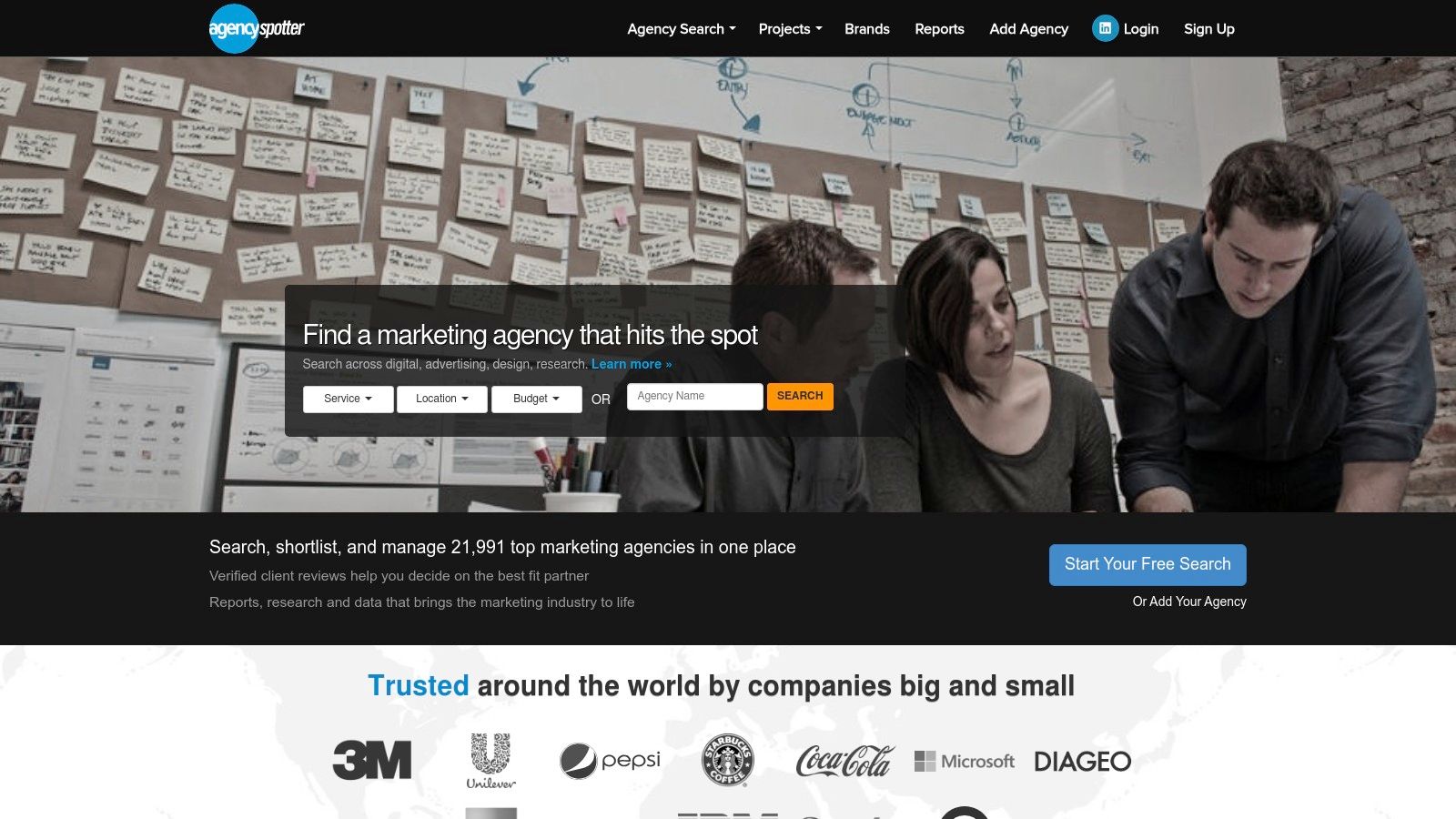
Agency Spotter is a broad discovery platform for marketing agencies. Its filtering and shortlisting tools make it a powerful starting point. It's useful for brands that need a structured process to find partners.
What It's For
The platform lets you search over 19,000 agencies. You can filter them by service area, budget, location, and diversity ownership. Its main function is to help teams build, share, and manage shortlists internally. This workflow is ideal for companies where multiple stakeholders must approve an agency. You can find capable meta ad agencies here, but you need to filter out the generalists.
As of August 2026, Agency Spotter's directory spans 19,042 agencies across 56 service areas and more than 140 countries — giving you precise control over your initial discovery process.
Key Considerations
Its broad scope means you must use its filters to isolate agencies with deep Meta expertise. Accessing more detailed agency stats requires a free user account. It is more of a database than a curated directory. The burden of vetting is on your team.
12. Bark – hire social media/PPC specialists (U.S.)
Bark is a lead generation marketplace. Brands can source quotes from local or remote social media and PPC professionals. You submit a project brief, and providers bid on your work. It’s effective for finding smaller freelancers or niche agencies.
What It's For
Bark streamlines the initial outreach process. You complete a single form detailing your needs, budget, and goals. The platform then matches you with relevant providers who send proposals. This model is ideal for DTC brands with a clear scope who want to compare bids quickly. You can get proposals from a diverse pool of meta ad agencies and freelancers.
Bark claims to connect millions of customers with professionals in over 1,000 services each year, highlighting its large scale.
Key Considerations
The platform is free for buyers. But its open marketplace model means provider quality can vary. You will likely get a high volume of responses. Be prepared to vet each candidate thoroughly. The key to success on Bark is a very specific brief. It’s a tool for sourcing, not for vetting.
Meta Ad Agencies: 12-Resource Comparison
| Product / Service | Core features | Speed / turnaround | Price / value | Best for / unique selling point |
|---|---|---|---|---|
| Needle Recommended | AI+human hybrid: connects Shopify, Klaviyo, Meta, Google, TikTok; generates ideas, assets, launches, weekly reports | Weekly creative cycle, uncapped volume, unlimited revisions | Flat monthly fee from $2,999/mo (Growth), $3,999/mo (Scale), Custom above ~$11K ad spend — no percentage of ad spend | DTC brands $1M–$10M, 5–50 people — agency-level strategy + software speed |
| Meta for Business – Agency Success Center | Official playbooks, policy updates, program benefits | Resource hub — on-demand | Free (Business login for personalized benefits) | Agencies managing FB/IG ads; first-party guidance and program access |
| Meta Blueprint | Structured courses, practice tests, certs, Pearson VUE exams | Self-paced; certification time varies | Most courses free; paid proctored exams | Advertisers and agencies seeking recognized Meta certifications |
| Upwork – Facebook Ads specialists | Freelancer marketplace, profiles, escrow, hourly/fixed contracts | Fast hiring; delivery times vary by freelancer | Wide price range (hourly or fixed) | Flexible bench talent, test projects, variable budgets |
| Fiverr – Facebook Ads gigs | Fixed-price gigs, tiered packages, delivery times, reviews | Often quick (days); depends on gig | Low fixed prices for discrete tasks | Cheap, fast one-off tasks (audits, setups, creatives) |
| Clutch – Facebook Advertising Agencies | Verified client reviews, in-depth transcripts, filters, case studies | Directory — timing depends on engaged agency | Free to browse; agency rates vary (often mid–high) | Enterprise shortlisting, due diligence, trusted reviews |
| Sortlist – Agency matchmaking | Curated listings, brief intake, proposals, budget signals | Proposal timelines vary by agency | Free to post briefs; agency fees vary | Efficient shortlist generation for boutique and mid-size agencies |
| DesignRush – Agency rankings | Editorial lists, agency cards, hourly/min budgets, specialties; 30,000+ agencies listed | Directory — N/A | Free to browse; some sponsored placements | Quick scanning of options and specialist capabilities |
| GoodFirms – Advertising companies | Vetted reviews, market-presence scores, Leaders Matrix; 23,796 companies across 131 countries | Directory — N/A | Free to browse; agency pricing varies | Compare service mixes and pricing bands globally |
| The Manifest – Agency lists | Curated top lists, budget/team summaries, concierge match | Fast shortlisting service | Free browsing; agency fees set by providers | Quick shortlist and concierge connection to vetted firms |
| Agency Spotter – Search & shortlisting | Search 19k+ agencies, build/share shortlists, briefs, reports | Depends on outreach and agency response | Free search; some features require sign-up | Team workflows for structured procurement and review |
| Bark – Hire social/PPC specialists | Intake form, local quotes, provider profiles, reviews | Fast quote generation; provider follow-up varies | Free to request quotes; provider fees vary | Rapid local bids from small agencies and freelancers |
Stop Managing Agencies. Start Getting Results.
You've just seen a list of resources. From directories like Clutch to freelance platforms like Upwork. The goal was to give you the tools to find the right partner. But the core challenge often remains, even after you've signed a contract.
The traditional agency model is struggling to keep pace. Its hefty retainers, slow communication, and opaque processes don't work for modern e-commerce. As a founder, your time is your most valuable asset. Spending it managing agencies is a drain on your growth.
The key takeaway isn't just a list of names. It's a shift in thinking about how you get ads managed. The search for the best meta ad agencies is no longer about finding the firm with the fanciest office. It's about finding a partner that operates at the speed of your business.
Your Next Steps: From Selection to Execution
The path forward requires a clear assessment of your brand's needs. Don't get distracted by case studies that don't mirror your situation. Instead, focus on these critical points:
- Define Your True Need: Do you need high-level strategy, or rapid execution? Many agencies excel at the former but stumble on the latter. If your bottleneck is producing fresh ad creative, a traditional agency's pace might be too slow.
- Calculate the Total Cost: A $5,000 retainer is just the start. Factor in the cost of your own time spent in meetings and project management. A 2023 HubSpot survey found that 46% of marketers spend several hours a week just managing their external agencies. Consider the opportunity cost of that time.
- Evaluate the Tech: Ask potential partners how they use technology. Are they using AI to analyze performance, or are they relying on manual processes? The right technology can be a massive force multiplier.
- Prioritize Transparency and Control: You should never be in the dark about your ad account's performance. The right solution gives you complete visibility and control. It lets you track results in real-time and make quick pivots.
Frequently Asked Questions (FAQ)
What does a Meta ad agency do?
A Meta ad agency manages advertising campaigns on Meta's platforms, which include Facebook, Instagram, Messenger, and WhatsApp. Their work includes strategy, creating ads, targeting specific audiences, managing the budget, and analyzing results to improve performance. In practice, that means building and structuring ad accounts, running creative tests, adjusting bids and budgets, monitoring frequency and fatigue, and producing regular performance reports.
A full-service agency handles every stage — from writing copy to launching campaigns to pulling weekly reports — so you're not logging into Ads Manager yourself. The quality of that work varies a lot: some agencies are proactive and creative-test-heavy; others are mostly reactive and manage spend without generating new ideas.
How much do Meta ad agencies charge?
Agency fees vary widely. Many traditional agencies charge a monthly retainer of $5,000 to $10,000 or more. Others charge a percentage of ad spend, typically 15–25%. Newer models, like Needle, use a flat monthly fee set by ad spend and list size (from $2,999/month) rather than an ad-spend percentage.
Watch for hidden costs: creative production is often billed separately at traditional agencies, which can add $1,000–$3,000/month on top of the retainer. A percentage-of-spend model also creates a misalignment — the agency earns more when you spend more, not necessarily when you profit more. Package-based pricing tends to work better for DTC founders because the cost is predictable regardless of how much you scale ad spend.
What should I look for when hiring a Meta ad agency?
Look for an agency with proven experience in your industry (e.g., DTC, e-commerce). Check their case studies and client reviews. Ask about their process for creating and testing new ads. Make sure their communication style and speed match your business needs. Specifically, ask how many new creative variations they produce per month and who handles production — many agencies outsource this to freelancers.
Ask to see a real performance report from an active client, not just a polished case study. Red flags to watch for: agencies that promise a specific ROAS before seeing your account, lock you into 12-month contracts without a 30-day exit clause, or can't explain exactly what they'll do in the first 30 days.
Can I run Meta ads myself instead of hiring an agency?
Yes, you can run ads yourself. Meta's Ads Manager provides the tools to do so. However, managing campaigns effectively requires significant time, skill, and continuous learning. An agency or specialized service can often achieve better results by applying deep expertise and saving you time. The real cost of DIY isn't the Ads Manager — it's the hours spent keeping up with Meta's algorithm changes, testing creative, and diagnosing underperformance.
If you're spending under $2,000/month on ads, DIY often makes sense until you have enough volume to justify outside help. Above that threshold, the opportunity cost of your time usually exceeds what a good agency or service costs.
What is the difference between a freelancer and an agency for Meta ads?
A freelancer is an individual expert you hire for specific tasks like media buying or ad creative. An agency is a team that typically offers a broader set of services, including strategy, creative, and analytics. Agencies usually cost more but provide a more complete service, while freelancers offer flexibility and lower costs for specific needs.
The risk with freelancers is single-point-of-failure: if your media buyer gets sick or takes on other clients, your campaigns stall. Agencies spread the work across a team, but add layers of account management that can slow turnarounds. A newer hybrid model — part automation, part human team — is worth considering if you need agency-level output without agency-level overhead.
How long should I commit to a Meta ad agency before judging results?
Most performance changes take 4–8 weeks to show up, since Meta's algorithm needs time to exit the learning phase after major account or creative changes. Agencies typically ask for a 3- to 6-month minimum commitment to properly test creative and audience combinations. If a partner promises dramatic results within the first two weeks, treat that as a red flag rather than a selling point.
A practical way to structure the relationship: set clear 30-day and 60-day milestones upfront — not on ROAS (too volatile early on), but on process metrics like number of creatives shipped, campaigns launched, and reporting cadence held. If an agency can't hit its own process commitments in month one, it's unlikely to hit performance targets by month three.
What's the difference between a Meta ad agency and a Meta Business Partner?
A Meta Business Partner is an agency Meta has formally vetted and given access to extra resources, like the Meta Performance Accelerator and dedicated support channels. Not every good agency is a Meta Business Partner, and not every Meta Business Partner is the right fit for a DTC brand under $10M in revenue — the badge signals platform access, not necessarily startup-friendly pricing or senior attention on your account.
For smaller brands, the Partner badge is most useful as a shorthand for technical competency — it means the agency has met minimum spend and training thresholds. What it doesn't tell you is whether your $5K/month account will get a senior media buyer or be handed to a junior team member while bigger clients take priority. Use the badge as a baseline check, not a shortcut for due diligence.
Should I hire a Meta-only specialist or an agency that also runs Google and TikTok ads?
It depends on where your revenue actually comes from. If Meta drives the majority of your paid acquisition, a Meta-focused specialist often produces better creative testing velocity than a generalist shop splitting attention across platforms. If your channel mix is more balanced, a multi-channel agency can coordinate budget and audience data across platforms in ways a single-channel specialist can't.
For most DTC brands under $10M, Meta is the primary paid channel — which means specialist depth usually wins over generalist breadth at this stage. The clearest way to decide: look at where you're leaving money on the table. Inconsistent Meta ROAS and slow creative output points to a Meta specialist; neglected Google and TikTok with a performing Meta account points to a multi-channel shop.
How many ad creatives should a Meta ad agency be testing each month?
For a DTC brand spending $5,000–$10,000/month on Meta, a healthy testing cadence is roughly 8–15 new creative variations per month across static images, carousels, and video. Fewer than that usually means creative fatigue sets in before you've found a winning angle; agencies that can't sustain this pace are often bottlenecked by manual production rather than strategy.
Each variation should test one variable at a time — hook, format, offer, or visual — so you can read the data cleanly rather than guessing what drove a performance change. Ask any agency you're vetting to show you their last three months of creative output for a comparable DTC client. If the answer is fewer than 6–8 pieces per month, the bottleneck is production capacity, and that will cap your results regardless of how good the targeting is.
The Emerging Alternative: The AI-Powered Agency Hybrid
The resources we've covered point toward a conventional way of doing things. For DTC brands that need to be agile, the most powerful option is a new hybrid model. It blends expert human strategy with AI-driven execution.
This approach eliminates the bloat of traditional meta ad agencies. Instead of paying for layers of account management, you invest in the outputs that matter: high-performing creative and expertly managed campaigns. This model is built for founders who value speed and efficiency over endless meetings. You get the strategic guidance you need without the operational drag. The future of ad management isn't another agency; it's a smarter, leaner way to grow.
Tired of the agency runaround? Needle is the AI marketing team we built because we couldn't find it when we were running our own brands. Get dedicated strategists, unlimited creative, and expertly managed campaigns on a simple flat monthly fee, all in one tab. Book a call with Needle to see how it fits your brand.