
Finding the right Facebook ad agency feels like a full-time job. You sort through pitches promising the moon, only to get stuck with high retainers and poor results. Traditional agencies often focus on their margins, not your growth — locking you into long contracts with playbooks that don't work anymore.
According to WordStream's 2025 Facebook Ads benchmark data, the average Meta Ads cost-per-click is $0.70 for traffic campaigns and $1.92 for lead campaigns, with average cost per lead at $27.66 depending on industry. That's a serious ongoing investment. If you're tired of paying for slow agencies, you need a partner who masters concepts like Facebook Ads automation to drive real scale.
This guide cuts the noise. We've listed the best places to find and vet top Facebook ad agencies and specialized talent — from full-service agencies to AI-driven models and freelancer marketplaces. No generic directories. Just platforms built for modern e-commerce.
1. Needle
Best for: AI-Powered Execution with Human Oversight
Needle is a hybrid solution for DTC brands. It gives you the power of a top agency, with AI-powered speed and a dedicated strategist. It combines an AI platform with human strategists and editors. You get a full marketing team in one efficient system. The model is built for brands that need to move faster and scale predictably.
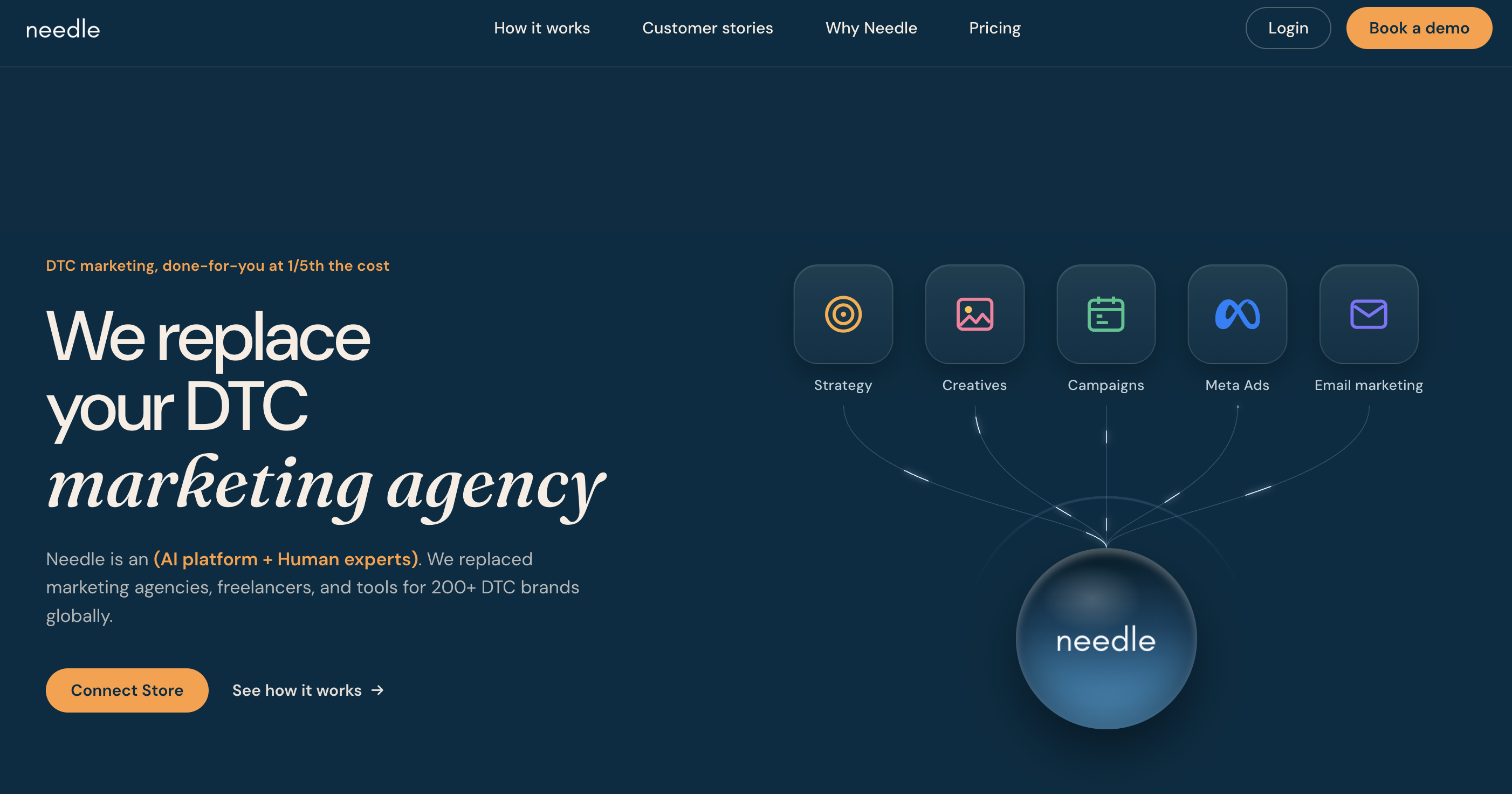
The platform connects to your Shopify, Klaviyo, Meta, Google, and TikTok accounts. It analyzes your data to automatically generate a weekly content calendar. This calendar is filled with on-brand ad creatives and email campaigns. Your job shifts from building to approving. Hours of work in Ads Manager and Canva become minutes of review. This is how Needle delivers quality assets so quickly.
Key Features & How It Works
Needle replaces messy workflows with one smart system. No more juggling spreadsheets, design tools, and ad platforms.
AI-Powered Content Generation: The platform analyzes your brand and performance data. It then creates drafts of images, videos, and email copy. This isn't generic AI. It's trained on what already works for your brand.
Human-in-the-Loop Quality Control: Every asset is reviewed by a human strategist and editor. This ensures creative quality and brand consistency. It avoids the common mistakes of pure automation.
Predictable Weekly Cadence: Needle runs on a weekly schedule. You get a campaign calendar for approval. Creative volume is uncapped and revisions are unlimited. This predictability beats traditional agency timelines.
Direct Campaign Launching & Reporting: Approved campaigns launch directly to Meta, Google, TikTok, and Klaviyo from the Needle platform. Every tier includes weekly ad optimization and a weekly Momentum Report. Performance is tracked automatically. Weekly reports feed insights back into the system for constant improvement.
Real-World Impact: According to Needle, brands running it for 3+ months see +177% annualized revenue uplift (top brands) and +91% marketing efficiency, and cut agency, freelancer, and tool costs by 62%. This shows the hybrid model works.
Who is Needle a Good Fit For?
Needle is built for a specific kind of DTC brand. It's for established businesses looking to scale efficiently.
Ideal Customer Profile: DTC brands in fashion, beauty, pet supplies, food, and lifestyle.
Revenue & Team Size: Best for brands with $1M to $10M in annual revenue and teams of 5 to 50 people.
Core Need: Founders who want to offload marketing execution without hiring a full team.
Brands outside this profile, like those not on Shopify, may not get the full benefit.
Pricing Model
Needle charges one flat monthly fee set by ad spend and email list size, with no percentage cut of ad spend. Creative volume is uncapped, and every tier includes hands-free campaign management, weekly ad optimization, a weekly Momentum Report, unlimited revisions, and a dedicated strategist.
- Growth: $2,999/month, for roughly $5–8K in monthly ad spend and ~5K active email subscribers
- Scale: $3,999/month, for roughly $8–11K in monthly ad spend and 5K–10K subscribers
- Custom: tailored pricing for $11K+ in monthly ad spend, 10K+ subscribers, or more complex needs such as BFCM spikes
The entry tier is well above self-serve tools, so smaller budgets may fall below it. See Needle's pricing page for current details.
| Feature | Needle — AI-Hybrid Model | Traditional Agency |
|---|---|---|
| Core Model | AI platform with human strategists | Fully manual, human-led services |
| Pricing | Flat fee from $2,999/mo Scale $3,999/mo; Custom above $11K ad spend |
Fixed retainer $5k – $10k+/mo |
| Turnaround | Weekly cadence; uncapped creative, unlimited revisions | 1–2 weeks or more |
| Workflow | Approve in-platform | Manual feedback via email/Slack |
| Best For | Scaling DTC brands $1M–$10M ARR |
Larger enterprises with complex needs |
Pros & Cons
Pros:
- Predictable Pricing: A flat monthly fee with no percentage cut of ad spend and uncapped creative volume.
- Speed & Efficiency: A weekly cadence and unlimited revisions eliminate bottlenecks.
- Integrated Execution: A true "all-in-one" system that builds, launches, and reports.
- Proven Results: Strong case studies show major ROAS improvements.
Cons:
- Niche Focus: Designed for DTC brands on the Shopify and Klaviyo stack, and the entry tier assumes roughly $5–8K in monthly ad spend.
- Seasonal Scaling: Brands with highly variable seasonal needs (such as BFCM spikes) may need Custom pricing.
2. Clutch
Clutch is not an agency. It's a B2B research and review platform. Its section for Facebook ad agencies is one of the best research tools available. Think of it as a pre-vetted starting point for your search. It saves you from endless, unreliable Google searches. The platform's value is its tough verification process.
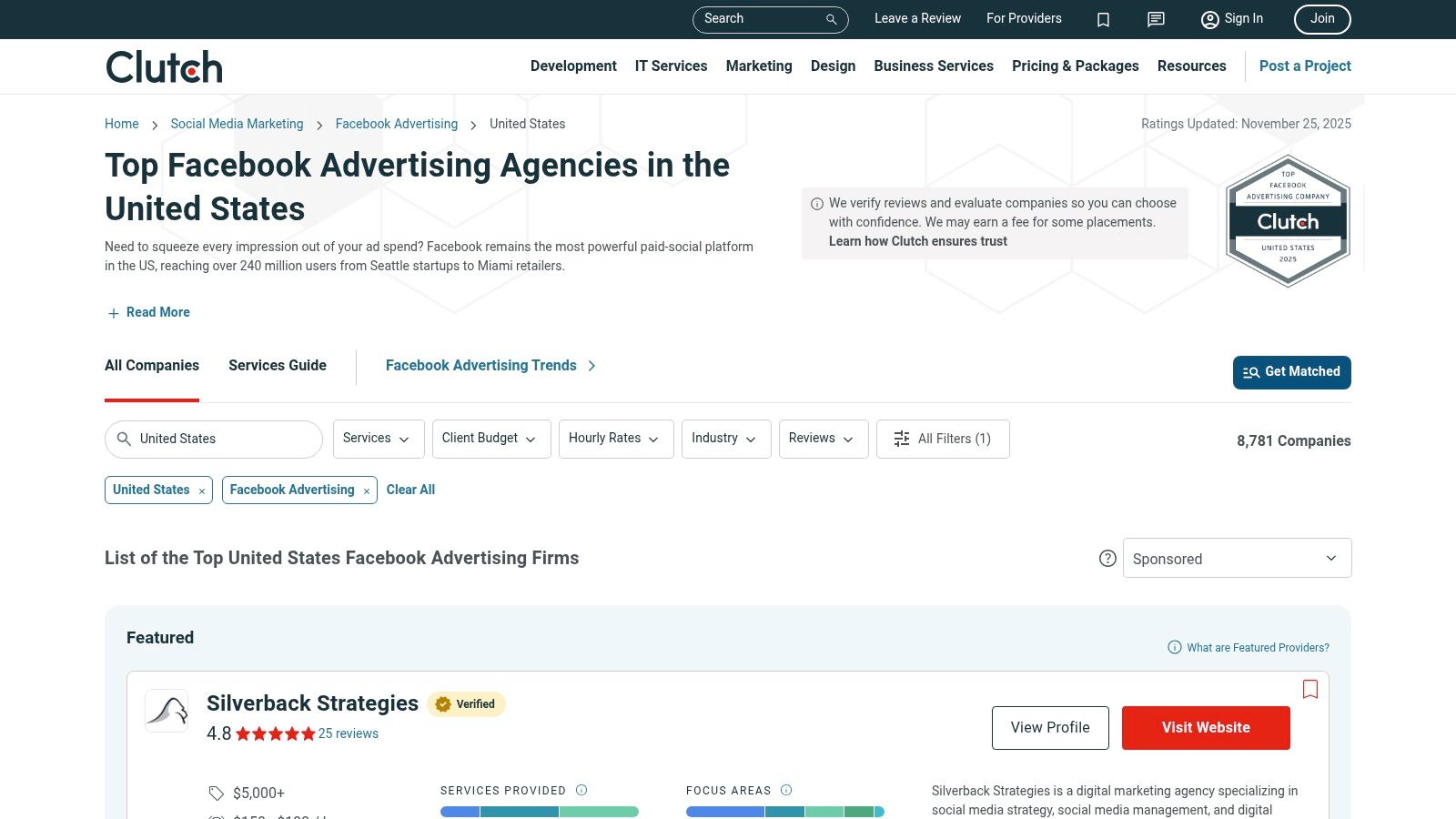
Clutch's review system is its key feature. It's not just star ratings. Clutch analysts conduct live phone interviews with an agency's clients. This gets detailed, unbiased feedback. It uncovers truths about an agency's communication and performance that you won't find on their website.
How to Use Clutch Effectively
Use the platform's filter system to get the most out of it. You can narrow down the huge list of top Facebook ad agencies by:
- Location: Filter by city or state for local partners.
- Budget: Set your minimum project size to see agencies that work at your scale.
- Industry Focus: Find agencies with experience in your niche, like fashion or beauty.
Once you have a shortlist, dig into the profiles. Look at the "Portfolio" section for real work. Read the "Reviews" for direct client quotes. Look for patterns in feedback, good and bad.
According to Sprout Social's 2026 social media statistics, roughly 81% of consumers say social media compels them to make spontaneous purchases multiple times per year or more. This underscores the need for a competent agency.
Key Information and What to Watch Out For
Clutch provides upfront details on pricing. It often lists hourly rates and minimum project retainers. This transparency saves time. You can quickly disqualify agencies outside your budget. The platform's "Leaders Matrix" is another useful tool. It plots agencies based on their ability to deliver versus their focus.
However, some agencies pay for sponsored placements. These are clearly marked. Evaluate every profile on its merits, especially the verified client reviews. The number of options can be overwhelming. Use the filters aggressively. For a more curated comparison of agencies for DTC brands, see this in-depth look at paid social agencies for DTC.
3. DesignRush
DesignRush is a B2B marketplace, much like Clutch. It helps brands connect with professional agencies. Its section for Facebook marketing agencies is a valuable resource for DTC brands. It focuses on domestic partners with clear pricing and verified performance.
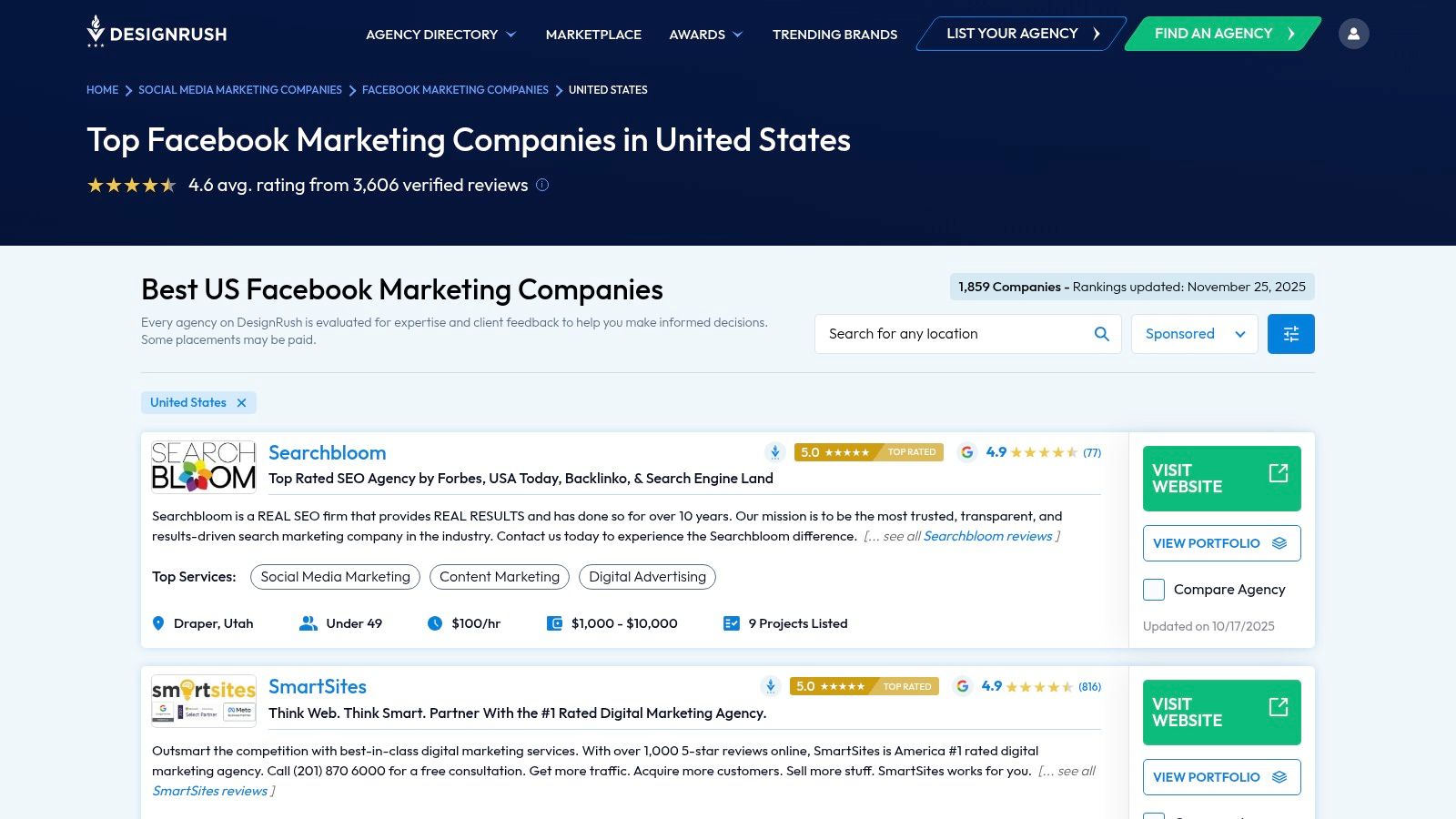
The platform's main advantage is its focus on clarity. Agency profiles often show hourly rates and minimum budgets on the listing page. This upfront financial info lets you quickly sift through partners. It saves you from discovery calls that lead nowhere.
How to Use DesignRush Effectively
Lean on its filtering to maximize your time. The platform lets you sort the list of top Facebook ad agencies with precision.
- Budget & Rates: Set your minimum project size and hourly rate to narrow the field.
- Industry Focus: Use the "Industry Expertise" filter to find agencies that know your market.
- Location: Filter by state or city if you prefer a local partner.
After shortlisting, dive into the profiles. Review their projects and client reviews. DesignRush provides review summaries for a quick check. Reading the full testimonials gives a better sense of an agency's strengths. This is crucial, as a versatile partner is invaluable for platforms like Instagram. Learn more in this guide on Instagram ad targeting.
"By providing in-depth information about agencies' portfolios, client reviews, and pricing structures, we aim to make the B2B matchmaking process seamless and efficient." — Gianluca Ferruggia, General Manager of DesignRush
Key Information and What to Watch Out For
DesignRush's "Top Facebook Marketing Companies" list is updated regularly. The clear display of ratings and budget needs simplifies comparison. It helps you quickly spot promising candidates.
However, like many platforms, DesignRush has sponsored listings. These paid placements appear at the top. Don't let a top rank be your only guide. Always evaluate an agency on its portfolio and verified reviews. Not every profile has deep case studies, so you may need to visit the agency's website for more data.
4. Sortlist
Sortlist is an agency marketplace with a unique twist. Instead of just browsing, you post a project brief for free. Vetted agencies review your needs and send you proposals. This RFP-style model is ideal for DTC brands that want to compare pitches without starting dozens of conversations.
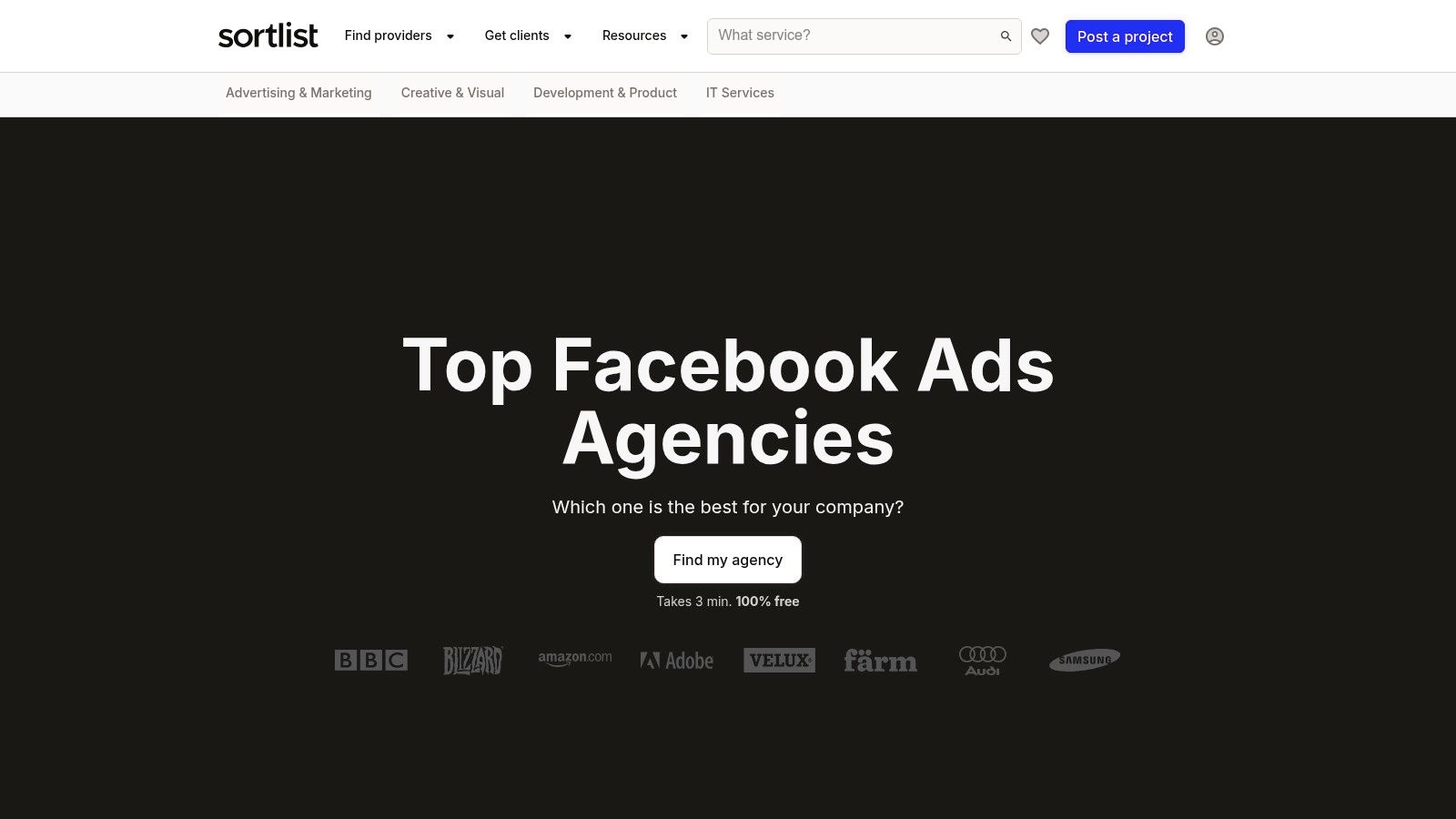
The core value is its guided matching system. The platform walks you through creating a detailed brief. It covers your goals, budget, and specific needs. This ensures the proposals you get are relevant from the start. It allows for an efficient side-by-side comparison.
How to Use Sortlist Effectively
Create a very specific project brief to get the best results. More clarity upfront means better proposals.
- Be Specific with Goals: Don't say "increase sales." Say "achieve a 3.5 ROAS on a $20k/month Meta ads spend for our skincare line."
- Define Your Budget Clearly: Specify your ad spend and management fee budget separately. This helps agencies propose realistic strategies.
- Outline Deliverables: Mention if you need creative production, landing page design, or just media buying. This helps you find the right kind of partner. For a deeper look, explore choosing between a full-service and specialized agency.
Once proposals arrive, shortlist your top candidates for discovery calls. Don't feel you have to talk to everyone who responds.
A McKinsey analysis found that today's personalization leaders drive 5 to 15% increases in revenue and 10 to 30% increases in marketing-spend efficiency. A good brief helps agencies understand how to personalize campaigns for your audience.
Key Information and What to Watch Out For
Each agency profile on Sortlist includes verified reviews and portfolio examples. This gives you the info needed to vet candidates before you talk to them. The process is free for brands.
However, the quality of outreach can vary. You might get a lot of proposals. Be disciplined in your shortlisting. Focus only on agencies that clearly read your brief and tailored their pitch. Ignore generic responses.
5. Upwork
Upwork is a global marketplace for freelance talent, not a traditional agency. For DTC brands, it's a great tool to hire individual Facebook Ads specialists. It offers a flexible alternative to agency retainers. It's ideal for specific needs like campaign audits or short-term projects. You connect directly with experts, skipping the agency overhead.
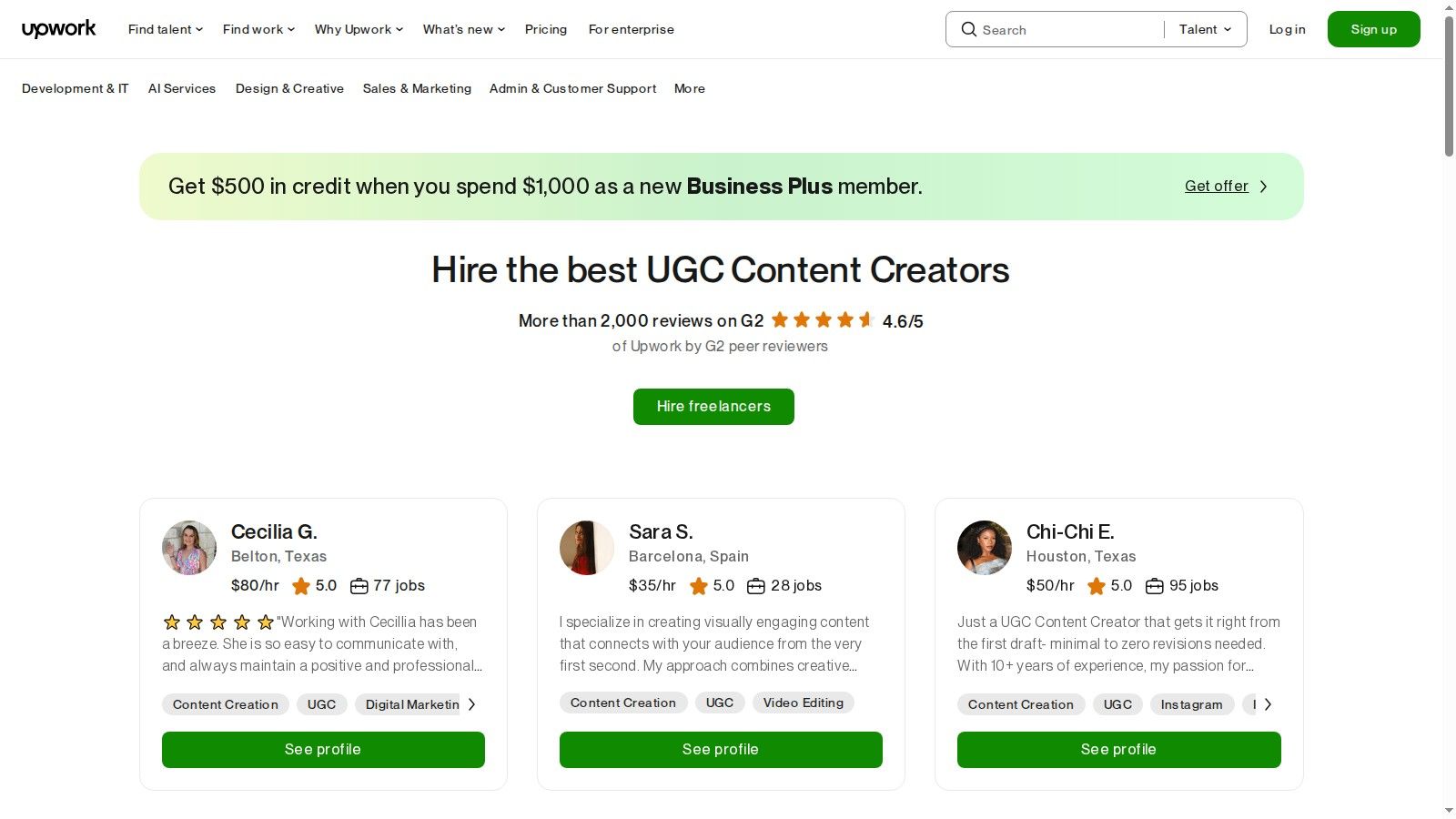
Upwork's key feature is its direct-access model and flexibility. You can post a job and get proposals from qualified freelancers, often within 24 hours. Each freelancer has a detailed profile showing their work history, client feedback, and "Job Success Score." This gives you a clear view of their track record.
How to Use Upwork Effectively
A strategic approach is key to finding top talent. Use the platform's filters to narrow your search for top Facebook ad agencies and specialists:
- Location: Filter for US-based specialists for local market knowledge.
- Job Success Score: Set a minimum of 90% for a consistent record of success.
- Hourly Rate: Specify a budget range to attract the right talent.
- Skills: Use tags like "Facebook Advertising," and "E-commerce" to find relevant experts.
When you post a job, be detailed. Outline your goals, audience, budget, and deliverables. This helps attract the right applicants. Once you have a shortlist, conduct brief video interviews to check their communication and strategic thinking.
According to Backlinko's analysis of Meta's investor data (updated April 2026), Facebook has 3.07 billion monthly active users worldwide. A skilled specialist can help you find your exact customer within that massive audience.
Key Information and What to Watch Out For
Upwork provides upfront cost guidance. Most freelancers publish their hourly rates on their profiles. The platform's time-tracking and payment protection add security.
However, the quality of talent varies. You must vet candidates thoroughly. Review portfolios, check feedback, and ask for relevant case studies. Be aware of platform fees: Upwork charges clients a service fee of 5% on the Basic plan (10% for Business Plus) on all payments to freelancers.
The volume of proposals can be a challenge. Have a clear vetting process. For more on this model, a guide on freelancers vs. agencies for paid social offers a deeper analysis.
6. Fiverr
Fiverr is a freelance marketplace for specific, project-based tasks. For DTC brands, it's a resource for handling smaller Facebook ad needs without a monthly retainer. Think of it as an à la carte menu for ad services. It's perfect for one-off projects, audits, or testing new creative.
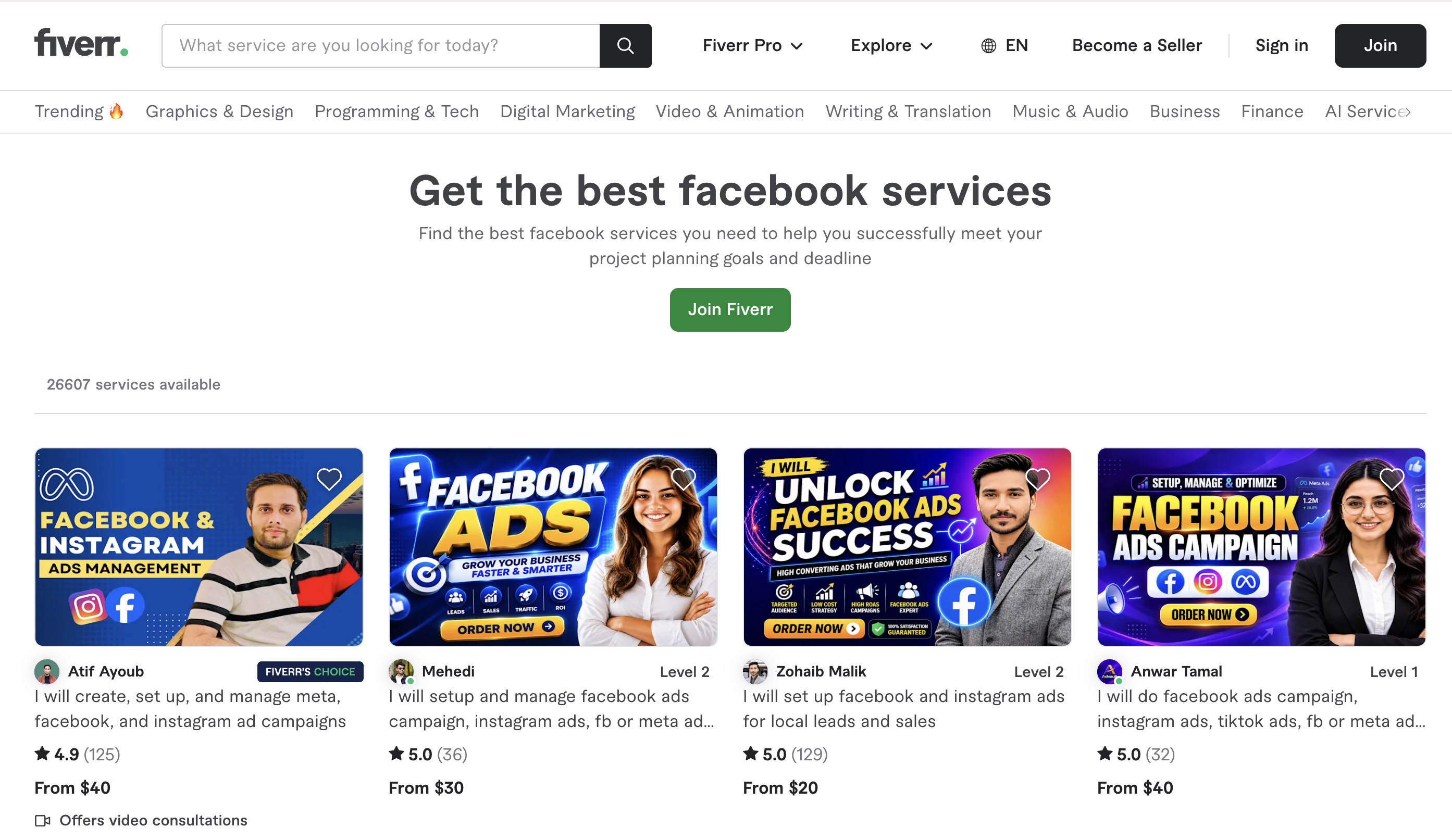
Fiverr's main feature is its transactional, "Gig" model. Freelancers package their services with fixed prices, clear deliverables, and set timelines. This transparency removes the usual ambiguity. You know what you're getting and how much it costs before you start.
How to Use Fiverr Effectively
To get the most out of Fiverr, be specific. Use its search and filtering to find the right talent:
- Service Options: Search for services like "Facebook ads audit," or "ad creative design."
- Seller Level: Filter by seller level (e.g., Top Rated) to find freelancers with a proven track record.
- Fiverr Pro: Use the "Pro services" toggle to see the top 1% of talent, hand-vetted by Fiverr.
Once you have a shortlist, review their profiles. Look at their portfolio for relevant ad examples and read all client reviews. Pay attention to comments on communication.
"There is no more B2B or B2C. It's H2H: Human to Human." — Bryan Kramer, a renowned business strategist. This is key for ad creative; find freelancers who can create authentic, human-centric ads.
Key Information and What to Watch Out For
Fiverr excels at transparent pricing. Each Gig lists several packages. This is ideal for quick tasks like getting a second opinion or producing a batch of UGC-style videos.
However, quality varies a lot. You are responsible for vetting each freelancer. Be aware of buyer fees, which are 5.5% of the purchase amount. Always clarify deliverables in a message before ordering. While great for tasks, managing multiple freelancers for a complex strategy can be difficult. A comparison of agencies versus AI-powered solutions offers a deeper look at different service models.
7. Agency Spotter
Agency Spotter is a directory that works like a search engine for marketing partners. For DTC brands, it's a platform to discover and compare potential agencies. Its primary value is organizing a fragmented market into a searchable format, complete with client reviews.
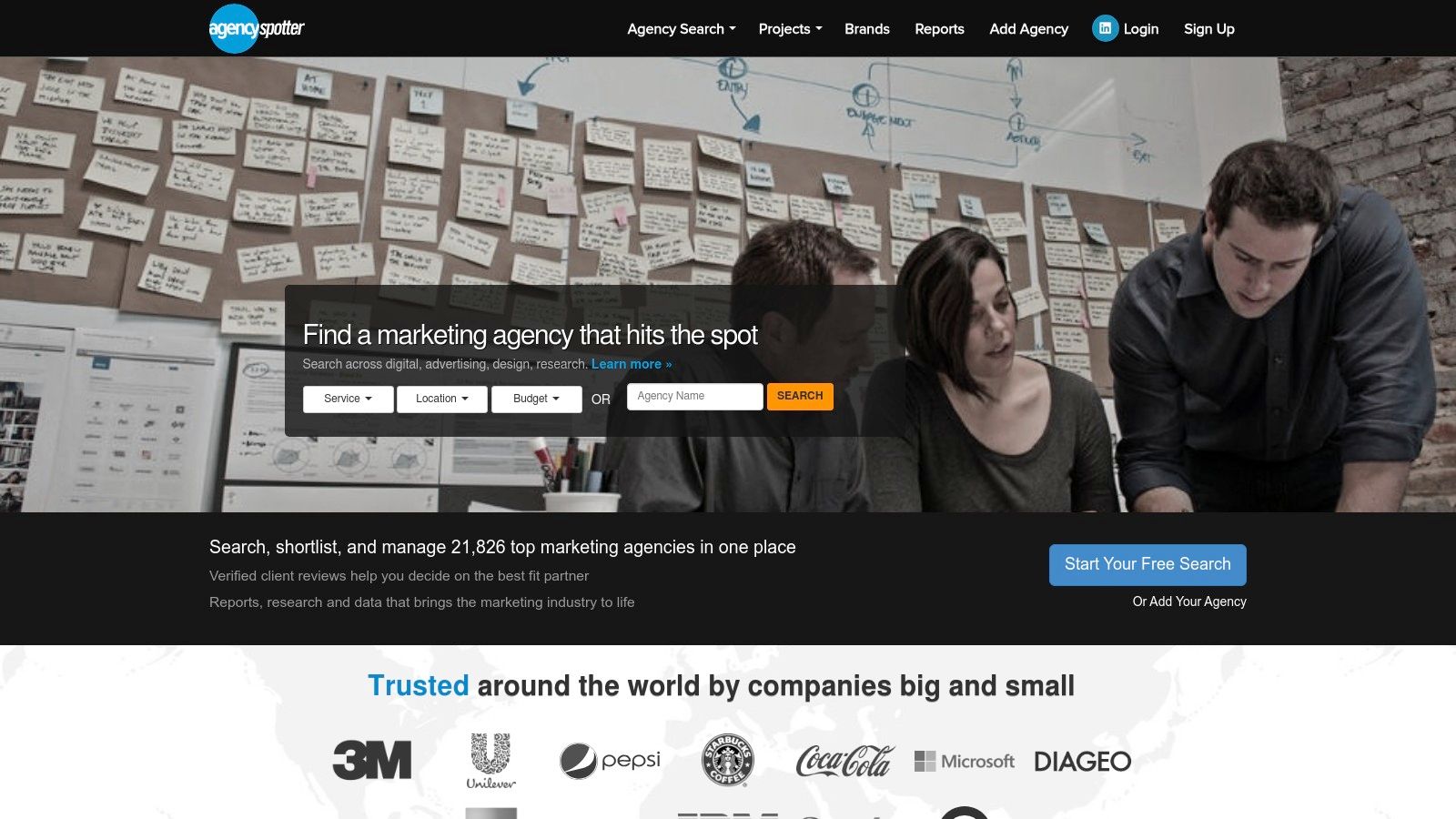
The platform is different because it focuses on structured vendor selection. It's designed for brands running a formal search process. The tools let you build and share shortlists with your team, making it a collaborative space.
How to Use Agency Spotter Effectively
To maximize your search, start with a specific query. Use the filters to find agencies that list Facebook or Meta advertising as a core service.
- Service Focus: Search directly for "Social Media Advertising" to filter the list.
- Build a Shortlist: As you find promising candidates, add them to a shortlist. This centralizes your research.
- Read Editorial Reports: Look for their "Top" reports on social media agencies. These lists can be a great starting point.
Once you have a list, examine the agency profiles. Use the platform to request information from several firms at once to gauge responsiveness.
"Our mission is to make it easier for businesses to find and work with great creative and marketing partners. We're closing the information gap and bringing more transparency to the industry." — Brian Regienczuk, Founder & CEO of Agency Spotter
Key Information and What to Watch Out For
Agency Spotter provides a good overview of an agency's capabilities. The review system adds social proof, though it's not as deep as Clutch's interview process. The collaborative tools are useful for teams.
However, many agencies listed have broad service offerings. You need to vet each one to ensure they have deep expertise in Meta advertising. Many profiles lack pricing details, so you'll have to ask for quotes directly. The platform is best used as a discovery tool to build an initial list of top Facebook ad agencies before you begin your own outreach.
Top 7 Facebook Ad Agency Platforms Comparison
| Platform | What It Is | Starting Cost | Best For |
|---|---|---|---|
| Needle | AI + human marketing system | From $2,999/mo | DTC brands $1M–$10M wanting full-stack execution |
| Clutch | Verified agency directory | Free to browse | Vetting agencies with real, interview-based client reviews |
| DesignRush | Ranked agency marketplace | Free to browse | Quick shortlisting with upfront pricing and ratings |
| Sortlist | Proposal-based matchmaking | Free to post | Comparing agency pitches without cold outreach |
| Upwork | Freelance marketplace | Varies + 5% fee | Flexible hires for audits or short-term campaigns |
| Fiverr | Gig marketplace | Fixed gig price | One-off tasks like ad audits or creative production |
| Agency Spotter | Agency directory | Free to browse | Team-based vendor search with built-in shortlist tools |
Frequently Asked Questions (FAQ)
What does a Facebook ad agency do?
A Facebook ad agency manages advertising campaigns on Facebook and Instagram for other businesses. This includes strategy, creating ad copy and visuals, setting up campaigns in Ads Manager, monitoring performance, and optimizing for better results like lower cost-per-acquisition or higher return on ad spend (ROAS). I
n practice, that means building audience segments, running creative tests, managing daily budgets, diagnosing underperformance, and producing regular reports. A full-service agency handles every stage — from the initial brief through to campaign launch and weekly optimization — so founders aren't logging into Ads Manager themselves.
Quality varies significantly between agencies, so how they structure creative testing, how frequently they report results, and how transparent they are about what's working matters as much as the retainer fee.
How much does it cost to hire a Facebook ad agency?
Costs vary widely. Traditional agencies often charge a monthly retainer, which can range from $2,500 to $10,000+ per month, plus a percentage of your ad spend (typically 10-20%). Newer models, like Needle, use a flat monthly fee set by ad spend and list size, starting from $2,999/month, instead of a percentage of ad spend, which can be more predictable for growing brands.
Freelancers on platforms like Upwork might charge by the hour ($50-$200+) or a fixed project fee. Watch for hidden costs: many traditional agencies bill creative production separately, adding $1,000–$3,000/month on top of the management retainer. A percentage-of-spend model also creates a structural misalignment — the agency earns more when you spend more, not necessarily when you profit more.
When should I hire a Facebook ad agency?
Hire an agency when you lack the time or expertise to manage ads effectively yourself. Good indicators are when your ad spend is significant (e.g., over $5,000/month), your results have plateaued, or you want to scale but don't know how. It's a move to make when managing ads distracts you from other core business functions.
A practical signal: if your creative hasn't changed in more than four to six weeks, ad fatigue is likely setting in and you're not addressing it fast enough. Another sign is making budget decisions on gut feel rather than structured test results — an agency or AI-hybrid service adds value when you need the production velocity and strategic input you can't sustain internally.
How do I choose the right Facebook ad agency?
Start by checking for relevant experience — look for case studies and clients in your industry, whether that's DTC, e-commerce, or fashion. From there, ask about their process: how they handle creative production, reporting cadence, and day-to-day communication. Strong agencies can walk you through this in a first call without hesitation. Verify results by talking to past clients if you can, and look at verified reviews on platforms like Clutch — patterns across multiple reviews tell you more than any single testimonial.
Make sure their communication style and team structure actually work for you. Don't sign a long-term contract until you're confident. As a final check, ask any agency you're vetting to show you a real performance report from an active client, not just a polished case study PDF — how they report on results tells you a lot about how they think about accountability.
What is a good ROAS for Facebook ads?
A "good" ROAS (Return on Ad Spend) depends on your profit margins. As a general benchmark, a 4:1 ROAS (meaning $4 in revenue for every $1 spent on ads) is often considered a solid target. However, for high-margin products, a 3:1 ROAS might be very profitable, while businesses with low margins might need a 5:1 or higher.
The most important metric is profitability, not just ROAS. A more useful internal benchmark is your break-even ROAS — the point at which ad revenue exactly covers your spend and cost of goods. If your product margin is 50%, your break-even ROAS is 2×. Everything above that is profit. Know that number before evaluating any agency's performance claims against it.
What's the difference between a Facebook ad agency and a full-service digital marketing agency?
A Facebook ad agency specializes specifically in Meta Ads Manager: campaign structure, creative testing, and budget optimization on Facebook and Instagram. A full-service digital marketing agency spreads its attention across SEO, email, influencer, and other channels too. If Facebook and Instagram are your primary growth channel, a specialist typically delivers deeper platform expertise. I
f you need coordinated strategy across five or more channels, a full-service partner may be worth the premium. For most DTC brands under $10M, Meta is the primary paid channel — which means specialist depth usually wins over generalist breadth at this stage. The clearest way to decide: look at where you're leaving money on the table. Inconsistent Meta ROAS and slow creative output points to a Meta specialist; neglected channels with an already-performing Meta account points to a multi-channel shop.
Do I need a separate agency for Instagram ads, or does a Facebook ad agency cover both?
Since Meta owns both platforms and runs them through the same Ads Manager, almost every Facebook ad agency also manages Instagram campaigns as part of the same engagement. You rarely need to hire separately. Ask any agency you're vetting to confirm cross-platform placement and reporting are included by default, not billed as an add-on.
What does vary is creative strategy — Instagram and Facebook audiences respond to different formats and hooks even when sharing the same ad account. A good agency accounts for that in their creative briefs rather than running the same asset across both placements and hoping for the best.
How much of my budget should go to agency fees versus actual ad spend?
Most DTC brands keep agency or management fees to roughly 10-20% of total ad spend, with the rest going directly into media buys on Facebook and Instagram. If a proposal has fees eating up 30% or more of your total budget, ask exactly what's driving that cost before signing. As a concrete example: if you're spending $10,000/month on Meta ads, a management fee in the $1,000–$2,000 range is typical.
A fee of $3,000+ on that same budget warrants a detailed breakdown of what's included — creative production, reporting, optimization, and strategy should all be clearly scoped, not bundled into a vague retainer.
What red flags signal a Facebook ad agency isn't a good fit?
Watch for agencies that won't share client references, can't explain their creative testing process, report only on vanity metrics like reach and impressions instead of ROAS and CAC, or push you into a 12-month contract before running a single test campaign. A good agency is comfortable being evaluated on 60-90 day performance. Another red flag: they promise a specific ROAS before seeing your account data.
Any agency that quotes a number without reviewing your ad history, product margins, and funnel is selling a forecast, not a strategy. The best agencies set 30- and 60-day process benchmarks first — number of creatives shipped, campaigns launched, reporting cadence — and let performance follow from there.
Can a Facebook ad agency work with my existing Shopify and Klaviyo setup?
Yes. Most agencies and AI-hybrid platforms like Needle connect directly to Shopify for product and sales data and to Klaviyo for email, so campaigns and creative recommendations are grounded in your actual store performance rather than generic best practices. Confirm integration support during your first call, especially if you're running a less common ecommerce stack.
The integration depth matters more than just a "yes, we connect." Ask how they actually use your Shopify data — are they pulling product-level conversion rates to inform which items to promote? Are they syncing Klaviyo segments to build Meta custom audiences? Agencies that use your data to make creative and targeting decisions outperform those that treat it as a reporting afterthought.
Stop Renting an Agency. Start Owning Your Growth.
You've just reviewed the top platforms for finding Facebook ad agencies. From massive marketplaces like Upwork to curated directories like Clutch, the options are there. But the challenge is the same: you need a partner for real growth, not just to manage ad spend.
The traditional agency model is showing its age. DTC founders need more than a campaign manager. You need a growth partner who understands the whole funnel.
Key Takeaways: Your Path Forward
Navigating the world of top Facebook ad agencies can be tough. Let's boil it down to what matters.
Define Your Need: Do you need a creative shop for video ads? Or a direct-response expert obsessed with ROAS? Fiverr and Upwork are great for specific tasks. Clutch and Agency Spotter are better for full-service partners.
Budget Beyond the Retainer: An agency's fee is just one part of the cost. Your total investment includes ad spend and creative production. A $5,000 retainer quickly becomes a $25,000 monthly commitment with a $20,000 ad budget.
Scrutinize Case Studies: Don't be fooled by vanity metrics. Look for case studies that mirror your business. An agency with results for a $500 product may not get your $50 subscription box. Ask for specifics: What was the starting ROAS? What was the customer acquisition cost?
"The goal of a marketing agency is to get you results. The means by which they do that are secondary." — Joe Apfelbaum, CEO of Ajax Union.
This quote makes a critical point. The method matters less than the outcome. The best agencies deliver real results and can help you implement effective strategies to improve conversion rates across your entire funnel.
Making Your Final Decision
Your choice comes down to balancing control, cost, and expertise.
If you have a strong in-house team and just need to outsource tasks like video editing, a freelancer from Upwork might be best.
If you're scaling fast and need a dedicated team for a six-figure ad spend, a vetted agency from Clutch could be the right fit.
But what if you fall in between?
This is where hybrid solutions are changing the game. They combine senior-level strategy with the efficiency of AI. You get top-tier thinking without the agency bloat and high overhead. It's about owning your growth, not just outsourcing it.
Think of this not as hiring a vendor, but as building a growth engine. The right partner won't just run your ads. They will help you build a system for acquiring customers profitably.
Tired of the agency runaround? Needle is the AI marketing team built for DTC brands doing $1M–$10M — dedicated strategists, human-polished creative, and campaigns launched directly to Meta, Google, TikTok, and Klaviyo every week. Book a call with Needle to see how Needle's learning loop can work for your brand.