
Sourcing user-generated content is a must for DTC brands. But it's often a chaotic process. You're either juggling dozens of freelancers on marketplaces like Upwork. Or you're locked into a pricey, slow contract with a traditional agency. We've been there. We know the frustration.
This guide cuts through the noise. It's a direct breakdown of the seven top UGC agency alternatives. We compare them on what actually matters to founders: cost, speed, and creative quality. We'll look at managed services, creator marketplaces, and freelance platforms.
This gives you the details needed to choose the right partner. But first, you need a solid foundation. Building a winning user-generated content strategy is key to getting ROI from any tool you choose.
According to Stackla's Consumer Content Report, consumers find UGC 9.8x more impactful on their purchasing decisions than influencer-created content. Emplifi's Q3 2025 Social Media Benchmarks Report found that posts featuring UGC drove 10.38x higher conversion rates compared to non-UGC posts. Getting it right is critical.
This roundup gives you a clear, side-by-side comparison to find your best fit. Each option includes direct links, pricing, and a clear verdict on who it's for. We'll also show you a different approach that pairs AI speed with agency strategy. Let's get into it.
1. Trend
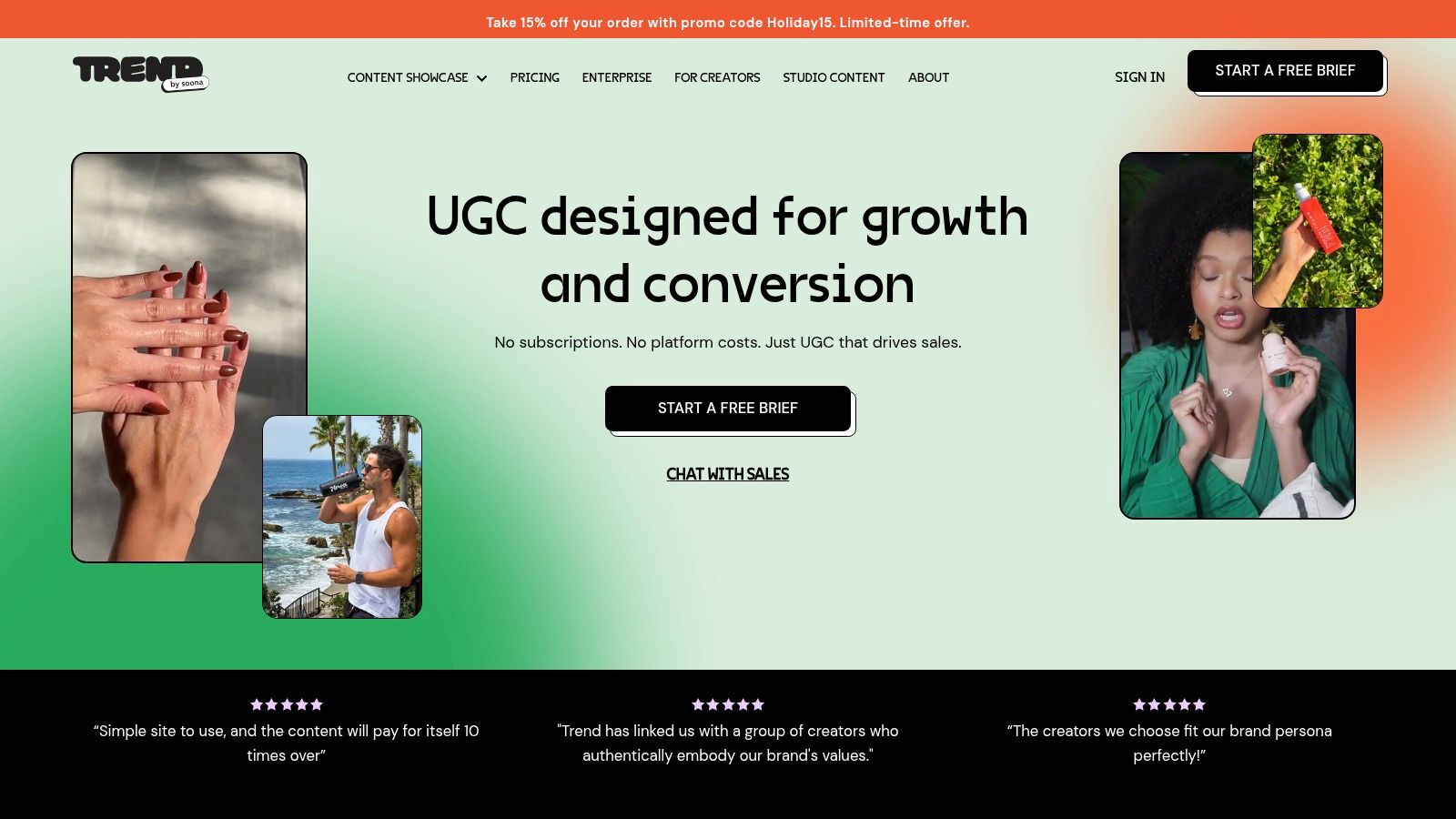
Trend acts as a managed "custom content studio." It's built for brands that want the output of a top UGC agency without the long-term retainer. Their model is simple. You pay per project for a batch of custom photos or videos.
This approach strips away management overhead. You submit a project brief. Trend's team handles finding, vetting, and managing US-based creators to produce the content. It's a hands-off experience for busy marketing teams. It's designed to deliver quality, conversion-focused assets quickly.
How Trend Works
The process is direct. You submit a brief with your goals, audience, and content needs. Trend's network of vetted creators can then apply. You pick the creators you want, ship them your products, and get the finished assets.
A key benefit is 100% licensing and distribution rights. You can use the assets anywhere. This includes paid ads, social media, your website, and email marketing. No future usage fees or royalties. This is crucial for brands using UGC in high-spend ad campaigns.
Key Takeaway: Trend is for brands needing a set number of quality UGC assets for a launch. You don't have to commit to a monthly subscription. It's a "buy what you need" model.
Pricing and Project Details
Trend uses a credit-based pricing model with four published tiers — no contracts or setup fees. Credits expire after 12 months.
- Starter — $550 (up to 6 videos or 15 photos; ~$91/video)
- Essential — $1,045 (up to 14 videos or 35 photos; ~$75/video)
- Growth — $1,980 (up to 28 videos or 70 photos; ~$71/video) — most popular
- Scale — $3,872 (up to 56 videos or 140 photos; ~$69/video) — best value
Larger packages are also available through a sales consultation, with an additional 15% discount.
Strengths:
- Transparent Tiered Pricing: Published packages make it easy to budget without a sales call.
- Full Licensing Included: No legal complexity. You own the content for all marketing purposes.
- Vetted Creator Network: US-based and reviewed creators ensure a baseline of quality.
- Focus on Performance: Geared toward producing ad-friendly formats like testimonials and unboxing videos.
Weaknesses:
- Credits Expire: Unused credits lapse after 12 months, so volume planning matters.
- Limited Creator Visibility: You can't browse creators before starting a project.
2. minisocial
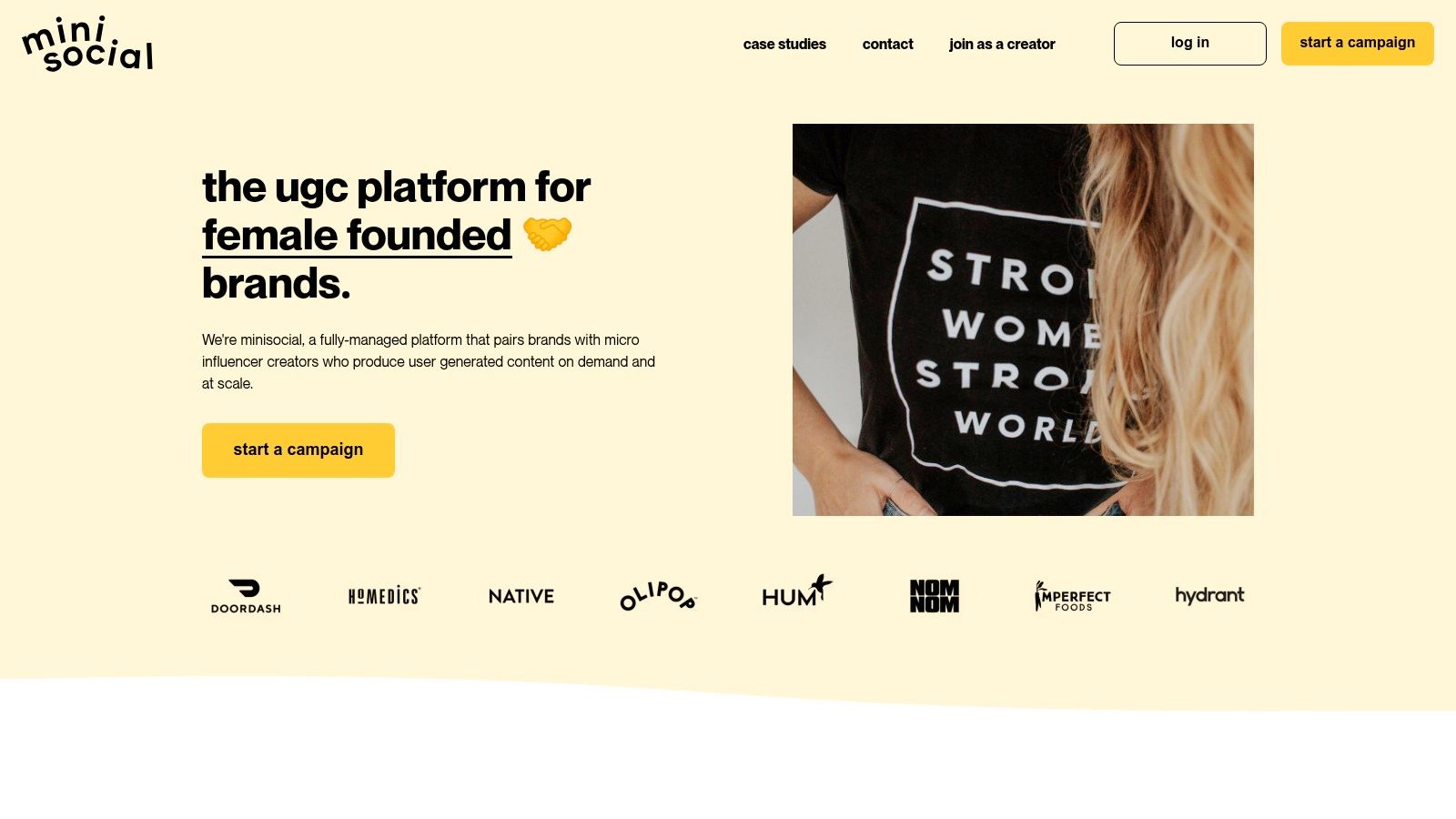
minisocial is a fully managed content service. It connects brands with vetted micro-influencers to produce licensed assets at scale. It's for brands that want the output of a top UGC agency with a hands-off approach. You avoid direct creator management. The model is project-based, providing campaign execution from start to finish.
This is ideal for lean marketing teams. You need a reliable flow of authentic content without the operational work. You give them a brief. minisocial handles the entire workflow: finding creators, shipping products, and delivering a final library of licensed assets. They use the authenticity of micro-influencers to create content that feels genuine.
According to Stack Influence's 2026 benchmark data, micro-influencers average 3.86% engagement versus 1.21% for larger accounts — making them a more cost-effective source of authentic, high-engagement content.
How minisocial Works
The process is managed entirely by the minisocial team. You define your campaign goals in a brief. Then, minisocial matches your brand with suitable micro-influencers. They manage all communications, product shipping, and content review.
A major advantage is full usage and licensing rights. This lets you repurpose photos and videos across all marketing channels. This includes paid social ads, organic posts, and your website, with no future fees. For brands scaling ad spend, this unlimited license is critical for testing creative without restrictions.
Key Takeaway: minisocial is best for brands who want to use micro-influencers for UGC at scale but lack the resources to manage it. It's a "done-for-you" service.
Pricing and Project Details
minisocial uses a project-based model with clear starting prices. Campaigns start at $3,000 for a package of 10 creators, inclusive of all creator fees and payments. This fixed-pack approach makes it easy to budget and pilot their service.
Strengths:
- Transparent Entry Price: Simple to test with a one-off project and a clear initial cost.
- Fully Managed Service: A completely hands-off experience for small or busy marketing teams.
- Micro-Influencer Scale: Taps into a network of smaller creators for more authentic content.
- Full Licensing Included: You get a library of assets with perpetual rights for all marketing channels.
Weaknesses:
- Limited Direct Control: Brands don't directly select creators; matching is handled by the minisocial team.
- Fixed Package Structure: Pre-set packages may be less flexible for brands with highly custom needs.
3. Insense
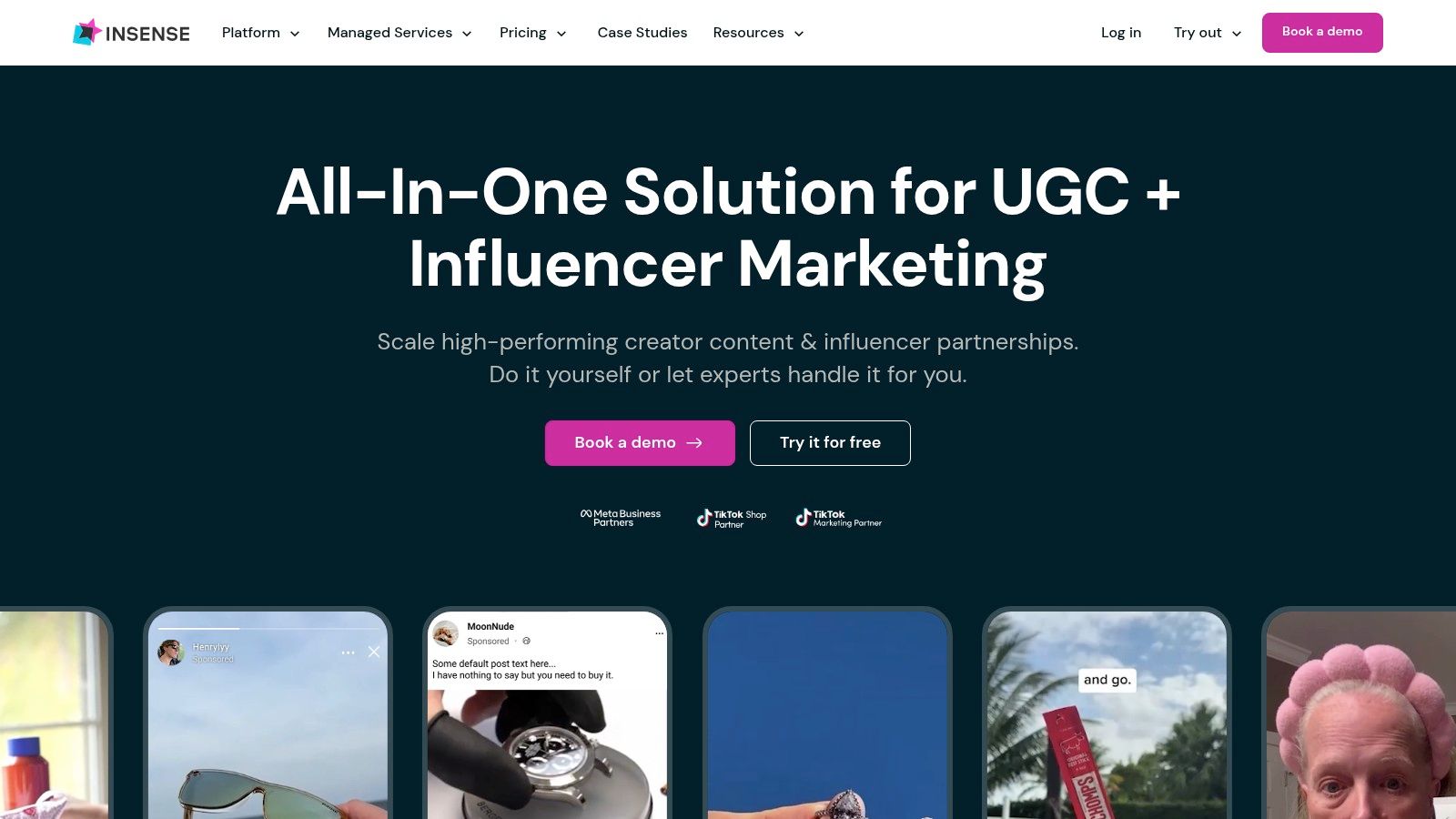
Insense is a hybrid UGC and influencer marketplace. It gives brands the choice between self-serve tools and managed services. It's for teams that want either direct control over creator campaigns or a more hands-off approach. The tool offers a full suite of features to brief, recruit, contract, and pay creators.
This dual approach lets brands start with a self-serve plan and scale up to managed services later. Insense also offers ready-to-go UGC ad bundles and post-production add-ons. This makes it a versatile option for sourcing a wide range of creative.
How Insense Works
The self-serve model lets you post a brief, review applications, and manage the campaign from a dashboard. This includes automated contracting, payments, and usage rights. It simplifies the legal and financial parts of creator partnerships. You have direct communication with creators and full control over selection.
For teams needing more support, Insense offers managed services. Their experts handle creator sourcing, negotiation, and campaign execution. This is ideal for brands without the internal resources to run campaigns. The tool also uses AI, a core component of modern marketing. You can learn more about how to use AI for marketing here.
Key Takeaway: Insense is a flexible marketplace for brands that want the option to manage their own UGC campaigns or outsource the work to experts, all in one system.
Pricing and Project Details
Insense uses a subscription-based model with different tiers. Pricing starts at $500/month (or $400/month billed annually at $4,800/year) for the Brand plan with self-serve access. Plans vary based on the number of active campaigns, user seats, and the level of support included.
Creator payments are separate from the subscription fee. A marketplace fee of 7–20% also applies depending on your plan. This requires careful planning to account for all costs.
Strengths:
- Clear Plan Structure: Public pricing and transparent fees make it easy to budget.
- Flexible Model: Switch between self-serve and managed services based on your team's bandwidth.
- Strong Workflow Tools: Automated briefs and payments simplify campaign execution.
- Wide Creator Network: Access to a large pool of creators for diverse campaign needs.
Weaknesses:
- Complex Cost Structure: Total cost includes a subscription, marketplace fees, and creator payments.
- Learning Curve: The self-serve marketplace can be complex for new users.
4. Cohley
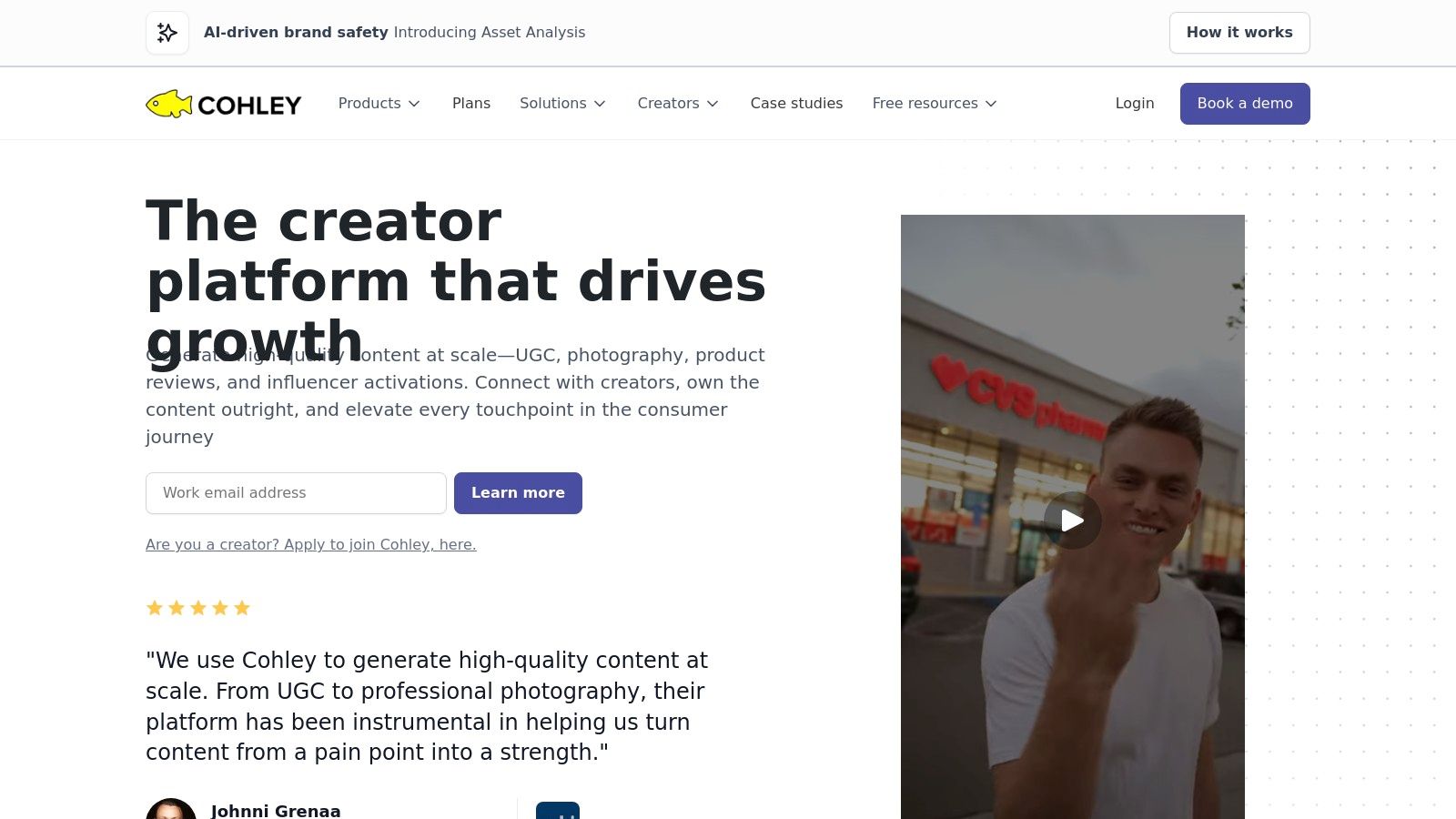
Cohley is an enterprise-grade solution for content generation. It's for established brands that need large volumes of UGC, influencer content, and professional photography. The company focuses heavily on governance, compliance, and legal rights. You get a dedicated customer success manager to help scale your content strategy.
This model is built for security and scale. Cohley provides perpetual usage rights. This is a critical feature for large companies running big, multi-channel campaigns. Brands can either manage the tool themselves or opt for a fully managed service where Cohley's team handles everything. This makes it a flexible choice for a top UGC agency.
How Cohley Works
Brands using Cohley typically start with a license. This gives them access to the creator marketplace and tools. The process begins with creating a detailed brief. From there, you can invite creators from their network to apply or have the Cohley team manage it for you.
A key differentiator is its enterprise-readiness. Cohley's system handles legal compliance and content rights at scale. All content comes with perpetual usage rights. This is a massive advantage for brands that need to repurpose assets across paid ads, websites, and even in-store displays without future fees. They also offer a paid pilot program to test the tool before committing.
Key Takeaway: Cohley is best for enterprise-level brands that need a scalable, compliant, and secure solution for generating UGC, with the flexibility of self-service or fully managed service.
Pricing and Project Details
Cohley uses a custom pricing model. It's based on a license and any additional managed services. You will need to book a demo to get a quote tailored to your specific needs. This approach is common for enterprise-focused solutions.
Strengths:
- Robust Compliance: Strong focus on governance and perpetual usage rights is ideal for enterprise campaigns.
- Flexible Service Options: Choose between a license-only model or a fully managed service.
- Enterprise-Ready: Built to handle large-scale content generation. Learn more about how agencies serve bigger brands in this guide to the best ecommerce marketing agencies.
- Paid Pilot Available: Allows brands to test the tool before a long-term commitment.
Weaknesses:
- Custom Pricing Only: Lack of transparent pricing and the need for a demo can create a longer sales cycle.
- Overkill for Small Brands: The features and price point are likely too much for startups.
5. Billo
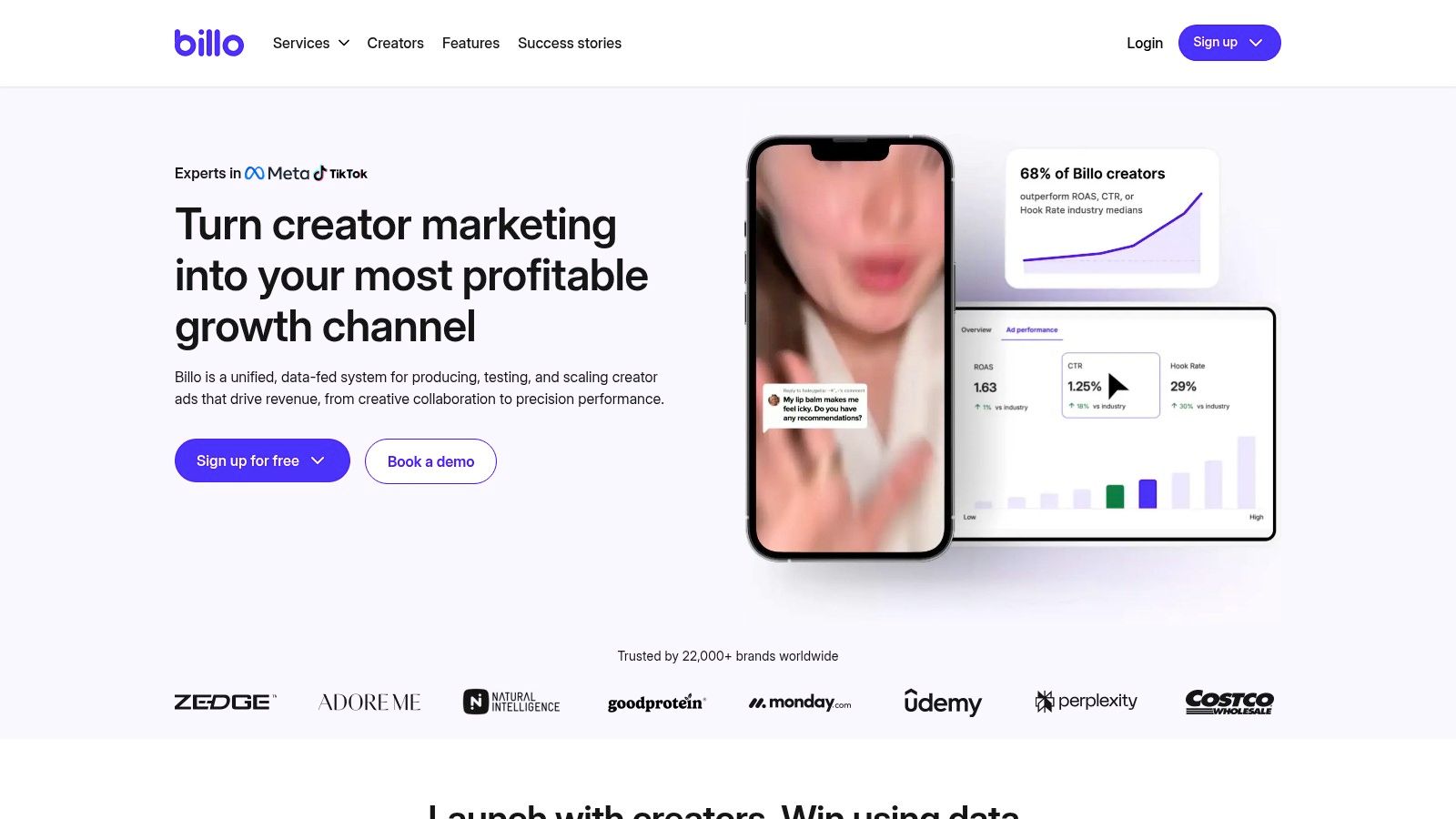
Billo is a marketplace for brands that need UGC videos at scale and an accessible price. It's a direct-to-creator service where you can order videos per asset. This is a strong choice for teams that need high volume without a retainer-based top UGC agency.
The service is built around a simple, fast-paced workflow. Brands can quickly launch a project, attract creators from its large international pool, and get content fast. Billo handles all creator payouts and communication, simplifying logistics.
How Billo Works
The process starts with you creating a "task" or brief. Creators from Billo's network apply, and you choose who fits your brand. After you ship your products, the creators produce and upload their videos for your review.
A standout feature is the optional "Expert Editing" add-on. For an extra fee, Billo's team will take the raw UGC and edit it into ad-optimized formats for TikTok and Meta. This includes adding captions, music, and other elements. This hybrid approach gives you raw UGC authenticity with the polish of a professionally edited ad.
According to Shopify, UGC-based ads get 4x higher click-through rates than average so the editing add-on a meaningful lever for performance marketers. The different types of content on social media each have unique needs, and this service helps.
Key Takeaway: Billo is built for speed and volume. It's an excellent fit for brands needing a steady stream of affordable UGC videos. The option for professional editing is a big plus.
Pricing and Project Details
Billo uses a transparent, pay-per-video model. You buy videos individually, with costs starting around $99 per video. This includes the creator's fee and basic usage rights. The final price depends on the creator and any add-ons you select.
The optional Expert Editing service is an additional cost per video. This makes budget forecasting straightforward for performance marketing teams.
Strengths:
- Transparent Pricing: Clear, per-video costs make it easy to budget for any campaign size.
- Large Creator Pool: Access a diverse network of creators in the US, Canada, UK, Australia, and more.
- Optional Ad Editing: The editing add-on is a major plus for teams without video editing capabilities.
- Volume-Oriented: The tool is designed to handle a high quantity of simple video orders efficiently.
Weaknesses:
- Mixed Third-Party Reviews: Some online reviews are mixed, so it's wise to start with a small test order.
- Best for Simple Briefs: Excels with straightforward concepts; complex briefs may require more hands-on management.
6. Upwork
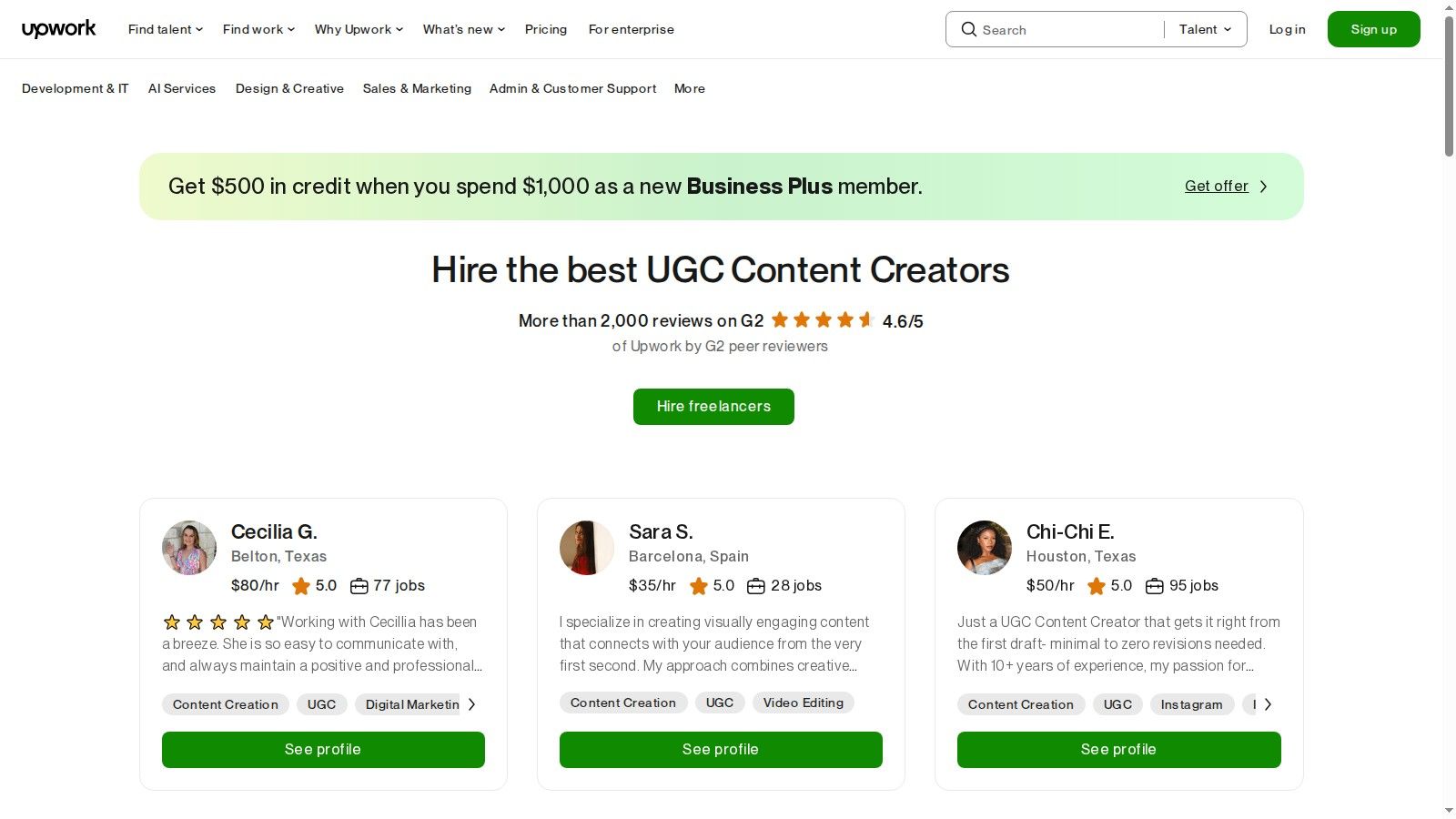
Upwork is not a dedicated UGC agency. It's a massive freelance marketplace where brands can directly hire individual UGC creators. It offers a completely hands-on approach. You get direct access to a global talent pool. This lets you build your own team of creators for one-off projects or long-term work.
This model gives you maximum control over the entire process. You handle creator selection, creative direction, and final edits. You can post a job brief and have creators bid on it. Or you can search for talent based on their portfolios, rates, and past client reviews. It's the ultimate DIY solution for brands that can manage the creative process in-house.
How Upwork Works
Brands can post a job detailing their UGC needs. Freelancers submit proposals, letting you compare their experience and rates. You can also search for "UGC creators" and invite specific freelancers to your project.
Once you hire a creator, you manage the relationship directly. This includes shipping products, giving feedback, and handling payments through Upwork's secure system. You can set up fixed-price or hourly contracts. This direct management is a key differentiator. It's more like building an in-house team than outsourcing to a top UGC agency.
Key Takeaway: Upwork is best for brands with the internal capacity to manage creator relationships. It offers great flexibility and cost control but requires you to handle vetting and quality control yourself.
Pricing and Project Details
Upwork has a flexible pricing model where you and the freelancer agree on terms. Fixed-price projects typically range from $100–$300 for a single product video, $300–$800 for a multi-hook testimonial bundle, and $1,000–$3,000/month for an ongoing UGC retainer of 4–8 videos. Hourly rates run $10–$150 depending on experience level. This transparency allows you to set a budget that fits your needs.
Strengths:
- Maximum Flexibility: Complete control over hiring, creative direction, and budgets with no platform fees.
- Cost-Effective: The open marketplace and bidding system can lead to competitive rates for UGC.
- Direct Communication: Work directly with creators for faster feedback and precise execution.
- Vast Talent Pool: Access thousands of creators with diverse styles and experience levels from around the world.
Weaknesses:
- High Management Overhead: You are responsible for sourcing, vetting, briefing, and quality control.
- Inconsistent Quality: Creator skill can vary widely, making the vetting process critical.
- Licensing is Your Responsibility: You must negotiate and confirm usage rights with each creator in your contract.
7. Fiverr
Fiverr offers a different path to UGC. It's a huge freelance marketplace, not a dedicated top UGC agency. It has a specific category for UGC video creators. This lets brands buy fixed-scope "gigs" from individual freelancers. This model is perfect for brands wanting to quickly test creative styles without any fees or subscriptions.
The service is built on transparency and speed. You can browse thousands of creators, view their work, read public reviews, and see exact package pricing upfront. This direct-to-creator approach removes the middleman. It gives marketing teams total control over who they hire and what they pay.
How Fiverr Works
The process is like online shopping. You search for UGC creators, filter by budget or delivery time, and review their profiles. Each creator offers tiered packages (e.g., Basic, Standard, Premium). These clearly define deliverables, like the number of videos and included revisions.
Once you find a creator, you place an order on their gig page. You provide your product and a brief. The creator delivers the content by the deadline. A major distinction is that licensing and usage rights are determined per gig. You must read each seller's terms carefully to ensure the rights align with your marketing plans.
Key Takeaway: Fiverr is the go-to for low-risk, high-volume testing. It allows brands to sample multiple creators and styles quickly with clear, upfront costs for each asset.
Pricing and Project Details
Fiverr's pricing is transparent and gig-based. Each creator sets their own rates for predefined packages. Entry-level UGC gigs start as low as $10, though mid-tier creators typically charge $50–$150 per video and experienced specialists can run several hundred dollars for a quality package.
This model allows for precise budget control. You know the exact cost before you commit. Any extras like faster delivery are listed as paid add-ons. There are no hidden fees or monthly commitments.
Strengths:
- Upfront Package Pricing: No surprises. You know the total cost before ordering.
- Fast and Easy to Start: You can find and hire a creator in minutes without sales calls.
- Massive Creator Diversity: Access a global talent pool to test countless creative styles.
- Public Reviews and Ratings: Social proof helps you vet creators and reduce risk.
Weaknesses:
- Variable Licensing Rights: Usage rights are not standard; you must verify the scope with each seller.
- Inconsistent Quality: Quality can vary significantly between sellers, requiring careful vetting.
- Self-Managed Process: Brands are responsible for briefing and managing each creator individually.
Top 7 UGC Agencies Comparison
The Alternative: When Sourcing UGC Isn't the Real Problem
Choosing from a list of the top UGC agency options is a critical step. But it's only the first step. The real challenge for DTC brands isn't just getting the content. It's turning that content into high-performing ad campaigns, quickly and affordably. This is where the traditional agency model often breaks down.
The workflow is slow. You pay a hefty retainer, wait weeks for creative briefs, and even longer for the final assets. Meanwhile, your competitors are launching new tests every day. The fundamental problem isn't a lack of creators. It's the operational bottleneck between content creation and campaign deployment. When sourcing UGC becomes a bottleneck, it highlights a broader challenge in mastering short form content creation.
Recapping Your UGC Agency Options
We've covered a lot of ground. You've seen how services like Trend and minisocial excel at delivering authentic, lifestyle-focused content. We explored how Insense and Cohley provide robust marketplaces for connecting with creators. For direct, project-based work, Billo, Upwork, and Fiverr offer flexible, on-demand solutions.
Each has its place. Your choice depends entirely on your goals, budget, and internal resources.
For authenticity at scale: Trend or minisocial are strong contenders. For creator discovery and management: Insense and Cohley offer powerful tools. For quick, one-off projects: Billo, Upwork, or Fiverr provide direct access to talent.
But what if the problem isn't finding the right creator? What if the real issue is the time, cost, and effort required to turn that creator's video into a live, revenue-generating ad?
The Core Problem: Speed and Cost
Agencies typically charge $2,500 to $10,000 per month. They take weeks to deliver a finished campaign. On the other end, DIY tools like Canva are cheap, but your team is stuck doing all the work. You're the strategist, the copywriter, the video editor, and the ad manager. This is a massive resource drain for a growing brand.
The gap between expensive, slow agencies and time-consuming DIY tools is where most DTC brands get stuck. You need agency-quality output without the agency price tag or timeline. You need a system that doesn't just source content but actively launches campaigns and learns from the results.
A New Model: AI-Powered Execution
This is precisely the problem Needle was built to solve. We're not another UGC marketplace. We are your AI marketing team, living in a single browser tab. Needle connects directly to your store's data, identifies your best campaign opportunities, generates all the creative assets, and launches the campaigns for you. Your only job is to approve.
You get the strategic output of a top UGC agency with a 48-hour turnaround time for a fraction of the cost. Brands like TWOOAK used Needle to cut their cost-per-order from $41 down to $19. They didn't just get UGC; they got a complete system for turning content into customers, fast. If you're tired of the agency runaround and the endless cycle of DIY creative work, it might be time to look beyond just sourcing content. The real win is in building a faster, smarter marketing engine.
Tired of the slow, expensive agency model? Needle gives you an AI marketing team that delivers complete, data-backed campaigns in 48 hours. Stop sourcing content and start launching campaigns that actually drive revenue. See how Needle works.
Frequently Asked Questions
What is a UGC agency?
A UGC agency specializes in sourcing content created by actual users or customers for a brand. Instead of producing polished ads in-house, they find and manage creators to make authentic videos, photos, and reviews. They handle the briefing, creator payments, and content rights so your team doesn't have to.
Some agencies are fully managed — you hand over a brief and receive finished assets. Others operate as marketplaces where you select creators yourself. The right model depends on how much direct control your team wants and how much bandwidth you have to manage the process.
How much does it cost to get UGC content?
The cost varies widely depending on the platform and volume. On freelance marketplaces like Fiverr, entry-level gigs start from $10, while Upwork single-video projects typically run $100–$300. Per-video platforms like Billo start around $99 per video. Credit-based platforms like Trend start at $550 for up to 6 videos. Managed services like minisocial start at $3,000 per campaign for a package of 10 creators, inclusive of all creator fees.
Subscription platforms like Insense range from $400 to $800/month (plus separate creator payments and marketplace fees). Enterprise solutions like Cohley use custom pricing. In general, managed services cost more upfront but save significant time and reduce operational overhead.
What is the difference between UGC and influencer marketing?
UGC is content from real customers or creators that looks authentic and unpolished. Its primary goal is to build trust and mirror how a real person talks about a product. Influencer marketing typically involves creators with established followings promoting a product — the content tends to be more polished, and reach is a core part of the value proposition. The two can overlap, but they serve different functions.
Do I need to pay for UGC?
Yes, in most cases. While some brands get organic UGC from happy customers, most paid UGC for marketing is sourced from creators. This is called "creator-generated content." An EnTribe survey found that 77% of shoppers are more likely to buy a product they found through UGC — which is why it's worth investing in rather than leaving to chance.
Paying ensures you have the proper licensing rights to use the content in your ads and on your website without legal issues. It also gives you control over the brief — so you get content that fits your brand guidelines, audience, and campaign goals rather than hoping organic posts happen to match what you need.
How do I find UGC creators for my brand?
You can use dedicated marketplaces like Billo, Insense, or Cohley. You can also hire freelancers directly on platforms like Upwork and Fiverr. Another option is to work with a fully managed service like Trend or minisocial, which finds the creators for you based on your brief. If you're just starting out, a freelance platform like Fiverr gives you the lowest barrier to entry — you can test a few creators with minimal spend before committing to a larger program.
For brands scaling volume, a managed service or subscription marketplace saves the time of running those searches yourself every campaign cycle.