
Cost Per Acquisition (CPA) is the real price you pay to get a new customer from a specific marketing campaign.
Forget vanity metrics like clicks and impressions. CPA tells you exactly what it cost to get that sale. For any brand, especially direct-to-consumer ones, it’s the most critical metric for survival.
The Bottom Line on Cost Per Acquisition
Think of CPA as the price tag on a new customer. If you spend $100 on a Meta ad campaign and it brings in two new buyers, your CPA is $50. It’s a dead-simple concept, but it's the bedrock of profitable marketing.
For founders, knowing your CPA is non-negotiable. It’s the difference between an investment that fuels growth and an expense that burns cash. A low CPA means your campaigns are efficient. A high one is an alarm that you’re overpaying for growth and need to fix something—fast.
Why This Metric Demands Your Attention
Understanding your cost per acquisition is more urgent than ever. The price of getting a new customer has skyrocketed. According to a 2022 study, customer acquisition costs have jumped by as much as 60% over the past five years.
For DTC brands, this trend is a direct threat to profitability. It makes efficient CPA management a non-negotiable part of staying in business.
"A good rule of thumb is that an LTV-to-CAC ratio of three or higher is attractive and indicates a scalable business where you’ll be able to cover your marketing costs, overhead, and still make a profit." - Christina Wallace, Harvard Business School Professor
This gets to the heart of it. Your business only works if the amount you spend to get a customer (CPA) is much less than what that customer spends with you over time (Lifetime Value, or LTV). Without a firm grip on CPA, you're flying blind.
Breaking Down CPA
To get a handle on this metric, you have to see its moving parts. It isn't just ad spend. It's the entire chain of events that leads to a sale.
CPA At A Glance: Why It Matters To You
This table strips away the jargon. It shows you what each piece of the CPA puzzle means for your brand's health.
Mastering these components is the first step toward building a marketing engine that doesn’t just bring in customers, but brings in the right customers, profitably.
How to Calculate Your True Cost Per Acquisition
Most founders get this wrong.
They glance at ad spend, divide it by sales, and call it a day. This mistake hides the real cost of acquiring customers. It leads to bad decisions and torched budgets.
Your true Cost Per Acquisition isn't just what you pay Meta. It's every single dollar you spend to win a new customer. To get an honest number, you need an honest formula.
True CPA = Total Marketing & Sales Spend ÷ New Customers Acquired
This isn't a vanity metric for a pitch deck. It's a health check for your entire business. An inaccurate CPA is like a broken compass. You feel like you're heading in the right direction, but you're actually burning cash.
What Goes into "Total Spend"
So, what does "Total Marketing & Sales Spend" really include? It’s more than just your ad budget. To get a clear picture of your true CPA, you have to account for everything.
For most DTC brands, this includes:
Ad Spend: The obvious one. The total cash you’re pushing into paid channels like Meta, Google, and TikTok.
Agency & Freelancer Fees: If you work with a marketing agency or freelancers, their fees are direct acquisition costs. Don't forget them.
Software Subscriptions: Your tech stack isn't free. This covers your email tool, SMS platform, and other marketing software.
Team Salaries: This is the one everyone misses. A portion of your marketing team's salaries needs to be included. If a team member spends 50% of their time on getting new customers, then 50% of their salary for that period is an acquisition cost.
For example, if a brand invests $10,000 in a campaign (including all hidden costs) and gets 1,000 new customers, the CPA is $10. This detail is what separates brands that scale from those that stall out.
A Real-World CPA Calculation Example
Let's walk through a realistic example for a DTC brand over one month.
A fashion brand spent the following last month:
Meta Ad Spend: $15,000
Google Ad Spend: $5,000
Agency Retainer: $4,000
Klaviyo & Attentive Subscription: $1,000
Marketing Manager Salary (50% on new customer acquisition): $3,000
From these efforts, the brand acquired 560 new customers.
Here's how the math breaks down:
Calculate Total Marketing & Sales Spend:
$15,000 (Meta) + $5,000 (Google) + $4,000 (Agency) + $1,000 (Software) + $3,000 (Salary) = $28,000Divide by New Customers Acquired:
$28,000 ÷ 560 New Customers = $50 CPA
The founder who only looked at ad spend would have calculated a CPA of $35.71 ($20,000 / 560). That $14.29 difference per customer is the gap between thinking you're profitable and actually being profitable.
Getting the complete picture is vital. It's also tied to other key metrics. Check out our guide on calculating ROAS to see how these numbers work together.
For brands on Amazon, that means understanding Amazon advertising cost to assess your true ROI. This is the only way to build a profitable, sustainable business.
Understanding DTC And Ecommerce CPA Benchmarks
Knowing your own Cost Per Acquisition is just the first step. To figure out if your marketing is working, you have to stack that number against industry benchmarks. Without that context, your CPA is just a number in space.
Benchmarks tell you if you’re paying more for customers than your competitors. They help you set realistic goals and spot weak links in your strategy. There’s no universally "good" CPA. It depends on your industry, business model, and the channels you’re using.
For ecommerce brands, the numbers are all over the map. A company selling $25 lipstick can't afford the same CPA as one selling $500 furniture. It always comes back to your margins and what that customer is truly worth to you over time.
What Factors Influence CPA Benchmarks
Your target CPA isn't a fixed number you set once and forget. It's constantly pushed and pulled by key business metrics you should already have a handle on.
Two of the most important levers are:
Average Order Value (AOV): The average amount a customer spends in one transaction. A higher AOV gives you more room for a higher CPA while still turning a profit on the first sale. If your AOV is $100, a $40 CPA feels good. If your AOV is $30, that same $40 CPA is a disaster.
Customer Lifetime Value (LTV): The total profit you expect from a customer over their entire relationship with your brand. LTV provides the ultimate context for your CPA, shifting the focus from one-off sales to a sustainable, long-term business.
Focusing only on AOV is a rookie mistake. It leads to short-sighted decisions. The real game is acquiring customers who come back again and again. That's why the CPA and LTV relationship is everything.
The LTV to CPA Ratio: The Gold Standard
The most important relationship in your business is the ratio between what a customer is worth (LTV) and what it costs to acquire them (CPA). This number tells you if your business model is built to last.
For a growing DTC brand, a healthy LTV to CPA ratio should be at least 3:1. For every dollar you spend to get a customer, you should expect to make at least three dollars back in profit over their lifetime.
If your ratio dips below 3:1, it’s a red flag. You might be overspending on ads, or your customers aren't sticking around. On the flip side, a ratio of 5:1 or higher might mean you’re underspending on marketing and leaving growth on the table. For a deeper look, check out our guide on the average cost of customer acquisition to see how these metrics fit together.
DTC Cost Per Acquisition Benchmarks By Channel
Different channels have different price tags. What’s a solid CPA on Google Ads might be a terrible one for email. Knowing the typical ranges helps you put your budget where it will work hardest.
Here’s a look at what you can generally expect from popular DTC channels.
DTC Cost Per Acquisition Benchmarks By Channel
Treat these numbers as a starting point, not gospel. A competitive niche like skincare might see higher CPAs. A unique product could come in much lower. The key is to measure your own performance and constantly find ways to beat these benchmarks.
Why Your Ad Platform CPA Tracking Is Lying to You
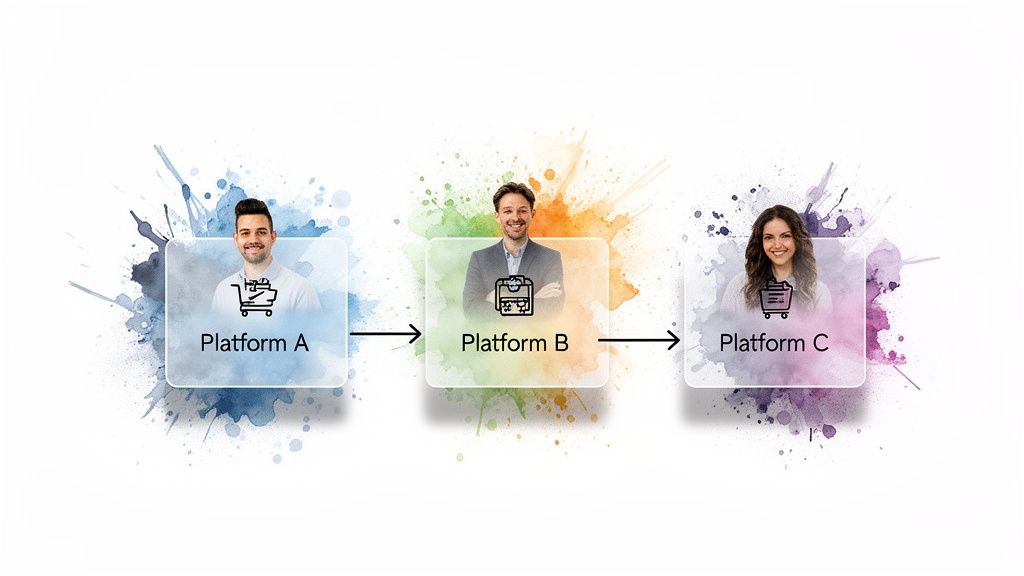
If you're making budget decisions based on your Meta Ads Manager dashboard, you're flying blind. It's a hard truth, but the CPA numbers inside ad platforms are misleading. They don't give you a true picture of your cost per acquisition.
This isn’t a conspiracy. It’s a conflict of interest.
Every platform—Meta, Google, TikTok—wants to take credit for every sale they touch. This creates a messy reality where multiple platforms claim the same conversion, inflating their performance and wrecking your data.
Imagine a customer sees your Instagram ad, gets a retargeting ad on Google, and then clicks a link in an email before buying. In this scenario, Meta, Google, and your email provider might all report a successful acquisition. You end up with three "conversions" for one actual sale. This makes each channel's CPA look way better than it is.
The Messy World of Attribution Windows
This reporting problem gets worse when you factor in attribution windows. An attribution window is the period after someone interacts with your ad during which a platform can claim credit for a sale.
Each platform sets its own generous defaults, all designed to make them look as effective as possible.
Click-Through Attribution: A platform takes credit if someone clicks an ad and then buys within a set timeframe (like 7 days).
View-Through Attribution: A platform takes credit if someone simply sees an ad (no click required) and then buys later on (often within 1 day).
A customer could see your Meta ad on Monday, click a Google ad on Wednesday, and buy on Friday. Both platforms could claim the sale, leaving you to guess what actually worked. If you want to dive deeper, our guide on how to install a Facebook pixel is a good place to start.
The platforms are grading their own homework. Their incentive is to attribute as many sales as possible to themselves. Trusting this data alone leads to terrible budget decisions.
Privacy Changes Broke the Old Model
For years, brands leaned on tracking pixels to follow users. But privacy updates, especially Apple's iOS 14 changes, shattered that model. These updates give users more control over who tracks them, which means a huge chunk of data is now invisible to ad platforms.
As a result, platform-reported CPAs are less reliable than ever. They are often based on "modeled" data—a fancy word for statistical guesswork—rather than direct tracking. This creates massive blind spots in your understanding of what's driving real sales.
A Better Way: Blended CPA and MER
So how do you get an honest view of performance? You stop trusting the conflicting stories from individual ad platforms and start looking at the big picture. This is where blended CPA and Marketing Efficiency Ratio (MER) come in.
Blended CPA is your total marketing spend divided by your total new customers—the same "True CPA" formula we talked about earlier. It cuts through the noise of platform-specific attribution and gives you a single source of truth.
MER, also known as "blended ROAS," takes a similar top-down approach:
MER = Total Revenue ÷ Total Marketing Spend
By tracking your MER daily or weekly, you can see the real impact of your marketing efforts. If you crank up your Meta budget and your MER goes up, it's working. If MER stays flat or drops, you know Meta's reporting was full of hot air.
This holistic view is the only reliable way to measure your true CPA and scale your brand profitably.
Five Actionable Strategies To Lower Your CPA
Knowing your CPA is one thing. Lowering it is where the real work begins. Forget generic advice. We’re giving you specific, proven tactics you can use this week.
These aren't theories. They're mini-playbooks we've run with over 200 brands to drive down acquisition costs. The goal for any modern brand is to constantly find ways to Lower Customer Acquisition Cost through practical strategies.
Let's get into five ways to make your marketing dollars work harder.
Strategy 1: Overhaul Your Creative Testing
Your ads are the single biggest lever you have. A winning creative can cut your CPA in half. A dud can burn through your budget with nothing to show for it.
Most brands test creative haphazardly. You need a structured process.
Test Big Ideas First: Stop testing button colors. Instead, test entirely different hooks and angles. For a skincare brand, this might mean pitting "problem/solution" creative against "aspirational lifestyle" creative.
Isolate Your Variables: Once you find a winning concept, iterate. Change just one thing at a time. Test a new headline on your best video. Try a different product shot in your top static ad. This is how you learn what drives performance.
Launch a Dedicated Testing Campaign: Set aside 10-20% of your budget for creative testing in a separate campaign. This keeps experiments from messing with the performance of your proven, scaled campaigns.
This disciplined approach stops you from guessing and starts building a library of creative that you know works.
Strategy 2: Refine Your Audience Targeting
Blasting ads to broad audiences is a surefire way to get a sky-high CPA. You have to get your message in front of the people most likely to buy.
Start by focusing on your highest-value audiences first.
Build Lookalikes from High-LTV Customers: Don't just build a lookalike from your entire customer list. Export a list of your top 25% of customers by lifetime value and use that as your source. This tells the ad platform to find more people like your best customers.
Layer Interests for Specificity: Instead of targeting a broad interest like "Skincare," get more granular. Layer interests to narrow the pool. For example, target people interested in "Skincare" AND "Sephora" AND "Clean Beauty." This hones in on users with stronger purchase intent.
Strategy 3: Optimize Your Funnel for Conversion
You can have the best ad in the world, but if it sends people to a slow, confusing landing page, you're lighting money on fire. Every bit of friction in your funnel inflates your CPA.
Your job is to make buying from you as easy as possible.
A slow-loading page is a conversion killer. According to research from Portent, the first five seconds of page-load time have the highest impact on conversion rates. Your funnel needs to be fast and frictionless.
Here’s a simple audit you can run right now:
Does your landing page match your ad? The message, offer, and visuals have to be consistent. If your ad promises a discount, that discount better be front and center on the page.
Is your call-to-action (CTA) obvious? Use a simple, direct CTA like "Shop Now." Make the button impossible to miss.
How many steps are in your checkout? Get rid of unnecessary fields. Enable one-click payment options like Shop Pay, Apple Pay, and PayPal to make checkout effortless.
Strategy 4: Leverage Email and SMS To Boost LTV
This strategy doesn't lower your CPA directly on the front end. Instead, it makes a higher CPA more sustainable by increasing your Customer Lifetime Value (LTV).
A customer who buys once is good. A customer who buys three times is gold.
Email and SMS are your lowest-cost channels for driving repeat purchases. They’re how you turn one-time buyers into loyal fans.
Implement a Post-Purchase Flow: As soon as someone buys, they should enter an automated email or SMS series. Use it to educate them on the product, share your brand story, and build a real relationship.
Segment Your Lists: Don't send the same generic message to everyone. Create segments for first-time buyers, VIPs, and customers who haven't purchased in a while. Send them targeted offers that make sense.
By increasing LTV, you give yourself more room to spend on acquiring new customers upfront. This is a huge competitive advantage.
Strategy 5: Strengthen Your Core Offer
Sometimes, a high CPA isn't a marketing problem—it's an offer problem. If your product, pricing, or guarantee isn't compelling enough, no amount of clever marketing can fix it.
Take an honest look at what you're actually selling.
Is the Value Obvious? Can a new customer understand what your product does and why they need it within five seconds? If not, your messaging needs work.
Can You Bundle Products? Creating bundles is a classic way to increase your Average Order Value (AOV). A higher AOV means you can afford a higher CPA while staying profitable on the first order.
Do You Have a Risk-Free Guarantee? A strong money-back guarantee can significantly boost conversion rates by removing risk for a new customer. If you truly stand behind your product, prove it.
Fixing your offer is often the highest-leverage move you can make. It strengthens every other part of your marketing.
How To Automate Your CPA Optimization
Manually managing your Cost Per Acquisition across Meta, Google, and email is a full-time job. It’s a grind of pulling reports, staring at spreadsheets, and tweaking campaigns. For founders, this slow, expensive process is a massive time suck.
Modern tools can act as a marketing co-pilot, handling the tedious stuff for you. This isn’t about replacing your gut instinct. It’s about arming you with the data to make smarter decisions, faster. The goal is a repeatable weekly cycle that drives down acquisition costs without you getting lost in the weeds.
Creating a Single Source of Truth
The first step is to tear down the data silos. Your Meta Ads Manager, Shopify store, and email provider all tell you different parts of the same story. They often contradict each other. Automation starts by plugging these together to create one accurate view of your blended CPA.
When your data is unified, you can see the real impact of your marketing spend. You can measure your true CPA across all channels without getting fooled by misleading platform attribution. This clear, holistic view is the bedrock of any real optimization strategy.
Think of it like this: instead of trying to navigate with three conflicting maps, you get one unified GPS that shows you exactly where you are and the fastest route to your destination.
A Modern Optimization Workflow
Once your data is connected, the optimization process gets a lot smarter. Instead of you digging through numbers for hours, the system can do the heavy lifting. This frees you up to focus on strategy, not manual execution.
Here’s what a modern, automated workflow looks like:
Analyze Performance: The system constantly watches your blended CPA and MER. It figures out which campaigns, audiences, and creatives are actually driving profitable growth.
Suggest New Campaigns: Based on what’s working, it suggests new campaign ideas to lower your CPA. It might recommend targeting a high-LTV lookalike audience or running a flash sale.
Generate Creative Assets: Once you approve a concept, the system helps create high-performing images, videos, and email copy. This combo of AI and human oversight gives you quality creative in a fraction of the time.
Launch and Learn: With your sign-off, the campaigns go live. The system then tracks performance and feeds that data right back into the next weekly optimization cycle.
This automated loop turns a chaotic, multi-week slog into a tight, 48-hour cycle. It’s a smarter way to manage your marketing budget and consistently lower what you pay for each new customer. Exploring tools for AI-driven marketing automation can give you a clear path to implementing this efficiency in your own brand.
Frequently Asked Questions
What's the Difference Between CPA and CAC?
CPA (Cost Per Acquisition) and CAC (Customer Acquisition Cost) are often used interchangeably, but they're not the same. CAC is the total cost of all your sales and marketing efforts divided by the number of new customers. It's a high-level, business-wide metric. CPA is more specific. It typically measures the cost to get a single action (like a sale) from a particular campaign. For a DTC brand, they are often very close, but CAC is the bigger picture.
What Is a Good CPA?
There is no single "good" CPA. It depends entirely on your business. A good CPA is any cost that is significantly lower than your Customer Lifetime Value (LTV). A common benchmark for a healthy business is an LTV to CAC ratio of at least 3:1. This means for every dollar you spend to get a customer, you make three dollars back over their lifetime. A good CPA for a brand with a $50 AOV will be much lower than for a brand with a $500 AOV.
How Often Should I Check My CPA?
When running active ad campaigns, you should check your CPA daily. But don't make knee-jerk decisions based on one bad day. Performance fluctuates. Look for trends over 3-day and 7-day windows. A weekly review is a good rhythm for making strategic changes, like shifting budget or testing new creative. This keeps you from overreacting to normal swings while making sure a bad campaign doesn't burn your cash for too long.
My CPA Is High. What's the First Thing I Should Fix?
Start with your ad creative and your landing page. These two have the biggest and most immediate impact on performance. Ask yourself: Is your ad good enough to stop the scroll and explain your value? Does your landing page deliver on the promise of the ad with a simple call-to-action? Before messing with complex audience targeting, make sure your core message and the user's path to buying are locked in. A weak ad or a confusing landing page will always give you a high CPA.
Stop guessing what's working and start optimizing. Needle connects your data, suggests winning campaigns, and creates the assets for you—all in one place. Get agency-level results at a fraction of the cost and time.
Learn how Needle can lower your CPA