

Fast online sales growth rarely comes from one magic campaign. It usually comes from stacking a few high-intent moves that remove friction, improve the offer, and put sharper creative in front of the right people.
The best marketing ideas for ecommerce are not random content prompts. They are small revenue experiments tied to a clear business lever: more qualified traffic, higher conversion rate, larger order value, or more repeat purchases. If an idea does not affect one of those levers, it might still build brand equity, but it probably will not grow online sales fast.
Use the 11 ideas below as a practical sprint list. Pick two or three based on your biggest bottleneck, launch them quickly, and review results weekly.
Start with the sales equation
Before jumping into tactics, look at your store through a simple equation:
Revenue = traffic x conversion rate x average order value x purchase frequency.
If traffic is low, you need more reach and better acquisition creative. If traffic is healthy but sales are flat, your product pages, offer, checkout, or retargeting probably need work. If new customers are coming in but profit is thin, you may need higher AOV or stronger retention.
This matters because “grow online sales fast” can mean different things depending on the store. A beauty brand with a strong repeat purchase cycle should prioritize replenishment and bundles. A fashion brand with high site traffic but low conversion may need better fit guidance, social proof, and retargeting. A brand with a new hero product may need sharper ad angles and a dedicated landing page.
1. Build a dedicated landing page for your best-selling product
Your best-selling product is already telling you where customer demand exists. Instead of sending all traffic to a generic homepage or collection page, create a focused landing page that turns that product into a complete buying argument.
A strong landing page should answer the questions a customer asks before buying: What problem does this solve? Why is it different? Who is it for? How do I use it? What do other customers say? What happens if I do not like it?
For fast execution, keep the page simple. Lead with a clear benefit, show the product in use, add reviews near the first call-to-action, and include a short FAQ for objections around sizing, ingredients, shipping, returns, or compatibility. Then send your warmest traffic there first, including retargeting ads, email subscribers, and high-intent paid social campaigns.
The goal is not to make the prettiest page. The goal is to create a page that gives one product the best possible chance to convert.
2. Replace generic discounts with a 72-hour problem-solution offer
A blanket “15% off everything” promotion can work, but it is often lazy and margin-draining. A stronger version is a short, problem-led offer that connects the discount or incentive to a specific customer need.
For example, instead of “Summer sale,” a skincare brand could run “3-step routine for oily skin, free cleanser this weekend.” A pet brand could run “New puppy starter kit, free training treats for 72 hours.” A home goods brand could run “Guest room refresh bundle, save when you buy the full setup.”
This works because customers do not just want a cheaper product. They want a clearer reason to buy now. The offer should make the buying decision easier, not just less expensive.
To launch quickly, choose one audience, one problem, one hero product or bundle, and one time-bound reason to act. Use the same message across Meta ads, email, SMS, and your homepage banner so the campaign feels coordinated.
3. Add an abandoned checkout sequence that handles real objections
Cart abandonment is one of the fastest revenue leaks to fix because the buyer has already shown intent. According to Baymard Institute research, the average documented online cart abandonment rate is about 70%, which means most stores have meaningful recoverable revenue sitting in their checkout funnel.
A basic abandoned cart email is better than nothing, but a stronger sequence should address why someone paused. Common objections include shipping cost, delivery timing, sizing uncertainty, product quality, trust, and whether the product is worth the price.
A simple three-message sequence works well for many ecommerce stores. The first message reminds the shopper what they left behind. The second adds proof, such as reviews, before-and-after results, press, or user-generated content. The third gives a final nudge, which could be a limited incentive, free shipping, or a helpful FAQ rather than an automatic discount.
If you use SMS, only message customers who have given proper consent and keep it short. The best abandoned checkout flows feel useful, not desperate.
4. Create a quiz or guided product finder
Choice overload kills online sales. If your store has multiple variants, sizes, formulas, styles, or bundles, a guided product finder can help shoppers reach the right product faster.
This does not need to be complex. A quiz can ask three to six questions and then recommend a product, bundle, or routine. A fashion brand might ask about fit preferences and use case. A supplement brand might ask about goals and dietary restrictions. A home brand might ask about room size, style, and budget.
The quiz also gives you valuable zero-party data, meaning information customers intentionally share. You can use that data to personalize follow-up emails, retargeting creative, and product recommendations.
For speed, start with your top three buying paths. If most customers fall into “beginner,” “premium,” and “gift buyer” segments, build the quiz around those outcomes first. Do not over-engineer it before proving that it improves conversion.
5. Launch starter bundles to increase average order value
If customers often buy one product and then come back later for related items, you may be leaving money on the table. Starter bundles help customers make a more complete purchase on the first order while increasing AOV.
The key is to bundle around a use case, not just inventory. “Best sellers bundle” is fine, but “First 30 days kit,” “Travel routine,” “New apartment setup,” or “Complete gift box” gives shoppers a clearer reason to buy multiple items together.
A strong bundle should feel curated and convenient. It should remove decision fatigue and offer a better outcome than buying one item alone. If you add savings, make the value clear, but avoid discounting so aggressively that customers learn to wait for bundles.
You can test bundles quickly by creating a landing page, adding a product page upsell, sending one email campaign, and running a small retargeting test. Watch AOV, conversion rate, and contribution margin together. A bundle that raises AOV but hurts conversion or margin may not be a true win.
6. Turn customer reviews into proof-led ads and emails
Your customers often write better copy than your marketing team because they describe the product in natural, specific language. Mine reviews, support tickets, post-purchase surveys, and social comments for phrases that explain why people bought and what changed after using the product.
Look for patterns. Are customers praising speed, quality, comfort, taste, fit, gifting, durability, or confidence? Turn those themes into ad hooks, email subject lines, product page callouts, and landing page sections.
For example, a review saying “I finally found jeans that fit my waist and thighs” is more persuasive than “premium denim engineered for comfort.” A review saying “My skin did not feel tight after washing” is more useful than “gentle daily cleanser.” Specific proof beats polished claims.
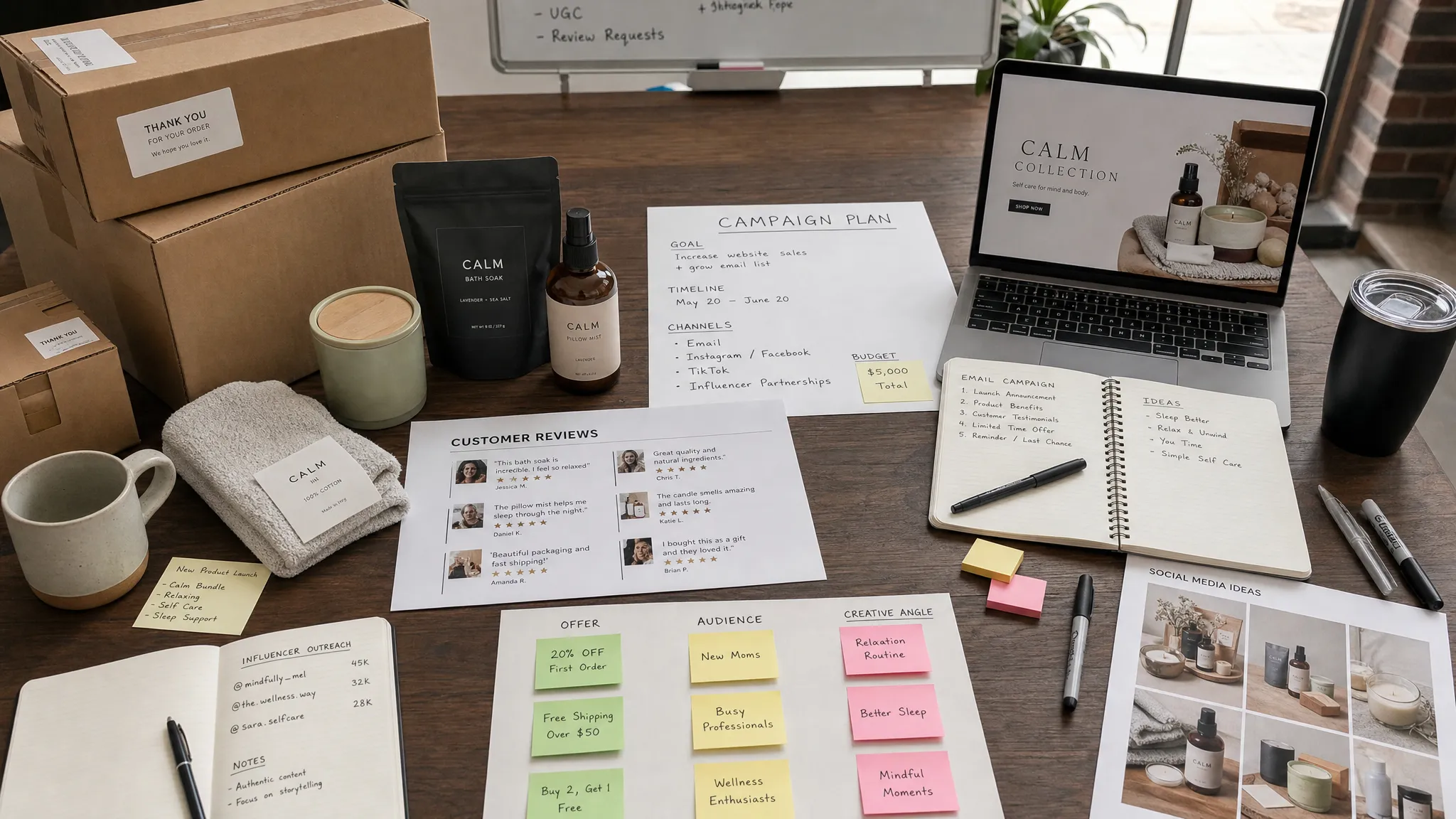
This is one of the fastest marketing ideas to execute because the raw material already exists. Pull 10 strong reviews, group them by objection or benefit, and create a campaign around the top theme.
7. Build a retargeting ladder instead of one catch-all ad
Many ecommerce brands run one retargeting ad to everyone who visited the site. That is better than ignoring warm traffic, but it misses an important point: not all visitors are equally ready to buy.
A visitor who viewed one blog post needs a different message than someone who added a product to cart yesterday. A repeat customer browsing a new collection needs a different angle than a first-time visitor comparing prices.
Create a simple retargeting ladder based on intent. Recent cart abandoners should see urgency, reassurance, and product-specific proof. Product viewers should see benefits, reviews, and use cases. General site visitors should see brand story, best sellers, or a quiz. Past purchasers should see replenishment, cross-sells, or new arrivals.
Keep budgets controlled and monitor frequency. Retargeting should recover demand, not annoy people into hiding your ads.
8. Send segment-specific campaigns to your highest-intent email list
If you need sales quickly, your existing list is usually more efficient than cold traffic. The mistake is sending the same campaign to everyone.
Start with your highest-intent segments. VIP customers can receive early access, limited editions, or premium bundles. One-time buyers can receive complementary products or replenishment reminders. Engaged non-purchasers can receive a first-order offer, buyer guide, or social proof campaign. At-risk customers can receive a win-back message tied to what they bought before.
This works because each segment has a different reason to buy. A VIP does not need the same trust-building message as a new subscriber. A one-time buyer may not need a discount, but they might need education on what to buy next.
A fast campaign plan could include one VIP offer, one one-time buyer cross-sell, and one engaged subscriber conversion email. Track revenue per recipient, click rate, conversion rate, and unsubscribe rate. If a segment produces strong revenue with low churn, make it part of your recurring calendar.
9. Create comparison and “which product is right for me?” content
Bottom-funnel content can drive sales because it meets shoppers at the decision stage. Instead of only publishing educational blog posts, create pages that help customers choose.
Examples include “Product A vs. Product B,” “Which size should I choose?,” “Best gift for new moms,” “Best routine for sensitive skin,” or “Starter kit vs. full kit.” These pages can rank in search, support paid ads, and reduce customer support questions.
The content should be honest. If one product is better for beginners and another is better for advanced users, say that clearly. If a cheaper option is enough for certain customers, acknowledge it. Trust increases when your brand helps people make the right decision instead of pushing the highest-priced item every time.
You can also repurpose these pages into email campaigns, retargeting carousels, quiz outcomes, and product page modules. One strong decision guide can become a multi-channel sales asset.
10. Run a weekly creative testing sprint
If online sales depend on paid social, creative is one of your biggest growth levers. Platforms have become more automated, so the ad concept, hook, visual, and offer often matter more than tiny audience tweaks.
A simple weekly sprint is enough to start. Choose one product, one audience pain point, and three creative angles. For each angle, create a few variations in format or hook. One might be a founder explanation, another a customer review, and another a product demo.
The point is to test hypotheses, not random assets. For example, you might test whether “saves time,” “better quality,” or “giftable” is the strongest reason to buy. Marketing teams learn faster when decisions are practiced in realistic scenarios, which is why business schools and corporate teams use experiential tools like marketing strategy simulations to make concepts stick. Ecommerce teams can apply the same principle by turning creative ideas into controlled market tests.
Judge early results with thumb-stop rate, CTR, CPC, add-to-cart rate, CPA, and ROAS, but do not scale based on vanity metrics alone. A funny ad that earns clicks but no purchases is not a winner. A plain product demo with a low CPA might be.
11. Create a post-purchase sales loop
The sale should not end at checkout. Post-purchase moments are high-leverage because the customer is paying attention and already trusts you enough to buy.
Start with the thank-you page and order confirmation email. Can you recommend a complementary product, offer a limited-time add-on, invite them to join a loyalty program, or explain how to get the best result from their purchase?
Then build follow-up campaigns based on timing. A consumable product might need a replenishment reminder after 30, 45, or 60 days. A fashion brand might recommend styling ideas one week after delivery. A home brand might cross-sell accessories after the customer has had time to use the main product.
The post-purchase loop should feel like service first and selling second. Help the customer succeed with what they bought, then introduce the next logical purchase.
How to choose which marketing ideas to launch first
Do not try all 11 ideas at once. Fast growth comes from focus. Choose ideas based on your current bottleneck and your team’s ability to execute well.
If you have traffic but low conversion, start with the landing page, quiz, retargeting ladder, and comparison content. If AOV is too low, start with bundles, post-purchase upsells, and problem-solution offers. If paid ads are expensive, focus on review-led creative and weekly testing sprints. If repeat purchase is weak, prioritize segmented email campaigns and post-purchase flows.
A useful weekly rhythm looks like this:
- Monday: Review revenue, conversion rate, AOV, CPA, MER, and email performance.
- Tuesday: Pick one bottleneck and approve one or two campaign ideas.
- Wednesday: Produce creative, copy, email, and landing page assets.
- Thursday: Launch tests across ads, email, and onsite placements.
- Friday: Review early signals and decide what to pause, iterate, or scale.
This cadence keeps marketing from becoming a pile of disconnected tasks. It turns ideas into a repeatable sales system.
Metrics that tell you whether an idea worked
Every campaign should have one primary metric and a few guardrails. If the goal is acquisition, watch CPA, ROAS, MER, and new customer revenue. If the goal is conversion, watch product page conversion rate, add-to-cart rate, checkout completion, and revenue per visitor. If the goal is retention, watch repeat purchase rate, revenue per recipient, customer lifetime value, and churn.
Be careful with platform-reported ROAS in isolation. It is useful, but it can over-credit certain channels and ignore margin, returns, discounts, and repeat purchases. For a clearer picture, pair channel metrics with Shopify revenue, gross margin, and blended marketing efficiency.
The best marketing ideas produce learnings even when they do not win immediately. If a bundle underperforms, you may learn the price is wrong. If a quiz gets high completion but low conversion, the recommendations may need work. If an ad gets strong CTR but weak purchase rate, the hook may be attracting the wrong audience.
Document those learnings. They are what make the next campaign better.
Frequently Asked Questions
What marketing ideas increase online sales the fastest? The fastest ideas usually target high-intent shoppers: abandoned cart recovery, segmented email campaigns, retargeting, better product landing pages, and limited-time offers. These work quickly because they focus on people who are already aware of your brand or close to buying.
Should I use discounts to grow online sales fast? Discounts can work, but they should be used carefully. Try problem-led offers, bundles, free gifts, free shipping thresholds, or VIP access before defaulting to sitewide discounts. The goal is to create urgency without training customers to wait for sales.
How many marketing ideas should I test at once? Most small ecommerce teams should test one to three ideas per week. Testing too many campaigns at once makes it hard to know what worked, slows execution, and spreads creative resources too thin.
Are paid ads or email better for fast sales growth? Email is often faster and more efficient if you already have an engaged list. Paid ads are better for expanding reach and acquiring new customers. The strongest approach connects both, using ads to drive demand and email to convert, recover, and retain shoppers.
Can AI help generate and execute marketing ideas? Yes, especially when AI is connected to real store, ad, and customer data. AI can help surface campaign angles, create on-brand assets, publish content, and track results, but human approval is still important for strategy, brand voice, and customer judgment.
Turn your next marketing idea into a launched campaign
Ideas only grow sales when they make it into market. The hard part is not brainstorming another campaign, it is producing the creative, writing the emails, publishing the assets, tracking performance, and improving the next round.
Needle helps ecommerce brands move from idea to execution faster. It generates tailored marketing ideas, creates on-brand creative assets, publishes directly to your platforms, tracks results, and turns performance into actionable learnings for continuous weekly optimization.
If your team has more ideas than execution capacity, Needle can help you turn the best ones into campaigns that actually ship.