

There are now hundreds of AI marketing tools promising to save DTC brands time and money. Most of them hand you a slightly smarter content generator and call it a day.
The problem isn't a shortage of tools. The average DTC brand doing $2M in revenue is already paying for 8–12 of them. The problem is that none of them replace the thinking, the creative judgment, or the execution. You still need someone to connect the dots between Shopify data, Meta performance, and the campaign calendar. Most AI tools just give you faster raw materials—the brand still does all the work.
This guide covers the 5 best AI tools for DTC marketing in 2026. Each is evaluated on what it actually does for a DTC operator: not what the demo promises, but what lands in your ad account, inbox, and revenue dashboard.
What are the best AI tools for DTC marketing?
The top 5 AI tools for DTC marketing are Needle, Madgicx, Glowtify, Omneky, and AdCreative.ai.
Needle is the only option that combines AI automation with a dedicated human team—a strategist, designers, and campaign managers who execute on your behalf, not just tools that wait for you to do the work. Madgicx is the strongest dedicated Meta ads intelligence layer—an AI that audits your ad account daily, surfaces ranked recommendations with rationale, and manages execution for brands spending $2.5K–$30K/month on Facebook and Instagram. Glowtify is the closest thing to a self-serve AI marketing OS for ecommerce: it ingests 2 years of Shopify history and generates campaigns across email, ads, and social from one interface.
Omneky is built for brands that need high-volume creative production across 10+ platforms with attribution down to the specific design element. AdCreative.ai—now owned by Appier—has the largest training dataset of any AI creative tool ($35B+ in ad spend data) and the lowest barrier to entry for pure ad creative generation.
Top AI tools for DTC marketing — Comparison table
| Platform | Starting Price | Best For | Key Differentiator | Free Trial |
|---|---|---|---|---|
| Needle | $2,999+/mo | DTC brands doing $1M–$10M who want execution, not just tools | AI + human team: strategy, creative production, campaign launch in one system | Not stated on pricing page |
| Madgicx | $69/mo (annual) | DTC brands running Meta ads | AI Marketer recommendation engine + Official Meta Business Partner | 7 days |
| Glowtify | $449/mo | Self-serve ecommerce teams wanting one tab | 2 years of Shopify history + omnichannel one-click publishing | Not specified |
| Omneky | $24/mo | Brands needing omnichannel creative at scale | Brand LLM + creative attribution to specific design elements | 7 days |
| [AdCreative.ai](http://adcreative.ai/) | $39/mo | Teams that need fast ad creative with performance scoring | $35B+ ad spend training dataset; Creative Scoring AI | 7 days |
1. Needle: Best AI marketing system for DTC brands doing $1M–$10M
Every tool on this list requires your team to do the work once the AI generates something. Needle is the only platform where execution is part of the product. You approve. Needle's team of dedicated strategists, designers, and campaign managers handles everything else—from the weekly content calendar to the live Meta, Google, TikTok, and Klaviyo campaign.
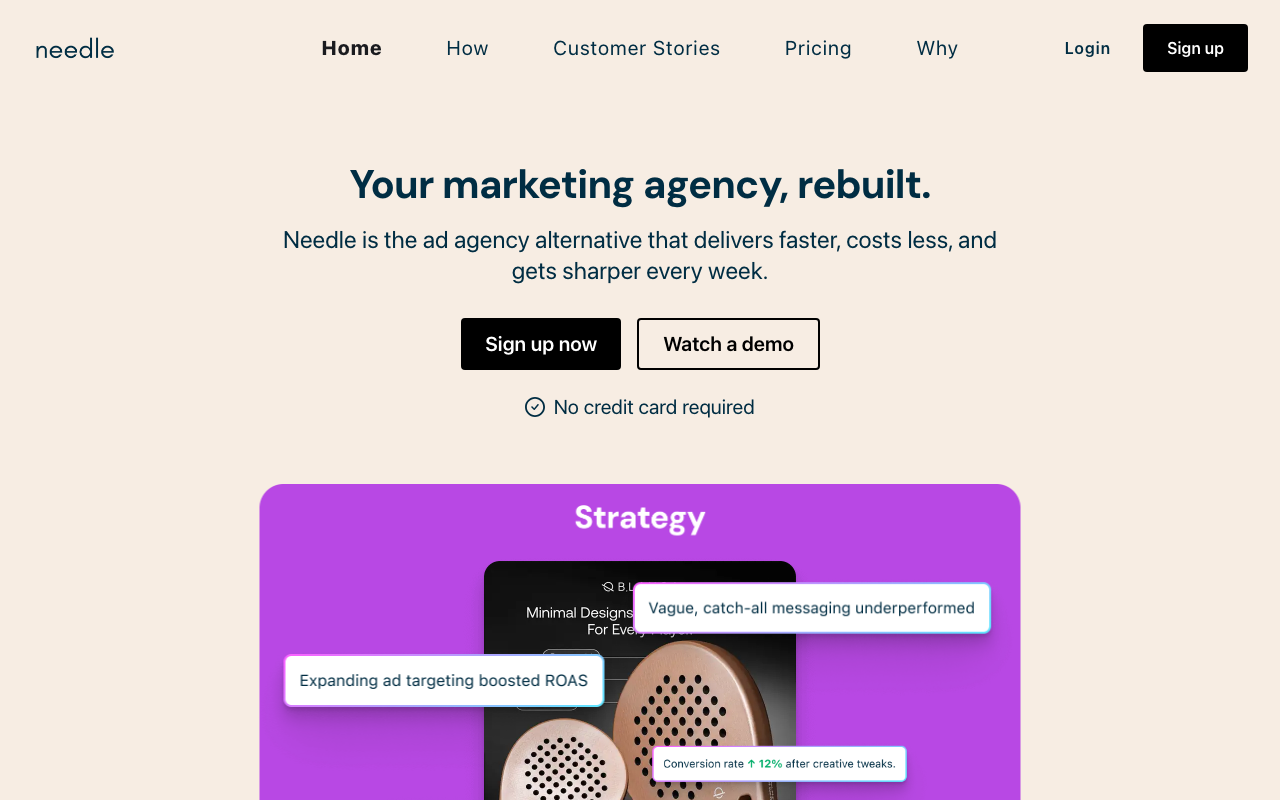
This matters because the bottleneck for most DTC brands doing $1M–$10M isn't ideas—it's time. A founder spending 2–4 hours per email, or a head of marketing manually uploading creatives to Meta, isn't failing because they lack a content generator. They're failing because they need a system that runs without them. Needle builds that system: it connects to Shopify, Klaviyo, Meta, Google, and TikTok, reads what's working, surfaces campaign recommendations every Monday, produces AI-drafted assets polished by human designers, and launches campaigns directly. Nothing waits in a queue for you to brief an agency.
The economics work differently than any other tool here. For a brand spending $5K–$8K/month on ads, Needle runs at $2,999/month as a flat fee with no percentage cut of ad spend—versus $5K–$10K for a traditional agency or $8K–$15K for a comparable in-house team. Needle's published averages for brands running it 3+ months are specific: +177% annualized revenue uplift (top brands), +91% marketing efficiency, and 62% lower agency, freelancer, and tool costs.
Key features
- Strategic Edge: Brand intelligence layer built during onboarding and updated continuously; maps the competitive landscape, defines brand positioning, informs every campaign recommendation automatically
- Weekly Content Calendar: Pre-loaded every Monday with campaign ideas pulled from Strategic Edge, performance history, and active channels; founders pick what they like in minutes
- Creative Production (AI + Human): AI drafts every asset; Needle's designers and editors polish for brand voice, visual identity, and quality; creative volume is uncapped and revisions are unlimited
- Campaign Launch: Sets up and launches directly to Meta, Google, TikTok, and Klaviyo; no manual uploads, no agency briefing required
- Momentum Report: Weekly performance summary covering what worked, what didn't, and what to do next; replaces manual analytics pulls and monthly agency PDFs
Pricing
Pricing scales with ad spend and email list size, not deliverable count:
- Growth: $2,999/mo — ~$5K–$8K monthly ad spend, ~5K active email subscribers
- Scale: $3,999/mo — ~$8K–$11K monthly ad spend, 5K–10K subscribers
- Custom: tailored pricing — ~$11K+ ad spend, 10K+ subscribers, or complex needs such as BFCM spikes
- Included in every tier: hands-free campaign management, weekly ad optimization, weekly Momentum Report, unlimited creative revisions, dedicated strategist. Needle's pricing page doesn't state a contract length, so confirm terms before signing.
Pros & cons
Pros:
- The only tool on this list where execution is included—not just tools and templates
- Humans in the loop throughout: dedicated strategist, designers, and campaign managers on every account
- Compounding learning model: the system gets better every week as it accumulates brand performance data
- Case studies are specific and verifiable: 12× ROI in month one (RTPTennis), MER of 41× peak (TWOOAK), ROAS held at ≥6× for 8 straight months (As Intended)
- Published averages for brands running 3+ months: +177% annualized revenue uplift (top brands), +91% marketing efficiency, 62% lower agency, freelancer, and tool costs
Cons:
- Priced by ad spend and email list size — the first published tier assumes roughly $5–8K in monthly ad spend and ~5K active subscribers, so smaller brands may fall below it; not a good fit for brands still testing whether AI marketing is worth it
- Channel coverage is Shopify, Klaviyo, Meta, Google, and TikTok—narrower than Omneky's 10+ ad platforms
- Growth is currently founder-capped; demand-gen machine not yet fully built
- Small social presence and limited brand awareness outside direct network
- Not a fit for brands under $1M (too early to have the ad spend that justifies the system)
Customers
Needle serves 200+ active brands across the US, Australia, and Singapore. Customer outcomes include RTPTennis (revenue per email send 3K → $4.8K, 12× ROI in month 1), TWOOAK contact lenses (CPO $41 → $19, peak MER of 41×, $2.3K spend → $95.7K revenue), Heliotrope SF (evergreen emails at 6× ROI; promo emails at 17× ROI), and As Intended (MER doubled in 60 days, held ≥6× ROAS for 8 consecutive months).
It's like having a full marketing team in one tab… each email now brings in 3–4× ROI, and if something doesn't work Needle pivots fast.
— JP, Founder, Heliotrope SF
2. Madgicx: Best AI tool for Meta ads optimization
If Facebook and Instagram are your primary growth channel, Madgicx is the most sophisticated AI layer available without hiring a full-time media buyer. Every other tool on this list generates creative or plans content. Madgicx does something more specific: it reads your live Meta ad account, audits what's working and what's wasting budget, and surfaces ranked actions for you to approve or dismiss—every single day.
The intelligence loop is the product. Madgicx connects to Meta, scores your campaigns against benchmarks from 15,000+ advertisers managing $500M+ in combined ad spend, and tells you exactly which ad sets are ROAS-efficient but underfunded, which creatives are fatiguing, and which audiences have room to scale. You approve. It executes. The next round of recommendations is shaped by what you just did.
Their pricing is aligned with media spend rather than a flat subscription—which means a brand spending $5K/month on Meta pays $90/month (annual) rather than a fixed fee that ignores context. An Official Meta Business Partner with deep API access, Madgicx describes their long-term vision as "Advertising General Intelligence"—a system that eventually runs your Meta ads better than any human could. They say they're currently about 60% of the way there.
Key features
- AI Marketer: Daily account audit with prioritised, ranked recommendations and the reasoning behind each one; brand approves or dismisses
- Automated Ad Launch Tool: Generates creative and deploys to Meta at scale; claimed 10× faster than manual setup
- Creative Fatigue Detection: Flags underperforming ad sets before they waste budget, with suggested replacements
- Cross-Channel Reporting: Meta, Google Ads, GA4, Shopify, Klaviyo, and TikTok data in one dashboard
- Automation Rules: Configurable triggers that execute without per-action approval once trust is established
- Tracking Pro (add-on, $49/mo): Server-to-server first-party data tracking for post-iOS accuracy
Pricing
Pricing is based on monthly ad spend:
- Up to $2,500/mo: $69/mo (annual) · $99/mo (monthly)
- $2,500–$5,000/mo: $83/mo (annual) · $119/mo (monthly)
- $5,000–$10,000/mo: $90/mo (annual) · $129/mo (monthly)
- $10,000–$20,000/mo: $160/mo (annual) · $229/mo (monthly)
- $20,000–$30,000/mo: $230/mo (annual) · $329/mo (monthly)
- $30,000+/mo: Custom
- Free trial: 7 days, no credit card
Pros & cons
Pros:
- The approval-flow recommendation engine is a genuine intelligence loop—it learns from every action you take
- Ad-spend-based pricing scales fairly with your budget; accessible for early-stage DTC
- Official Meta Business Partner with deep API access—not a workaround
- 15,000+ advertisers at scale means benchmarks are grounded in real performance data
- Case studies are specific: 2× ROAS, 5× ad spend, 80 ROAS on a single campaign
Cons:
- Meta-only for campaign execution—cannot touch Google Ads, TikTok, or email
- No email production or Klaviyo campaign management; a separate tool is required for lifecycle marketing
- No human strategists—you interpret the recommendations and own the creative brief
- Reviews diverge sharply by platform: G2 4.6/5 from 219 reviews vs. Trustpilot 1.7/5 from 272 reviews, where billing and cancellation complaints dominate
Customers
Madgicx serves 15,000+ advertisers across DTC, retail, and e-commerce. Published case studies include Negative Apparel (2× ROAS, 5× ad spend), Tanganyika Wildlife Park (80 ROAS, $400K revenue in one month), and GLAMCOR (12.72 retargeting ROAS, 64% increase in attributed conversions). G2 rating: 4.6/5 from 219 reviews — worth weighing against its much rougher Trustpilot record before committing.
After Madgicx, our monthly ad spend went 5× and our customer base grew 1.5×. The AI recommendations made it obvious where our budget was being wasted.
— Negative Apparel
3. Glowtify: Best self-serve AI marketing OS for ecommerce teams
Glowtify is what happens when a digital agency founder gets tired of the agency model and rebuilds it as software. Marc Allard ran Walter Interactive, a Montreal ecommerce agency, for years before spinning out Glowtify—which means the product is built around the actual workflows small DTC teams use, not a generic AI content generator with an ecommerce skin on top.
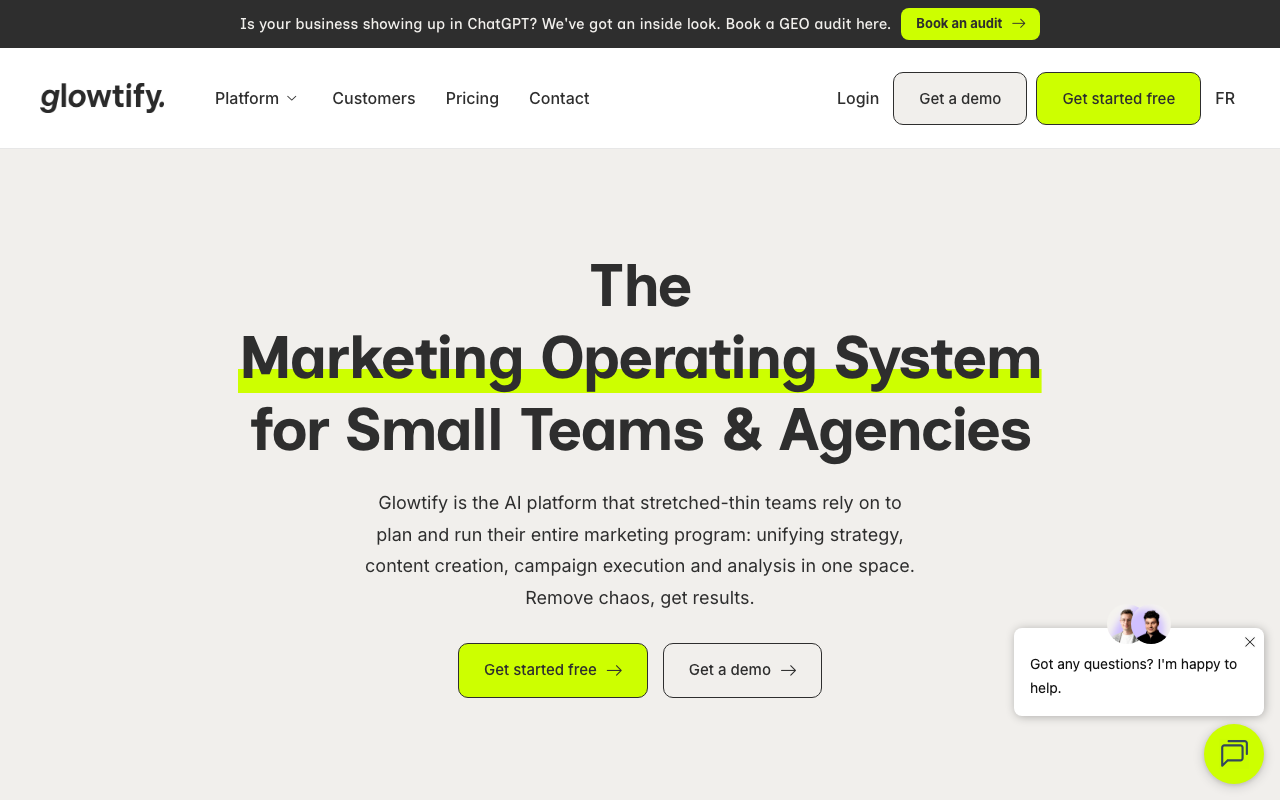
The differentiator is what Glowtify does with your Shopify data. It ingests two years of transaction history before generating a single campaign idea—which means recommendations are grounded in your actual performance patterns, not templated suggestions. When the platform surfaces a campaign for a product launch, it already knows which SKUs have seasonal demand, which segments buy twice within 30 days, and what your email revenue per send looked like in the last six months.
One-click publishing across Meta, TikTok, Google, Klaviyo, Mailchimp, and WordPress is genuinely useful for a team of two managing five channels simultaneously. The unlimited-user model on both plans removes the per-seat friction that kills team adoption. Glowtify is self-serve—there are no account managers or human creative teams—but for brands that want to stay in control of execution and just need the AI to eliminate the blank-page problem, it covers more ground than most.
Key features
- AI Campaign Builder: Generates campaign ideas, copy, and creative from connected store and channel data; 60+ ecommerce content formats
- Shopify Data Ingestion: Pulls 2 years of transaction history to make recommendations specific to your brand's actual performance, not generic best practices
- Omnichannel Publishing: One-click publish across email, social, ads, and web simultaneously (Meta, TikTok, Google, Klaviyo, Mailchimp, WordPress)
- Strategy Module: Weekly campaign recommendations surfaced from performance data and live store signals
- Unlimited Users: No per-seat pricing on any plan—entire team included at the base price
- Add-ons: Strategy consulting, SEO, ads management, design templates, video creation available as extras
Pricing
- Startup: $449/mo — brands under $100K/year revenue; email support
- Growth: $899/mo — brands over $100K/year revenue; dedicated expert included
- Add-on services available: consulting, SEO, ads management, video creation
Pros & cons
Pros:
- Ingests 2 years of Shopify history—more brand-specific context than any other self-serve tool
- Genuine omnichannel coverage in a self-serve tool, including Mailchimp and WordPress publishing
- Unlimited users on all plans—no seat-count anxiety as the team grows
- Built by agency practitioners who know what DTC brands actually need from a creative workflow
- Lower price point than Needle's $2,999+/mo tier
Cons:
- Self-serve only—no human strategist, no creative team, no account manager to own execution
- Brand controls all creative quality; AI drafts are final unless the team edits them
- Independent estimates put 2025 ARR around $330K — well below the $2M target its own earlier materials cited (Getlatka)
- No compounding per-brand learning system; each campaign recommendation starts from data, not accumulated context
- Less DTC-depth than Needle; broader SMB positioning includes non-ecommerce clients
Customers
Glowtify serves approximately 150 paying customers and 1,500+ including free and trial accounts. Case studies include Brume ("4× more marketing execution without scaling the team"; 60% of product SEO automated), Jolie Ride (+54.8% total social engagement YoY), and Peppermint Cycling (50% time savings on email campaign planning). ~55% of customers are US-based.
Small teams shouldn't have to choose between speed and craft.
— Marc Allard, CEO, Glowtify
4. Omneky: Best for omnichannel AI creative production at scale
Omneky is built for a specific problem that grows more acute as brands scale: as you run more ads across more platforms, creative production becomes a manufacturing problem. At 10+ ad platforms with 50+ variants running simultaneously, no creative team can generate, test, and iterate fast enough. Omneky automates that manufacturing layer while closing the attribution loop that most creative tools leave open.
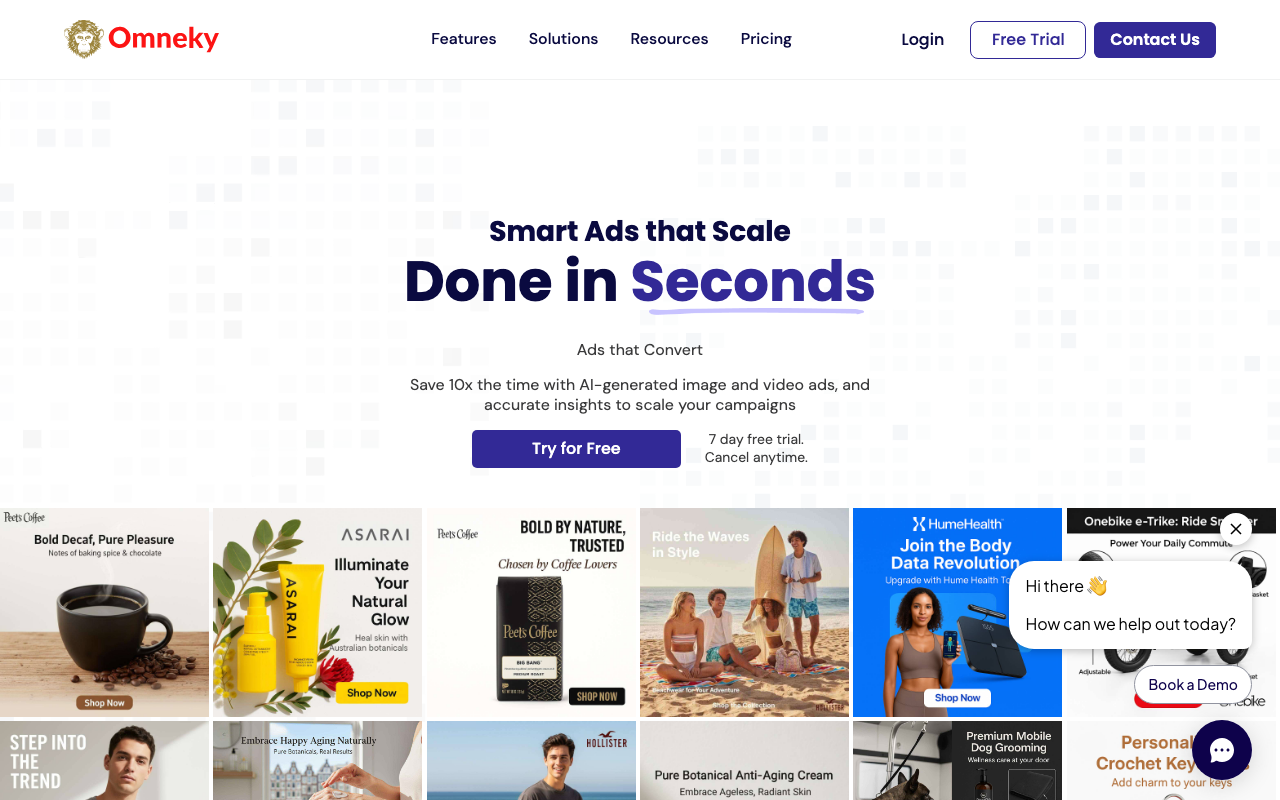
The feature that sets Omneky apart is creative attribution at the element level. Most tools tell you "this ad worked." Omneky tells you why: this specific headline framing, combined with this color palette, against this audience, produced a measurably different outcome. That kind of feedback transforms the next round of creative from intuition into data—and compounds over time as the brand's Brand LLM is fine-tuned on its own performance history.
For DTC brands spending $10K+ per month across Meta, Google, YouTube, TikTok, LinkedIn, and Reddit, Omneky's agentic optimization layer handles the routine decisions—scaling winners, pausing underperformers, generating fresh variants—without requiring a human to catch every signal. Founded by a Harvard CS graduate backed by SoftBank DeepCore and Village Global, and recognized by Gartner as "a leading innovator in AI-driven creative solutions" in November 2024, Omneky has the technical credibility behind its claims.
Key features
- Brand LLM: Fine-tuned language model trained on your brand's assets, voice, and performance data; enforces consistency across thousands of ad variations at scale
- Multi-Format Generation: Image ads, video ads (scripts, storyboards, AI avatars, music, transitions), product photography, and carousel ads across 10+ platforms
- AI Avatars: AI-generated spokespeople for product demonstrations without video production resources
- Creative Attribution: Links specific design choices—headline framing, colors, CTA wording, imagery type—to business outcomes; most granular creative feedback of any tool on this list
- Smart Ads: On-brand ads generated from live performance data; creative adapts automatically as results come in
- Agentic Optimisation: Autonomous agent scales winning variants and pauses underperformers without per-action approval
Pricing
Credit-based model:
- Lite: $24/mo — 200 credits
- Standard: $79/mo — 1,000 credits ("74% of creators choose this")
- Pro: $199/mo — 4,000 credits
- Enterprise: Custom
- Free trial: 7 days
Pros & cons
Pros:
- Most granular creative attribution on this list—links performance to specific design elements, not just campaign-level outcomes
- Genuine omnichannel coverage: 10+ platforms vs Madgicx's Meta-only execution
- Brand LLM enforces brand consistency across thousands of ad variations—scales what in-house creative teams can't
- Very low entry price ($24/mo) with a real performance feedback loop built in
- AI Avatars remove video production costs for product demos and spokesperson content
- Independent estimates put ARR at roughly $8.3M, bootstrapped (Getlatka) — stronger commercial traction than earlier figures suggested
Cons:
- Creative production and optimisation only—no email flows, no strategy layer, no campaign budget management
- Brand still owns campaign structure, audience targeting, and budget allocation; Omneky executes creative, not strategy
- No human strategists, account managers, or dedicated creative team
- Credit-based pricing gets expensive at high volume; enterprise-tier use cases can outpace plan limits quickly
Customers
Omneky serves 100+ clients including Stance, Brex, Checkr, You.com, Sony, and Wayfair. Published case studies include Omiana (135% increase in ad spend, 200% increase in sales), Flex Agent (227% more sign-ups), and RAD Intel (80% reduction in lead costs). Average reported client ROAS: 2.7×. Recognized by Gartner (November 2024) as "a leading innovator in AI-driven creative solutions."
We went from producing 5 ad variants per month to 50—and the new ones outperform the old ones because we actually know what's working.
— Omneky customer
5. AdCreative.ai: Best for AI creative generation with performance scoring
AdCreative.ai has the largest training dataset of any ad creative tool: $35B+ in ad spend data across 4.2M+ businesses and 1B+ generated creatives. That data moat is what makes its Creative Scoring AI credible—when the platform ranks variants by predicted performance before you download them, it's ranking against real outcomes from a dataset no startup can replicate.
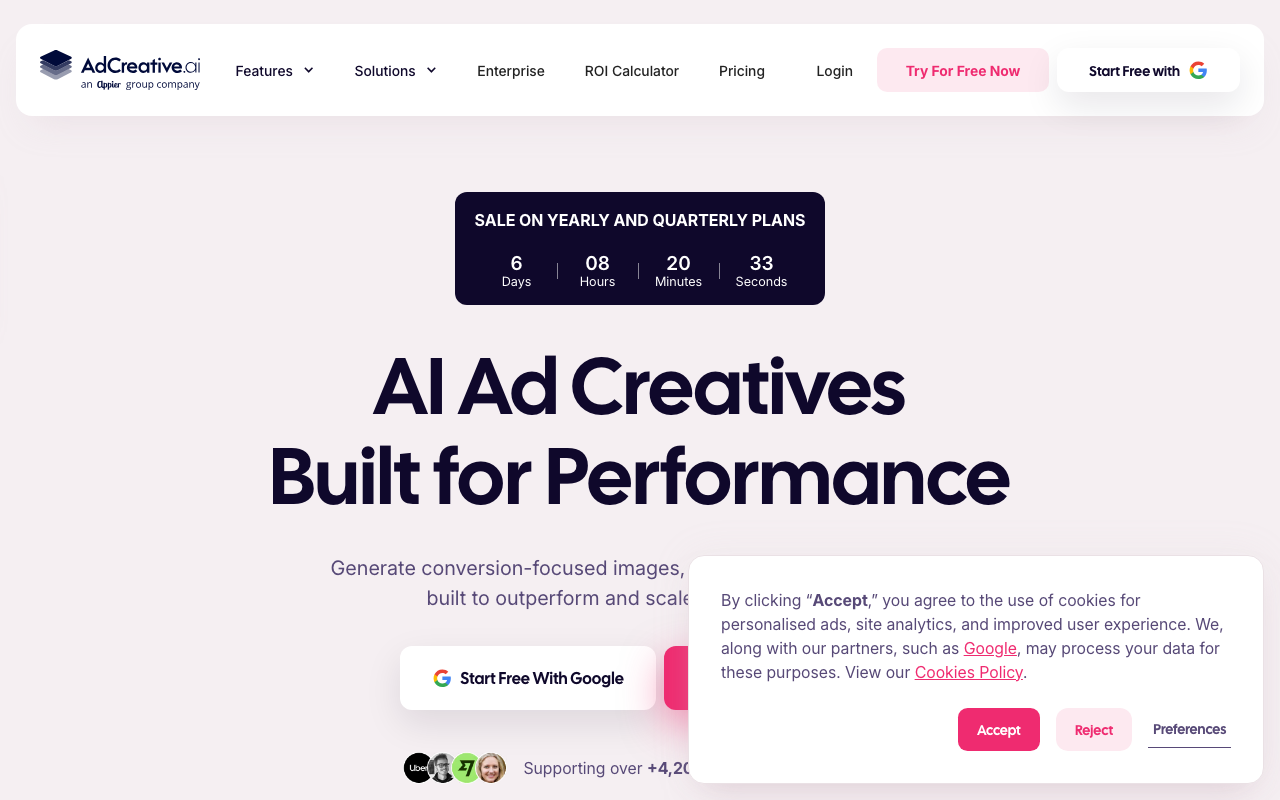
Acquired by Japanese AI SaaS company Appier in March 2025 for $38.7M—its largest acquisition since IPO—AdCreative.ai now operates with enterprise backing and APAC distribution. For DTC brands that need a fast, data-backed starting point for ad creative without committing to a full-service system, the Starter plan at $39/month is a legitimate entry point. The AI Photoshoot feature, which transforms standard product photos into studio-quality images, removes a genuine production cost for brands that haven't yet invested in photography.
The tradeoffs are real. Trustpilot shows 3.1/5 from nearly 4,000 reviews—with a dominant complaint pattern around billing: auto-enrollment in paid plans after free trials, charges without clear consent, and difficulty canceling. For a tool with 4.2M+ installs, billing complaints at that volume are a structural red flag. Teams evaluating AdCreative.ai should test on annual billing with a clear cancellation plan established before trialing.
Key features
- Creative Scoring AI: Ranks all generated variants by predicted performance before download; claims 90%+ accuracy; trained on $35B+ in ad spend data
- AI Photoshoot: Transforms product photos into studio-quality lifestyle and studio images without a photoshoot; eliminates photography production costs
- Competitor Insights AI: Surfaces rivals' top-performing ad formats and creative approaches in your category
- Creative Insights: Shows which live creatives are performing best in connected Facebook and Google ad accounts
- Product Photography + Video Generation: Full creative suite including UGC-style video production
- G2 Track Record: 3rd fastest-growing product on G2 in both 2023 and 2024
Pricing
- Starter: $39/mo (monthly) · ~$25/mo (annual)
- Professional: $249/mo (monthly) · ~$149/mo (annual)
- Ultimate: $999/mo (monthly) · ~$599/mo (annual)
- Enterprise: Custom
- Free trial: 7 days
Pros & cons
Pros:
- Largest ad spend training dataset of any creative tool ($35B+) makes performance scoring predictions credible
- Very low entry price ($39/mo) with an enormous installed base of 4.2M+ businesses as social proof
- Competitor Insights adds strategic intelligence beyond generation—surfaces what rivals' best ads look like
- AI Photoshoot eliminates a meaningful production cost for brands without photography budgets
- Appier acquisition brings enterprise infrastructure and APAC distribution
Cons:
- Trustpilot 3.1/5 from ~3,855 reviews is a significant red flag; billing abuse complaints dominate one-star reviews
- Creative generation tool only—no campaign execution, strategy, lifecycle marketing, or Shopify integration
- Integration depth is shallow: import/export with Facebook and Google Ads only; not full campaign management
- Appier acquisition shifts long-term roadmap toward APAC enterprise priorities—DTC-specific feature development may slow
- No email, no human oversight, no compounding per-brand learning
Customers
AdCreative.ai serves 4.2M+ businesses and has generated 1B+ ad creatives. Enterprise customers include Marks & Spencer ($1M in cost savings, 1.3× ROAS boost), Häagen-Dazs (150+ customised creatives per product, 11,000% increase in actionable customer responses), Snap Inc., Pernod Ricard, and Amazon. G2: 4.2/5 from ~793 reviews. Capterra: 3.4/5 from ~165 reviews.
The creative scoring saves us from launching bad ads. We never ship a variant that the AI hasn't already ranked against 35 billion data points worth of real performance.
— AdCreative.ai customer
Frequently asked questions
Do I need one tool or multiple tools for DTC marketing?
Most DTC brands doing $1M–$10M are already running 8–12 marketing tools. The question isn't how many tools you have—it's whether the system compounds. Madgicx adds intelligence to your Meta ad account; AdCreative.ai or Omneky generate the creative; Glowtify or Needle manage the strategy and content calendar. The gap most tools leave is execution: who actually launches the campaigns, monitors performance, and makes the next call. That's what Needle closes.
What's the difference between an AI creative tool and an AI marketing system?
An AI creative tool (AdCreative.ai, Omneky, parts of Glowtify) generates assets—images, copy, video—faster than a human could. You still brief it, evaluate the output, and launch campaigns manually. An AI marketing system (Needle, to some extent Glowtify at the higher tier, Madgicx for Meta) connects to your live data, generates strategic recommendations, and in Needle's case, executes the campaigns with human oversight baked in. Systems compound; tools don't.
Which tool is best for a DTC brand just getting started with AI marketing?
Madgicx at $69–$90/month is the strongest entry point for a brand already spending on Meta ads—it pays for itself when a single recommendation prevents a wasted budget cycle. AdCreative.ai at $39/month is the lowest-friction starting point for ad creative generation if you're not ready for a system commitment. For brands above $1M in revenue that want execution included from day one, Needle's entry package at $2,999/month is structured for that specific stage.
What does "AI + human" mean in the context of Needle?
It means AI drafts the first version of every asset, and Needle's designers and editors polish it before it goes anywhere near your brand. No creative leaves the system without human judgment applied. Most tools label themselves "AI + human" when they offer a chatbot for support questions. Needle's humans are on the creative production line, not just in the support queue.
Which platforms do these tools connect to?
Madgicx connects to Meta exclusively for execution (plus Google Ads, GA4, Shopify, Klaviyo, and TikTok for reporting). Glowtify connects to Meta, TikTok, Google, Klaviyo, Mailchimp, Shopify, and WordPress. Needle connects to Shopify, Klaviyo, Meta, Google, and TikTok. Omneky publishes to 10+ ad platforms including Meta, Google, YouTube, TikTok, LinkedIn, Reddit, and Snapchat. AdCreative.ai integrates with Facebook Ads and Google Ads only.
How long does it take to see results from an AI marketing tool?
Madgicx can surface actionable recommendations within the first 48 hours of connecting your ad account. AdCreative.ai and Omneky can generate campaign-ready creative within minutes. Glowtify typically shows meaningful campaign output within the first week after Shopify data ingestion. Needle's compounding model needs time to learn your brand—but case studies show 12× ROI in month one for some accounts and double-digit ROAS improvements within 60 days.
Conclusion: Choosing your AI marketing tool
The right choice depends on where your bottleneck actually is.
For DTC brands doing $1M–$10M that want agency-level output without managing execution themselves, Needle is the only option where execution is included—across strategy, creative, and campaign management, with humans in the loop throughout. You approve. Needle handles everything else.
For DTC brands where Meta is the growth engine and the team is data-capable, Madgicx delivers the highest ROI per dollar: a genuine intelligence loop, Official Meta Business Partner depth, and pricing that scales with ad spend rather than a flat monthly fee.
For ecommerce teams that want self-serve control with AI lifting the content production load, Glowtify comes closest to a full marketing OS without requiring external execution—particularly if you're managing Google Ads and TikTok alongside Meta and email.
For brands running high-volume creative across 10+ platforms that need attribution below the campaign level, Omneky's Brand LLM and creative attribution make it the specialist tool. Best paired with a system like Needle or Madgicx that handles the strategy layer.
For teams that need fast ad creative and performance scoring before committing to a system, AdCreative.ai offers the lowest barrier to entry and the largest training dataset. Approach the billing model carefully—but the $35B+ scoring engine is a genuine asset at the Starter tier.
Running $1M+ in DTC revenue with marketing that still feels like chaos? Book a call with Needle and see how 200+ brands get agency-level output from one system—without the agency.