

Ad costs are not just “media costs” anymore. For most ecommerce brands, the real spend is hidden in the operational drag behind advertising: briefing, sourcing UGC, editing variants, writing copy, building new angles, launching tests, then repeating the whole cycle before creative fatigue hits.
That is why AI for advertising is having a real moment in 2026. Not because it magically makes Meta or Google cheaper, but because it helps you produce more high-quality tests per week, learn faster, and waste less money keeping losing ads alive.
This guide breaks down where AI actually cuts costs, how to scale creative without wrecking your brand, and a practical workflow you can run weekly.
Why AI is changing advertising (and why creative matters more than targeting)
Most major ad platforms now lean heavily on machine learning for delivery. On Meta, for example, automation influences bidding, placements, and audience expansion in ways you cannot fully “out-manual” anymore.
So if everyone has access to similar delivery automation, what is the lever you still control?
For DTC and ecommerce, it is usually:
- Offer and funnel quality (product page, pricing, landing page match)
- First-party data and measurement hygiene (Pixel/CAPI, product catalog, events)
- Creative volume and iteration speed (new hooks, new formats, new proofs)
AI helps most with the third lever. It makes “creative velocity” realistic for small teams, without paying agency retainers or coordinating a swarm of freelancers.
Where AI for advertising actually cuts costs
AI only saves money when it reduces a real bottleneck. In ecommerce ad accounts, the biggest bottlenecks are usually content production and decision-making speed.
1) Lower cost per creative variant
Traditional creative production often forces a tradeoff:
- High quality, slow turnaround (agency)
- Fast turnaround, inconsistent quality (freelancers)
- Cheap, but founder time-intensive (DIY)
AI shifts the curve by making the first draft and variants cheap, then leaving your team to do what humans do best: taste, positioning, and final approvals.
The cost reduction shows up in two ways:
- Fewer paid hours per asset (copy, design, editing, resizing)
- Less rework (clearer briefs, faster iteration, consistent brand inputs)
2) More tests per week (which reduces wasted spend)
Most ad accounts do not fail because the team cannot find one winning ad. They fail because the team cannot produce enough shots on goal to find the winners consistently.
AI helps you:
- Spin up more angles (problem, outcome, comparison, founder story, objection handling)
- Create more format variants (static, carousel, short video, UGC-style cuts)
- Refresh creatives before performance decays
More tests per week usually means you stop “hoping” an ad works and start running a repeatable system.
3) Faster iteration loops (time is a cost)
A common hidden cost is time-to-learning.
If it takes your team two weeks to ship new creative, you will:
- Keep spend behind mediocre ads longer than you should
- Miss seasonality windows (launches, restocks, holidays)
- Burn out internal operators who are stuck in production mode
AI shortens the loop: generate ideas, produce assets, publish, read results, generate the next set.
4) Workflow automation (less coordination tax)
A surprising amount of ad “cost” is coordination:
- Gathering inputs (product details, claims, reviews, photos)
- Creating briefs
- Passing files between tools
- UTM naming and launch checklists
- Building ad variations manually
AI-driven workflows can automate chunks of this, especially when the system integrates with your existing tools and can publish directly.
5) Better reuse of what already works
Many brands sit on a pile of winning ingredients and do not systematically repurpose them:
- A high-performing hook in one ad never becomes five new variants
- A great email angle never becomes a retargeting ad
- A winning UGC concept never becomes a static carousel
AI makes repurposing faster by rewriting, reformatting, and adapting winners across placements.
The creative velocity math (a simple way to think about ROI)
You do not need a complex attribution model to justify AI. Start with a basic question:
What does one week of delayed learning cost you?
Here is a practical way to frame it.
Think in “cost per useful test”
A useful test is not “any ad you launch.” It is an ad built around a distinct hypothesis, for a clear audience stage (prospecting vs retargeting), with a clean measurement window.
If you can only afford to launch two tests per month, you will often:
- Overfund tests because you are emotionally invested
- Keep ads running too long to “get enough data”
- Accept mediocre performance because you have no replacements
If AI lets you run 8 to 12 meaningful tests per month, you can cut losers faster and reallocate budget into what works.
The compounding effect
A winner today becomes an input for the next generation:
- Winner hook becomes 10 new hooks
- Winner offer becomes 3 new bundles
- Winner proof becomes a carousel and a video
AI accelerates this compounding by turning learnings into new assets quickly.
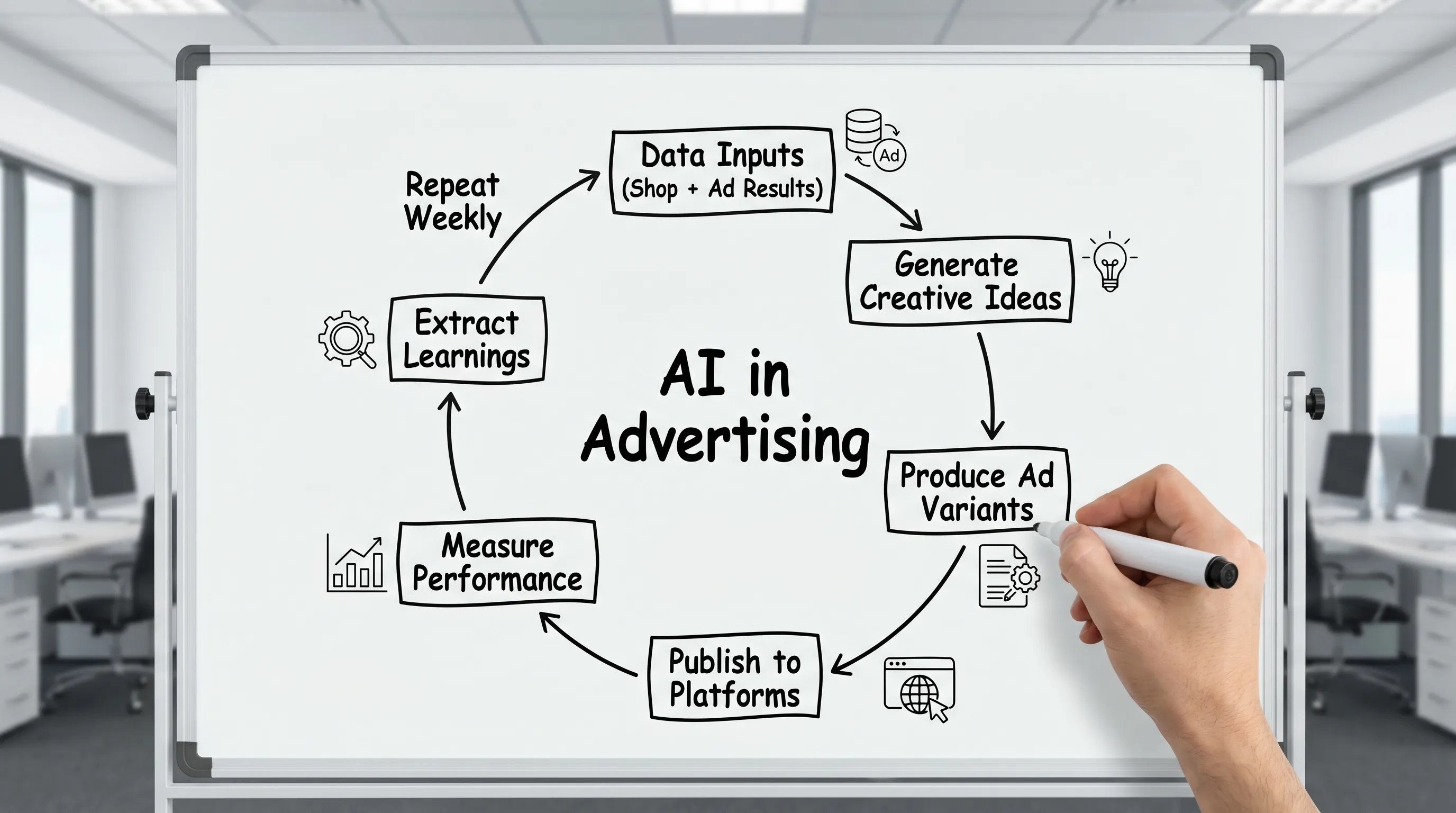
A practical weekly AI advertising workflow (that does not feel like chaos)
The easiest way to waste AI is to use it like a slot machine: prompt, generate, post, hope.
A better approach is a weekly operating rhythm.
Step 1: Start with one clear goal
Pick one objective per week:
- Lower CPA on prospecting
- Increase CTR on a new concept
- Improve retargeting conversion rate
- Reduce creative fatigue on a scaling campaign
When AI generates ideas, you want it constrained by the goal. Constraints improve quality.
Step 2: Feed AI the right inputs
AI outputs are only as good as the inputs. Useful inputs include:
- Your top 3 best-selling SKUs and margins
- Customer reviews and common objections
- Your best-performing ads from the last 30 to 90 days
- Offer details (bundles, guarantees, shipping thresholds)
- Brand voice guidelines (what to say, what not to say)
If you are in apparel, product readiness matters too. For example, if you are developing new drops and need samples, fabrics, or production support to hit launch timelines, partnering with an end-to-end manufacturer can reduce bottlenecks upstream of advertising. A resource like Arcus Apparel Group, an apparel development and manufacturing partner can help teams move from concept to producible product faster, which also makes it easier to capture product assets early for ads.
Step 3: Generate a batch of angles, not a batch of “ads”
Angles are the real unit of advertising strategy.
Ask for:
- 10 hooks for one customer pain
- 5 variants of the same hook (short, medium, long)
- 3 proofs per hook (review, stat, founder claim, demonstration)
Then turn your best angles into creatives.
Step 4: Produce creative variations by format
Most brands under-test formats. AI helps you scale formatting work that normally takes time.
A simple approach is:
- One static concept with 3 headline variants
- One UGC-style video script with 2 hook variants
- One carousel that stacks proof and objections
If you only have time for one format, default to what your account has historically rewarded. If you do not know, many DTC brands start with short-form video plus a few statics to anchor messaging.

Step 5: Launch with discipline
AI can speed creation, but it cannot protect you from messy testing.
Keep your tests clean:
- Change one core variable at a time (angle or format)
- Use consistent naming conventions
- Decide the minimum spend or time window before judging
Step 6: Turn results into a learning memo
Every week, extract:
- What hooks increased thumbstop (CTR)
- What messages improved conversion (CPA, purchase rate)
- What objections kept showing up in comments
- What audiences or placements over-indexed
Then feed those learnings back into the next batch.
Guardrails: how to scale with AI without harming brand or compliance
The risk with AI advertising is not that it is “bad.” It is that it becomes generic, inconsistent, or legally sloppy.
Brand guardrails
Protect consistency by standardizing inputs:
- Your positioning statement (who it is for, why you win)
- Approved claims list (and disallowed claims)
- Vocabulary and tone examples
- A short list of competitor comparisons you will and will not make
If you do this once, every future generation gets better.
Compliance and trust guardrails
Even performance ads need trust.
- If you use testimonials or endorsements, follow the FTC’s endorsement guidelines.
- Avoid generating medical or financial claims unless you can substantiate them.
- Keep an internal approval step for sensitive categories (skincare, supplements, intimates)
AI can draft, but humans should approve.
Creative quality guardrails
If your ads “look AI,” performance usually drops. Not because customers hate AI, but because they hate low-effort content.
Use AI to accelerate:
- Concepting
- Drafting
- Variations
- Editing and resizing
Then use human judgment for:
- Final selection
- On-brand polish
- Offer strategy
- Sequencing across funnel stages
What to look for in an AI for advertising solution
If you are evaluating tools or platforms, focus less on “can it generate ads?” and more on “can it run the system?”
Look for an end-to-end loop
A strong AI advertising stack should support:
- Idea generation based on what is working
- On-brand creative production (copy, images, video concepts)
- Publishing or deployment support so assets become live tests
- Measurement and learnings that translate performance into next actions
Look for integrations and connected data
Advertising AI is far more useful when it connects to your store and marketing tools. That is how it can personalize outputs and learn from results.
Look for human-in-the-loop controls
You want an “approver” workflow, not a black box.
That includes:
- Review and approval gates
- The ability to enforce brand rules
- A clear audit trail for what shipped
How Needle fits into the AI advertising approach
Needle is built for ecommerce teams that want to cut production costs and scale creative, without adding agency bloat. Instead of juggling disconnected generators, Needle connects to your tools, generates marketing ideas and on-brand assets, publishes directly, and runs a weekly optimization loop where you approve and Needle executes.
If you want an example of what that can look like in practice, Needle has published multiple ecommerce case studies showing how founders reclaimed hours each week while improving performance, including:
- RTPTennis: 12x ROI in the first month
- Heliotrope: 6x ROI on evergreen email campaigns
- As Intended: above 6x MER
The larger point is not the numbers, it is the operating model: build a system where creative and learnings compound weekly.
Frequently Asked Questions
Is AI for advertising only useful for big brands with huge budgets? No. Smaller brands often benefit more because AI reduces the time and cost required to produce enough tests to find winners.
Will AI replace my media buyer or performance marketer? It usually replaces repetitive production and coordination tasks, not strategy. Strong accounts still need humans for offer decisions, testing discipline, and brand judgment.
What is the fastest way to see cost savings from AI in ads? Use AI to increase creative output and refresh cadence, then cut losers faster. Cost savings typically show up as lower production spend and less wasted ad spend on stale creatives.
How many new creatives should I launch per week? There is no universal number, but many DTC teams aim for a consistent weekly cadence (even small) rather than sporadic “big drops” of creative.
Can AI generate compliant ad copy for regulated categories? It can draft, but you should keep strict human review and maintain an approved claims list. Compliance is a process, not a prompt.
Does AI help more on Meta, TikTok, or Google? AI helps most where creative variety drives performance (often Meta and TikTok). On Google, AI can still support ad copy variants and creative for YouTube and Performance Max, but your product feed and landing pages matter heavily.
Cut ad costs by making creative a weekly system
If your team is stuck choosing between expensive agencies and inconsistent freelancers, the fix is usually not “one better ad.” It is building a repeatable loop that produces, launches, and improves creative every week.
Needle helps you run that loop end-to-end: connect your tools, generate tailored campaign ideas and on-brand assets, publish to your platforms, track results, and turn performance into next-week learnings.
Get started at Needle.