
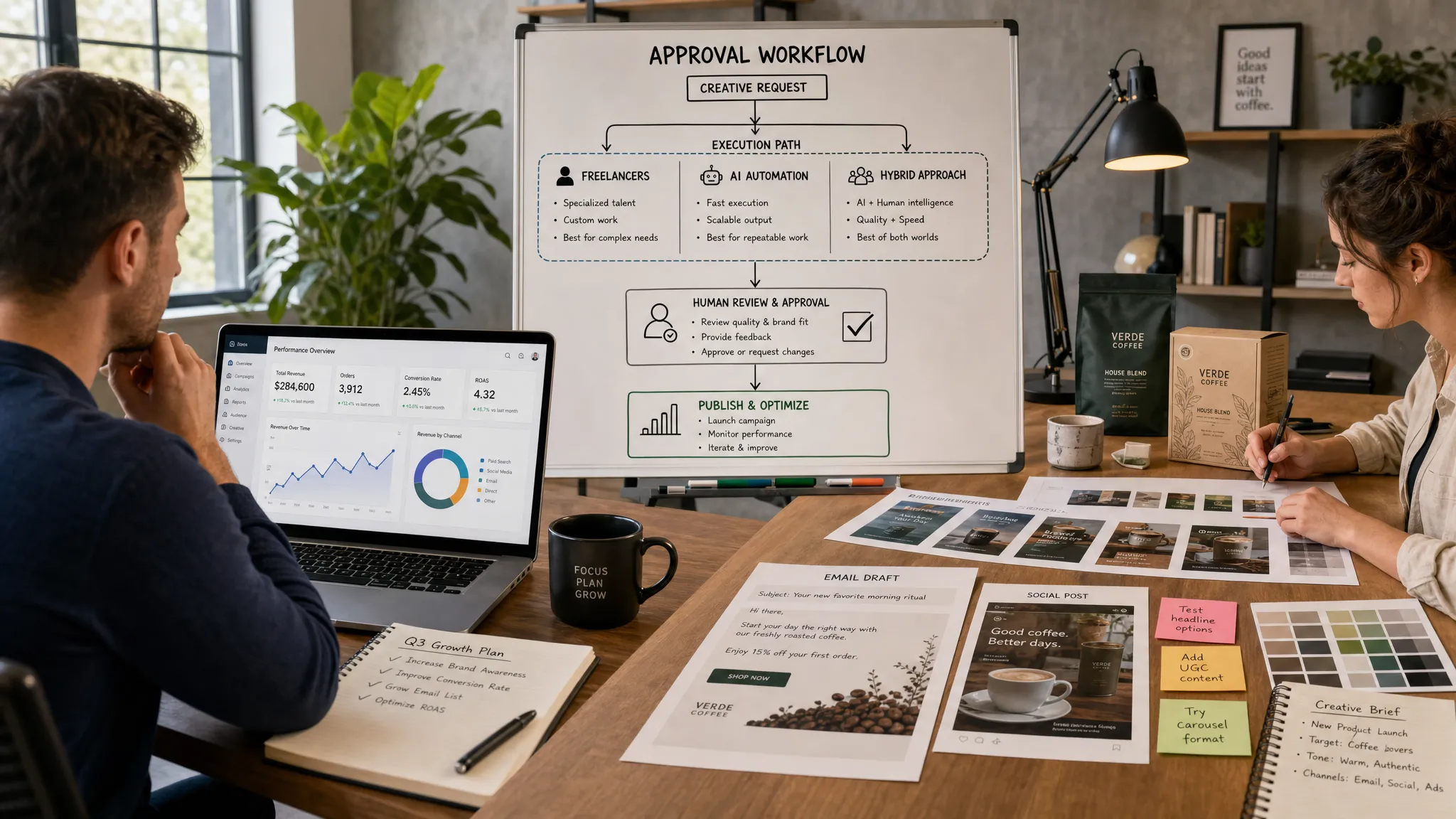
For ecommerce teams, the question is no longer whether AI can create marketing work. It can. The sharper question is whether you should keep hiring marketing freelancers, replace parts of that work with AI, or build a hybrid system that gets the best of both.
In 2025, the answer depends on what you are buying. If you need raw output, faster testing, campaign variations, email drafts, ad concepts, short-form videos, or weekly iteration, AI is usually the better operating layer. If you need deep strategic judgment, unusual creative taste, customer interviews, founder-level positioning, or a specialist who can challenge your assumptions, a strong freelancer can still be worth every dollar.
The brands that win are not choosing humans or AI as a philosophy. They are choosing the right production model for the job.
The short answer: what is best in 2025?
For most growing ecommerce and DTC brands, AI is best for execution speed and workflow consistency, while marketing freelancers are best for specialized judgment and one-off expertise.
That means AI should increasingly handle the repeatable marketing engine: campaign ideation, creative versioning, email variations, ad copy, publishing workflows, performance tracking, and routine optimization. Freelancers should be used more selectively for projects where human context matters, such as brand strategy, product positioning, high-value creative direction, lifecycle audits, or complex paid media diagnosis.
A simple rule helps:
- Use AI when you need more high-quality output, faster feedback loops, and lower coordination overhead.
- Use freelancers when you need a specific expert opinion, a fresh strategic lens, or a creative leap that your internal team cannot make alone.
- Use both when you have traction but need scale without hiring a full in-house team.
The biggest mistake is comparing a freelancer’s best possible work to a generic AI prompt. That is not the real comparison. The real comparison is between two operating systems: a human-led, contractor-managed workflow versus an AI-assisted marketing workflow with human approval.
What marketing freelancers still do better than AI
Marketing freelancers remain valuable because marketing is not just production. Good marketing depends on taste, context, prioritization, and the ability to understand what is not written in a brief.
A strong freelancer can notice that your offer is confusing, that your customer research is too shallow, or that your product page is converting poorly because the creative promise does not match the checkout experience. AI can surface patterns and generate options, but it does not own business judgment in the same way a skilled operator does.
Strategic ambiguity
AI performs best when the objective is clear. Freelancers are useful when the objective is fuzzy.
For example, if your prompt is “write five Meta ad hooks for a collagen supplement,” AI can produce useful starting points in seconds. But if the real problem is that your supplement brand sounds like every competitor, the task is not five hooks. The task is positioning.
A sharp freelancer may ask questions like:
- Why should this product exist in a crowded market?
- What does the customer believe before they buy?
- Which claims are legally safe, emotionally compelling, and meaningfully different?
- What proof do we have that competitors do not?
That kind of diagnostic thinking is still hard to automate fully.
Taste and brand judgment
Creative performance is not purely mechanical. Sometimes an ad works because it feels native to a platform. Sometimes it fails because the photography looks too polished, the hook sounds fake, or the offer feels desperate.
Freelancers with category experience can bring taste developed through years of seeing what customers actually respond to. They can say, “This is technically on-brand, but it feels lifeless,” or “This UGC script is too clean to feel believable.”
AI can help create options. A human with taste can decide which options deserve to ship.
High-trust collaboration
A good freelancer can become a strategic partner. They remember past experiments, understand your founder’s preferences, and know how far they can push the brand voice. That continuity can be powerful, especially for smaller teams without senior marketers in-house.
The downside is that this value depends heavily on the individual. One freelancer may operate like a senior growth partner. Another may simply wait for task instructions and return average deliverables. AI reduces some of that variability, but it cannot fully replace a trusted human who understands your business deeply.
Where AI beats freelancers
AI has changed the economics of marketing execution. In 2025, the core advantage is not just cheaper content. It is faster learning.
Ecommerce growth depends on the number of good experiments you can run, the speed at which you interpret results, and the consistency with which you turn those learnings into the next campaign. That is where AI often outperforms freelancer-led workflows.
Speed from idea to launch
Freelancer workflows usually require briefing, scheduling, delivery windows, revisions, and handoff. Even with a great contractor, a simple creative refresh can take days.
AI can compress that cycle dramatically. A team can generate campaign angles, ad copy, email subject lines, landing page variants, and creative concepts in the same working session. The time saved is not just production time. It is management time.
This matters because channels move fast. Your best offer may fatigue. Your winning ad may stop performing. A competitor may copy your hook. A seasonal moment may appear and disappear in 48 hours. AI makes it easier to respond while the opportunity is still live.
Volume for testing
Freelancers often price by project, retainer, or hourly rate. That makes experimentation feel expensive. If every new creative direction requires a new scope, brands tend to test fewer ideas.
AI changes that psychology. It makes variation inexpensive. You can test more hooks, more formats, more product angles, more seasonal messages, and more audience-specific campaigns. Not all of them will be great, but the cost of exploring is lower.
That advantage compounds. The more you test, the more you learn. The more you learn, the better your prompts, briefs, creative rules, and campaign strategy become.
Workflow consistency
Freelancers are people. They have calendars, client loads, sick days, style preferences, and availability constraints. AI systems can provide a more consistent baseline for repeatable marketing tasks.
This is especially valuable for brands that need weekly execution across multiple channels. A platform like Needle is built around that operating reality: it can generate marketing ideas, create on-brand creative assets, publish directly to platforms, automate campaign workflows, track results, and turn performance into actionable learnings for continuous optimization.
That does not mean you remove human approval. It means your team spends less time chasing deliverables and more time deciding what should go live.
Better use of performance data
Many freelancers can analyze results, but not every freelancer is set up to close the loop between data and execution. In practice, performance reporting often becomes a separate meeting, spreadsheet, or recap deck.
AI-driven workflows can make learning more continuous. Results can inform the next round of ideas, creative assets, and campaigns without restarting the entire briefing process.
This is aligned with the broader productivity shift around generative AI. McKinsey has estimated that generative AI could automate work activities that absorb a large share of employees’ time, especially in knowledge-heavy functions like marketing and sales. For ecommerce teams, the practical impact is clear: more of the repetitive work can move into systems, while humans focus on judgment.
The hidden cost of marketing freelancers
Freelancers can look affordable on paper. A copywriter, designer, media buyer, or email specialist may be cheaper than a full-time hire or agency. But the invoice is only part of the cost.
The hidden cost is coordination.
You still need to write briefs, explain context, manage timelines, review work, request revisions, transfer assets between tools, publish campaigns, check performance, and decide what to do next. If you use multiple freelancers, that coordination multiplies.
For a founder or lean marketing lead, this becomes a tax on attention. You are not just buying marketing work. You are managing a small external team.
There is also context loss. Freelancers may not see the full picture across ads, email, site conversion, inventory, product launches, margins, and customer feedback. A designer may make beautiful creative without knowing which offer is most profitable. A copywriter may write strong emails without seeing paid social learnings. A media buyer may request new assets without understanding brand constraints.
This does not mean freelancers are a bad investment. It means they work best when the scope is clear and the brand has enough internal leadership to direct them.
The hidden cost of AI
AI also has costs that are easy to underestimate.
The biggest one is quality control. AI can generate a lot of work quickly, but speed without standards creates noise. Brands need clear rules for voice, claims, compliance, visual identity, offer framing, and what should never be published.
AI also needs good inputs. If your customer research is weak, your positioning is generic, or your product benefits are unclear, AI may simply produce polished versions of weak ideas. The output may sound professional while still failing to persuade.
Finally, AI can create sameness. If every brand uses the same generic prompts, customers will start seeing the same hooks, structures, and visual patterns everywhere. The best teams use AI to accelerate their process, not to outsource their taste.
This is why approval workflows matter. AI should make the first draft faster and the testing loop smarter, but a human still needs to decide what is true, distinctive, and worthy of the brand.
Use case by use case: freelancer or AI?
The right choice becomes clearer when you break marketing into specific jobs.
Paid social creative
AI is excellent for generating creative angles, hooks, ad copy variations, and briefs for static or video assets. It is especially useful when you need to refresh concepts weekly or test different customer pain points.
Freelancers can still help when you need standout art direction, UGC production, advanced editing, or a deep creative audit. If paid social is your main growth lever, you may also want to compare human support models beyond this AI discussion. Needle’s guide to freelancers vs agencies for scaling paid social campaigns goes deeper on that choice.
Email and lifecycle marketing
AI can draft campaign calendars, subject lines, abandoned cart emails, product launch sequences, winback flows, and segmentation ideas. It can also help repurpose ad learnings into email angles.
A freelancer is useful when you need a full lifecycle strategy, deliverability diagnosis, deep segmentation logic, or a complete retention audit. For many brands, the strongest model is AI for production and a senior human for periodic review.
Brand and positioning
This is still one of the strongest cases for human expertise. AI can help with research synthesis, competitor analysis, and message variations, but positioning requires hard choices. You need to decide what the brand will stand for and what it will ignore.
A strong strategist or creative director can be valuable here, especially if your product category is crowded.
Creative asset production
AI can help create and adapt on-brand creative assets across campaigns, especially when the goal is speed and variation. For ecommerce brands, this matters because creative is often the bottleneck between strategy and revenue.
If you are still defining what counts as a strong marketing creative, Needle’s founder-focused guide to creatives in digital marketing is a useful primer.

Customer research and social listening
AI can summarize reviews, mine customer feedback, identify repeated objections, and turn raw language into campaign insights. It can also help teams monitor niche communities where customers discuss problems in their own words.
For example, if Reddit is an important discovery channel in your category, tools like Reddit conversation monitoring for customer acquisition can help identify relevant discussions and engagement opportunities. That kind of insight can feed better ad hooks, landing page copy, and content ideas.
Freelancers can add value by interviewing customers, interpreting emotional nuance, and separating loud opinions from commercially meaningful patterns.
Performance analysis
AI is strong at spotting patterns, organizing results, and suggesting next steps from campaign data. It can help teams move from “what happened?” to “what should we test next?” more quickly.
Freelancers are helpful when performance issues are complex, such as diagnosing a paid media account, evaluating attribution, or finding the real constraint across creative, offer, landing page, and economics.
A practical decision framework for ecommerce brands
Instead of asking whether marketing freelancers or AI are better in general, ask which model fits your current stage.
Choose freelancers when expertise is the bottleneck
Hire a freelancer when you do not know what good looks like yet. This is common when you are entering a new channel, reworking positioning, fixing retention, or trying to understand why performance has stalled.
A freelancer is also the better choice when the work requires taste and accountability, not just output. Examples include a brand voice overhaul, a paid media audit, a product launch strategy, or a UGC creative direction system.
The key is to hire for a clear problem, not vague help. “Improve our retention strategy” is a better freelancer brief than “help with email.” “Audit our Meta creative and define three new testing lanes” is better than “make ads.”
Choose AI when execution is the bottleneck
Choose AI when you already have a decent understanding of your customer, offer, and channels, but your team cannot produce enough campaigns or creative variations to keep up.
This is where many ecommerce brands find themselves in 2025. They are not short on ideas because nobody is creative. They are short on operational capacity. The founder has too many approvals. The marketer is stuck in production. The designer is overloaded. The best learnings are not being turned into new campaigns fast enough.
AI helps by turning marketing into a more continuous system. Ideas become assets. Assets become campaigns. Campaign results become the next set of learnings.
If you are evaluating the broader market of AI solutions, Needle’s guide to AI tools for marketing in 2025 can help you compare tools by use case.
Choose a hybrid model when you need scale and taste
The hybrid model is often the best answer. Use AI for speed, volume, and workflow automation. Use humans for strategy, judgment, approval, and high-leverage creative decisions.
In practice, that might look like this: AI generates weekly campaign ideas and creative options, your team approves the strongest ones, a freelancer supports occasional high-end creative direction, and performance data informs the next cycle.
This model avoids the biggest weakness of each side. You are not waiting on freelancers for every asset, but you are also not publishing generic AI output with no human taste.
How to shift from freelancers to AI without losing quality
If you already rely on marketing freelancers, do not replace everything overnight. The safer path is to map your workflow and identify which tasks are repetitive, slow, or overly dependent on manual coordination.
Start with the work that has clear inputs and outputs: ad copy variations, email campaign drafts, creative briefs, product benefit angles, reporting summaries, and content repurposing. Keep freelancers involved in areas where the brand still needs expert judgment.
Then create approval rules. Decide who reviews claims, who approves creative, who checks brand voice, and which types of campaigns require human review before publishing. AI should reduce bottlenecks, not remove accountability.
Finally, measure the transition by business outcomes, not just cost savings. Track whether you are launching more campaigns, testing more creative, reducing turnaround time, improving conversion rates, or learning faster from performance.
If AI only helps you make more mediocre assets, it is not working. If it helps your team ship more relevant campaigns with clearer learnings, it is becoming a growth system.
So, are marketing freelancers becoming obsolete?
No. But the role of marketing freelancers is changing.
In 2025, brands should be less willing to pay freelancers for work that AI can do quickly, consistently, and at scale. Basic copy variations, first-draft creative concepts, routine reporting, and simple campaign calendars are no longer premium freelance tasks.
The freelancers who remain valuable will move up the value chain. They will sell strategy, taste, diagnosis, creative direction, channel expertise, and implementation judgment. They will also use AI themselves to deliver faster and better work.
For brands, this is good news. You can reserve human budget for the work where humans matter most, while using AI to build a faster marketing engine around them.
Frequently Asked Questions
Are marketing freelancers still worth hiring in 2025? Yes, especially for strategy, creative direction, audits, positioning, and specialized channel expertise. They are less necessary for repetitive production work that AI can now handle quickly.
Can AI fully replace a freelance marketer? Not in every case. AI can replace many execution tasks, but it still needs strong inputs, brand guardrails, and human judgment. The best setup is often AI for production and humans for strategy and approval.
Is AI cheaper than hiring freelancers? Usually, but cost is not the only factor. AI can reduce production and coordination costs, while freelancers may provide expert insight that prevents expensive mistakes. Compare total workflow cost, not just invoices or software fees.
What should ecommerce brands automate first? Start with repeatable tasks like campaign ideation, ad copy variations, email drafts, creative briefs, performance summaries, and content repurposing. Keep humans involved for claims, strategy, and final approval.
What is the best model for a growing DTC brand? A hybrid model is usually best. Use AI to increase speed and consistency, then use internal leaders or freelancers to guide strategy, maintain taste, and approve what ships.
Build a faster marketing engine with Needle
The best answer to “marketing freelancers vs AI” is not to choose sides. It is to build a system where AI handles the repetitive execution and humans focus on the decisions that actually move the brand forward.
Needle helps ecommerce brands do exactly that. It generates tailored marketing ideas, creates on-brand assets, publishes directly to platforms, automates campaign workflows, tracks results, and turns learnings into continuous weekly optimization.
If your team is relying on freelancers because you need more marketing output, but you are tired of slow handoffs and scattered workflows, Needle can help you scale faster without agency bloat. Visit Needle to see how an AI-powered marketing workflow can support your next stage of growth.