
Most DTC founders don’t have a marketing ideas problem. They have a throughput problem.
You know you should test more ad angles, send better emails, refresh tired creatives, repurpose winners, and learn from last week’s results. The hard part is turning all of that into campaigns fast enough, without hiring another freelancer, chasing an agency, or spending your nights inside five different tools.
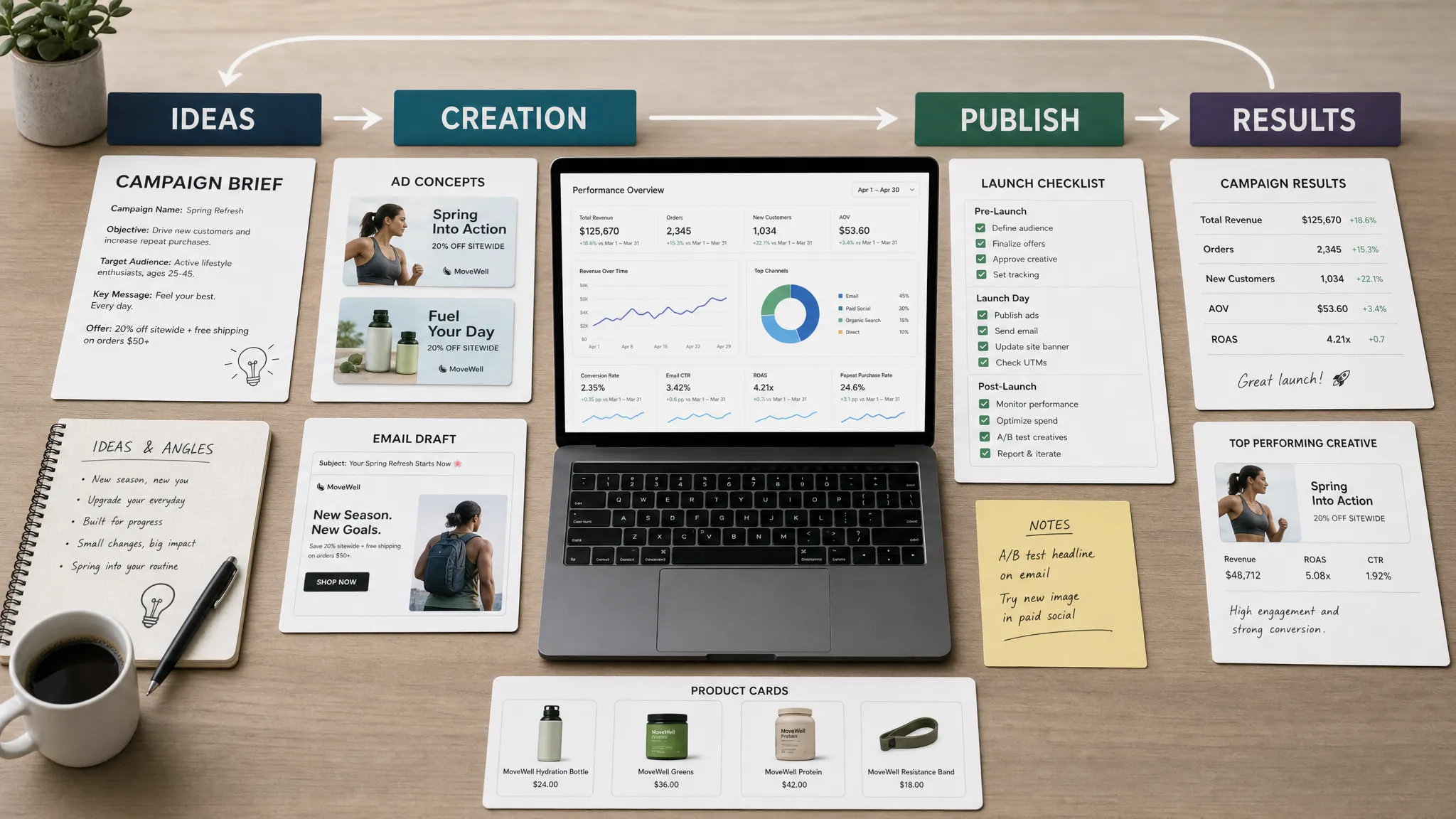
That is where Needle marketing comes in. Needle is built to help direct-to-consumer brands move from scattered marketing tasks to a connected growth workflow: generate ideas, create on-brand assets, publish campaigns, track performance, and use the learnings to improve the next round.
For DTC teams, the point is not just more content. The point is faster, more consistent execution tied to revenue.
What Needle marketing means for DTC brands
Needle is an AI-powered marketing platform for ecommerce brands. It helps teams create ads, emails, and videos without the bloat of a traditional agency model. Instead of giving you another blank AI prompt box, Needle connects to your existing tools, understands your brand and performance context, then helps produce and launch campaigns your team can approve.
In practice, Needle marketing means using AI to run the parts of marketing that slow lean teams down:
- Generating campaign ideas based on brand, product, and performance context.
- Creating on-brand creative assets for channels like paid social and email.
- Publishing approved campaigns directly to connected platforms.
- Automating repeatable marketing workflows.
- Tracking results and turning them into actionable learnings.
Put simply: Needle helps a lean team move from “we should run a campaign” to “this is live, measured, and improving” faster.
That matters because DTC marketing is no longer won by one perfect campaign. It is won by repeatable creative testing, sharper retention, faster learning loops, and fewer execution bottlenecks.
The DTC growth problem Needle is built to solve
A growing DTC brand usually has more marketing opportunities than team capacity. A skincare brand may need educational product ads, founder-led videos, replenishment emails, seasonal campaigns, and abandoned-cart improvements. A fashion brand may need weekly UGC tests, collection launches, VIP emails, retargeting, and post-purchase styling content.
The challenge is that every channel tends to create its own workflow. Meta ads live in Ads Manager. Email campaigns live in Klaviyo or another ESP. Product data lives in Shopify. Creative files live in design tools. Reporting lives in a spreadsheet. Strategy lives in someone’s head.
That fragmentation creates predictable problems. Campaigns take too long to launch. Creative refreshes happen after performance drops, not before. Founders approve isolated assets without seeing the bigger growth system. Reporting explains what happened, but rarely becomes next week’s action plan.
Needle is designed to close that gap. It brings campaign planning, creative production, publishing, measurement, and learning into one operating rhythm, so marketing becomes less reactive and more systematic.
How Needle marketing works
Needle’s workflow is easiest to understand as a loop. It starts with context, turns that context into campaigns, then uses real results to improve the next cycle.
1. Connect your marketing stack
Needle integrates with the tools your brand already uses. For many DTC brands, that means your ecommerce store, ad platforms, email systems, and creative workflow.
The goal is to give the platform enough context to understand what you sell, which audiences matter, what your brand sounds like, and which campaigns have performed in the past. Instead of creating generic AI content, Needle can work from actual marketing inputs: products, offers, creative history, customer behavior, and performance signals.
That context is the difference between AI that writes nice-sounding copy and AI that helps execute commercially useful marketing.
2. Generate data-backed campaign ideas
Once Needle has context, it can help generate marketing ideas that fit your brand and business goals. These ideas can come from patterns like best-selling products, underused customer segments, seasonal moments, past creative winners, funnel gaps, or retention opportunities.
For example, a DTC apparel brand might need a new-customer acquisition push around a best-selling category, while a supplement brand might need post-purchase education to increase repeat purchase rates. A generic AI tool might give both brands the same campaign template. Needle’s value is in using brand and performance context to make the ideas more relevant.
This is also where Needle helps teams prioritize. Not every idea deserves production. Strong DTC marketing starts with a clear goal, such as reducing cost per order, improving MER, increasing email revenue, or boosting repeat purchase rate.
3. Create on-brand assets
After campaign ideas are selected, Needle helps produce the creative assets needed to execute. That can include ad concepts, ad copy, email creative, campaign messaging, and video assets, depending on the workflow and channels in use.
The important part is brand consistency. DTC brands live and die by trust, and trust is built through repeated signals: tone, product positioning, offer clarity, visual identity, proof, and customer language. Needle helps scale creative production while keeping the brand from turning into a patchwork of freelancer styles.
Your team still keeps approval control. Needle is built around an approve-and-execute model, which means the founder or marketing lead can review the work before it goes live.
4. Publish campaigns directly
A major bottleneck in DTC marketing is the gap between approved creative and live campaigns. Assets get approved, but someone still has to resize files, upload copy, build campaigns, check links, coordinate timing, and confirm everything is published correctly.
Needle helps reduce those handoffs by publishing directly to connected platforms. That is especially useful for lean teams that want agency-level output without managing an agency-style process.
The result is faster execution. Instead of waiting days or weeks between idea, asset, and launch, the workflow becomes more continuous.
5. Track performance and create weekly learnings
The most useful marketing system is not the one that creates the most assets. It is the one that learns the fastest.
Needle tracks marketing results and turns them into actionable learnings. That might mean identifying which creative angle lowered acquisition costs, which email segment generated stronger revenue per recipient, or which product story deserves another round of testing.
This learning loop is what separates campaign automation from random content generation. Needle is not just helping you make more ads and emails. It is helping your team understand what to do next.
A weekly Needle workflow for DTC teams
Needle works best when it becomes part of a weekly growth rhythm. A simple cadence might look like this:
- Monday, review the truth: Look at revenue, orders, ad spend, MER, CPA, email performance, creative fatigue, and conversion trends.
- Tuesday, choose the next campaign opportunities: Use Needle to generate and prioritize campaign ideas based on the biggest growth lever that week.
- Wednesday, create assets: Produce ad, email, and video assets aligned to one goal, one audience, and one core message.
- Thursday, approve and publish: Review the work, make final edits, and push approved campaigns live.
- Friday, capture learnings: Track what changed, document winning angles, and feed those insights into the next cycle.
That rhythm is intentionally simple. DTC teams do not need more complexity. They need a repeatable system that makes high-quality marketing easier to ship every week.
Where Needle fits in the DTC funnel
Needle is most useful when it supports the full customer journey, not just one isolated channel.
Acquisition
For acquisition, Needle helps brands create and test the creative assets that drive paid social performance. This matters because platforms like Meta and Instagram have become increasingly creative-led. Targeting still matters, but the ad concept, hook, visual, proof, and offer often determine whether a campaign can scale.
Needle can help generate new angles, refresh stale ads, repurpose winning ideas, and create variations for testing. That gives DTC brands a more reliable creative pipeline instead of waiting until performance drops to scramble for new assets.
Conversion and storefront alignment
Needle can help keep campaign messaging consistent, but it cannot turn a broken storefront into a profitable machine by itself. If a brand needs a dedicated launch site, landing page system, or a faster no-code build before sending more paid traffic, a partner focused on high-converting Webflow and Framer websites can complement Needle’s campaign execution.
For DTC brands, this alignment matters. If an ad promises a specific benefit, the product page should reinforce that benefit. If an email promotes a bundle, the landing experience should make the bundle easy to understand and buy. Needle helps campaigns move faster, but the highest ROI comes when ads, emails, and site experience all tell the same story.
Retention
DTC profitability often improves when brands stop treating email as an afterthought. Needle can help create and optimize email campaigns that educate customers, recover carts, announce launches, promote evergreen offers, and increase repeat purchase behavior.
This is especially powerful because retention campaigns are usually less expensive than acquiring new customers. A brand that already has Shopify and email data can use that context to create more relevant messaging for different customer groups.
Learning and optimization
Needle also supports the reporting layer. Instead of looking at Meta, Shopify, and email metrics in isolation, teams can use results to decide what to create next.
That is where weekly optimization compounds. One winning ad hook can become an email subject line. A strong email theme can become a retargeting ad. A high-converting product proof point can become a product page section. Needle helps turn those insights into future execution.
Needle vs agencies, freelancers, and DIY AI tools
Needle sits between three common options: traditional agencies, freelancers, and standalone AI tools.
A traditional agency can bring strategy and channel expertise, but many DTC founders struggle with slow turnaround times, expensive retainers, and too many layers between insight and execution. By the time a new campaign goes live, the opportunity may already be fading.
Freelancers can be faster and more flexible, but the founder often becomes the project manager. You may need one person for copy, one for design, one for video, one for email, and another for paid media. The cost is not just the invoices. It is the coordination.
Standalone AI tools can create copy or images quickly, but they usually leave the hard parts to you: prompting, editing, organizing, uploading, publishing, measuring, and deciding what to do next.
Needle is designed for a different operating model. It helps generate the ideas, create the assets, publish the work, track results, and keep improving through a weekly learning loop. Your team approves. Needle executes.
Real DTC use cases
Needle’s value is clearest when you look at DTC brands that needed faster execution and better performance accountability.
For TWOOAK, a Singaporean premium contact lens brand, Needle helped consolidate fragmented Meta Ads and email systems into a more cohesive campaign structure. According to the TWOOAK case study, the brand cut cost per order by more than half and reached a peak MER of 41x while maintaining more than 10x during testing cycles.
For Road to Pro Tennis, the issue was time. The founder had been spending hours creating each email. With Needle, the workflow shifted toward a faster approval process and more evergreen email strategy. In the RTP Tennis case study, the brand achieved 12x ROI in the first month.
For Heliotrope SF, a clean skincare brand, Needle focused on email marketing and budget allocation. The Heliotrope case study reports 6x ROI on evergreen email campaigns and up to 17x ROI on seasonal promotions.
Those results are not magic AI outcomes. They come from reducing handoffs, connecting data to execution, improving creative consistency, and building a rhythm where every campaign teaches the next one.
Of course, every brand’s results depend on offer strength, margins, traffic quality, conversion rate, product-market fit, and budget. Needle works best when there is already a real business to optimize, not when marketing is expected to fix a weak product or unclear positioning.
What to prepare before using Needle
Needle can reduce marketing complexity, but the output is only as strong as the inputs. Before using any AI-powered marketing system, DTC brands should prepare a few basics.
- Access to your core tools: Needle works best when it can connect to the systems where your marketing already runs.
- A clear business goal: Pick a primary KPI, such as MER, CPA, cost per order, email revenue, repeat purchase rate, or revenue per recipient.
- Brand rules: Document your voice, visual style, customer promises, product claims, compliance limits, and examples of past work you like.
- Unit economics: Know your margins, AOV, break-even points, and acceptable acquisition costs before scaling campaigns.
- A decision owner: Assign one person to approve campaigns quickly, so the workflow does not stall.
These inputs help Needle generate campaigns that are not just polished, but commercially useful.
What Needle marketing is not
Needle is not a magic traffic button. It will not replace the need for a compelling product, a clear offer, or a storefront that converts.
It is also not an approval-free robot. DTC brands still need human judgment for positioning, compliance, taste, customer empathy, and final decisions. AI can accelerate production, but the best results come when the brand provides clear strategy and fast feedback.
Finally, Needle is not just a content generator. The value is in the full loop: strategy, creative, publishing, measurement, and learning. If you only need one-off copy ideas, a basic AI writing tool may be enough. If you need a repeatable marketing execution system, Needle is built for that broader job.
Frequently Asked Questions
What is Needle marketing? Needle marketing is the use of Needle’s AI-powered platform to plan, create, publish, measure, and optimize marketing campaigns for ecommerce and DTC brands. It focuses on turning brand and performance data into faster campaign execution.
How is Needle different from a basic AI ad generator? A basic AI ad generator usually creates assets, but leaves you to manage strategy, publishing, reporting, and iteration. Needle is designed as a connected workflow that helps generate ideas, create assets, publish campaigns, track results, and improve future marketing based on learnings.
Does Needle replace a marketing agency? For many DTC brands, Needle can replace parts of the agency workflow by reducing manual production, coordination, and reporting. Some brands may still use specialists for areas like brand strategy, web development, PR, or complex creative production.
What types of DTC brands benefit most from Needle? Needle is a strong fit for ecommerce brands that already have products, customers, and marketing data, but need faster campaign output and clearer optimization. It is especially useful for lean teams that want to reduce reliance on freelancers or slow agency processes.
How fast can Needle improve performance? Speed to impact depends on your current marketing setup, data quality, offer, creative backlog, and approval process. Many brands can improve execution speed quickly, while performance gains usually require testing, measurement, and iteration over multiple cycles.
Can Needle work with existing marketing tools? Yes. Needle is designed to integrate with existing tools, so brands can use their current ecommerce, ad, email, and reporting systems instead of rebuilding the entire stack from scratch.
Turn your next campaign into a repeatable growth loop
DTC marketing rewards teams that learn and ship faster. Needle helps turn your marketing from a backlog of ideas into a weekly system for creating, launching, measuring, and improving campaigns.
If your team is tired of juggling freelancers, waiting on agency timelines, or operating too many disconnected AI tools, Needle gives you a more efficient way to scale.