
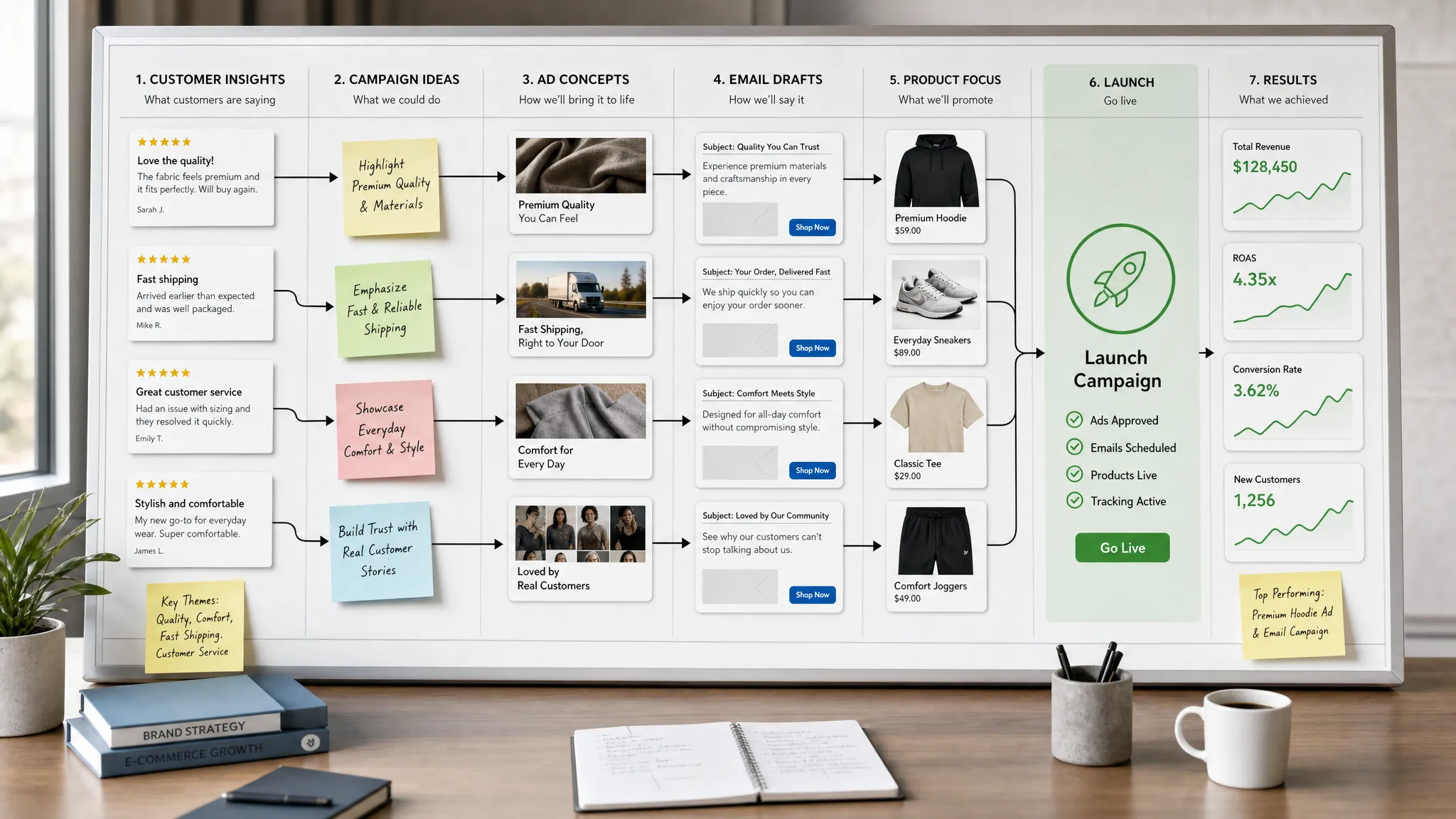
For ecommerce teams, marketing AI is no longer a novelty. The useful question is not whether AI can write a caption or generate a product image. It is whether it can help you create better campaigns, launch faster, learn from performance, and turn those learnings into more profitable growth.
That distinction matters. A generic AI tool can produce endless copy. A growth-focused marketing AI system should help you answer sharper questions:
- Which products deserve more promotion this week?
- Which customer segments are most likely to buy again?
- Which ad angles should be tested next?
- Which emails should be automated instead of manually rebuilt?
- Which campaigns are actually improving profit, not just platform-reported ROAS?
For ecom brands, the best use of marketing AI is not replacing judgment. It is compressing the time between data, strategy, creative, launch, and optimization.
What marketing AI means for ecommerce
Marketing AI is software that uses your business data, customer behavior, brand inputs, and performance history to help plan, create, execute, and improve marketing.
In ecommerce, that usually means connecting AI to the places where growth data already lives: Shopify, email/SMS platforms, Meta, Google, TikTok, analytics tools, reviews, customer support logs, and creative libraries.
Once connected, AI can support the four growth levers that matter most:
- Acquisition: Creating and testing ad angles, audience ideas, UGC scripts, and campaign variants.
- Conversion: Improving landing pages, product pages, offers, checkout messaging, and abandoned cart recovery.
- Retention: Segmenting customers, personalizing email/SMS, and building win-back or post-purchase campaigns.
- Measurement: Summarizing results, spotting patterns, and turning weekly data into actions.
The key is context. AI that does not understand your products, margins, audience, offer, seasonality, and brand voice will produce generic output. AI that works from real ecommerce inputs can become a practical growth engine.
If you are new to the workflow, this guide on how to build an AI marketing campaign in five steps is a useful companion.
The foundation: give AI better inputs
Most ecommerce teams get weak AI outputs because they treat AI like a blank text box. They ask for ad ideas without providing customer objections. They ask for email copy without sharing purchase behavior. They ask for campaign strategy without sharing margins, best sellers, or inventory constraints.
Before using marketing AI for growth, collect the inputs that shape good decisions:
- Best-selling products, high-margin products, and slow-moving inventory.
- Customer reviews, support tickets, objections, and refund reasons.
- Past campaign performance by angle, format, product, and channel.
- Email and SMS segments, including VIPs, one-time buyers, and inactive customers.
- Brand guidelines, approved claims, visual rules, and tone of voice.
- Seasonal moments, launch dates, shipping cutoffs, and promotion rules.
This does not need to become a six-month data project. Start with the sources you already trust. For many ecommerce brands, Shopify order data, Klaviyo campaign results, Meta ad performance, customer reviews, and a simple brand guide are enough to improve AI output dramatically.
Practical use 1: finding campaign ideas from real customer behavior
The fastest win for marketing AI is campaign ideation. Not random brainstorming, but idea generation based on what customers already do and say.
For example, AI can analyze reviews and support tickets to surface recurring purchase drivers:
- Customers buy the product because it saves time.
- New buyers hesitate because they do not understand sizing.
- Repeat buyers mention gifting.
- High-AOV customers often buy bundles.
- Refund requests often mention a misunderstood product feature.
Those insights become campaign angles. A skincare brand might turn review language into an ingredient education campaign. A pet brand might build a bundle campaign around multi-pet households. A fashion brand might use sizing objections to create try-on videos, fit guides, and retargeting emails.
The practical workflow is simple: feed AI customer language, ask it to group the themes, then turn each theme into a campaign hypothesis. The output should not be a final campaign yet. It should be an angle bank your team can prioritize.
A strong campaign hypothesis sounds like this: If we educate first-time visitors on fit and sizing before asking them to buy, then product page conversion rate should improve because the main purchase objection is uncertainty.
That is far more useful than: Write 10 ads for our leggings.
Practical use 2: scaling ad creative without losing strategy
AI is especially useful for creative volume. Ecommerce ads burn out quickly, especially on Meta and TikTok. The teams that win usually test more angles, hooks, visuals, and proof points than their competitors.
But more creative is not automatically better. AI-generated ads work best when they are built from a clear testing structure.
Instead of asking AI for 50 random ads, define the variables you want to test:
- Hook: problem, benefit, social proof, comparison, founder POV, or demo.
- Offer: bundle, free shipping, limited drop, quiz result, first-order incentive, or VIP access.
- Format: static image, carousel, vertical video, UGC script, GIF, or product demo.
- Audience stage: cold prospecting, warm retargeting, cart abandoner, or past customer.
- Proof: reviews, press, before-and-after, usage stats, creator testimonial, or founder story.
AI can then generate structured variants that isolate a specific learning. For instance, if you are testing whether problem-led hooks outperform benefit-led hooks, everything else should stay similar. That gives you a cleaner read on what actually moved CTR, CPA, or ROAS.
This is also where brand guardrails matter. AI should know which claims are approved, which phrases are off-brand, which visual styles are acceptable, and which products should be pushed. If you need a deeper workflow, Needle’s guide to making on-brand AI creative breaks down how to move from brief to ad variants faster.
Practical use 3: personalizing email and SMS campaigns
Email is one of the most practical places to use marketing AI because the channel already has rich first-party data. You know who subscribed, what they viewed, what they bought, how much they spent, and when they last engaged.
AI can help turn that data into more relevant campaigns. Instead of sending one generic promotion to everyone, you can create versions for different segments:
- First-time buyers who need education and trust-building.
- VIP customers who respond to early access and exclusivity.
- One-time buyers who need replenishment reminders or cross-sells.
- At-risk customers who have not purchased in months.
- Product-specific buyers who should receive usage tips, accessories, or bundles.
The goal is not to make every email feel artificially personalized. The goal is to make each message more relevant to the customer’s stage.
For example, a customer who bought running socks should not receive the same next email as someone who bought a winter jacket. AI can help draft segment-specific angles, recommend product pairings, write subject line tests, and summarize which segments generated the most revenue per recipient.
The highest-value email use cases are usually evergreen flows: welcome series, abandoned cart, post-purchase, replenishment, win-back, and VIP campaigns. Once built, these can keep generating revenue while your team focuses on new campaigns.
Practical use 4: improving product pages and landing pages
Marketing AI is not only for ads and emails. It can also help improve the pages where traffic converts or drops off.
Product pages are full of small conversion opportunities. AI can analyze reviews, competitor positioning, FAQs, and customer objections to suggest better copy and structure. It can help rewrite product descriptions around benefits instead of features, create comparison sections, generate FAQ answers, and align landing page copy with the ad that sent the visitor there.
This is especially useful when an ad gets strong clicks but weak purchases. The issue may not be the ad. It may be a mismatch between the promise in the creative and the proof on the product page.
A practical AI-assisted CRO workflow looks like this:
- Identify one page with high traffic and low conversion.
- Collect the ad angle, product reviews, FAQs, and checkout objections.
- Ask AI to find gaps between what the ad promises and what the page proves.
- Generate improved headline, benefit, proof, FAQ, and CTA options.
- Test the changes and measure conversion rate, revenue per visitor, and contribution profit.
This works best when you make focused changes. Do not rewrite your entire site at once. Pick one page, one hypothesis, and one metric.
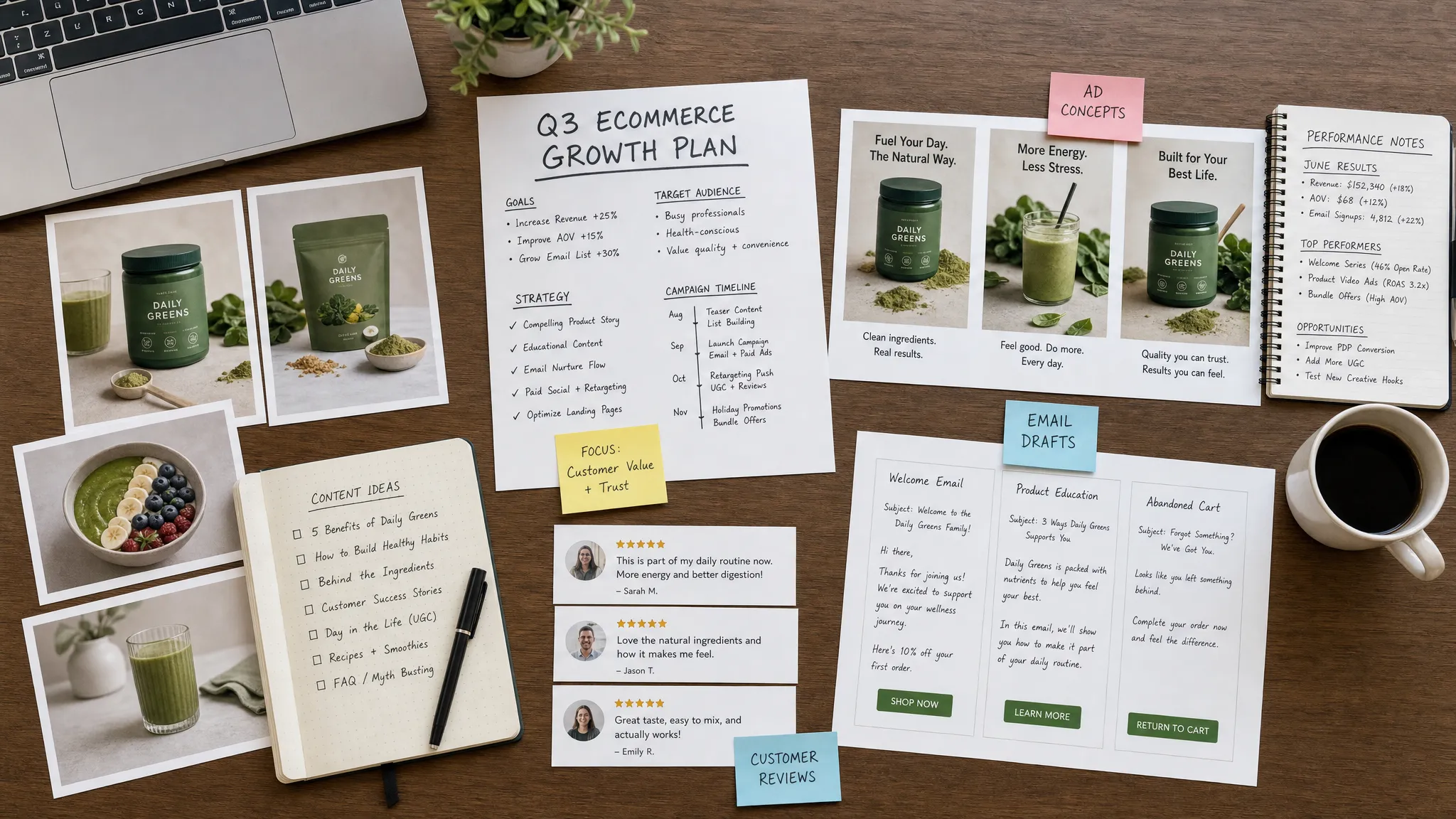
Practical use 5: turning weekly reporting into decisions
Many ecommerce teams already have reporting. The problem is that reporting often stops at screenshots and dashboard summaries.
Marketing AI can help translate performance data into next actions. Instead of manually reviewing Shopify, Meta, Klaviyo, and GA4 every Monday, AI can summarize what changed and recommend what to do next.
Good AI reporting should answer:
- What changed this week versus last week?
- Which channels drove incremental growth?
- Which products or collections are gaining momentum?
- Which campaigns spent money without producing profitable outcomes?
- Which creative angles are fatiguing?
- Which customer segments deserve a campaign next week?
This is where ecommerce teams should avoid relying only on platform-reported ROAS. A Meta campaign can look strong while overall profitability is flat. An email campaign can look small in revenue but drive repeat purchases from high-LTV customers. A discount-heavy campaign can boost conversion rate while hurting contribution margin.
Use AI to speed up analysis, but judge the business on metrics that connect to profit: MER, CAC, LTV:CAC, contribution margin, conversion rate, AOV, revenue per recipient, and repeat purchase rate.
If measurement is the current bottleneck, this guide on how to prove marketing results with the right metrics gives a stronger KPI framework.
Practical use 6: building a faster campaign operating system
The biggest advantage of marketing AI is not one isolated task. It is the ability to connect the full campaign workflow.
A traditional ecommerce campaign might involve separate steps across spreadsheets, docs, creative tools, email platforms, ad accounts, approval threads, and reporting dashboards. That creates delay. By the time the campaign launches, the opportunity may already be gone.
A stronger AI workflow connects the steps:
- Spot an opportunity in data.
- Generate campaign ideas and prioritize one.
- Produce ad, email, and landing page assets.
- Route assets for founder or marketing lead approval.
- Publish to the right platforms.
- Track results and summarize learnings.
- Feed those learnings into next week’s campaign.
This is the operating model Needle is built around. Needle connects with existing tools, generates tailored marketing ideas, creates on-brand creative assets, publishes content directly, automates campaign workflows, tracks results, and turns performance into actionable learnings for continuous weekly optimization.
For lean ecommerce teams, the benefit is moving from operator mode to approval mode. Instead of stitching together freelancers, single-purpose tools, and manual handoffs, you get a more connected process for campaign creation and optimization.
Practical use 7: combining AI speed with category expertise
AI is powerful, but it is not a substitute for category judgment. A supplement brand, apparel brand, beauty brand, and sports brand may all use similar channels, but the buyer psychology, compliance concerns, creator strategy, proof points, and purchase cycles can be very different.
That is why some brands pair AI execution with specialized expertise. For example, sports, fitness, and wellness ecommerce brands may benefit from working with partners that understand performance marketing and category-specific growth, such as OPTYO’s sports marketing agency, especially when brand positioning, creative strategy, and conversion goals need to work together.
The broader lesson: use AI to accelerate the repeatable work, but keep humans involved where judgment matters. Positioning, customer empathy, offer strategy, creative taste, compliance review, and final approvals should not be fully automated.
A 30-day rollout plan for ecommerce teams
If you try to apply AI everywhere at once, you will likely create noise. Start with one growth bottleneck and build from there.
Days 1 to 7: choose one revenue problem
Pick a specific problem, not a vague goal. Good starting points include high CAC, weak abandoned cart recovery, low product page conversion, poor email revenue, ad creative fatigue, or slow campaign production.
Define one KPI before you begin. For example: reduce blended CAC by 10%, increase revenue per recipient, improve add-to-cart rate, or launch five new ad angles per week.
Days 8 to 14: connect the right inputs
Bring together the minimum data needed for that problem. If the issue is ad fatigue, gather your best and worst ads, spend, CTR, CPA, product focus, hooks, and creative formats. If the issue is email revenue, gather segment data, past campaigns, flow performance, and product purchase history.
Also add your brand guardrails. AI needs to know what not to say, not just what to create.
Days 15 to 21: create and launch a controlled test
Use AI to generate several options, then choose a small number to launch. The goal is not maximum volume yet. The goal is a clean learning.
For ads, test one variable at a time. For email, test one segment or flow improvement. For CRO, test one page and one hypothesis. Keep the scope tight enough that you can interpret the results.
Days 22 to 30: review and systematize
After the test, use AI to summarize results and identify patterns. Which hook worked? Which segment responded? Which offer improved revenue without damaging margin? Which creative format deserves more investment?
Then document the learning and turn it into a repeatable rule. That is where AI compounds. Each week should make the next campaign smarter.
Common mistakes to avoid
The most common mistake is using AI as a content volume machine. More assets do not matter if they are disconnected from strategy, data, or measurement.
Another mistake is letting AI make decisions without business constraints. AI may recommend pushing a product that is low-margin, out of stock, hard to fulfill, or strategically unimportant. Always give it commercial context.
Teams also struggle when they use too many disconnected AI tools. One tool writes copy, another generates images, another summarizes data, and another schedules posts. That can help temporarily, but it often creates more coordination work. For ecommerce growth, connected workflows usually beat scattered tools.
Finally, do not remove human approval. AI should accelerate production and analysis, but founders and marketers still need to protect the brand, challenge assumptions, and decide what is worth launching.
Frequently Asked Questions
What is marketing AI in ecommerce? Marketing AI in ecommerce refers to AI systems that help online stores plan campaigns, create assets, personalize messages, automate workflows, and analyze performance using customer, product, and channel data.
What is the best first use case for marketing AI? The best first use case is the bottleneck closest to revenue. For many ecommerce brands, that means ad creative testing, abandoned cart emails, product page optimization, or weekly performance reporting.
Can marketing AI replace a marketing team? No. AI can reduce repetitive work and speed up execution, but human judgment is still needed for positioning, brand voice, creative taste, offer strategy, compliance, and final approvals.
How much data do ecommerce brands need before using AI? You do not need enterprise-level data. Shopify orders, product performance, email results, ad performance, customer reviews, and brand guidelines are enough to start generating better campaign ideas and assets.
How should ecommerce teams measure AI marketing success? Measure business outcomes, not content output. Useful metrics include CAC, MER, conversion rate, revenue per recipient, AOV, LTV:CAC, repeat purchase rate, and contribution profit.
Turn marketing AI into a weekly growth engine
Marketing AI works best when it is connected to execution. Ideas are useful, but growth comes from launching, measuring, learning, and improving every week.
Needle helps ecommerce brands move faster by generating marketing ideas, creating on-brand ads, emails, and videos, publishing directly to platforms, automating campaign workflows, tracking results, and turning performance into actionable learnings.
If your team is tired of juggling freelancers, disconnected tools, and slow campaign cycles, explore how Needle can help you scale marketing execution with AI while keeping you in control of approvals.