
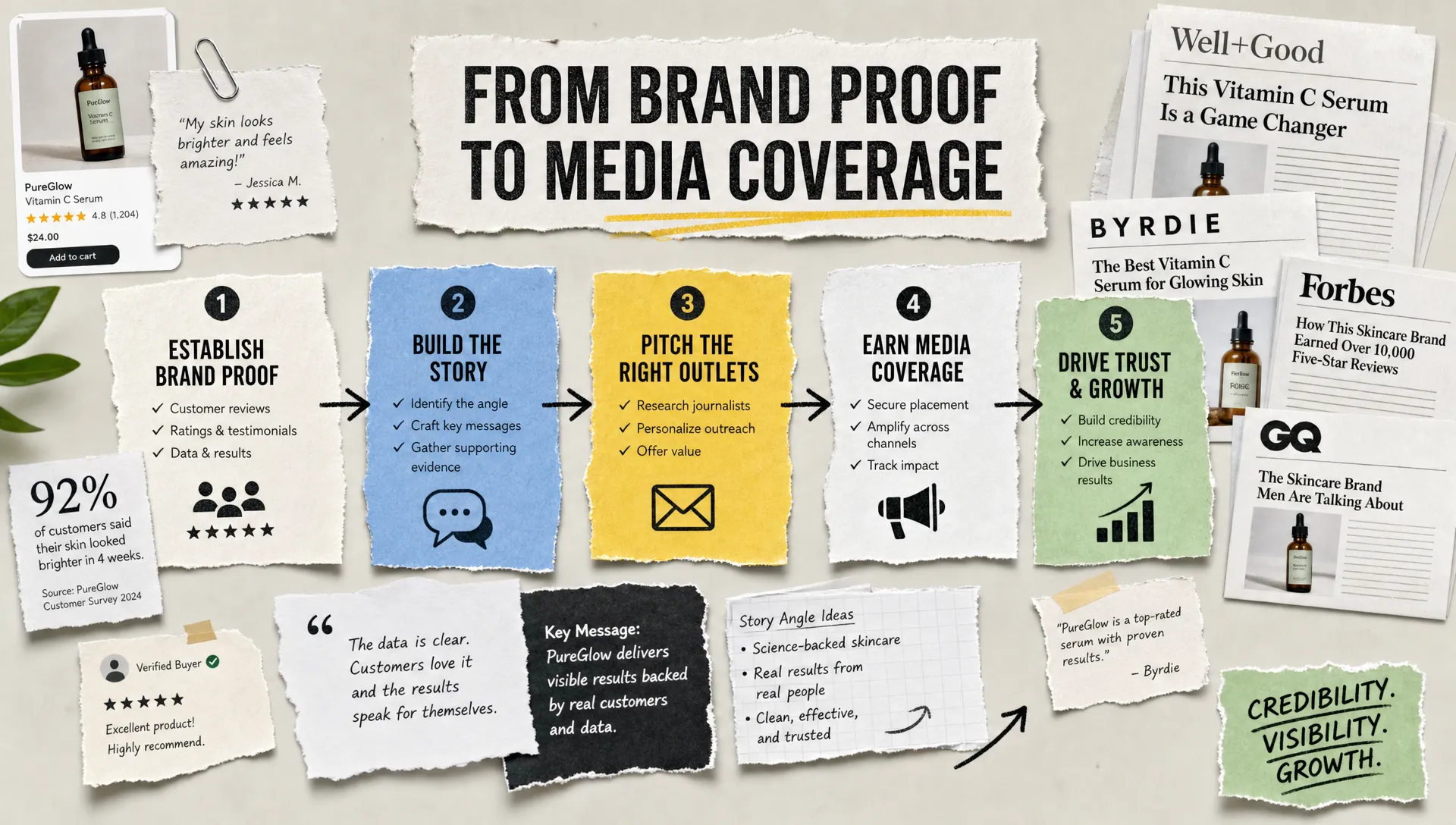
DTC brands are built for speed, but attention is getting harder to win with paid media alone. When acquisition costs rise and social feeds blur together, public relations gives customers a reason to care before they see the discount code.
The best public relations ideas for DTC brands are not vague awareness plays. They create a story that journalists, creators, customers and category insiders can repeat. That story might come from your origin, your product data, your customers, your supply chain, your founder or a timely cultural shift.
Below are nine practical PR ideas designed for ecommerce teams that need attention without building a bloated agency process.
| PR idea | Best for | What it can become |
|---|---|---|
| Customer proof newsroom | Brands with strong reviews or UGC | Press angles, landing pages, ads, emails |
| Founder point of view | Founder-led brands | Interviews, LinkedIn posts, podcasts |
| Data story | Brands with customer insights | Reports, pitches, infographics |
| Category myth busting | Products that solve misunderstood problems | Expert commentary, SEO content, short videos |
| Supply chain transparency | Apparel, beauty, food, home goods | Trust content, trade press, brand story |
| Community challenge | Lifestyle and wellness brands | Social participation, creator coverage |
| Local market activation | Brands with regional concentration | Local press, events, retail momentum |
| Partnership with a credible insider | Newer brands seeking trust | Co-created content, PR angles, campaigns |
| Launch story with proof | Product launches | Press outreach, waitlists, email campaigns |
1. Build a customer proof newsroom
Most DTC brands sit on more proof than they use. Reviews, support tickets, repeat purchase behavior, before-and-after photos, customer interviews and UGC all contain PR material. The issue is that this proof usually gets scattered across tools and only resurfaces when someone needs a testimonial for an ad.
A customer proof newsroom turns those fragments into a living source of story ideas. Instead of pitching “we launched a better product,” you can pitch “customers are replacing three products with one,” “parents are buying this for college move-ins” or “runners are changing their recovery routine after injury.”
Start by tagging customer proof by theme, not just rating. Look for repeated phrases customers use when describing the problem, the moment they decided to buy and what changed after using the product. Those patterns can become PR hooks because they are grounded in real behavior.
This also helps your paid and owned channels. A strong PR angle can become ad creative, email copy and landing page messaging. If you need more ways to convert those angles into paid campaigns, Needle’s guide to advertisement ideas that make DTC brands stand out pairs well with this approach.
2. Turn the founder’s sharpest opinion into a media angle
Journalists rarely want a generic founder profile. They want a point of view that explains a shift in the market. For DTC brands, the founder’s opinion can be a valuable PR asset if it is specific, slightly contrarian and backed by real experience.
A bland quote sounds like this: “We believe customers deserve better quality.” A stronger angle sounds like this: “The problem with premium skincare is not price, it is that customers are being asked to buy five steps when two would do.”
The second version gives media, podcast hosts and newsletter writers something to respond to. It also positions the founder as a commentator on the category rather than just another operator trying to sell a product.
Good founder PR angles often come from questions like these:
- What is the category getting wrong that customers already know?
- What assumption did you reject when building the product?
- What behavior are you seeing before larger brands notice it?
- What would you warn customers about if you were not allowed to mention your brand?
This works especially well for DTC brands in crowded categories like supplements, apparel, baby products, home goods, pet care and beauty. A founder with a clear thesis becomes easier to quote, invite and remember.
3. Publish a small data story from your own customer behavior
You do not need a national survey to create a data-driven PR story. A focused insight from your own customer base can be enough if it reveals a timely behavior.
For example, a meal brand might analyze which products spike during back-to-school season. A home brand might identify the fastest-growing colors or materials by region. A fitness brand might compare buying patterns between New Year resolution shoppers and spring event shoppers.
The key is to make the insight useful beyond your own sales team. “Our best-selling product grew 40 percent” is not a PR story. “Customers are buying recovery products earlier in marathon training season than last year” has a better chance because it points to a broader behavioral shift.
Keep the format simple. Create a short report, a few charts and three plain-language takeaways. Then pitch the story to niche newsletters, trade publications, local business media and creators who cover your category. The report can also be repurposed into blog content, email campaigns and founder social posts.
4. Bust a category myth customers keep believing
Every DTC category has myths that confuse buyers. PR can help you correct those myths in a way that builds trust.
A cookware brand might challenge the idea that heavier always means better. A haircare brand might explain why more foam does not mean a deeper clean. A sleep brand might unpack why thread count alone is a weak way to judge sheets. A fitness apparel brand might explain why fabric construction matters more than trend-driven silhouettes.
This PR idea works because it is educational, useful and easy for others to cite. It also avoids sounding like a sales pitch. You are helping customers make a better decision, with your product sitting naturally inside that worldview.
A strong myth-busting PR campaign includes one clear claim, one simple explanation and one practical takeaway. Do not try to correct every misconception at once. The tighter the idea, the easier it is to pitch and repeat.
5. Make your supply chain part of the story
Many DTC brands talk about quality, but fewer show how quality is created. For categories where materials, sourcing, production or craftsmanship matter, supply chain transparency can become a strong PR angle.
This is especially relevant for apparel, sportswear, home goods, personal care and food brands. Customers want to know what makes a product different before they pay a premium. Media and creators also respond well to behind-the-scenes stories because they offer concrete details instead of abstract brand claims.
You could show how a material was chosen, why a product took longer to develop, how sampling changed the final design or what tradeoffs your team refused to make. For activewear or teamwear brands, for instance, discussing cut-and-sew development, low minimum order quantities or private-label production can help explain how emerging brands get products made. A partner like a custom sportswear manufacturer can be part of that story when manufacturing quality, customization and production flexibility are relevant to the brand narrative.
The goal is not to overwhelm customers with factory language. The goal is to translate production choices into buyer value: better fit, stronger seams, cleaner ingredients, less waste, faster iteration or more consistent quality.

6. Create a community challenge with a visible outcome
A community challenge gives people a reason to participate in your story rather than passively read about it. The best version is tied to the product’s use case and produces a visible result.
A hydration brand could run a seven-day morning routine challenge. A pet brand could organize a local shelter donation drive tied to customer orders. A running apparel brand could invite customers to log miles for a community goal. A home organization brand could host a weekend reset challenge with customer before-and-after submissions.
For PR, the visible outcome matters. “We hosted a challenge” is weak. “Customers completed 18,000 minutes of movement in one week” or “500 closets were cleared out for local donation partners” is much stronger, if those numbers are real and verifiable.
A community campaign also gives you content across channels. Customer submissions can become social proof, email stories, short videos and creator briefs. If you plan to turn one campaign into multiple assets, Needle’s guide to content repurposing strategies for DTC brands can help you stretch the PR moment beyond the initial spike.
7. Win a local market before chasing national press
National press is attractive, but local relevance often converts better for DTC brands that have a strong customer concentration in a city, state or region. Local media also tends to care about founder stories, hiring, retail pop-ups, community partnerships and regional trends.
Look at your order data and identify where demand is already clustered. If a skincare brand has surprising traction in Austin, a pet brand over-indexes in Denver or a home brand is gaining customers in Charleston, that location can become a PR beachhead.
A local PR angle might include a pop-up, a collaboration with a local business, a donation program, a founder return-to-hometown story or a city-specific product bundle. The story becomes more credible when it connects to existing customer behavior rather than forcing a market because it sounds trendy.
Local PR can also support retail conversations. If you can show demand, press mentions and community activity in a region, you have a stronger story for boutiques, specialty retailers and wholesale partners.
8. Partner with a credible insider, not just a large influencer
Influencer marketing and PR overlap, but they are not the same. For PR, credibility often matters more than reach. A credible insider might be a dermatologist, stylist, dietitian, coach, interior designer, parent educator, chef, athlete or category specialist.
The right partner helps translate your product into a trusted context. Instead of paying for a quick post, build a campaign around their expertise. Co-author a guide, host a live Q&A, publish a trend forecast or ask them to audit common customer mistakes in your category.
This type of partnership gives you a stronger PR pitch because the story is not only “brand partners with creator.” It becomes “expert explains what consumers misunderstand about X” or “brand and specialist create a practical guide for Y.”
Be clear about disclosures when compensation or product gifting is involved. Trust is the asset you are building, so the campaign should be easy for customers to understand.
9. Package your launch around proof, not novelty
Many DTC launches fail to earn attention because the story begins and ends with “new product available now.” Novelty alone is rarely enough unless the brand already has a large audience.
A better launch PR story includes proof. That proof might come from a waitlist, customer testing, a founder problem, expert feedback, an unusual material choice, a seasonal behavior or a community request. If you can explain why the product exists and why now is the right moment, your launch becomes easier to pitch.
For example, instead of “we launched a travel bag,” the story could be “after interviewing 200 parents traveling with toddlers, the brand designed a carry-on that separates snacks, wipes and electronics without extra packing cubes.” The second version gives press and customers a real reason to pay attention.
Launch PR should also connect with your owned channels. A press mention can drive traffic, but email, landing pages and retargeting turn that attention into revenue. If you are planning a release soon, Needle’s guide to promotional campaign ideas for your next launch can help you build the campaign around the PR moment.
How to choose the right PR idea for your brand
The right PR idea depends on what your brand can prove. Do not start with what sounds impressive. Start with what is true, specific and useful to the audience you want to reach.
Use this quick filter:
| If your strongest asset is... | Choose this PR direction |
|---|---|
| Customer reviews and UGC | Customer proof newsroom |
| A founder with a strong thesis | Founder point of view |
| Interesting purchase or behavior patterns | Data story |
| A misunderstood category | Myth-busting campaign |
| Materials, production or sourcing | Supply chain transparency |
| A loyal customer base | Community challenge |
| Regional sales concentration | Local market activation |
| Access to trusted specialists | Insider partnership |
| A new product with a real reason to exist | Proof-led launch story |
Once you choose the idea, define the one sentence you want others to repeat. That sentence should be clear enough for a journalist to use, a creator to explain and a customer to remember.
Make PR work harder after the mention
PR should not live in a screenshot folder. For DTC brands, every earned media moment should become fuel for the rest of the marketing system.
A single PR win can support:
- Paid social creative that opens with third-party validation
- Email subject lines and newsletters built around the story
- Landing page modules that feature press quotes or proof points
- Founder social posts that expand on the angle
- Retail sell-in decks that show market credibility
This is where many lean teams struggle. The PR idea is only the start. The real value comes from turning that idea into creative assets, campaign workflows and learnings that improve the next campaign.
Needle is built for DTC teams that want to move faster without adding agency bloat. It helps generate tailored marketing ideas, create on-brand assets, publish content directly, track results and turn learnings into weekly optimization.
Frequently Asked Questions
What makes a good public relations idea for a DTC brand? A good PR idea is specific, credible and easy to repeat. It should connect your brand to a customer behavior, cultural shift, founder insight, product proof or category problem that people already care about.
Do DTC brands need a PR agency to get attention? Not always. Agencies can help with relationships and pitching, but many DTC brands can start by building stronger stories from customer proof, founder expertise, product development and community activity.
How is PR different from advertising for ecommerce brands? Advertising buys attention through paid placements. PR earns attention through stories that media, creators, customers or communities choose to share. The best DTC teams use both together.
How often should a DTC brand run PR campaigns? A lean brand can start with one strong PR push per quarter, then support it with ongoing founder commentary, customer stories, product education and community content.
Turn PR attention into campaigns customers actually see
A strong PR idea can earn attention, but attention fades if your team does not turn it into content, ads, emails and follow-up campaigns.
With Needle, DTC brands can move from idea to execution faster. Generate marketing angles, create on-brand assets, publish directly to your platforms, track results and keep improving every week without piling on more freelancers or agency overhead.