
Let’s get one thing straight. Content marketing automation isn’t about replacing your creative team. It’s about getting repetitive tasks off your plate so you can focus on strategy. Think of it as a system that clears the path for your best ideas to get to market, fast.
So, What Is Content Marketing Automation, Really?

If you're a founder, you know the grind. You constantly juggle a dozen tabs. Shopify for sales data. Klaviyo for email engagement. Meta Ads for performance metrics. You’re trying to stitch it all together into a coherent campaign. The whole process is manual, fragmented, and exhausting.
Content marketing automation fixes that. It’s not about creating soulless, robotic content. It’s about connecting scattered data sources into one smart process. When your sales data, email clicks, and ad metrics talk to each other, the system can do the heavy lifting for you.
You get your time back. You get to focus on your brand, not busywork.
From Manual Chaos to Automated Clarity
Think about your current workflow. You poke around in Shopify to see what’s selling. You jump over to Klaviyo to find your best emails. You bounce to Meta Ads Manager to see which creatives are working. Then you mash it all into a spreadsheet to create a campaign idea.
Sound familiar? This manual process is the bottleneck for most DTC brands. It’s slow, it’s prone to human error, and it stops you from acting on what’s working right now.
Automation turns this multi-tab mess into a focused operation. Instead of you hunting for ideas, the system brings them to you. It analyzes performance data across your tools and points you toward what to create next.
This means you can:
Stop guessing: Your content calendar gets filled with ideas backed by sales and engagement data.
Move faster: First drafts of emails, ad copy, and social posts are generated for your team to refine.
Stay on brand: Your team shifts from tedious execution to strategic review and creative polishing.
“Automation is not about being lazy,” says marketing expert Ann Handley. “It’s about being smarter, more strategic, and more efficient.” This gets to the heart of it: this is about reclaiming your most valuable asset—time.
The Real Value for a Founder
The biggest win isn't just speed. It's about building a predictable marketing engine. When your content creation is tied to performance data, you build a powerful feedback loop. You launch, you learn, and you immediately apply those learnings to the next campaign.
This is different from general marketing automation for ecommerce, which usually focuses on the customer’s journey. Content marketing automation zooms in on the production side—the lifecycle of the content itself.
A good system handles the logistics for you:
Planning and ideation based on hard data.
Creation workflows with AI-assisted first drafts.
Distribution to the right channels at the right time.
Analysis of what worked, what didn't, and why.
For a founder tired of being the bottleneck, this is freedom. You graduate from being the primary doer to the strategic approver. You can finally spend your energy on the big picture while the system handles the day-to-day grind.
Uncovering the True Cost of Manual Content Marketing
What does manual content marketing really cost your DTC brand? It's not just your Canva subscription. The real cost is your time, your team's sanity, and the sales you leave on the table.
Think about a typical manual campaign launch. It’s hours staring at spreadsheets, trying to guess what might work. You brief a freelancer. You wait two weeks for a handful of assets. You spend an afternoon manually uploading everything. This cycle leads to burnout and inconsistent results.
This isn’t just a process problem; it's a cash problem. It’s the lost revenue from an abandoned cart email that never got built. It’s the winning ad creative you couldn't scale because your production pipeline is a mess. Your marketing output is capped by the number of hours you can work.
The Hidden Financial Drain
The invisible costs are what really kill your momentum. Let's get specific about the hours spent on tasks a system should handle.
Brainstorming and Research: Manually pulling data from Shopify, Meta, and Klaviyo. (5-10 hours/month)
Creative Production: The endless loop of briefing, managing, and chasing freelancers. (10-20 hours/month)
Campaign Setup: The soul-crushing work of uploading assets and copy into each tool. (5-10 hours/month)
That’s easily a full workweek, every month, spent on repetitive work. This is time you’re not spending on brand strategy or building a better product. The rise of content marketing automation is a direct response to this exact pain. You can see how to fix this broken creative loop with better content creation services.
The global marketing automation market hit $5.78 billion in 2023 and is projected to reach $15.3 billion by 2030, according to Next Move Strategy Consulting. For DTC founders, this isn't a trend. It’s a fundamental shift away from manual chaos.
More Than Just Time and Money
The true cost goes beyond your P&L. It hits your brand’s potential and crushes team morale. When you’re buried in the weeds, you create a system that can’t scale beyond you.
For brands heavy on visuals, the cost is even higher. Innovations like automatic 3D modeling are already slashing the time and expense of creating product visuals.
This constant juggling leads to massive missed opportunities. Winners in DTC are masters of multi-channel marketing. Simple automated workflows like abandoned cart sequences can generate up to 30x more revenue per person than a standard email blast, according to Klaviyo. Every day you stick with the manual process, you’re leaving that money on the table. It's time for a new way of working.
How Automation Works for a Real DTC Brand
Let's get out of the clouds and into reality. Here’s what a week looks like for a DTC founder who put automation first.
It’s Monday morning. You grab your coffee and open a single browser tab. That’s it.
You’re looking at a content calendar, but it’s already filled with fresh campaign ideas. These aren't random guesses spit out by a generic AI. They’re specific, data-backed suggestions pulled from your own store.
The system has already analyzed your Shopify sales data, looked at your top Meta ads, and checked your most profitable Klaviyo flows. It knows what's working right now and suggests new campaigns to double down on those wins.
This is what content marketing automation is all about: turning data into action, fast.
Your New 10-Minute Marketing Play
Let's walk through a classic money-maker: a “Back in Stock” announcement. Manually, this is a slow, painful process. With an automated engine, it’s a quick win.
Here's the new workflow:
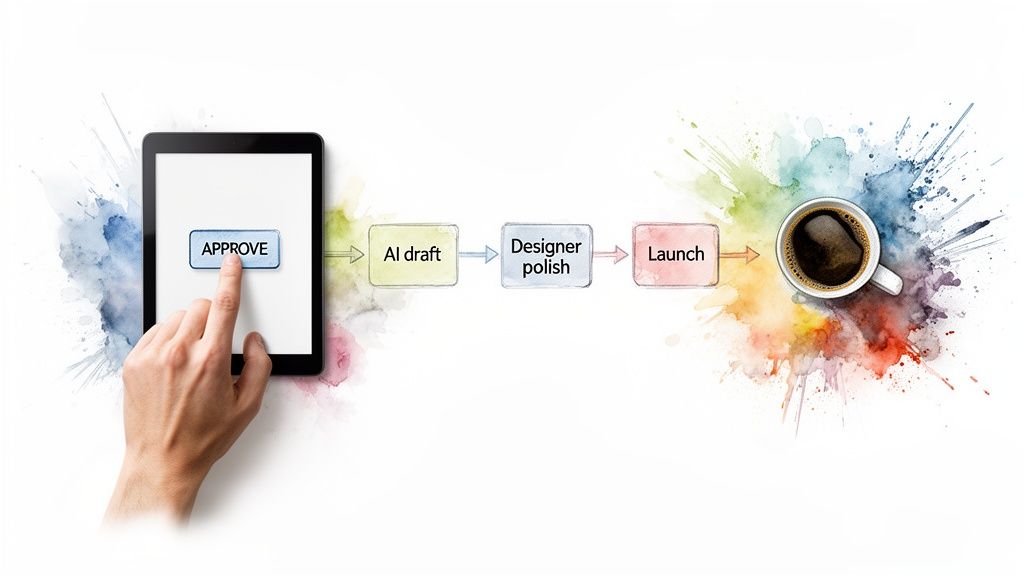
1. Approve the Concept (2 Minutes)
The system flags that your top-selling hoodie is back in stock. It suggests a multi-channel campaign. The brief is already written, using the formula from your last successful restock. You scan the concept and click ‘Approve’.
2. Review the Assets (5 Minutes)
The engine kicks into gear. AI drafts the email copy, SMS alerts, and social posts. Before anything goes live, a human designer on our end polishes every asset. They kill any "AI look" and make sure it feels 100% on-brand. A few hours later, you get a ping. You review the finished assets and give the final green light.
3. Launch (0 Minutes From You)
Once you approve, the campaign goes live automatically. Emails are scheduled in Klaviyo. Ads launch on Meta. Social posts are published. No more manual uploads. You just made a key marketing decision in less time than it took to finish your coffee.
The real advantage here is speed. According to Storyteq, brands using this level of automation can cut content production time by 50-70%. This isn’t about working harder; it’s about having a system that works for you.
This workflow isn't just scheduling posts. It’s an entire production engine running in the background.
From Manual Grind to Automated Rhythm
Let's compare this to the old way. The manual process was pure chaos. This table breaks down just how much time you get back.
Manual vs Automated Workflow: A Head-to-Head Comparison
| Task | The Manual Way (The Chaos) | The Automated Way (The Needle Method) |
|---|---|---|
| Idea & Strategy | 2–4 hours: Digging through Shopify, ads, and email data. | 0 minutes: AI analyzes data and suggests the campaign for you. |
| Briefing | 1–2 hours: Writing a detailed brief for a freelancer. | 0 minutes: The brief is auto-generated based on past winners. |
| Creative Production | 3–5 days: Waiting on freelancers for copy and visuals. | 4–6 hours: AI drafts content; a human designer refines it. |
| Review & Feedback | 1-2 days: Back-and-forth emails and revisions. | 5–10 minutes: Review all assets in one place and approve. |
| Campaign Setup | 1–2 hours: Manually uploading assets into Klaviyo, Meta, and social tools. | 0 minutes: Approved assets are automatically scheduled and launched. |
| Total Time | ~1 Week | ~10 Minutes (Your Time) |
The old way meant you were always behind. By the time you launched, the opportunity had passed.
The automated way sets a predictable, winning rhythm.
Monday: Approve concepts.
Wednesday: Review and approve assets.
Friday: Get a report on what worked and what the system learned.
This creates a powerful compounding effect. The system learns from every campaign, so your marketing gets smarter each week. Data drives ideas. Automation handles production. The results feed right back into the next cycle. You can see how this stacks up against other methods in our guide to Shopify marketing automation.
This isn't a futuristic dream. It’s how the sharpest DTC brands operate today. They’ve traded the manual grind for an automated rhythm that lets them out-execute everyone else without burning out.
Choosing Your Automation Approach
You know you need to escape the manual content grind. The chaos is costing you time and money. But what's the right path forward? You have three main options.
The right choice comes down to your budget, your time, and how fast you want to grow.
Path 1: The Traditional Agency
This is the old-school move. You find a marketing agency, hand over a fat monthly check, and hope for the best.
Expect to pay anywhere from $5,000 to $10,000 per month. That's often for a limited scope of work. Sure, you get a team, but that team is also juggling 15 other clients. This is why you get slow turnarounds—often weeks for a single campaign.
The agency model is built on billable hours, not efficiency. They profit from manual work. They have zero incentive to build a faster, smarter system for you.
Path 2: The DIY Toolkit
This is the other end of the spectrum. You build your own "automation" machine by duct-taping together tools like Canva, Jasper, and a social media scheduler. It feels like you're saving money, but you’re paying for it with your own time.
You become the human API, connecting the dots yourself. You’re still the one who has to:
Dig through your own data to find campaign ideas.
Write every creative brief.
Manage the messy creation process.
Manually set up and launch campaigns.
Let's be honest: this isn't a system. It's a second job. Your marketing output is capped by the hours you can personally sink into it. It’s cheap on paper, but it doesn't scale.
"The challenge is that many tools are siloed," notes one founder. "You have one for social, one for email, one for ads. You spend more time managing the tools than doing the marketing." This highlights the core flaw in the DIY approach, as explored in Human-Powered vs Automated Instagram Growth: Which Strategy Wins?
The DIY path keeps you stuck as the primary doer. It’s a fast track to burnout.
Path 3: The Hybrid Model (Our Approach)
There’s a third way. It gives you the strategic brain of an agency combined with the speed and efficiency of software. This is the model we built at Needle. We saw the flaws in the other paths because we’ve lived them.
Here’s how it works: you get a dedicated human strategist who knows your brand. They handle the high-level thinking. We pair them with our AI engine, which handles all the repetitive execution. It analyzes data, generates first drafts, and launches campaigns.
The result? You get agency-level quality with 48-hour turnarounds, all at a fraction of the cost. No slow retainers or DIY chaos. If you want a deeper dive, check out our guide on becoming an AI automation agency.
For example, the team at TWOOAK was stuck with an agency that left them with a cost-per-order of $41. After switching to our model, they slashed their CPO to just $19 and fired their agency. They got better results, faster, for less money.
This is the smartest path for a modern DTC brand. It lets you focus on strategy while an efficient system handles the rest. You get to make decisions, not just manage tasks.
Real Results From Brands Automating Their Content
Talk is cheap. Let's look at how content marketing automation actually performs for real DTC brands. These aren't just flashy numbers. They’re the direct outcome of ditching manual chaos for a smarter system.
If you’re a founder in the $1M-$10M range, this is a practical growth lever. It frees you up to work on your brand, not get buried in busywork.
From Hours of Work to 5-Minute Approvals
Take RTPTennis, a brand in a competitive niche. The founder was spending hours every week stuck in Klaviyo, manually building and sending every email. It was slow, tedious, and pulled him from running the business.
After switching to an automated system, his workflow changed. Instead of building campaigns from scratch, he started his week by reviewing data-backed campaign ideas. He went from spending hours on each email to just 5-minute approvals.
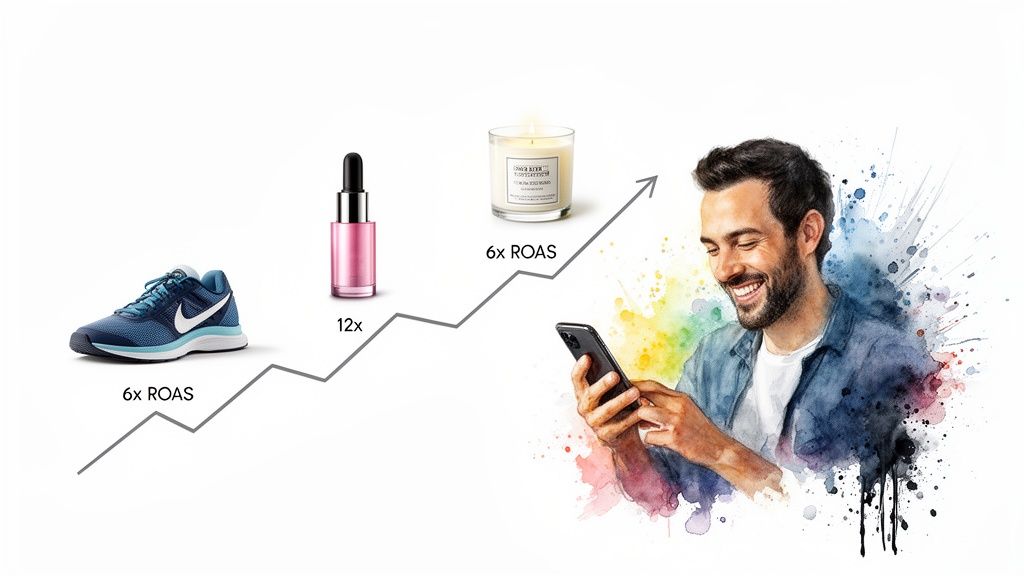
The result? A 12x ROI in the first month from email marketing alone. The time he got back was just a bonus. This is what happens when you let a system handle execution while you steer strategy.
Doubling Efficiency and Sustaining Growth
This isn't about one-off wins. It's about building a predictable engine for growth. The fashion brand As Intended was dealing with inconsistent marketing. One good week, one bad week.
By automating their weekly campaign learnings, they saw a dramatic shift. Within 60 days, they had doubled their marketing efficiency. They also sustained a 6x ROAS for eight consecutive months.
This wasn't a fluke. They built a tight feedback loop. The system automatically learned from every campaign and applied insights to the next round of assets.
That level of optimization is nearly impossible to pull off manually. Automation makes it the new standard. You can see more wins from brands like these in our customer stories.
The Data Behind the Wins
These results aren't happening in a vacuum. A 2023 HubSpot survey found that 75% of marketers already use AI for content creation.
Meanwhile, a Statista report shows that tools for content creation and optimization are used by over 60% of B2C marketers. For DTC brands, the signal is clear: automate or get left behind.
For brands in fashion, beauty, and lifestyle, this proves that content automation isn't just for giant corporations. It’s how you turn content volume into velocity and profit—without burning out.
Your First 30 Days With Automation
So, you’re ready to make the jump. Let's talk about what the first month of content marketing automation feels like. This is a real, battle-tested roadmap for your first 30 days. Here’s how you’ll go from manual chaos to a predictable marketing engine.
Week 1: Hooking Everything Up
Your first week is the only heavy lift. The goal is simple: connect your core business tools so the system can understand what makes you money.
You’ll plug in the essentials:
Shopify: This is your ground truth. It tells the system what’s selling and what’s in stock.
Meta Ads: This feed shows which ad creatives and offers are hitting the mark.
Klaviyo: This reveals which email flows are converting and what messaging resonates.
This initial sync is what separates real automation from scheduling tools. The system stops guessing. It starts generating campaign ideas based on your actual business performance. Once connected, it digs through your historical data, looking for winning patterns.
Think of this as creating a single source of truth for your marketing. It’s the difference between guessing what might work and knowing what has worked.
By the end of the week, your tools are talking to each other. The foundation is poured.
Week 2: Your First Automated Campaign Cycle
This is when you see the machine whir to life. You’ll get your first AI-generated content calendar. These are campaign concepts pulled directly from the data you connected last week.
Instead of staring at a blank page, you’re making quick, strategic calls.
You might see ideas like:
A “Back in Stock” campaign for a bestseller Shopify just reported as available.
An ad creative based on a top-performing organic post from last month.
An email flow targeting customers who bought a product six months ago.
Your job isn't to brainstorm for hours. It’s to review and approve. This is a 5-minute task, not a five-hour meeting. Once you give the green light, the system starts building the assets.
Week 3: Launch, Learn, and Let Go
Week three is when your first automated campaigns go live. Emails are scheduled in Klaviyo. Ads are running on Meta. Social posts are published. You haven’t manually uploaded a single file.
For most founders, this is a massive mental shift. You are no longer the bottleneck in your own marketing.
While campaigns are out in the wild, the system gathers performance data. At the end of the week, you get your first report. It’s a dead-simple summary of what worked, what flopped, and why. You'll see which ad creative had the best click-through rate and which email drove the most sales.
Week 4: Close the Loop and Scale
The final week is about compounding. You take the insights from week three’s report. You use them to make the next round of campaigns even smarter.
Did a certain lifestyle photo crush your standard product shots? The system will suggest more campaigns with that visual style. Did a "How-To" email get great engagement? You'll see more educational content ideas pop up.
This transforms your marketing from a guessing game into a powerful feedback loop. You're no longer just creating content. You're building an engine that gets smarter with every campaign. After 30 days, the reactive chaos is gone. It's replaced by a predictable, data-driven rhythm that builds on itself.
Straight Answers for Founders
We get it. You've heard the buzz about AI. You’ve also seen the generic, soulless content it can spit out. Before you change how you work, you have real questions. Here are the no-BS answers.
Will My Brand Look Like It Was Made by AI?
No. Our entire model is designed to prevent that.
Think of it this way: AI is the junior employee who does the heavy lifting. It sifts through data and pulls together first drafts. But a human strategist and designer who understand your brand finalize every detail.
Nothing goes live without your final nod. We kill the robotic "AI look," not lean into it.
How Is This Different From Using Jasper and Canva?
Those are great tools. But with tools like Jasper and Canva, you're still the one doing all the work. You’re the strategist, the project manager, and the operator.
We’re not just another tool; we're the entire system. We plug into your data, figure out what campaigns to run, create the assets, and get them launched. You stop being the person juggling everything. You become the person who gives a quick "yes" or "no."
Is My Brand Big Enough for This?
This was built for DTC brands in the $1M to $10M revenue sweet spot. It’s for founders who wear too many hats and feel like marketing has become a bottleneck. It's for brands not ready to hire a full-time marketer or lock into a pricey agency contract.
If marketing chaos is holding back your growth, you're the right size. It’s less about revenue and more about how much you value your time.
What Results Can I Expect and How Fast?
You'll feel the difference in your workflow in the first week. The pressure of managing campaigns disappears. It's replaced by quick, 5-minute approval decisions.
In terms of performance, the impact is usually immediate. Because the system is constantly learning, campaigns get smarter every week. The founder of RTPTennis went from burning hours on email marketing to spending just minutes. He hit a 12x ROI in his first month.
This isn't just about moving faster. It's about getting better, more consistent results because your marketing is running on a data-driven rhythm instead of chaos.
Ready to stop being the bottleneck in your own marketing? Needle is your AI marketing agency in one tab. We connect to your data, suggest campaigns, and create the assets for you. You just approve.