
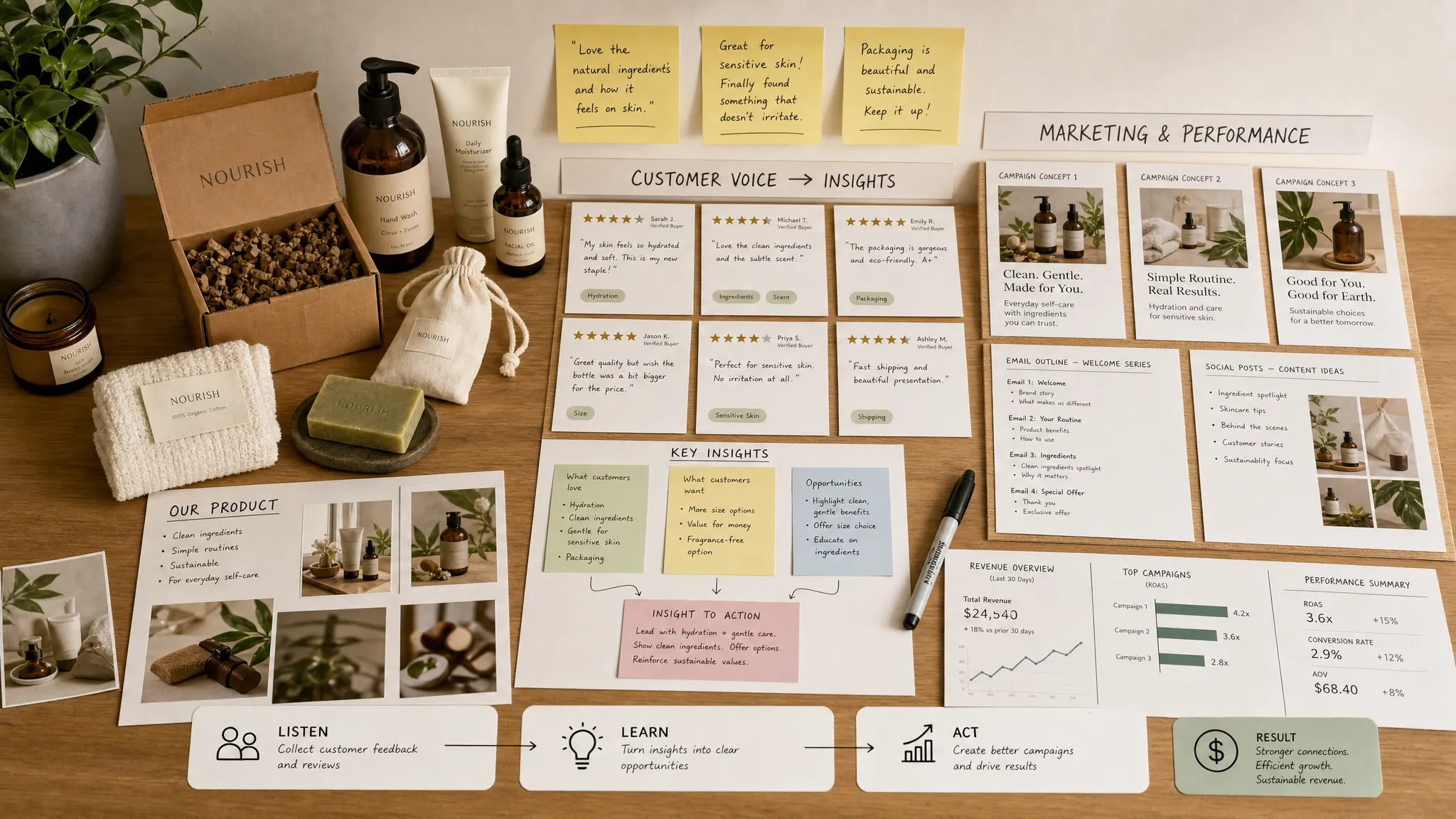
More revenue does not have to mean a bigger ad budget. For many ecommerce brands, the fastest path to growth is not adding another channel, hiring another freelancer, or throwing more money into campaigns. It is finding the places where money is already leaking, then turning those same inputs into better output.
That shift matters in 2026 because acquisition is still competitive, customer expectations are higher, and creative fatigue moves quickly. The brands that win are not always the ones spending the most. They are the ones learning faster, reusing what works, and making every visitor, subscriber, and customer more valuable.
The goal is simple: increase revenue per dollar spent. That means improving conversion, raising average order value, keeping customers longer, and making paid media work harder. Here are smarter ecom tactics that help you grow without bloating your spend.
Start with a profit map, not a bigger campaign plan
Before you optimize ads or launch new creative, get clear on where profit actually comes from. Revenue can hide weak economics. A campaign can look exciting in Shopify while quietly draining margin through discounts, shipping costs, high return rates, or one-time buyers who never come back.
At a minimum, your weekly growth view should include:
- Conversion rate: The percentage of visitors who buy.
- Average order value: How much customers spend per order.
- Gross margin: What remains after product and fulfillment costs.
- Customer acquisition cost: What you pay to acquire a new customer.
- Repeat purchase rate: How many customers come back.
- Marketing efficiency ratio: Total revenue divided by total marketing spend.
This gives you a more useful question than “How do we get more traffic?” Instead, ask: “Which lever will create the most profitable next dollar?”
If conversion is low, more traffic amplifies waste. If average order value is too low, paid acquisition becomes harder to sustain. If repeat purchase is weak, you have to keep paying to replace customers. A profit map shows whether your next move should be CRO, creative, retention, merchandising, or media efficiency.
Fix conversion leaks before funding more traffic
A lot of ecommerce spend is wasted after the click. The ad does its job, the visitor lands on the site, then friction takes over. Product pages lack proof. Shipping details are unclear. The offer is confusing. Checkout asks for too much too soon.
This is why conversion work is often the lowest-spend path to more revenue. You are not paying for new visitors, you are improving the value of the visitors you already have. Baymard Institute’s research has long shown that online cart abandonment sits around 70%, which means small checkout improvements can have a meaningful impact on revenue.
Start with the pages closest to purchase:
- Product pages with high traffic and low add-to-cart rate.
- Cart pages with high abandonment.
- Checkout steps where mobile users drop off.
- Landing pages tied to your highest-spend campaigns.
- Collection pages that attract traffic but fail to guide product discovery.
Look for obvious trust and clarity gaps. Do shoppers know what makes the product different? Can they quickly compare variants? Are reviews, guarantees, shipping timelines, and return policies easy to find? Does the mobile experience feel fast and simple?
If you are on Shopify, this founder’s guide to Shopify conversion rate optimization is a useful next step for diagnosing and prioritizing revenue leaks.
For teams that need extra support with ecommerce site foundations, SEO, or content infrastructure, working with specialists such as Sleek Web Designs can also help strengthen the parts of the funnel that paid traffic depends on.
Make your offer easier to say yes to
A stronger offer often beats a larger budget. Many brands assume they need more awareness, but the real issue is that the purchase decision feels too risky, too vague, or too easy to postpone.
A high-converting offer does not always mean a bigger discount. In fact, discounting can train customers to wait and can erode margins. Instead, improve the perceived value and reduce hesitation.
Consider offer improvements like:
- Bundles that solve a complete use case instead of selling one item at a time.
- Free shipping thresholds that raise average order value without blanket discounts.
- First-purchase incentives tied to email or SMS capture.
- Limited-time gifts with purchase that protect price integrity.
- Clear guarantees that reduce perceived risk.
- Product education that explains who the product is for and when to use it.
The best offer answers three questions fast: Why this product? Why this brand? Why buy now?
If those answers are buried, your acquisition costs rise because every click has to work harder. If they are clear, the same spend can produce more orders.
Reuse proven creative instead of constantly starting over
Creative is one of the biggest hidden cost centers in ecommerce marketing. Not just because production costs money, but because teams waste time making new assets without learning from the old ones.
A smarter approach is to treat creative like a performance system. Every ad, email, landing page, and social post gives you data. The winning hook from a Meta ad can become an email subject line. A strong customer review can become product page copy. A founder story can become a short video, a welcome flow section, and a landing page opener.
Paid creative should be especially disciplined. If you are spending on acquisition, your creative testing should isolate variables such as the hook, angle, format, proof point, and offer. For a deeper breakdown of how to keep ads profitable, Needle’s guide to profitable ecommerce ads covers channel strategy and budget discipline for founders.
The key is to build a creative library around what customers actually respond to. Tag assets by product, audience, objection, format, and performance. Then remix winners instead of reinventing from scratch every week.
Turn customer questions into revenue assets
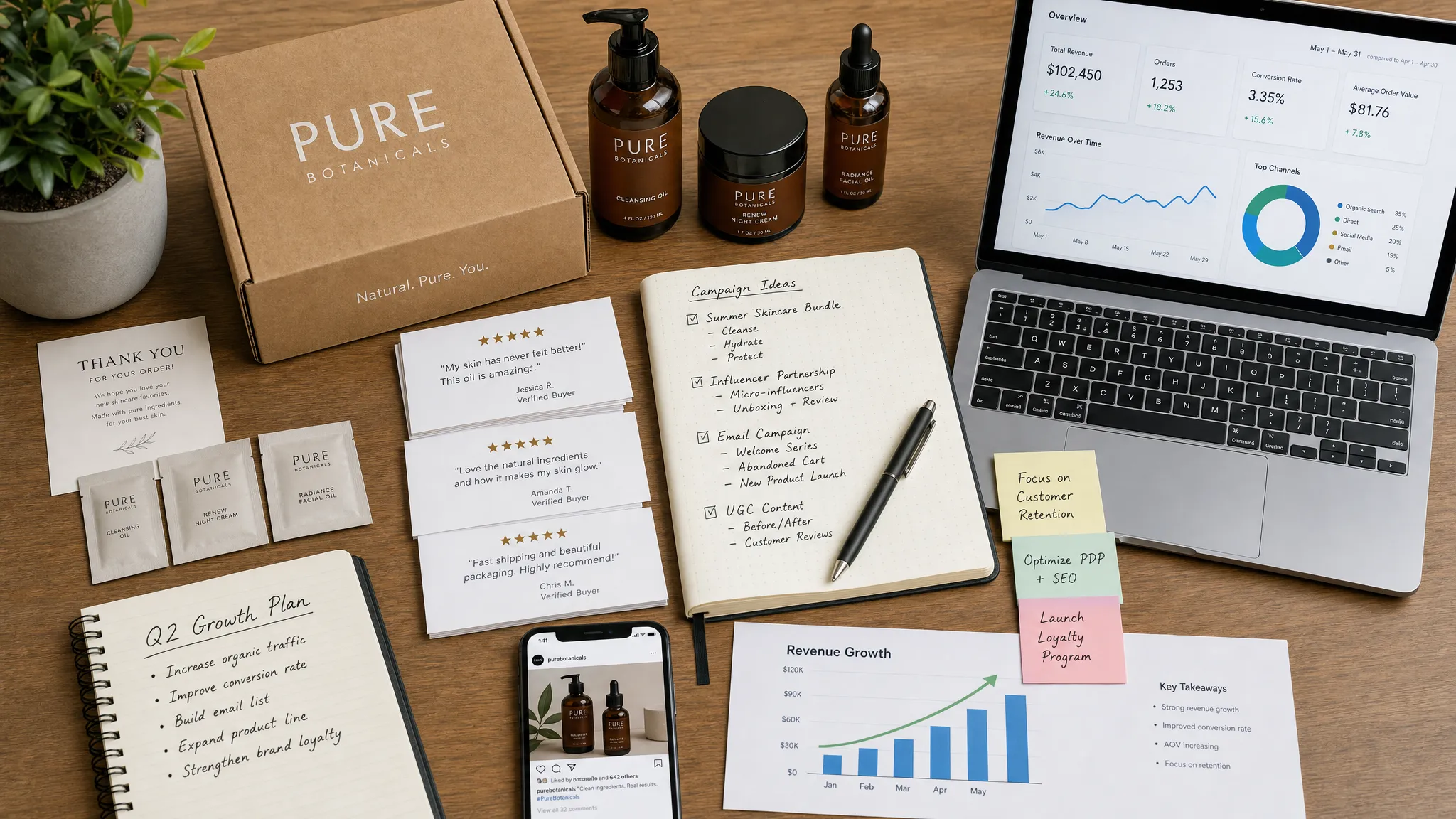
Your customers are already telling you what to create. Their questions, objections, reviews, support tickets, and return reasons reveal the friction that blocks purchases.
Instead of guessing at next week’s content, mine your customer language. Look for patterns such as:
- “Will this work for my specific problem?”
- “How long does it take to see results?”
- “Is it worth the price?”
- “How does this compare to a cheaper alternative?”
- “What size, shade, flavor, or bundle should I choose?”
Each question can become a revenue asset. A sizing concern becomes a better product page module. A comparison question becomes an email. A review theme becomes ad copy. A support ticket becomes a FAQ section or post-purchase education flow.
This tactic lowers spend because it reduces friction across multiple channels at once. You are not creating content for content’s sake. You are creating purchase support.
Increase average order value without hurting trust
Raising AOV can make the same ad spend more profitable, but only if the upsell feels useful. Random cross-sells can feel like clutter. Relevant merchandising feels helpful.
Good AOV tactics are based on customer intent. If someone is buying a skincare cleanser, a routine bundle may make sense. If someone is buying coffee, a subscription or sampler pack may fit. If someone is buying apparel, complementary basics or care products may be more natural than unrelated accessories.
Try these AOV improvements before increasing ad budgets:
- Add “complete the routine” bundles on product pages.
- Show threshold-based free shipping progress in cart.
- Offer product kits for beginners, best sellers, or gift buyers.
- Test post-purchase upsells that do not interrupt checkout.
- Use customer segments to recommend relevant add-ons.
The principle is simple: help the shopper get a better outcome. When upsells feel aligned with the reason they came to your store, AOV rises without damaging trust.
Build retention into the first purchase
Retention is where many brands create more revenue with less spend. A returning customer is usually cheaper to convert than a new one, yet many ecommerce teams focus most of their energy on first purchases.
The retention journey starts immediately after purchase. The customer is most engaged right after they buy, which makes post-purchase communication critical. Use that window to reinforce the decision, explain how to use the product, set expectations, and introduce the next best purchase path.
A strong retention system includes:
- Order confirmation and shipping updates that feel on-brand.
- Product education that reduces returns and disappointment.
- Replenishment reminders for consumable products.
- Cross-sells based on the first product purchased.
- Loyalty, referral, or VIP messaging for high-value customers.
- Winback campaigns that respond to purchase cycle timing.
Retention also improves acquisition economics. If your customers buy again, you can afford to acquire them more confidently. If they never return, every ad campaign has to carry the full weight of growth.
Use AI to shorten the distance between insight and execution
The bottleneck in ecommerce marketing is often not strategy. It is execution speed. Teams know they should test new hooks, refresh emails, repurpose content, and publish consistently, but the workload piles up.
This is where AI can create real leverage. Not by replacing judgment, but by compressing the time between “we learned something” and “we shipped the next version.”
For example, if a product review theme is converting well in ads, AI can help turn that theme into new email copy, landing page sections, social variations, and short-form video scripts. If a campaign underperforms, AI can help generate alternative angles based on the data instead of forcing the team to start from a blank page.
Needle’s article on practical uses for marketing AI in ecommerce growth explores this in more depth, including campaign ideation, creative scaling, and optimization workflows.
The important part is keeping AI connected to business context. Generic content does not create efficient growth. Data-backed, brand-specific execution does.
Create a weekly optimization rhythm
Smart ecom growth compounds through cadence. One big campaign push is less valuable than a consistent operating rhythm where every week produces learning, action, and iteration.
A simple weekly loop can look like this:
- Review performance: Look at revenue, margin, spend, conversion rate, AOV, repeat purchase, and channel efficiency.
- Identify the biggest constraint: Choose one priority, such as low add-to-cart rate, weak creative performance, or poor email revenue.
- Create focused assets: Build only what supports that constraint, such as new hooks, product page copy, bundles, or flow emails.
- Launch and measure: Publish quickly, then monitor leading indicators before making broad conclusions.
- Turn learnings into the next test: Keep what works, cut what does not, and document why.
This rhythm prevents random marketing. It also reduces spend because the team is not chasing every idea. Each test is tied to a clear business bottleneck.
Know when to cut spend and when to reallocate it
“Less spend” does not always mean spending less everywhere. Sometimes it means cutting waste in one area so you can invest more confidently in another.
Do not kill a channel just because one campaign had a weak week. Look at trends, creative fatigue, audience saturation, attribution changes, and margin. A low last-click return may still support profitable growth if the channel introduces new customers who convert later through email, search, or direct traffic.
At the same time, do not protect spend because of habit. If a campaign has poor creative, low-quality traffic, weak conversion, and no clear learning, pause it. Move that budget into higher-confidence tests.
The best teams treat budget as fluid. Spend follows evidence.
Frequently Asked Questions
What is the fastest way to get more revenue without increasing ad spend? Start with conversion leaks on high-traffic pages and checkout. Improving product page clarity, trust signals, mobile speed, and cart friction can lift revenue from traffic you already have.
Should ecommerce brands reduce paid ads when costs rise? Not always. First separate wasted spend from strategic spend. Cut campaigns with weak evidence and poor economics, but keep testing creative, offers, and landing pages where the audience and margins still make sense.
Which metric matters most for more revenue with less spend? Marketing efficiency ratio, contribution margin, conversion rate, AOV, and repeat purchase rate are more useful together than any single metric alone. The right priority depends on your current bottleneck.
How can AI help ecommerce teams spend less? AI can reduce manual work across campaign ideation, creative variation, email production, publishing, and performance analysis. The biggest gains come when AI uses real brand and customer data rather than generic prompts.
How often should ecommerce brands run optimization tests? Weekly is a practical cadence for most growing teams. The goal is not to test everything at once, but to choose one meaningful constraint, ship improvements, measure results, and apply the learning the next week.
Make every marketing dollar work harder
More revenue with less spend comes from a better system, not one isolated tactic. You need sharper offers, stronger conversion paths, reusable creative, better retention, and a weekly loop that turns data into action.
Needle is built for that kind of ecommerce growth. It helps brands generate tailored marketing ideas, create on-brand assets, publish content directly, automate campaign workflows, track results, and apply actionable learnings week after week.
If your team is ready to scale smarter without agency bloat, explore how Needle can help you turn your existing marketing inputs into more efficient growth.